UK gambling market hits £17.5bn as online growth outpaces retail decline
The Gambling Commission's 2025-2026 report reveals a 4.4% industry growth to £17.5 billion GGY, driven by strong online performance while physical premises continue to shrink, with betting shops declining for the twelfth consecutive period.
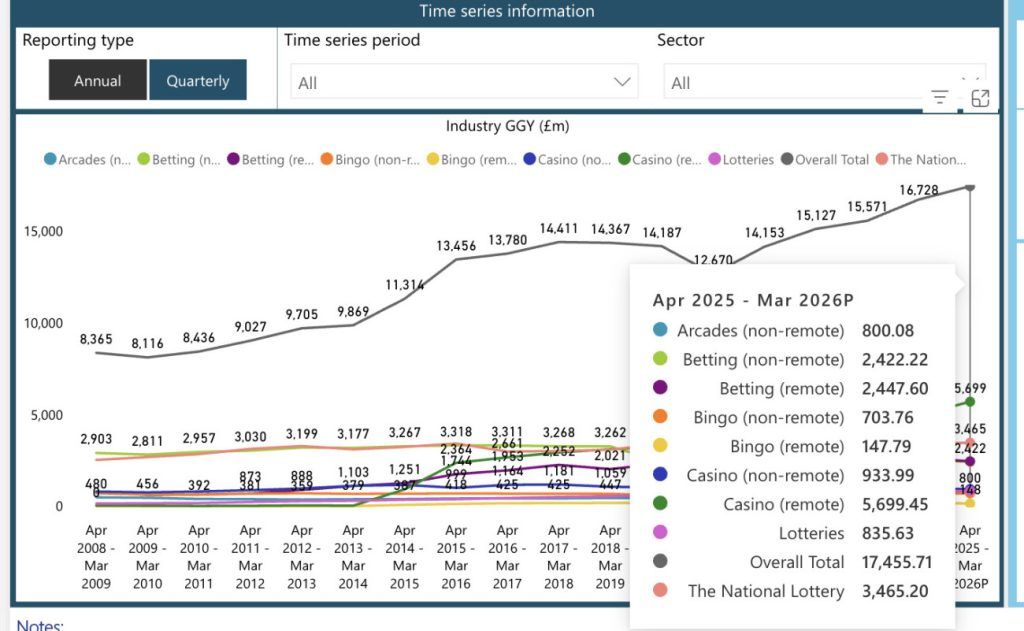
The UK gambling industry reached £17.5 billion in gross gambling yield (GGY) during the 2025-2026 financial year, marking a 4.4% year-on-year increase according to the Gambling Commission's comprehensive industry activity report. This growth demonstrates the sector's resilience despite ongoing regulatory changes and shifting consumer behaviors. The figures highlight a fundamental transformation in how British consumers engage with gambling products, with digital channels now firmly established as the market leader.
Online gambling becomes dominant force
Remote gambling channels accounted for £8.3 billion in GGY, representing a substantial 6.9% annual increase and constituting 63% of all non-lottery gambling revenue. This performance underscores how digital platforms have become the backbone of the UK gambling economy. Within this segment, online casino emerged as the strongest vertical with £5.7 billion in GGY, demonstrating particular strength in slots which contributed £4.8 billion of that total. The remote betting category reached £2.4 billion, with football betting leading at £1.2 billion followed by horse racing at £769.3 million, showing the continued popularity of sports wagering. Remote bingo, while smaller at £147.8 million, maintained its presence in the digital marketplace.
The first quarter of 2026 reinforced these trends, with online verticals generating £2.2 billion between January and March. Remote casino alone accounted for 68.3% of that quarterly total with £1.5 billion in GGY, demonstrating its overwhelming dominance within the digital gambling ecosystem. When excluding all reported lottery activity, which remains a significant component of the overall market, the industry's GGY stood at £13.2 billion - a 4.7% year-on-year increase that further illustrates the growing importance of non-lottery gambling products.
READ MORE: Brazil betting ban dominates discourse at SBC Summit Lisbon 2026
READ MORE: Deutsche Bank analysis warns UK Machine Gaming Duty hike could disproportionately impact Rank Group
Retail sector faces continued challenges
The land-based gambling sector recorded modest growth of 1.1% to reach £4.9 billion in GGY, though this figure masks significant structural challenges. The UK's total licensed gambling premises fell by 2% to 8,081 locations, continuing a long-term contraction of physical gambling venues. Betting shops declined for the twelfth consecutive reporting period, now standing at 5,617 - a 3.6% reduction representing the loss of 208 shops year-on-year. Major retail operators including William Hill and Betfred have implemented strategic reductions to their physical footprints, closing hundreds of shops between them in response to changing market conditions.
Within the retail segment, performance varied across different formats. Non-remote betting declined 3.3% to £2.4 billion, reflecting broader challenges facing traditional bookmaking operations. Non-remote casinos showed slight growth of 0.4% to £933.9 million, while bingo halls demonstrated more robust expansion with an 8.2% increase to £703.8 million. These differential growth rates suggest varying levels of resilience among traditional gambling formats, with bingo maintaining stronger appeal to its customer base compared to other retail offerings.
Gaming machines show resilience amid policy uncertainty
Gaming machines in arcades generated £800.1 million in GGY, representing a significant 10.7% increase that was primarily driven by adult gaming centres (AGCs) which contributed £761.4 million - an 11.3% rise. Across all formats, gaming machines collectively contributed £2.7 billion to the industry's GGY, reflecting a 4.3% uplift. The final quarter of the reporting period saw 191,804 gaming machines operating in licensed premises nationwide.
This growth occurs against a backdrop of potential regulatory changes. Prime Minister Andy Burnham has proposed repealing the established 'aim to permit' rule for betting shops and 24-hour slot machine arcades across Great Britain. This policy shift would remove the presumption in favor of granting permission for such venues, potentially making new openings more difficult. Under the proposed changes, AGCs in England offering round-the-clock access to gambling machines would require specific planning approval. The government is also considering imposing increased taxation on gaming machines, based on a proposal from the Social Market Foundation, with potential changes likely to appear in the upcoming autumn budget.
Lottery sector maintains steady performance
The National Lottery reported £7.9 billion in ticket sales, marking a 0.9% increase despite prize payouts decreasing slightly by 0.6% to £4.5 billion. Contributions to good causes grew by 2.8%, estimated between £1.6 billion and £1.7 billion, demonstrating the lottery's continued importance as a funding mechanism for charitable and community initiatives. Large society lotteries also experienced growth across key metrics, with ticket sales up 5.7% to £1.2 billion, prizes increasing 6.1% to £335.6 million, and contributions rising 2.8% to £498.5 million.
The Gambling Survey for Great Britain (GSGB), conducted among 5,277 adults between January and May 2026, found stable participation patterns that help contextualize these financial results. Approximately 49% of surveyed adults reported gambling within the past four weeks, a figure consistent with previous years. When excluding those who only played lottery draws, participation stood at 28%, indicating that lottery-only players comprise roughly 21% of the adult population. Online gambling participation reached 39% (16% excluding lottery-only players), while in-person gambling participation was reported at 29% (18% excluding lottery-only players).
Demographic insights and industry structure
The survey revealed distinct patterns in gambling participation across different demographic groups. Betting activity remained predominantly male, with 16% of men reporting gambling on betting compared to just 4% of women. Age-wise analysis showed overall gambling participation peaking among 45- to 64-year-olds (56%-59%) when including lotteries, but the 35- to 44 age group emerged as the most active for non-lottery gambling at 35%. Popular non-lottery activities included scratchcards (13%), betting (10%) and online instant win games (8%).
Consumer motivations provided important context for these participation patterns, with respondents predominantly citing the pursuit of large winnings and entertainment as their primary reasons for gambling. About 42% reported positive feelings about their most recent gambling expenditure, suggesting generally favorable perceptions among active participants. The industry's structure showed some consolidation, with the number of licensed operators declining by 1.1% to 2,154, while separately licensed gambling activities edged up 0.4% to 3,097 - indicating potential diversification within existing operator portfolios.