Canada ranks 18th on global pension index but faces demographic challenges
The country received a B grade but has a low rate of private sector pension plans, a key weakness.
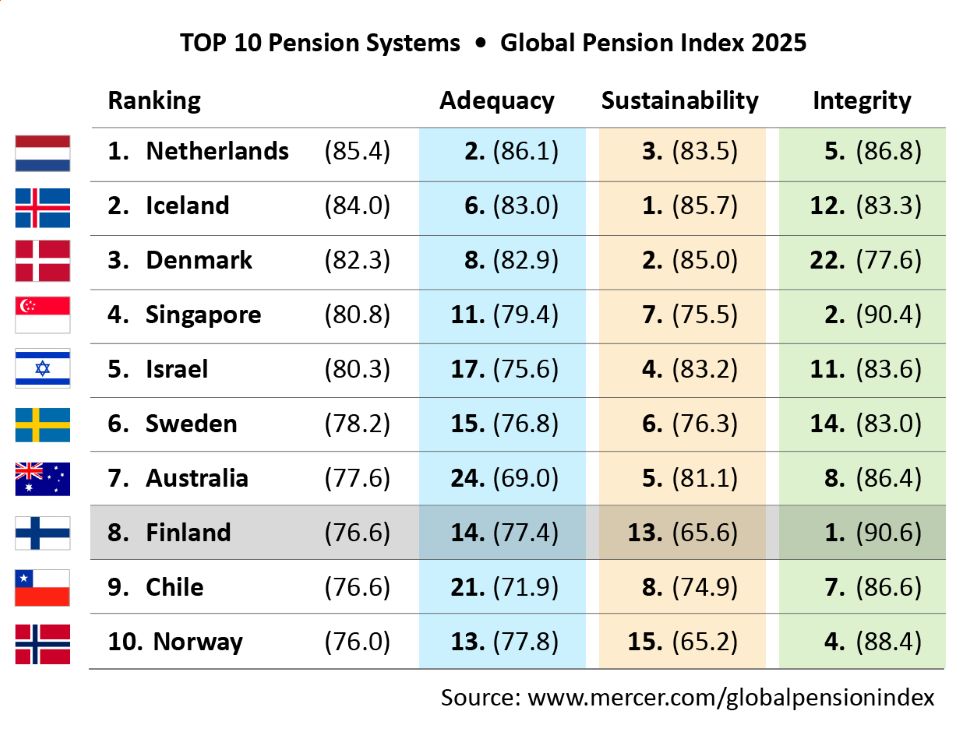
Canada's retirement system ranks 18th out of 55 countries on a global pension index, according to a report from professional services firm Marsh.
"Canada's retirement system is strong. There's no doubt about it," said Hubert Tremblay, a partner and senior wealth adviser at Marsh Canada in Montreal.
The country received a B grade, which translated to a score of 70.6 out of 100. The report cited solid minimum support for the poorest older Canadians, decent workplace pension coverage, strong pension assets relative to GDP and a system with strong regulations.
READ MORE: RBC warns Canada's energy sector faces risk of costly overruns in $100-billion build-out
READ MORE: Stelco layoffs in Hamilton signal risk to Canada's steel industry, union says
Marsh calculated scores by measuring the adequacy, sustainability and integrity of retirement systems. Canada scored 67.1 in adequacy, 66.6 in sustainability and 81.7 in integrity.
Six countries, including the Netherlands, Denmark and Iceland, scored above 80 to achieve an A grade.
The report identified the lack of private-sector retirement savings arrangements as Canada's biggest flaw. Tremblay estimated only 10 per cent of workplaces in the private sector have a defined-benefit pension plan.
"A fix for that that would allow Canada to move up on the index would be to have mandatory employer contributions to workplace pension plans," he said, adding he doesn't think that "will come anytime soon."
Another way to strengthen the system would be for more older Canadians to work longer. Tremblay said the participation rate for people aged 60 to 65 has doubled over the past 25 years.
Increasing that number would improve the sustainability of the pension system because people would contribute longer and collect payments later. Tremblay said this trend reflects better health, not a failure of the pension safety net.
The report also said households increasing savings and reducing debt would help secure a more stable retirement. Canada has the highest household debt of the Group of Seven countries.
Marsh said Ottawa needs to rein in debt as a per cent of GDP to protect Old Age Security and the Guaranteed Income Supplement, which are pay-as-you-go programs. Tremblay said they account for three per cent of Canada's GDP.
Broader global trends are also putting pressure on retirement systems, including aging populations, declining birth rates and rising life expectancy.
Statistics Canada data shows the proportion of Canadians aged 65 and up has risen to 20 per cent from 18.7 per cent over the past five years.
Tremblay said the birth rate has fallen to 1.4 children per woman, much lower than the population renewal rate of around 2.1.
While the Canada Pension Plan and Quebec Pension Plan have factored in more older beneficiaries, Tremblay said social programs like OAS and GIS can be compromised if there aren't enough workers to sustain economic activity and government revenue.
"That's where those programs can be compromised," he said.
Among the solutions Marsh proposes to address demographic challenges are improving Canada's productivity and increasing immigration.
With files from Financial Post