Lennox Lewis
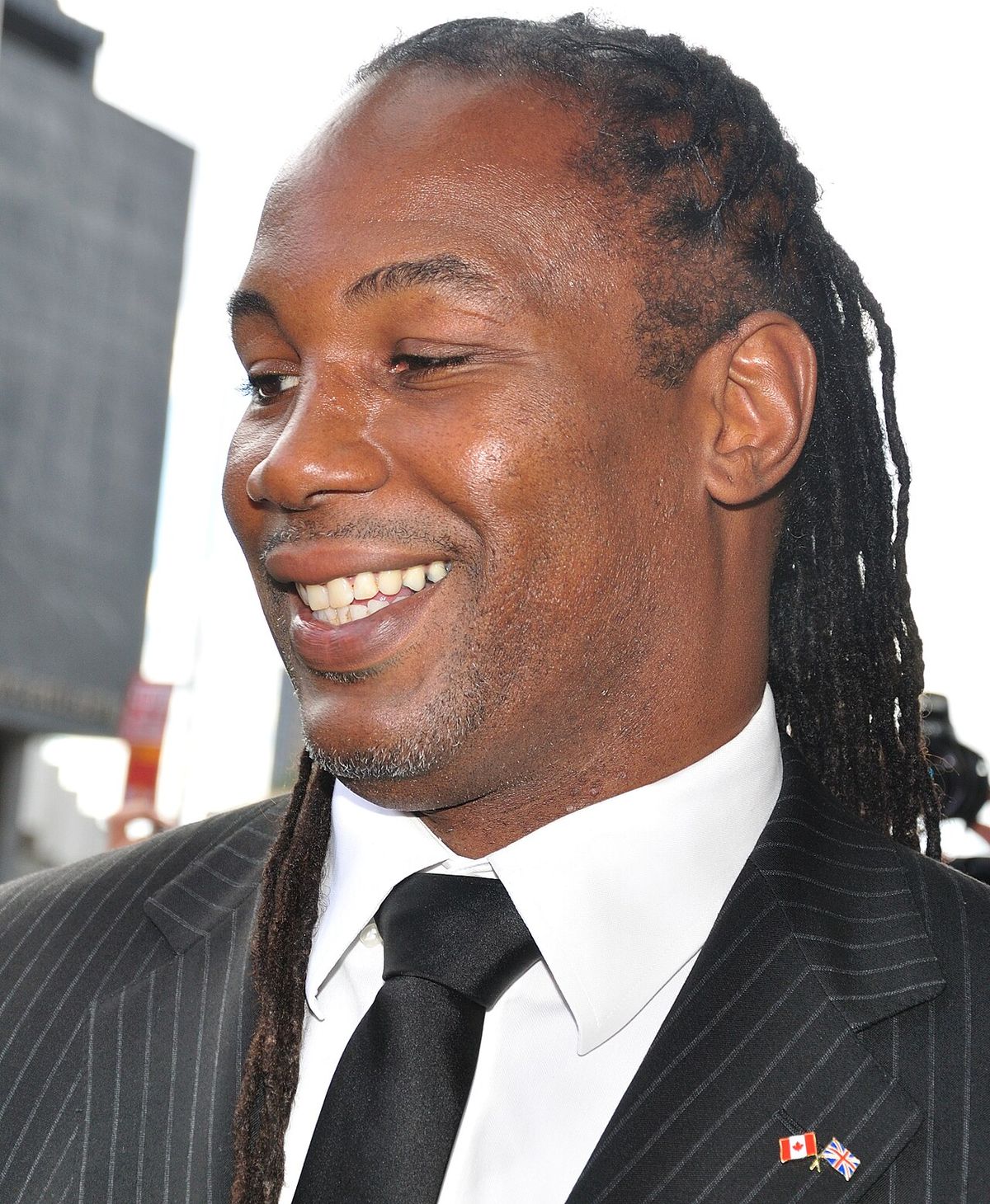
Lennox Claudius Lewis is a former professional boxer and current boxing commentator widely regarded as one of the greatest heavyweight champions of all time. Born in London but raised in Kitchener, Ontario, from age 12, Lewis represented Canada as an amateur, capturing a super-heavyweight gold medal at the 1988 Seoul Olympics. As a professional, he became a three-time world champion, a two-time lineal champion, and the undisputed heavyweight champion, unifying the WBC, WBA, and IBF titles. His career, marked by significant victories over legends like Evander Holyfield and Mike Tyson, cemented his legacy as a preeminent figure in both British and Canadian sporting history.
Early Life and Move to Canada
Lennox Lewis was born on 2 September 1965 in West Ham, London, to Jamaican immigrant parents. At birth he weighed 4.8 kg (10 lb 10 oz), and was given the name Lennox by the doctor, who said "he looked like a Lennox." Lewis moved to Kitchener, Ontario, Canada with his mother in 1977 at the age of 12. He attended Cameron Heights Collegiate Institute for high school, where he excelled in Canadian football, soccer, and basketball. In the 1982-83 school year, he helped the school's AAA basketball team win the Ontario provincial championship.
Amateur Boxing Career and Olympic Gold
Lewis took up boxing around 1978 in Canada and quickly developed into a dominant amateur under the guidance of coaches Arnie Boehm and Adrian Teodorescu, who would later guide him to his Olympic title. He won the gold medal at the Junior World Championships in 1983, establishing himself as an international prospect. At age 18, he represented Canada in the super-heavyweight division at the 1984 Summer Olympics in Los Angeles, where he was ranked sixth in the world by the AIBA. He advanced to the quarter-finals before losing to eventual gold medallist Tyrell Biggs of the United States, and his coaches at the time admitted they had to pressure him to convert his size and raw talent into aggression.
Determined to win Olympic gold, Lewis continued as an amateur for four more years, capturing a gold medal at the 1986 Commonwealth Games in Edinburgh after a loss in the preliminary round of that year's World Championships. His amateur career included a controversial loss to Cuba's Jorge Luis González at the 1987 Pan American Games super-heavyweight finals, which he avenged eight days later to win the North American amateur title. The culmination came at the 1988 Summer Olympics in Seoul, South Korea, where in the gold medal final he defeated American rival Riddick Bowe via a second-round referee stopped contest. This victory made him the first Canadian to win an Olympic boxing gold medal in 56 years, and he was honoured as Canada's flag bearer in the Games' closing ceremony, becoming the first super-heavyweight gold medallist to later become world heavyweight champion as a professional.
Professional Career: Rise to Champion
After winning Olympic gold, Lewis turned professional in 1989 and, due to a perceived lack of infrastructure for developing boxers in Canada at the time, relocated to England to pursue his career under promoter Frank Maloney. He explained in 2015 that he had to go to the United Kingdom to pursue his career because the development system wasn't in Canada then. His early professional fights were marked by a series of knockouts against journeymen opponents, including Osvaldo Ocasio, and he claimed he had always considered himself British despite some British fans viewing him as a Canadian at heart. By 1990, having signed with American promoter Main Events, Lewis began capturing regional titles, winning the European heavyweight title against Jean Maurice Chanet in 1990, the British title against undefeated, world-ranked Gary Mason in March 1991, and the Commonwealth title against Derek Williams in April 1992.
During this ascent, he also defeated notable opponents like former WBA champion Mike Weaver, 1984 Olympic gold medallist Tyrell Biggs, and former world cruiserweight title holder Glenn McCrory, as well as trial horses Levi Billups and Mike Dixon. A decisive moment came on 31 October 1992, when Lewis knocked out Canadian Donovan Ruddock in two rounds to secure the number one contender position in the World Boxing Council rankings. Sportscaster Larry Merchant declared after the fight that 'We have a great new heavyweight,' and this victory established him as a top heavyweight and led directly to his first world title. When reigning champion Riddick Bowe refused a mandatory defence and threw his WBC belt in a rubbish bin at a press conference, Lewis was declared the WBC heavyweight champion on 14 December 1992, becoming the first British-born world heavyweight titleholder of the 20th century.
Setbacks, Technical Refinement, and Regaining the Title
Lewis successfully defended his new title three times, defeating Tony Tucker, whom he knocked down for the first time in Tucker's career, Frank Bruno in the first all-British world heavyweight title fight of the modern era, and Phil Jackson by knockout. His first reign ended in a major upset on 24 September 1994 when he was knocked out by Oliver McCall in the second round at London's Wembley Arena after McCall landed a powerful right cross. Lewis argued the stoppage was premature and that a champion should be given the benefit of the doubt, but observers like Boxing Monthly editor Glynn Leach noted he only seemed to recover once the fight was waved off. Following this loss, Lewis fired trainer Pepe Correa, who denounced him in public after being fired, and made a crucial change by hiring renowned trainer Emanuel Steward, who had previously trained McCall.
Steward corrected several of Lewis's technical flaws, including maintaining a more balanced stance, reducing reliance on his cross, and focusing on using a strong, authoritative jab that became a defining feature of his style for the remainder of his career. Lewis worked his way back to a title shot, knocking out Lionel Butler to secure the mandatory challenger position, though the WBC initially bypassed him for Mike Tyson at the behest of promoter Don King. He defeated former WBO champion Tommy Morrison in October 1995 to win the minor IBC title and then won a close majority decision over Olympic gold medallist Ray Mercer in May 1996. After legal manoeuvring and accepting a $4 million step-aside fee from Don King to allow Tyson to fight Bruce Seldon, with a guarantee of a future title shot, a rematch with McCall for the vacant WBC title was set for 7 February 1997 in Las Vegas after Tyson relinquished the belt.
Achieving Undisputed Championship Status
In one of the strangest fights in boxing history, McCall, who had lost the first three rounds, refused to box in the fourth and fifth rounds and began crying in the ring, forcing the referee to stop the fight and award Lewis the victory and the WBC title. As the recrowned champion, Lewis successfully defended his title in 1997 against fellow Briton Henry Akinwande, who was disqualified after five rounds for excessive clinching, and against Poland's Andrew Golota, whom he knocked out in the first round. In 1998, he retained the title by knocking out lineal champion Shannon Briggs, who had recently outpointed George Foreman, and won a 12-round unanimous decision over previously undefeated European champion Željko Mavrović, a fight Lewis later called his most awkward win. This set the stage for a historic unification with Evander Holyfield, holder of the WBA and IBF titles, on 13 March 1999 in New York City.
Lewis fought a tactical fight, keeping Holyfield off balance with a long jab and peppering him with powerful combinations throughout the bout, landing 348 punches to Holyfield's 130 and out-jabbing him 137 to 52. Despite most media observers believing Lewis had clearly won, the bout was declared a draw, with judge Eugenia Williams scoring it for Holyfield after saying she saw Lewis land fewer punches. The camps agreed to an immediate rematch with both fighters receiving equal purses of $15 million, and the sanctioning bodies ordered the second fight held on 13 November 1999 in Las Vegas. In a more competitive contest, Lewis again outlanded Holyfield, 195 punches to 137, and won a unanimous decision (115 to 113, 116 to 112, 117 to 111) to become the undisputed heavyweight champion, with the British public voting him the 1999 BBC Sports Personality of the Year.
Reign as Unified Champion and High-Profile Defences
After unifying the titles, the WBA ordered Lewis to defend against mandatory challenger John Ruiz, an obscure Don King fighter. Lewis sought to fight contender Michael Grant first, leading to a legal challenge from promoter Don King based on a clause in the Lewis-Holyfield rematch contract. The WBA subsequently created its 'Super Champion' designation to give unified titleholders more time for defences, but it stripped Lewis of its title when he proceeded to fight Grant in April 2000. Lewis successfully defended his WBC, IBO and IBF titles against the 203-centimetre Grant with a second-round knockout at Madison Square Garden, then later that year knocked out Francois Botha in two rounds in London and won a unanimous decision over IBF mandatory challenger David Tua in Las Vegas.
Lewis's reign was interrupted on 21 April 2001 when he was knocked out by 20-to-1 underdog Hasim Rahman in the fifth round at Carnival City Casino in South Africa, with the main event taking place at 05:00 local time to accommodate HBO's United States audience. Before the bout, Lewis had a role in the film Ocean's Eleven in which he 'boxed' against Wladimir Klitschko. Lewis immediately sought a rematch, but Rahman, now promoted by Don King, tried to secure another opponent for his first title defence. Lewis took the matter to court to enforce the rematch clause in their contract, and during promotion for the rematch the fighters got into a brawl on ESPN's Up Close similar to the famous Ali-Frazier confrontation.
The Tyson Fight and Final Bout
On 17 November 2001, Lewis regained the WBC and IBF titles by outclassing and then knocking out Rahman in the fourth round of their court-ordered rematch. This victory set up one of the most anticipated fights in boxing history against Mike Tyson, originally scheduled for 6 April 2002 in Las Vegas but rejected due to Tyson's licensing problems. Memphis, Tennessee, eventually bid $12 million to host the fight at the Pyramid Arena on 8 June 2002, and prior to the fight Tyson had to pay Lewis $335,000 for biting him at a news conference. Ticket sales were initially slow due to prices as high as US$2,400, but a crowd of 15,327 attended to see Lewis dominate with his jab and reach before knocking Tyson out with a right cross in the eighth round after Tyson became tired, swollen, and cut. After the fight, George Foreman declared Lewis 'the best heavyweight of all time,' and the event became the highest-grossing event in pay-per-view history at that time. In what would be his final professional contest, Lewis defended his titles against Vitali Klitschko on 21 June 2003, having been awarded The Ring magazine heavyweight title prior to the event after its discontinuation in the late 1980s. The fight against Klitschko was competitive and stopped after six rounds due to severe cuts on Klitschko's face, awarding Lewis a technical knockout victory.
Post-Retirement and Legacy
Since retiring, Lennox Lewis has remained a prominent figure in boxing as a commentator and analyst for various broadcasting networks, including HBO. He has also been involved in charitable work and business ventures, maintaining his status as a respected elder statesman of the sport. His legacy is firmly established in the annals of boxing history, with Lewis frequently cited as one of the greatest heavyweight boxers of all time, renowned for his formidable jab, tactical intelligence, and powerful right hand. He is the last heavyweight to hold the undisputed championship, having unified the WBC, WBA, and IBF titles in 1999, and his career is noted for avenging both of his professional losses, a rare accomplishment that demonstrates his resilience and competitive spirit. Lewis's unique transatlantic identity and achievements make him a seminal figure in both British and Canadian sports, with his amateur record commonly cited as 85 wins and 9 losses though HBO Boxing credited him with 75 wins and 7 losses. In Canada, he is remembered as an Olympic hero who carried the flag and brought home gold, inspiring a generation of athletes, while in the United Kingdom he is celebrated as the country's first world heavyweight champion in the modern era. Lewis himself reflected that while Evander Holyfield was his toughest opponent, his 1996 fight with Ray Mercer was his most difficult fight, testing his limits in a way no other bout did.
Notable Professional Fights and Results
In his first three years as a professional, Lewis won several regional heavyweight championships, including the European, British, and Commonwealth titles. After winning his first 21 fights, he defeated Donovan Ruddock in 1992 to take over the number one position in the World Boxing Council (WBC) rankings. He was declared WBC heavyweight champion later that year after Riddick Bowe gave up the title, refusing to defend it against Lewis. He defended the title three times before an upset knockout loss to Oliver McCall in 1994, a defeat he later avenged in a 1997 rematch to regain the vacant WBC title.
| Date | Opponent | Result | Title(s) at Stake | Significance |
|---|---|---|---|---|
| 31 Oct 1992 | Donovan Ruddock | Win (KO 2) | WBC No. 1 Contender | Established as top contender. Most impressive win to date |
| 14 Dec 1992 | , | Awarded Title | WBC Heavyweight | Declared champion after Bowe vacated. First British heavyweight champ of 20th century |
| 24 Sep 1994 | Oliver McCall | Loss (KO 2) | WBC Heavyweight | First professional loss in major upset |
| 7 Feb 1997 | Oliver McCall | Win (TKO 5) | Vacant WBC Heavyweight | Regained WBC title in bizarre rematch |
| 13 Mar 1999 | Evander Holyfield | Draw | WBC, WBA, IBF Heavyweight | Controversial unification draw despite dominant punch stats |
| 13 Nov 1999 | Evander Holyfield | Win (UD) | WBC, WBA, IBF Heavyweight | Became Undisputed Champion. Won BBC Sports Personality |
| 21 Apr 2001 | Hasim Rahman | Loss (KO 5) | WBC, IBF Heavyweight | Lost titles to 20-1 underdog |
| 17 Nov 2001 | Hasim Rahman | Win (KO 4) | WBC, IBF Heavyweight | Regained titles in court-ordered rematch |
| 8 Jun 2002 | Mike Tyson | Win (KO 8) | WBC, IBF Heavyweight | Historic victory. Highest-grossing PPV event at time |
| 21 Jun 2003 | Vitali Klitschko | Win (TKO 6) | WBC, IBF, The Ring | Final professional fight. Won by stoppage due to cuts |
Career Highlights and Accolades
As an amateur, Lewis represented Canada at the 1984 and 1988 Olympics, winning the super-heavyweight gold medal in 1988. He became the first super-heavyweight gold medallist to become world heavyweight champion as a professional. Lewis was a three-time world champion, a two-time lineal champion, and held the undisputed championship. He is regarded by many as one of the greatest heavyweight boxers of all time, and is considered among the greatest British and Canadian boxers in history.
- 1983 Junior World Championships Gold Medalist in Santo Domingo.
- 1986 Commonwealth Games Gold Medalist (Super-Heavyweight) in Edinburgh.
- 1988 Olympic Gold Medalist (Super-Heavyweight) for Canada in Seoul. Canada's flag bearer in closing ceremony.
- First British-born world heavyweight champion of the 20th century (WBC, awarded 14 December 1992).
- Undisputed Heavyweight Champion (WBC, WBA, IBF titles unified on 13 November 1999).
- Two-time Lineal Heavyweight Champion (1999 to 2001, 2001 to 2004).
- 1999 BBC Sports Personality of the Year award winner, as voted by the British public.
Lewis, upon turning professional, had registered an amateur record of 85-9, while HBO Boxing credited him with a shorter amateur record of 75 wins (58 by knockout) and 7 losses. In his early professional career, he won the European heavyweight title in 1990, the British title in 1991, and the Commonwealth title in 1992. After winning the Olympic gold, Lewis was approached immediately by big-time American boxing promoters, including Bob Arum, but he was not overly impressed by their contract offers. Lewis was offered a $13.5 million guarantee to fight Mike Tyson in 1996 to settle a lawsuit, but turned it down, and later received equal purses of $15 million for each of his two fights against Evander Holyfield in 1999.
Questions about Lennox Lewis
Is Lennox Lewis Canadian?
Yes, Lennox Lewis holds dual British and Canadian citizenship. He moved to Kitchener, Ontario, at age 12 and was raised there, attending Cameron Heights Collegiate Institute and helping its basketball team win an Ontario provincial championship. He represented Canada as an amateur boxer, winning a gold medal at the 1988 Seoul Olympics and carrying the Canadian flag in the closing ceremony. While he pursued his professional career primarily in the United Kingdom, he has consistently identified with his Canadian roots, explaining in 2015 that he moved to the UK to turn pro because the infrastructure to develop boxers wasn't in Canada at the time.
How many times did Lennox Lewis win the world heavyweight title?
Lennox Lewis was a three-time world heavyweight champion. He first won the WBC title in December 1992 after it was vacated by Riddick Bowe, who threw the belt in a rubbish bin to avoid a mandatory defence. He lost it to Oliver McCall in 1994, then regained the vacant WBC title in their 1997 rematch. After unifying the WBC, WBA, and IBF titles in 1999 to become undisputed champion, he lost his belts to Hasim Rahman in 2001 but won them back later that same year in a rematch. He held the WBC, WBA, IBF, IBO, and The Ring titles at various points in his career before retiring as champion.
What was the result of the Lennox Lewis vs. Mike Tyson fight?
Lennox Lewis defeated Mike Tyson by knockout in the eighth round on 8 June 2002 in Memphis, Tennessee. Lewis dominated the fight with his jab and reach advantage, and by the seventh round Tyson was tired, swollen, and cut from the accumulated punishment. Lewis finished the fight with a powerful right cross in the eighth, and after the bout George Foreman declared Lewis the best heavyweight of all time. The event drew a crowd of 15,327 to the Pyramid Arena and became the highest-grossing pay-per-view event in history at that time, solidifying Lewis's status as the dominant heavyweight of his era.
Did Lennox Lewis ever fight Evander Holyfield?
Yes, Lennox Lewis fought Evander Holyfield twice in heavyweight unification bouts. Their first bout on 13 March 1999 ended in a highly controversial draw, despite Lewis landing 348 punches to Holyfield's 130 and out-jabbing him 137 to 52. In the ordered rematch on 13 November 1999, Lewis won a unanimous decision (115 to 113, 116 to 112, 117 to 111) to become the undisputed heavyweight champion, unifying his WBC title with Holyfield's WBA and IBF belts. Lewis later stated that Holyfield was his toughest opponent, though not his toughest fight, which was his 1996 majority decision win over Ray Mercer.
Who did Lennox Lewis lose to in his professional career?
Lennox Lewis lost his WBC heavyweight title to Oliver McCall in 1994 and was later knocked out by Hasim Rahman in 2001. The loss to McCall occurred in the second round at Wembley Arena in London in what was considered a huge upset. Lewis was knocked down by a powerful right cross and the referee stopped the fight, though Lewis argued the stoppage was premature. The upset loss to Rahman happened in South Africa in 2001 where he was knocked out by the 20 to 1 underdog. Importantly, Lewis avenged both of these defeats in subsequent rematches, regaining his titles on each occasion.
When did Lennox Lewis retire and what was his final record?
Lennox Lewis retired from professional boxing in February 2004. His final fight was in June 2003, where he defeated Vitali Klitschko by stoppage. Following that victory, he vacated his remaining world titles, which included the WBC and IBF championships, and formally retired several months later. He was a three time world champion and held the undisputed championship, having avenged both of his professional losses in immediate rematches.
Sources and further reading
- Lennox Lewis (Wikipedia)
- Lennox Lewis, Team Canada, Olympic.ca (olympic.ca)
Checked by the Yadude Books desk. Last updated 2026-11-01.