Steven Pinker
Steven Arthur Pinker is a Canadian-born cognitive psychologist, psycholinguist, and bestselling author of popular science. A prominent public intellectual, he is the Johnstone Family Professor of Psychology at Harvard University. Pinker is best known for his accessible writings on language, mind, and human nature, which synthesize evolutionary psychology and the computational theory of mind. His work, including books like The Language Instinct and The Better Angels of Our Nature, has sparked widespread public debate and earned him recognition as one of the world's most influential thinkers, maintaining a significant connection to his Canadian roots and intellectual heritage.
Early life and education
Steven Pinker was born on September 18, 1954, in Montreal, Quebec, into an upper-middle class, secular Jewish family that was part of the city's English-speaking community. His grandparents had immigrated to Canada from Poland and Romania in 1926, and the family operated a small necktie factory in Montreal. His father, Harry Pinker, worked in real estate and was a lawyer, while his mother, Roslyn, began as a homemaker before becoming a guidance counsellor and high-school vice-principal, whom Pinker has described as a very intense reader who knows everything. He credits the book One Two Three... Infinity by George Gamow with sparking his initial love of science during his youth, and he adopted atheism at the age of 13 while continuing to identify as a cultural Jew.
Pinker's siblings also pursued intellectual careers, with his brother, Robert, serving for decades as an administrator and policy analyst for the Canadian government. His sister, Susan Pinker, is a psychologist and writer, author of The Sexual Paradox and The Village Effect, and she also works as a columnist for The Wall Street Journal. Pinker's own academic path began at Dawson College, from which he graduated with a Diploma of College Studies in 1971, and he then attended McGill University, earning a Bachelor of Arts in psychology in 1976. For his doctoral studies, he moved to Harvard University, where he worked under the supervision of Stephen Kosslyn in experimental psychology, receiving his PhD in 1979 after conducting research on visual cognition and mental imagery.

Academic career and research
After completing a year of postdoctoral research at the Massachusetts Institute of Technology, Pinker began his professorial career at MIT, where he taught from 1982 until 2003. He held significant leadership roles including co-directing the Center for Cognitive Science from 1985 to 1994 and directing the Center for Cognitive Neuroscience from 1994 to 1999, and he took a sabbatical at the University of California, Santa Barbara, in the 1995-96 academic year. In 2003, Pinker returned to Harvard University, where he was appointed the Johnstone Family Professor of Psychology, a position he continues to hold, and between 2008 and 2013 he also held the title of Harvard College Professor in recognition of his dedication to teaching. In the early 2010s, he gave lectures as a visiting professor at the New College of the Humanities, a private college in London, expanding his influence beyond North American institutions.
Pinker's early research in visual cognition, conducted with his thesis adviser Stephen Kosslyn, demonstrated that mental images represent scenes and objects as they appear from a specific vantage point. This work corresponded to the neuroscientist David Marr's theory of a 'two-and-a-half-dimensional sketch.' Pinker showed that this level of representation is used in visual attention and in object recognition for asymmetrical shapes. This finding was contrary to Marr's theory that recognition uses purely viewpoint-independent representations. His primary scholarly focus later shifted to psycholinguistics and language acquisition. In this field, Pinker became an early proponent of using computational learning theory to understand how children learn language.
A central and influential part of his research involved the acquisition of verb past tenses. This work began with a 1988 critique of connectionist models that Pinker co-authored with Alan Prince. Their subsequent studies argued that language depends on two distinct mechanisms. The first is associative memory for retrieving irregular forms like 'brought,' and the second is the use of rules to combine symbols for regular forms like 'walked.' Pinker presented evidence that children's errors, such as saying 'breaked' and 'comed,' demonstrate the application of a default '-ed' rule. He argued that irregular forms must be learnt and retrieved from memory individually by each generation. Pinker noted a massive correlation between frequency and irregularity, explaining that the ten most frequently occurring English verbs are all irregular.
In a seminal 1990 paper with Paul Bloom, Pinker argued for a continuity-based view that the human language faculty must have evolved through natural selection. This argument challenged the discontinuity-based theories held by linguist Noam Chomsky and Stephen Jay Gould. The paper became widely cited and shifted scholarly debate from whether language evolved to how it evolved. It also renewed interest in the evolutionary prehistory of language. Pinker has also been consistently critical of theories that propose language evolved from earlier musical cognition. He sees music as a possible evolutionary spandrel rather than an adaptation, a view he compared to 'auditory cheesecake' in his 1997 book How the Mind Works.
Popular science writings and public debates
Inspired by Richard Dawkins's The Blind Watchmaker, Steven Pinker began a highly successful career as a popular science author, bringing complex ideas in cognitive science and evolutionary psychology to a broad audience. His first major work, The Language Instinct (1994), argues that language is an innate, biologically evolved adaptation for communication, popularizing Noam Chomsky's theory with the twist that the faculty evolved by natural selection. The book challenges several widely held ideas, including that language needs to be taught, that people's grammar is declining, the Sapir-Whorf hypothesis, and that other great apes can learn languages, presenting language as a unique human instinct akin to specialized adaptative behavior in other species. Pinker credits his thesis mentor, Roger Brown, and Brown's book Words and Things as key inspirations, and he acknowledges scientists Eric Lenneberg, George Miller, Roger Brown, Morris Halle and Alvin Liberman as opening new areas of language study.
The nativist views in The Language Instinct have been contested by scholars such as linguist Geoffrey Sampson in his 1997 book Educating Eve. Sampson argued for the greater role of culture and learning in language acquisition. The views have also been challenged by connectionist perspectives like those in Jeffrey Elman's Rethinking Innateness. Machine intelligence researcher Igor Aleksander, while calling the book excellent, noted Pinker's strong dislike of the 'Standard Social Sciences Model.' Aleksander also observed that Pinker later used a neural net model himself. Pinker's subsequent books like How the Mind Works (1997) and The Blank Slate (2002) broadly survey the mind and defend the idea of a complex human nature with many genetically adaptive mental faculties.
In The Blank Slate, Pinker linked political ideologies to underlying visions of human nature. He praised Thomas Sowell's concept of the 'Tragic Vision' and 'Utopian Vision' as the views behind right- and left-wing ideologies. His 1999 book Words and Rules: The Ingredients of Language argued from his research that regular and irregular phenomena are products of computation and memory lookup, respectively. The book was critiqued by linguist Charles Yang for focusing on an unglamorous topic and risking a compromise in 'no man's land' between rival theories. The Stuff of Thought (2007) looks at how words relate to thoughts and the world. It asks how a mind adapted to Stone Age life works in the modern world.
His later major works turn to broad historical trends. The Better Angels of Our Nature (2010) posits that violence in human societies has generally declined over time. The book identifies six major trends and five historical forces of this decline. This thesis was extended in Enlightenment Now (2018), which argues the human condition has generally improved over recent history because of reason, science, and humanism. His 2021 book Rationality examines the nature and importance of reason itself. Throughout his writings, Pinker has expressed sceptical views on other topics, such as criticizing 'whole language' reading instruction techniques.
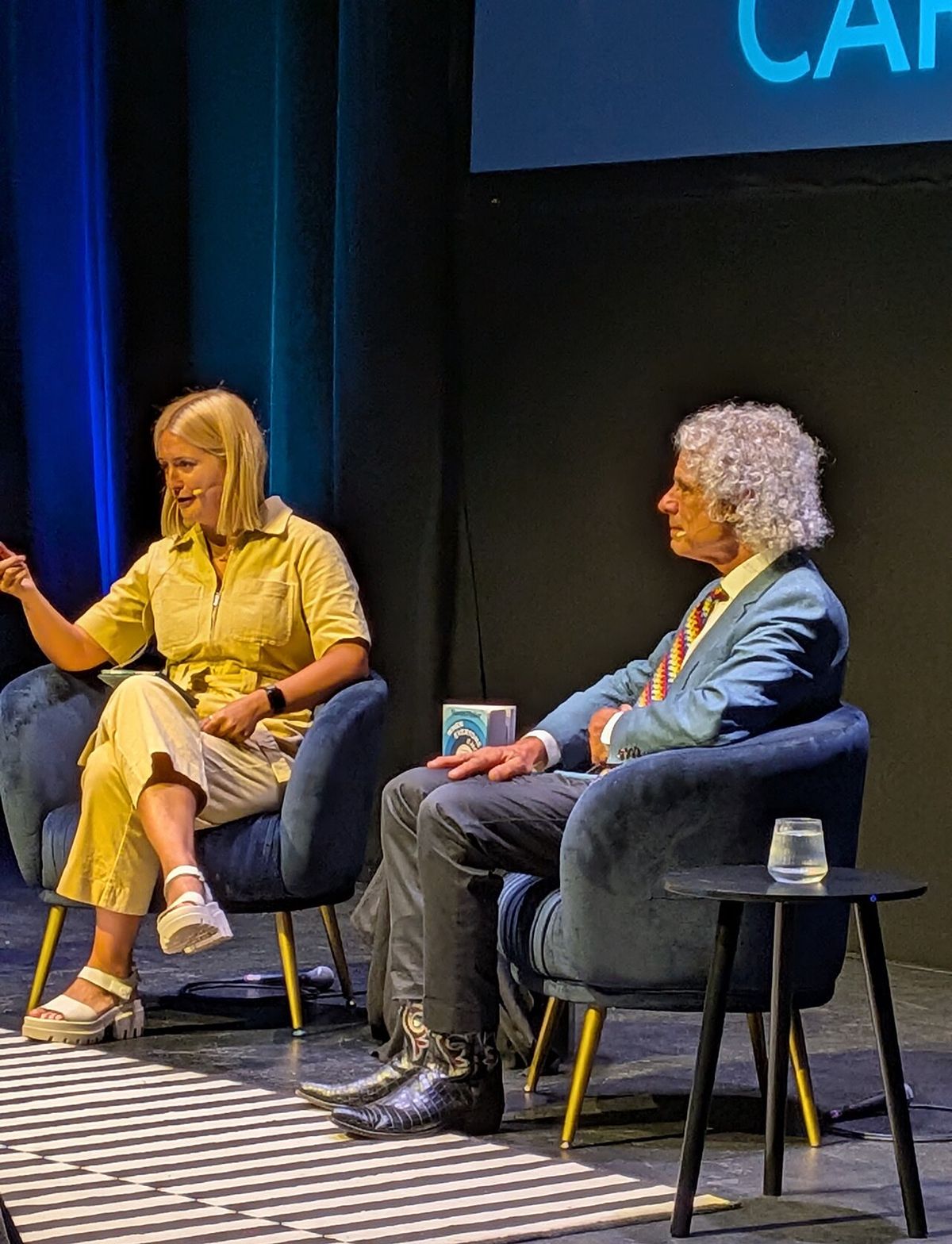
Awards, recognition, and professional service
Steven Pinker's influence as a scientist and public intellectual has been recognized through numerous awards and honours from prestigious institutions across the sciences and humanities. His work has earned him awards from the American Psychological Association, the National Academy of Sciences, the Royal Institution, the Cognitive Neuroscience Society, and the American Humanist Association for his contributions to research and public understanding. Media outlets have frequently listed him among the world's foremost thinkers, with Time magazine naming him one of 'The 100 Most Influential People in the World Today' in 2004, and Foreign Policy magazine including him on its list of 'Top 100 Global Thinkers' in 2005, 2008, 2010, and 2011. In 2013, Prospect Magazine included him in its top 10 'World Thinkers,' cementing his status as a leading public intellectual. Beyond these accolades, Pinker has contributed to language scholarship and academic governance in several formal capacities that shape both public and professional discourse. He served as the chair of the Usage Panel of the American Heritage Dictionary from 2008 to 2018, influencing guidance on English language usage for a decade, and he has served on the editorial boards of various academic journals as well as the advisory boards of several institutions. These roles support the dissemination and development of research in cognitive science and related fields, extending his impact from his own publications to the broader academic community and public language standards.
Personal life and public engagement
Pinker has been married three times. His first marriage was to Nancy Etcoff in 1980, and they divorced in 1992. He then had a second marriage in 1995 that also ended in divorce. Pinker finally married novelist and philosopher Rebecca Goldstein in 2007. Through his marriage to Goldstein, he has two stepdaughters: the novelist Yael Goldstein Love and the poet Danielle Blau. Outside of his academic work, Pinker is known to be an avid cyclist. He is also a vocal advocate for effective altruism, which he calls 'one of the great new ideas of the 21st century.'
In 2006, Pinker provided a linguistic interpretation of a federal law pertaining to the enticement of minors via the internet to Alan Dershowitz. Dershowitz was a personal friend of Pinker's and was Jeffrey Epstein's defense attorney at the time. Dershowitz included Pinker's opinion in a letter to the court during proceedings that resulted in a plea deal. In 2019, Pinker said he was unaware of the nature of the charges against Epstein at the time. He stated that he did an unpaid favor for Dershowitz, as he had regularly done, and that he regrets writing the letter. Pinker said he never received money from Epstein and met him only three times over more than a dozen years.

Selected bibliography
Steven Pinker has authored numerous books, ranging from technical academic works to bestselling titles for a general audience. His publications consistently explore themes of language, mind, human nature, and progress. He examines these themes through the lens of cognitive science and evolutionary psychology. His technical books established his theories on language acquisition. His popular works brought these and other ideas to a wide readership. These popular works have sparked public debate and earned critical acclaim across multiple disciplines.
- Language Learnability and Language Development (1984), A technical book outlining a theory of how children acquire the words and grammatical structures of their mother tongue.
- Learnability and Cognition: The Acquisition of Argument Structure (1989), Focuses on one aspect of acquisition, the ability to use different kinds of verbs in appropriate sentences.
- The Language Instinct (1994), Argues language is an innate, evolved human instinct shaped by natural selection for communication.
- How the Mind Works (1997), A broad survey of mental faculties from an evolutionary perspective, defending a complex human nature.
- Words and Rules: The Ingredients of Language (1999), Presents the 'words and rules' theory of language based on past tense acquisition research.
- The Blank Slate: The Modern Denial of Human Nature (2002), Defends the concept of an evolved human nature against 'blank slate' theories and links visions of human nature to political ideologies.
- The Stuff of Thought: Language as a Window into Human Nature (2007), Examines how language reveals the workings of the mind adapted to Stone Age life.
- The Better Angels of Our Nature: Why Violence Has Declined (2010), Documents the historical decline of violence, identifying six major trends and five historical forces.
- The Sense of Style: The Thinking Person's Guide to Writing in the 21st Century (2014), A general language-oriented style guide informed by cognitive science.
- Enlightenment Now: The Case for Reason, Science, Humanism, and Progress (2018), Argues the human condition has improved because of reason, science, and humanism.
- Rationality: What It Is, Why It Seems Scarce, Why It Matters (2021), An exploration of the nature and importance of rational thought.
Key concepts and intellectual positions
Several core concepts define Steven Pinker's intellectual contributions across his research and popular writings. The computational theory of mind posits that human cognition works, in part, through combinatorial symbol-manipulation. This view contrasts with purely associative connectionist models. It also supports his analysis of language as a system of words and rules. His advocacy for evolutionary psychology is central to his arguments that many mental faculties are genetically adaptive traits shaped by natural selection. He advanced this position in his 1990 paper with Paul Bloom.
Pinker's specific theory of language acquisition combines nativism with a dual-mechanism processing model, arguing children are born with an innate capacity for language but must learn specific words and irregular forms through memory while applying generative rules for regular grammatical constructions. His work on the historical decline of violence identifies six major trends: the Pacification Process, the Civilizing Process, the Humanitarian Revolution, the Long Peace, the New Peace, and the Rights Revolutions. The five historical forces he credits for this decline are the Leviathan (a state monopoly on force), gentle commerce, feminization, the expanding circle of empathy, and the escalator of reason, forces he argues are central to the broader improvement of the human condition through applied reason and science as detailed in Enlightenment Now. Pinker's analysis of political ideology, as discussed in The Blank Slate, links right- and left-wing thought to underlying 'Tragic' and 'Utopian' visions of human nature, respectively, which he derived from Thomas Sowell's work and sees as driving many policy debates.
Questions about Steven Pinker
Where is Steven Pinker from?
Steven Pinker was born in Montreal, Quebec, on September 18, 1954. He grew up in an upper-middle class, secular Jewish family within the city's English-speaking community. His grandparents immigrated to Canada from Poland and Romania in 1926. Pinker graduated from Dawson College in Montreal in 1971. He then earned a Bachelor of Arts in psychology from McGill University in Montreal in 1976.
What is Steven Pinker's most famous book?
Steven Pinker has authored several influential books for general audiences. The Language Instinct (1994) argues that language is an innate behavior shaped by natural selection. The Better Angels of Our Nature (2010) posits that violence in human societies has generally declined over time. Enlightenment Now (2018) argues that the human condition has generally improved because of reason, science, and humanism.
What is Steven Pinker's theory of language?
Pinker's theory posits that language depends on two core mechanisms. The first is the associative remembering of sounds and their meanings in words. The second is the use of rules to manipulate symbols for grammar. He argues that language is an innate faculty that evolved through natural selection for communication. This view was promoted in a seminal 1990 paper he co-authored with Paul Bloom.
Where does Steven Pinker teach?
Steven Pinker is the Johnstone Family Professor of Psychology at Harvard University. He has served in this role since 2003. Between 2008 and 2013, he also held the title of Harvard College Professor. Prior to Harvard, he taught at the Department of Brain and Cognitive Sciences at MIT from 1982 until 2003.
What awards has Steven Pinker won?
Pinker has won awards from several major organizations. These include the American Psychological Association, the National Academy of Sciences, and the Royal Institution. He has also won awards from the Cognitive Neuroscience Society and the American Humanist Association. In 2004, he was named in Time magazine's 'The 100 Most Influential People in the World Today.'
Is Steven Pinker married?
Yes, Steven Pinker is married to novelist and philosopher Rebecca Goldstein. They were married in 2007. Through this marriage, he has two stepdaughters: the novelist Yael Goldstein Love and the poet Danielle Blau. This is Pinker's third marriage. His first marriage was to Nancy Etcoff from 1980 to 1992, and he had a second marriage in 1995 that also ended in divorce.
Sources and further reading
- Steven Pinker (Wikipedia)
- Steven Pinker, The Phil Lind Initiative (lindinitiative.ubc.ca)
- The Thinking Person's Guide to Writing in the 21st Century (stevenpinker.com)
- Steven Pinker (advicetowriters.com)
Checked by the Yadude Books desk. Last updated 2026-10-23.