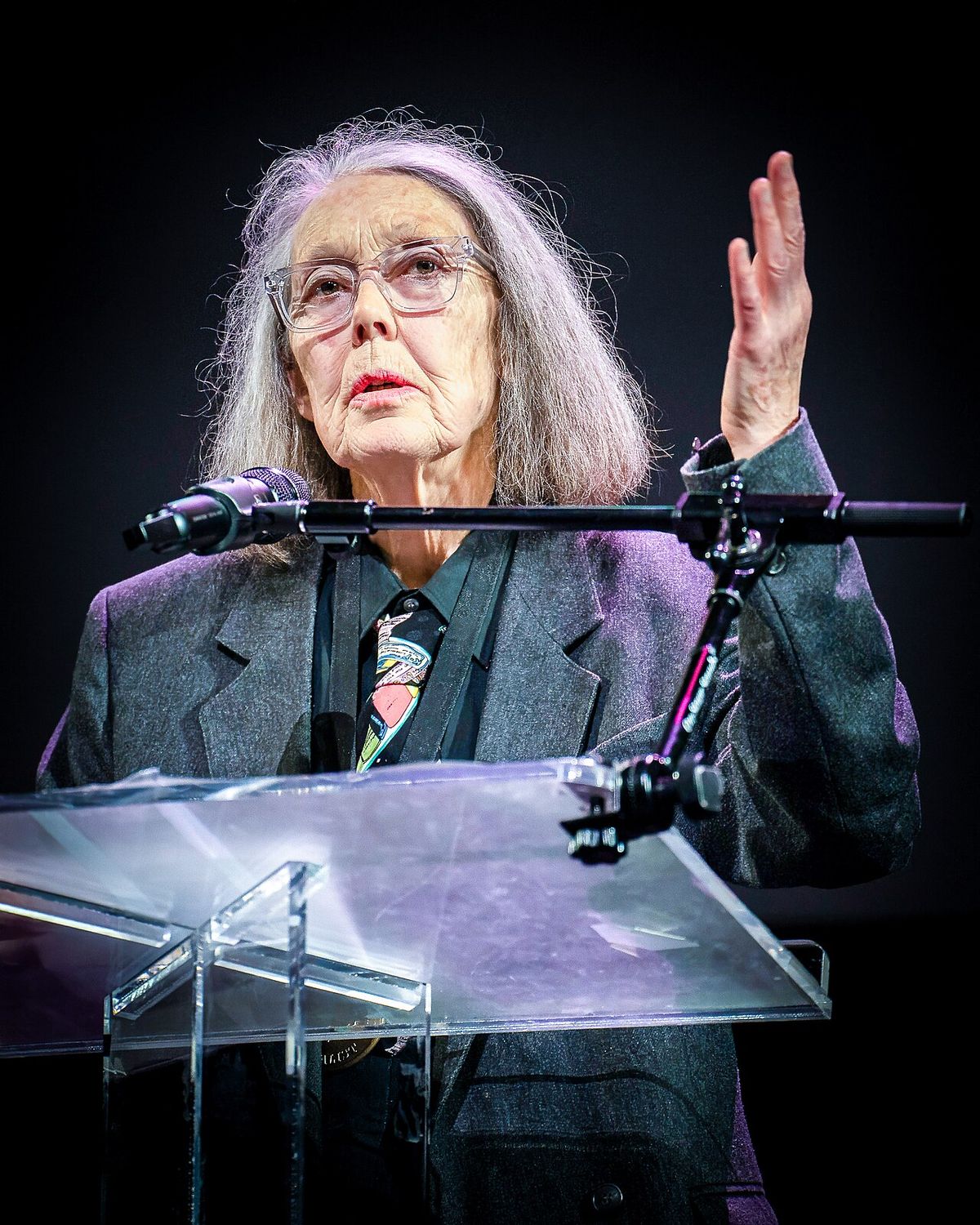
William Gibson
William Gibson is an American-Canadian speculative fiction writer and essayist whose work has shaped contemporary science fiction and popular culture. Widely credited with pioneering the cyberpunk subgenre, he coined the term "cyberspace" and his landmark 1984 novel Neuromancer helped define the aesthetic and anxieties of the digital age. Gibson's connection to Canada is deep and personal. He moved to Toronto in 1967, later settling in Vancouver where he began his writing career, studied at the University of British Columbia, and became a permanent resident. His evolving body of work, from the dystopian Sprawl trilogy to the contemporary Blue Ant books, continues to explore the intersections of technology, society, and human identity, securing his status as a visionary literary figure with global influence.
Early Life and Move to Canada
William Ford Gibson was born in Conway, South Carolina, on March 17, 1948, but spent much of his childhood in Wytheville, Virginia, a small Appalachian town where his parents originated. His father managed a large construction company, causing the family to move frequently during Gibson's youth, including a stay in Norfolk, Virginia, where he attended Pines Elementary School. His father choked to death in a restaurant while on a business trip when Gibson was still a young child, an event that precipitated a return to Wytheville. Gibson later described Wytheville as a place where modernity was distrusted, and he credits the feeling of abrupt exile he felt there with sparking his early interest in science fiction, which he called his "native literary culture." At George Wythe High School, he was an unproductive student, spending time alone reading and listening to records, and at age 13 he secretly bought an anthology of Beat Generation writing that introduced him to Allen Ginsberg, Jack Kerouac, and William S. Burroughs.
Burroughs's work had a pronounced effect on Gibson, altering his ideas about the possibilities of literature. A shy and ungainly teenager who consciously rejected the religion of his surroundings, Gibson's mother, frustrated with his academic performance, threatened to send him to boarding school. He reacted enthusiastically, and she sent him to the Southern Arizona School for Boys in Tucson, which he resented for its structure but later appreciated for forcing social engagement. After his mother's death when he was 18, Gibson left school without graduating and traveled through California and Europe, immersing himself in the counterculture. In 1967, he elected to move to Canada, later stating his motivations were less about draft evasion and more about a desire to "sleep with hippie chicks" and indulge in hashish, noting he was never actually drafted.
After weeks of nominal homelessness in Toronto, Gibson was hired as manager of the city's first head shop, a retailer of drug paraphernalia. He found the community of American draft dodgers in Toronto difficult due to widespread clinical depression, suicide, and substance abuse. During the Summer of Love in 1967, he appeared in a CBC newsreel segment on the hippie subculture in Yorkville, for which he was paid $500, equivalent to 20 weeks' rent, funding his subsequent travels. He later spent a brief period in Washington, D.C., where he completed his high school diploma at age 21, before returning to Toronto and meeting Vancouverite Deborah Jean Thompson. The couple traveled through Europe, concentrating on nations with fascist regimes and favorable exchange rates, including time on a Greek archipelago and in Istanbul in 1970, before marrying and settling in Vancouver, British Columbia, in 1972.

Education and Literary Beginnings in Vancouver
In Vancouver, Gibson initially looked after the couple's first child while they lived on his wife's teaching salary. During the 1970s, he supplemented their income by scouring Salvation Army thrift stores for underpriced artifacts to resell to specialist dealers. Realizing it was easier to sustain high grades for student financial aid than to work, he enrolled at the University of British Columbia, where he earned a Bachelor of Arts degree in English in 1977, a degree he later described as "desultory." His study of English literature exposed him to a wider range of fiction, including postmodern works, which he credits with giving him ideas inaccessible from within science fiction culture. At UBC, he took a science fiction course taught by Susan Wood, which culminated in him writing his first published short story, "Fragments of a Hologram Rose," for the Summer 1977 issue of Unearth.
After graduation, Gibson considered pursuing a master's degree on the topic of hard science fiction novels as fascist literature but discontinued writing for a year, instead expanding his collection of punk records. He worked various jobs, including a three-year stint as a teaching assistant for a film history course at UBC. His literary trajectory changed after attending a science fiction convention in Vancouver around 1980 or 1981, where his impatience with the mainstream led him to connect with fellow panelist John Shirley, a punk musician and author. Shirley became an immediate and lifelong friend, persuading Gibson to sell his early short stories and to take writing seriously. Through Shirley, Gibson came into contact with science fiction authors Bruce Sterling and Lewis Shiner, who recognized his work as "breakthrough material."
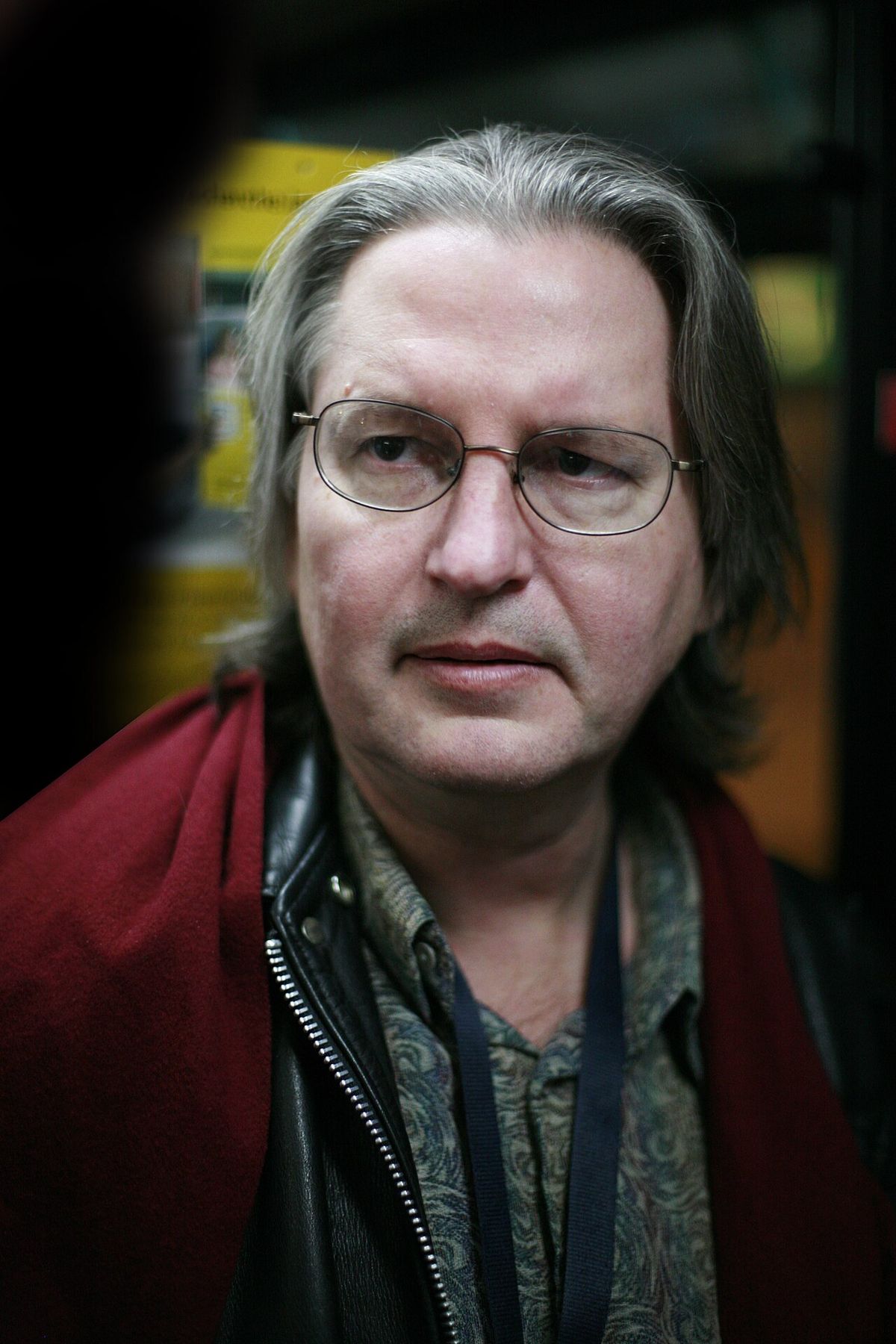
Gibson met Sterling at a science fiction convention in Denver, Colorado, in the autumn of 1981, where he read his story "Burning Chrome" to an audience of four people and noted that Sterling "completely got it." In October 1982, Gibson traveled to Austin, Texas, for ArmadilloCon, appearing on a panel called "Behind the Mirrorshades: A Look at Punk SF" with Shirley, Sterling, and Shiner. After a weekend discussing rock and roll, MTV, Japan, fashion, drugs, and politics, Gibson left declaring half-jokingly that "a new axis has been formed." Sterling, Shiner, Shirley, and Gibson, along with Rudy Rucker, formed the core of the radical cyberpunk literary movement, solidifying a shared aesthetic and thematic direction.
The Cyberpunk Breakthrough and Major Works
Gibson's early short stories, beginning with "Fragments of a Hologram Rose," established his near-future, noir style exploring the effects of cybernetics and computer networks. His themes of hi-tech shanty towns, recorded stimulus, and the dystopic blending of technology and humanity were evident from the start. Stories like "Burning Chrome" (1982), where he coined the term "cyberspace," and "Johnny Mnemonic" appeared in Omni and Universe 11, developing a bleak, film noir feel that consciously distanced itself from mainstream science fiction. Science fiction critic Darko Suvin identified these stories as cyberpunk's "best works" and its "furthest horizon." The Sprawl setting of "Burning Chrome" and the character of Molly Millions from "Johnny Mnemonic" directly led to his first novel.
Neuromancer was published in 1984, commissioned by Terry Carr for the Ace Science Fiction Specials series featuring debut novels. Gibson had a year to complete it and wrote out of "blind animal terror," rewriting the first two-thirds twelve times. He feared the novel was sunk after seeing the first 20 minutes of Blade Runner in 1982, worried readers would think he copied its visual style. Upon release, the novel became an underground word-of-mouth hit, selling more than 6.5 million copies worldwide. In 2005, Time magazine included it in its list of the 100 best English-language novels since 1923, with critic Lev Grossman stating there was "no way to overstate how radical" the novel was upon its appearance.
Gibson followed Neuromancer with two sequels, Count Zero (1986) and Mona Lisa Overdrive (1988), completing the Sprawl trilogy and solidifying his reputation. Both later novels earned Nebula, Hugo, and Locus SF Award nominations. He had initially intended to write an unrelated postmodern space opera titled The Log of the Mustang Sally but abandoned it after a dispute over the dustjacket art for Count Zero. In 1990, he collaborated with Bruce Sterling on The Difference Engine, an alternative history novel set in a technologically advanced Victorian Britain. The novel was a departure from cyberpunk, nominated for the Nebula Award in 1991 and the John W. Campbell Memorial Award in 1992, and it became the best-known work of the nascent steampunk genre.
The Bridge Trilogy and Evolution of Style
Throughout the 1990s, Gibson wrote the Bridge trilogy, comprising Virtual Light (1993), Idoru (1996), and All Tomorrow's Parties (1999). These novels explored sociological developments in near-future urban environments, postindustrial society, and late capitalism with a more grounded, matter-of-fact style than his first trilogy. Virtual Light was described as a "darkly comic urban detective story" depicting an "end-stage capitalism" where private enterprise is taken to its logical conclusion. The villains in the Bridge trilogy shifted from multinational corporations to mass media, specifically tabloid television and the cult of celebrity. Critic Steven Poole asserted that All Tomorrow's Parties marked Gibson's development from "science-fiction hotshot to wry sociologist of the near future," while Salon's Andrew Leonard called Idoru a "return to form."
After All Tomorrow's Parties, Gibson began to adopt a more realist style of writing, which science fiction critic John Clute interpreted as a recognition that traditional science fiction was no longer possible "in a world lacking coherent 'nows' to continue from." This new approach resulted in the Blue Ant books, a series of contemporary thrillers set in the same universe as the present day. The series includes Pattern Recognition (2003), Spook Country (2007), and Zero History (2010), which share characters like Hubertus Bigend and Pamela Mainwaring of the enigmatic marketing company Blue Ant. These works brought Gibson onto mainstream bestseller lists for the first time, significantly broadening his audience beyond traditional science fiction readers.
Following the turn of the century, Gibson emerged with a series of increasingly realist novels set in a contemporary reality. His most recent novels, The Peripheral (2014) and Agency (2020), returned to a more overt engagement with technology and recognizable science fiction themes. Throughout his career, Gibson has written more than 20 short stories and 12 critically acclaimed novels, one of which was in collaboration. He has also contributed articles to major literary, culture, and news publications and collaborated extensively with performance artists, filmmakers, and musicians.
Literary Themes and Lasting Influence
Gibson's work is unified by several interconnected themes that have remained consistent even as his settings shifted from the far future to the present. The most prominent is the exploration of cyberspace and digital consciousness, a domain he defined as a "widespread, interconnected digital technology" where data and human perception merge. His narratives persistently examine the social and human consequences of technological advancement within late capitalist societies where corporate power is pervasive and often sinister. Characters frequently operate in dystopian urban landscapes, or "Sprawls," where immense technological wealth exists alongside poverty, decay, and makeshift communities, a visual he described as "lowlife and high tech."
The concept of transcendence, whether achieved through technological augmentation, spiritual awakening, or immersion in subcultures, is another recurring motif in Gibson's novels. A deep skepticism towards mass media, advertising, and the manufactured nature of celebrity also permeates his work, particularly in the Bridge and Blue Ant trilogies. His friend and collaborator Bruce Sterling summarized Gibson's core aesthetic as the "classic one-two combination of lowlife and high tech," a formula that captured the uneven distribution of technological progress. Gibson's own relationship with his early work is complex. A 52-year-old Gibson later commented on his Neuromancer-era self that "I'd buy him a drink, but I don't know if I'd loan him any money," and referred to the novel as "an adolescent's book."
Gibson's influence extends far beyond literature into academia, design, film, music, and technology. He is frequently cited as a key inspiration for the development of the internet and virtual reality, with his vocabulary becoming part of the lexicon of computer science. The visual style of cyberpunk cinema, including films like The Matrix, owes a significant debt to his early descriptions of digital worlds and urban decay. His collaboration on The Difference Engine helped catalyze the steampunk genre in literature, fashion, and design. Critics have described him as "probably the most important novelist of the past two decades" and a "noir prophet" whose work anticipated the complexities of the information age.
Awards and Selected Bibliography
William Gibson's work has been recognized with science fiction's highest honours, particularly for his groundbreaking debut. His novels and stories have also been frequent nominees for major awards, reflecting his sustained critical acclaim over four decades. Beyond his celebrated novels, Gibson has authored numerous short stories and contributed essays to major publications, engaging with cultural and technological trends. His short story collection, Burning Chrome (1986), gathers his influential early work and includes the story where he first coined the term "cyberspace." The collection's introduction by Bruce Sterling helped frame the cyberpunk movement for readers.
- Nebula Award nomination for The Difference Engine (1991, with Bruce Sterling)
- John W. Campbell Memorial Award nomination for The Difference Engine (1992)
- Locus SF Award nominations for multiple novels across his career.
Gibson's major novels are grouped into distinct trilogies or series. After the Sprawl trilogy, he composed the Bridge trilogy of novels in the 1990s. Following the turn of the century, he wrote a series of increasingly realist novels set in a contemporary reality. His recent work brought him mainstream bestseller lists status for the first time. His ideas consistently engage with emerging technological and social realities.
Gibson's Published Novels
William Gibson's novels show a progression from his cyberpunk origins. After his acclaimed debut novel Neuromancer (1984), he expanded on that story with two more novels to complete the dystopic Sprawl trilogy. He then collaborated with Bruce Sterling on the alternate history novel The Difference Engine (1990). In the 1990s, he composed the Bridge trilogy. Following the turn of the century, he wrote a series of increasingly realist novels set in a contemporary reality. His most recent novels returned to a more overt engagement with technology.
| Year | Title | Series | Notes |
|---|---|---|---|
| 1984 | Neuromancer | Sprawl trilogy | Winner of Nebula, Hugo, and Philip K. Dick Awards. |
| 1986 | Count Zero | Sprawl trilogy | Nominated for Nebula and Hugo Awards. |
| 1988 | Mona Lisa Overdrive | Sprawl trilogy | Nominated for Nebula and Hugo Awards. |
| 1990 | The Difference Engine | Standalone | Co-written with Bruce Sterling. Seminal steampunk work. |
| 1993 | Virtual Light | Bridge trilogy | First book in the Bridge trilogy. |
| 1996 | Idoru | Bridge trilogy | Second book in the Bridge trilogy. |
| 1999 | All Tomorrow's Parties | Bridge trilogy | Final book in the Bridge trilogy. |
| 2003 | Pattern Recognition | Blue Ant books | First contemporary "Bigend" novel. |
| 2007 | Spook Country | Blue Ant books | Second Blue Ant book. |
| 2010 | Zero History | Blue Ant books | Third Blue Ant book. |
| 2014 | The Peripheral | Jackpot trilogy | Return to overt science fiction themes. |
| 2020 | Agency | Jackpot trilogy | Sequel to The Peripheral. |
Gibson's body of work demonstrates a journey from pioneering the cyberpunk subgenre to writing contemporary realist novels and back to technological speculation. His early works explored the effects of technology, cybernetics, and computer networks on humans. His work has been cited as influencing a variety of disciplines including academia, design, film, literature, music, cyberculture, philosophy, and technology. His novels have been critically acclaimed and continue to be studied.
Questions about William Gibson
Is William Gibson a Canadian citizen?
William Gibson is a permanent resident of Canada but retains his American citizenship. He moved to Toronto in 1967 and later settled in Vancouver, where he has lived since 1972. He studied at the University of British Columbia and began his writing career there. While he is deeply associated with Canadian literary and cultural life, he has not become a Canadian citizen.
What is William Gibson's most famous book?
William Gibson's most famous book is his debut novel Neuromancer (1984). It is widely credited with pioneering the science fiction subgenre known as cyberpunk. Gibson coined the term cyberspace in an earlier story and later popularized the concept, along with his usage of the matrix, in Neuromancer. The novel hit a cultural nerve and quickly became an underground word-of-mouth hit.
What did William Gibson study at UBC?
William Gibson studied English literature at the University of British Columbia. He earned a bachelor's degree in English in 1977. He enrolled partly because he realized it was easier to sustain high college grades to qualify for student financial aid than to work. Through studying English literature, he was exposed to a wider range of fiction, including an awareness of postmodernity, which gave him ideas he felt were inaccessible from within the culture of science fiction.
What is the Blue Ant series about?
The Blue Ant series is a set of three contemporary thriller novels by William Gibson: Pattern Recognition (2003), Spook Country (2007), and Zero History (2010). They are set in the very recent past and explore themes of global marketing, branding, intelligence gathering, and cultural anxiety. The stories are connected by the mysterious marketing firm Blue Ant and its founder, Hubertus Bigend. These books marked Gibson's shift to a more realist style and brought him mainstream bestseller status.
Did William Gibson write any books with another author?
Yes, William Gibson co-wrote one novel with fellow cyberpunk author Bruce Sterling. The book, titled The Difference Engine, was published in 1990. It is an alternative history novel set in a Victorian era where Charles Babbage's mechanical computers have been successfully built, radically changing society. The novel is a seminal work in the steampunk genre and was nominated for the Nebula Award and the John W. Campbell Memorial Award.
What book did William Gibson win the Hugo and Nebella awards for?
William Gibson won both the Hugo Award and the Nebula Award for his debut novel Neuromancer (1984). This novel achieved a rare feat by becoming the first winner of a science fiction triple crown, as it also received the Philip K. Dick Award for best paperback original. The book was a major critical and commercial success, eventually selling more than 6.5 million copies worldwide. Its release marked a significant moment in science fiction literature, credited with renovating the genre in the 1980s. Neuromancer's imaginative concepts, including the popularization of cyberspace and the matrix, established Gibson as a pioneering voice.
Sources and further reading
- William Gibson (Wikipedia)
- William Gibson (williamgibsonbooks.com)
- William Gibson, BA'77 (magazine.alumni.ubc.ca)
- William Gibson (albany.edu)
- William Gibson (zenoagency.com)
Checked by the Yadude Books desk. Last updated 2026-10-21.