Fairfax Financial
Fairfax Financial Holdings Limited is a Canadian multinational financial holding company headquartered in Toronto, Ontario. Founded in 1985 by Prem Watsa, the company has grown from a small trucking insurer into a global conglomerate anchored by property and casualty insurance and reinsurance, with extensive holdings in sectors including retail, hospitality, agriculture, and consumer services. As one of the world's top 20 property and casualty insurers, with gross premiums of US$33 billion and an investment portfolio exceeding US$70 billion, Fairfax is a significant component of the Canadian financial landscape and a member of the S&P/TSX 60 Index. Its long-term investment performance, compounding book value per share at 18.7 percent annually since inception, represents one of the strongest records of wealth creation in Canadian corporate history.
Corporate History and Evolution
Fairfax Financial's origins trace back to Markel Service of Canada, incorporated on March 13, 1951. In 1985, Prem Watsa, having recently co-founded Hamblin Watsa Investment Counsel, took control of the company, then named Markel Financial Holdings Ltd., which specialized in trucking insurance. Watsa reorganized the firm and renamed it Fairfax Financial Holdings Limited in May 1987, with the name standing for fair, friendly acquisitions. From this foundation, Watsa began building the company through a series of strategic acquisitions and prescient investment decisions.
Throughout the 1990s and 2000s, Fairfax expanded its insurance operations and continued its value-oriented, sometimes contrarian, investment approach. A major expansion occurred on August 13, 1998, with the acquisition of Crum & Forster for approximately US$565 million, significantly boosting its U.S. commercial insurance footprint. In the late 1990s, Watsa expressed concern over speculation in U.S. technology stocks, leading Fairfax to hold put options on the S&P 500 and a basket of tech stocks. Similarly, by 2007, Fairfax had built a substantial credit default swap book valued at $18.5 billion notional to bet against the U.S. housing bubble, a move that proved highly profitable during the subprime mortgage crisis.
Major Acquisitions and Strategic Moves
Fairfax's growth into a global conglomerate has been driven by a consistent strategy of acquiring and holding high-quality businesses for the long term. The company makes controlling investments in operating companies across insurance and non-insurance sectors, often during periods of market stress or corporate transition. A landmark deal was completed in July 2017 with the acquisition of Allied World Assurance Company Holdings, AG for approximately US$4.9 billion, adding a global specialty insurer to its stable. In the consumer retail space, Fairfax acquired the Canadian division of Toys R Us in June 2018 for $234 million, keeping 82 stores open after the chain's U.S. liquidation, though it sold the business in 2021. The company has also made significant investments in well-known Canadian brands, often taking them private, such as its August 2022 proposal for a $954 million takeover of restaurant operator Recipe Unlimited Corp.
On July 22, 2024, Fairfax Financial agreed to acquire Sleep Country Canada Holdings Inc. for approximately C$1.7 billion through an all cash offer. The sale received final court approval from the Ontario Superior Court of Justice in late September 2024. In December 2023, Fairfax completed the acquisition of an additional equity interest in Gulf Insurance Group, increasing its ownership from 43.69 percent to 90.01 percent. On December 20, 2024, Fairfax increased its ownership of Peak Achievement Athletics Inc. to 100 percent by acquiring the remaining equity interests for total consideration of $765 million. On October 14, 2026, the Government of India's Cabinet Committee on Economic Affairs approved the sale of a combined 60.72 percent stake in IDBI Bank to Fairfax Financial for ₹52,878 crore, with the transfer still subject to final regulatory clearance from the Reserve Bank of India.
- 1998: Acquired Crum & Forster for US$565 million.
- 2013: Made a $4.7 billion offer for BlackBerry, later providing a $1 billion cash injection.
- 2017: Completed acquisition of Allied World for US$4.9 billion.
- 2018: Purchased Toys R Us Canada for $234 million.
- 2024: Acquired Sleep Country Canada for C$1.7 billion.
- 2026: Government approval received to acquire 60.72% of IDBI Bank.
Insurance Operations and Global Reach
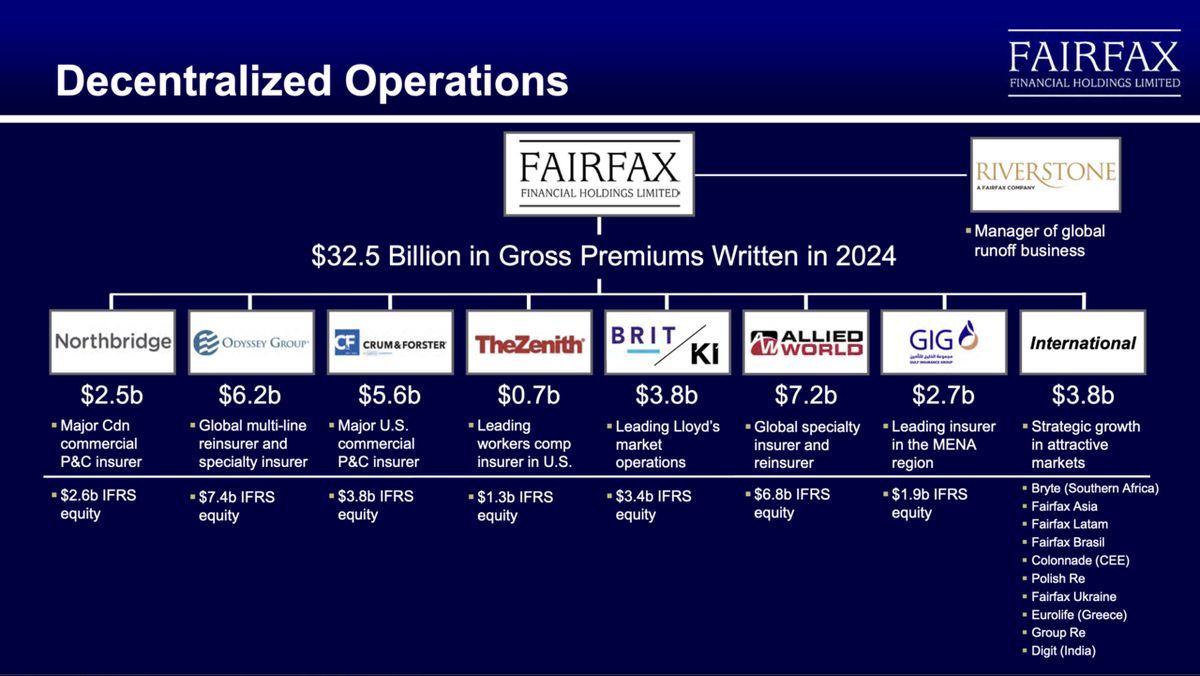
Property and casualty insurance and reinsurance form the core earnings engine of Fairfax Financial, contributing roughly two-thirds of its profits from North America with the remainder from Europe and Asia. The company operates through a decentralized network of more than 26 insurance subsidiaries, each managed autonomously but overseen by the holding company for capital and risk. This structure allows for local expertise while leveraging the group's financial strength. Fairfax ranks among the world's top 20 property and casualty insurers, writing US$33 billion in gross premiums annually through its extensive global portfolio.
The insurance group is organized by geographic region and specialty, with major subsidiaries leading operations on each continent. In North America, key insurers include Odyssey Group, Crum & Forster, Zenith, and Northbridge. In Europe, Brit Insurance and Colonnade are central platforms, while in Asia, the group is anchored by Gulf Insurance and Digit Insurance. The company also has a growing presence in emerging markets through operations like Bryte in Africa, Southbridge Chile, and SBI Seguros Uruguay. This global diversification provides stability and growth opportunities, insulating the group from regional economic downturns and allowing it to capitalize on insurance markets at different stages of development.
Investment Philosophy and Portfolio Management
Fairfax's investment strategy is a fundamental driver of its success, managed by Hamblin Watsa Investment Counsel (HWIC) and deeply influenced by the value investing principles of Benjamin Graham and John Templeton. The approach is long-term, value-oriented, and focused on compounding book value per share with a strong emphasis on downside protection. A key source of investable capital is insurance float, the premiums collected before claims are paid, which is allocated across public equities, fixed income, and private businesses. Investments are made with a margin of safety and typically held for many years, with the portfolio featuring both controlling stakes in operating companies and minority positions in publicly traded firms. Capital allocation decisions are centralized at the holding company level, directing excess capital to support profitable underwriting growth, acquire businesses, reduce debt, or repurchase Fairfax shares when they trade below intrinsic value. The strategy has delivered exceptional results, with book value per share compounding at 18.7 percent annually from 1985 through 2024, and the common share price rising from CDN$3.25 at inception to over CDN$2,000 by the end of 2024.
| Representative Holding | Sector/Region | Note |
|---|---|---|
| Eurobank Ergasias | Banking (Europe) | Public equity investment |
| Orla Mining | Mining (Americas) | Partial sale in 2025 realized $177M gain |
| Commercial International Bank | Banking (Africa) | Public equity investment |
| CVS Health | Healthcare (U.S.) | Public equity investment |
| Thomas Cook India | Hospitality (Asia) | Controlled subsidiary |
| Bengaluru International Airport | Infrastructure (Asia) | 64% ownership stake |
Corporate Culture and Governance
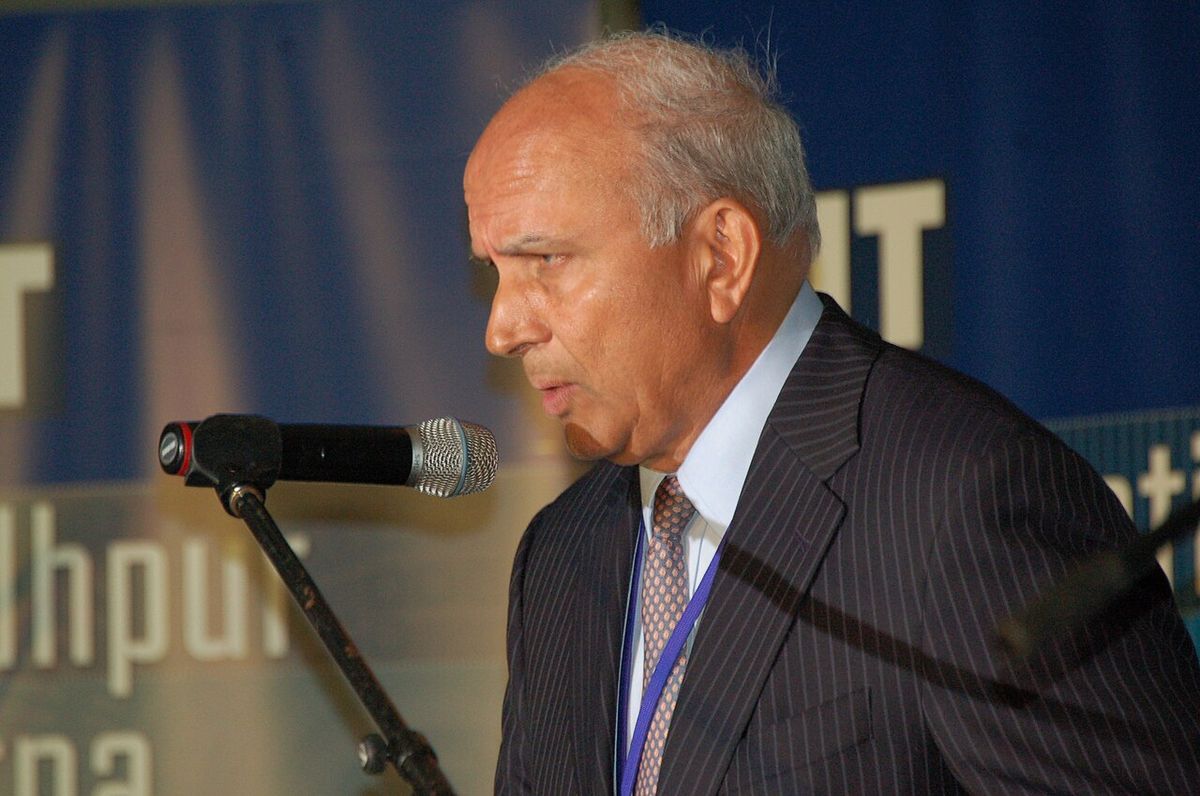
Fairfax Financial is characterized by a distinctive corporate culture shaped by Prem Watsa's leadership and a formal set of Guiding Principles. The company operates under a dual-class share structure that gives Watsa voting control, a design intended to insulate management from short-term activist pressure and ensure continuity of its long-term philosophy. Watsa has served as both Chairman and Chief Executive Officer since the company's founding in 1985. Succession plans indicate his son, Ben Watsa, is expected to succeed him as Chairman, while President and Chief Operating Officer Peter Clarke is expected to become CEO, maintaining the family's guiding influence over strategic direction.
The culture emphasizes ethical conduct, prudent capital management, and a familial care for employees. In 2023, Watsa added the Golden Rule, treat others as you would want to be treated, to the company's formal principles. This ethos was demonstrated practically in 2024 when, after the deaths of several long-serving employees from cardiac issues, Fairfax rolled out a global cardiac screening program for employees aged 50 and older and their spouses. The program identified ten North American employees in need of stents within its first few months. Watsa's annual salary has remained fixed at $600,000 for decades, a modest figure relative to the company's scale. Fairfax also runs an employee share ownership program and commits 2 percent of its pre-tax profits annually to charitable causes.
Shareholder Communications and Public Profile
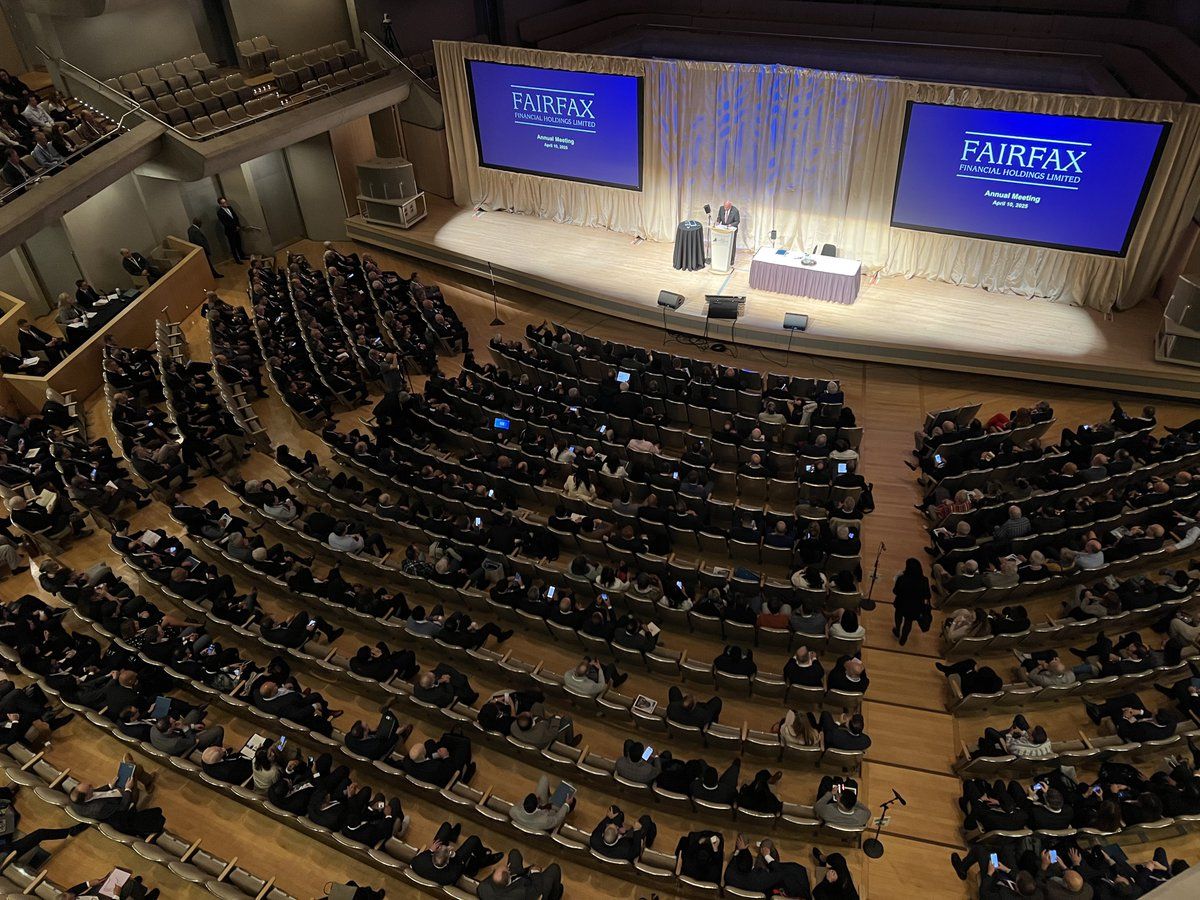
Prem Watsa's annual letter to shareholders, published each March alongside the company's year-end financial results, is a key feature of Fairfax's transparency and has become essential reading within the global value investing community. Written in a candid and conversational style, the letters provide a detailed review of underwriting performance, investment activity, and portfolio changes. They also offer Watsa's views on macroeconomic conditions, financial markets, and corporate philosophy, often referencing historical financial crises and investment legends. These communications have built a loyal following by demystifying complex financial strategies and holding the company accountable for its long-term results. The Annual Shareholders' Meeting, held each April at Roy Thomson Hall in Toronto, serves as a live extension of the annual letter, drawing a large audience and providing a forum for Watsa to elaborate on themes and answer investor questions directly.
Prem Watsa's annual letters to shareholders, published each March, have become essential reading in the value investing community. Written in a candid, conversational style, the letters cover underwriting performance, investment philosophy, and portfolio activity. Fairfax's Annual Shareholders' Meeting, held at Roy Thompson Hall in Toronto each April, draws a following of long term shareholders. The meeting serves as a forum for Watsa to expand on the themes raised in the letter and take questions directly from investors. This combination of detailed written analysis and open dialogue has fostered a strong sense of partnership between the company and its owners.
Non-Insurance Holdings and Diversified Portfolio
Beyond its insurance core, Fairfax holds a vast and growing portfolio of controlling interests in companies across multiple industries and continents. These investments are typically made with the same long-term, value-oriented mindset applied to its securities portfolio. In Canada, notable wholly owned subsidiaries include Recipe Unlimited, one of the country's largest food service operators, and Sleep Country Canada, the leading mattress and sleep accessories retailer. The company also holds Peak Achievement Athletics, parent company of the Bauer Hockey and Maverik Lacrosse brands, which it fully consolidated in December 2024.
Internationally, Fairfax's holdings reflect a strategic focus on high-growth economies and essential services. Through Fairfax India Holdings Corporation, launched in 2015, the company has major stakes in entities like Bengaluru International Airport Limited and Digit Insurance. It holds a controlling interest in Thomas Cook India, a major travel services company. Other significant investments span sectors such as hospitality through Grivalia Hospitality, food manufacturing via Meadow Foods, and integrated facilities services with Dexterra Group. This diversified portfolio of operating companies provides stable cash flows, reduces reliance on insurance underwriting cycles, and offers additional avenues for capital deployment and value creation.
- Recipe Unlimited: Canadian restaurant franchisor (100% owned).
- Sleep Country Canada: Mattress and sleep products retailer (100% owned).
- Peak Achievement Athletics: Owner of Bauer Hockey (100% owned).
- Fairfax India: Investment vehicle for Indian assets like Bengaluru Airport (64%).
- Thomas Cook India: Travel and tourism services (controlled subsidiary).
- Kennedy Wilson: Real estate investment and services (significant stake).
Questions about Fairfax Financial
Who founded Fairfax Financial and who runs it?
Fairfax Financial was founded in 1985 by Prem Watsa, who has served as its Chairman and Chief Executive Officer since inception. Watsa controls the company through a dual-class share structure. The day-to-day operations are overseen by President and Chief Operating Officer Peter Clarke, who is expected to succeed Watsa as CEO. Watsa's son, Ben Watsa, is expected to succeed him as Chairman, ensuring the family's continued guiding influence over the company's long-term strategy.
What is Fairfax Financial's main business?
Fairfax Financial's core business is property and casualty insurance and reinsurance, conducted through a global network of over 26 decentralized subsidiaries. This segment generates roughly two-thirds of the company's earnings, primarily from North America. The company ranks among the world's top 20 insurers in this sector, writing US$33 billion in gross premiums annually. Alongside insurance, Fairfax is a major investment holding company with a consolidated portfolio exceeding US$70 billion and controlling stakes in diverse operating companies across retail, hospitality, and consumer services.
What are some of Fairfax's most well-known Canadian holdings?
Fairfax owns several major Canadian consumer brands. It fully owns Recipe Unlimited, a giant food service operator with chains like Swiss Chalet and Harvey's. In 2024, it acquired Sleep Country Canada, the country's leading mattress retailer, for approximately C$1.7 billion. It also fully owns Peak Achievement Athletics, the parent company of Bauer Hockey, a well-known name in sports equipment. Historically, Fairfax has held significant stakes in companies like BlackBerry and Torstar, and it previously owned and operated Toys R Us Canada from 2018 to 2021.
How has Fairfax's investment performance been over the long term?
Fairfax Financial has delivered exceptional long-term investment performance since its founding in 1985, establishing one of the strongest compounding records of any publicly listed Canadian company. Its book value per share has compounded at an annual rate of 18.7 percent. The common share price, including dividends, has compounded at 19.2 percent annually, rising from CDN$3.25 at inception to over CDN$2,000 by the end of 2024. This performance is attributed to its value-oriented, long-term investment strategy managed by Hamblin Watsa Investment Counsel and its successful use of insurance float as investable capital.
What major international deal is Fairfax currently pursuing?
As of late 2026, Fairfax is pursuing its largest international deal: the acquisition of a 60.72 percent controlling stake in IDBI Bank, a major Indian bank. The Government of India's Cabinet Committee on Economic Affairs approved the sale to Fairfax for ₹52,878 crore in October 2026. The Indian government and the Life Insurance Corporation of India are selling 30.48 percent and 30.24 percent stakes, respectively, and will retain a combined residual stake of about 15 percent. The transaction is pending final regulatory clearance from the Reserve Bank of India and represents a massive strategic entry into the Indian banking sector.
What is Fairfax's investment strategy?
Fairfax employs a long-term, value oriented investment strategy centred on compounding book value per share, using insurance float as a primary source of investable capital. This strategy is applied by Hamblin Watsa Investment Counsel and is influenced by the philosophies of Benjamin Graham and John Templeton. Investments are allocated across public equities, fixed income securities, and private businesses with a focus on total return and downside protection, and are made with a margin of safety for long holding periods. The company has a history of thematic contrarian bets, such as purchasing Nikkei put options before the 1990 Japanese market decline and S&P 500 and technology stock puts ahead of the dot com bust. Capital allocation decisions are made at the holding company level, directing excess capital to support underwriting growth, acquire businesses, reduce debt, or repurchase Fairfax shares when they trade below intrinsic value.
Sources and further reading
- Fairfax Financial (Wikipedia)
- About Fairfax (fairfax.ca)
- Fairfax Financial Holdings Limited (FFH.TO) (ca.finance.yahoo.com)
Checked by the Yadude Books desk. Last updated 2026-10-23.