Alberta mail-in referendum voting process faces scrutiny amid misinformation claims
Elections Alberta clarifies its verification process after social media posts falsely claim mail-in ballots can be obtained fraudulently from outside the province. Officials explain the multi-layered security measures including database verification and ID requirements that ensure only eligible voters can participate in the October 19 referendum.
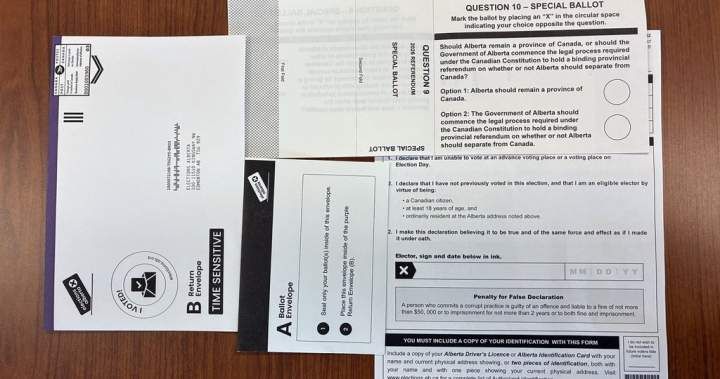
Claims circulating on social media that Alberta's mail-in referendum voting system is vulnerable to fraud have been thoroughly disputed by election officials, who maintain multiple layers of verification protocols to ensure only eligible voters receive ballots. The controversy has emerged as Alberta prepares for a historic referendum containing ten questions about constitutional matters and potential separation from Canada, with voting scheduled for October 19. The debate over election integrity comes amid unprecedented demand for mail-in voting options, with officials reporting over 610,000 requests received ahead of Friday's deadline, reflecting both increased voter interest and expanded access to mail-in ballots.
The viral claims and their rapid dissemination
A September 20 post on X, formerly known as Twitter, that received over 201,000 views within 24 hours made false claims about Alberta's mail-in voting system requiring no verification of provincial residency. The post featured a purported message from a British Columbia resident who stated they had successfully registered by only declaring Canadian citizenship, without providing any proof of Alberta residence. The message claimed "No verification of Alberta residents and they will mail the ballot anywhere," a statement that Elections Alberta has categorically denied.
These assertions gained traction as other social media users posted screenshots appearing to show successful application submissions with addresses outside Alberta. One notable example came from an Alberta lawyer who shared a screenshot suggesting she had submitted an application using a Vancouver address. While the screenshot displayed confirmation from Elections Alberta that the application had been submitted, it did not indicate approval, a crucial distinction that was often omitted in subsequent sharing of the image. These posts fueled concerns about potential vulnerabilities in the voting system during a politically sensitive referendum that could shape Alberta's constitutional future.
READ MORE: NDP Leader Avi Lewis faces criticism for remarks on Jewish responsibility in Gaza conflict
Elections Alberta's comprehensive verification process
Elections Alberta spokesperson Maia Hanrahan provided detailed explanations about the multi-layered verification system in place to ensure election integrity. While the initial application screen allows applicants to enter addresses without immediate blocking - including those outside Alberta - every submission undergoes rigorous manual verification. "An out-of-province address cannot simply proceed through the process and be approved. While the initial application screen does not automatically block every address that is not recognized by the system, every submission is subject to human review, and no application with an invalid or out-of-province address will be approved or proceed to the next step," Hanrahan emphasized in her statement.
The verification process cross-checks applications against Alberta's voter registration system through sophisticated tools called VoterLink and the Register of Electors. These systems allow election officials to verify an applicant's information and determine eligibility before mailing out any ballots. When The Canadian Press tested the lawyer's application confirmation code, the system showed the Vancouver-address application had been denied the day after submission, displaying the message "Your application has been reviewed and declined." This demonstrated the backend verification process working exactly as designed to catch ineligible applications.
Multiple security measures throughout voting process
The mail-in voting process contains several overlapping safeguards beyond the initial application screening. Even in the unlikely event that an application were approved incorrectly, voters must include with their returned ballot a copy of government-issued identification showing proof of Alberta residency. This creates a second verification point before any vote would be counted, effectively creating a two-stage security process.
Lorne Gibson, Alberta's former chief electoral officer, explained that jurisdictions across Canada handle special ballot verification differently. Some provinces require identification upfront with applications, while Alberta's system focuses on backend verification through its comprehensive voter registration database. Gibson noted his preference for Alberta's approach, stating "I tend to prefer this approach since it prevents a ballot from ever being sent to a person who is not an eligible voter in the first place." This system design choice reflects a balance between accessibility and security.
Substantial legal consequences for fraudulent voting
The potential penalties for attempting to vote illegally in Alberta's referendum are substantial and serve as a strong deterrent. Provincial election laws establish severe consequences for voting offenses, including fines up to $50,000 and possible jail sentences of up to two years. These penalties apply to both individuals attempting fraudulent voting and anyone assisting such attempts, creating legal risks for those who might consider testing the system.
Gibson emphasized that Alberta's verification tools make successful fraud extremely unlikely given these deterrents and the system's multiple verification steps. "The potential penalties for someone trying to vote illegally are high," he noted, adding that the combination of database verification, ID requirements, and severe penalties forms a comprehensive security framework designed to protect the integrity of the electoral process while maintaining reasonable access for legitimate voters.
Historical context of mail-in voting expansion
The current controversy emerges against the backdrop of Alberta's first widespread availability of mail-in voting without requiring proof of special circumstances. Mount Royal University political science professor Lori Williams explained that in previous elections, voters needed to demonstrate extraordinary circumstances to qualify for mail-in ballots, such as being absent from the province during voting periods or having mobility issues that prevented in-person voting.
This referendum marks a significant expansion of voting access, which Williams noted has been encouraged by various organizations to avoid polling station lines and make participation more convenient. However, this expansion of democratic participation opportunities has also led to increased scrutiny of election procedures and created openings for misinformation about the voting process to spread, particularly on social media platforms where context and nuance are often lost.
The referendum's constitutional significance
The October 19 referendum includes ten questions about constitutional matters, with the central issue asking whether Alberta should pursue a binding vote on separation from Canada. This politically charged context has heightened sensitivities around election administration and voting procedures, with all parties keen to ensure the legitimacy of the outcome regardless of which position prevails.
The referendum represents both a test case for Alberta's expanded mail-in voting system and a potential turning point in Alberta's constitutional relationship with Canada. The combination of constitutional questions, expanded voting methods, and intense public interest creates unique challenges for election administrators working to maintain both accessibility and integrity during a vote that could have significant historical consequences.
Broader implications for election administration
The spread of misinformation about election procedures poses ongoing challenges for democratic processes across Canada, particularly during high-stakes votes. This incident demonstrates how election administration becomes politicized during consequential votes, with procedural details taking on outsized significance in public debate. Alberta's experience shows the importance of clear public communication about voting safeguards, especially when introducing new voting methods that may be unfamiliar to citizens.
Election authorities nationwide must continually balance accessibility with security - a tension that becomes particularly acute when jurisdictional identity forms part of the voting question itself. The case also highlights the need for robust verification systems that can withstand public scrutiny while maintaining reasonable access for legitimate voters, as well as the challenges of countering misinformation in an era of rapid social media sharing.