Emily Carr
Emily Carr was a Canadian artist and writer who became one of the most significant figures in the nation's cultural history. Born in Victoria, British Columbia, in 1871, she dedicated her career to capturing the monumental art of First Nations peoples and the powerful forests and skies of the Pacific Northwest. Though initially underrecognized, her stature grew, with her work celebrated for its bold modernist style and her writing praised for its complete candour. Today, Carr is considered a national treasure, a designation reflected in her status as a National Historic Person and the enduring demand for her paintings and books.
Early life and artistic training
Emily Carr was born in Victoria in 1871, the second youngest of nine children to English immigrants Richard and Emily Carr. The family home, now the Emily Carr House National Historic Site, was on Birdcage Walk in the James Bay district, furnished in lavish English fashion. Her father encouraged her artistic inclinations, but she pursued art seriously only after her parents' deaths, her mother dying in 1886 and her father in 1888. Carr studied for three years at the California School of Design in San Francisco from 1890 to 1893, taking classes in drawing, portraiture, still life, and landscape painting, though she preferred landscapes. In 1899, she traveled to London, England, to transform herself into a professional artist, studying at the Westminster School of Art and with instructors like John William Whiteley in Bushey and Julius Olsson in St Ives, Cornwall. A nervous breakdown in 1902 forced a period of convalescence before she returned to British Columbia in 1904, where she began teaching art and creating political cartoons for the Week, a Victoria newspaper.
Documenting First Nations villages and art
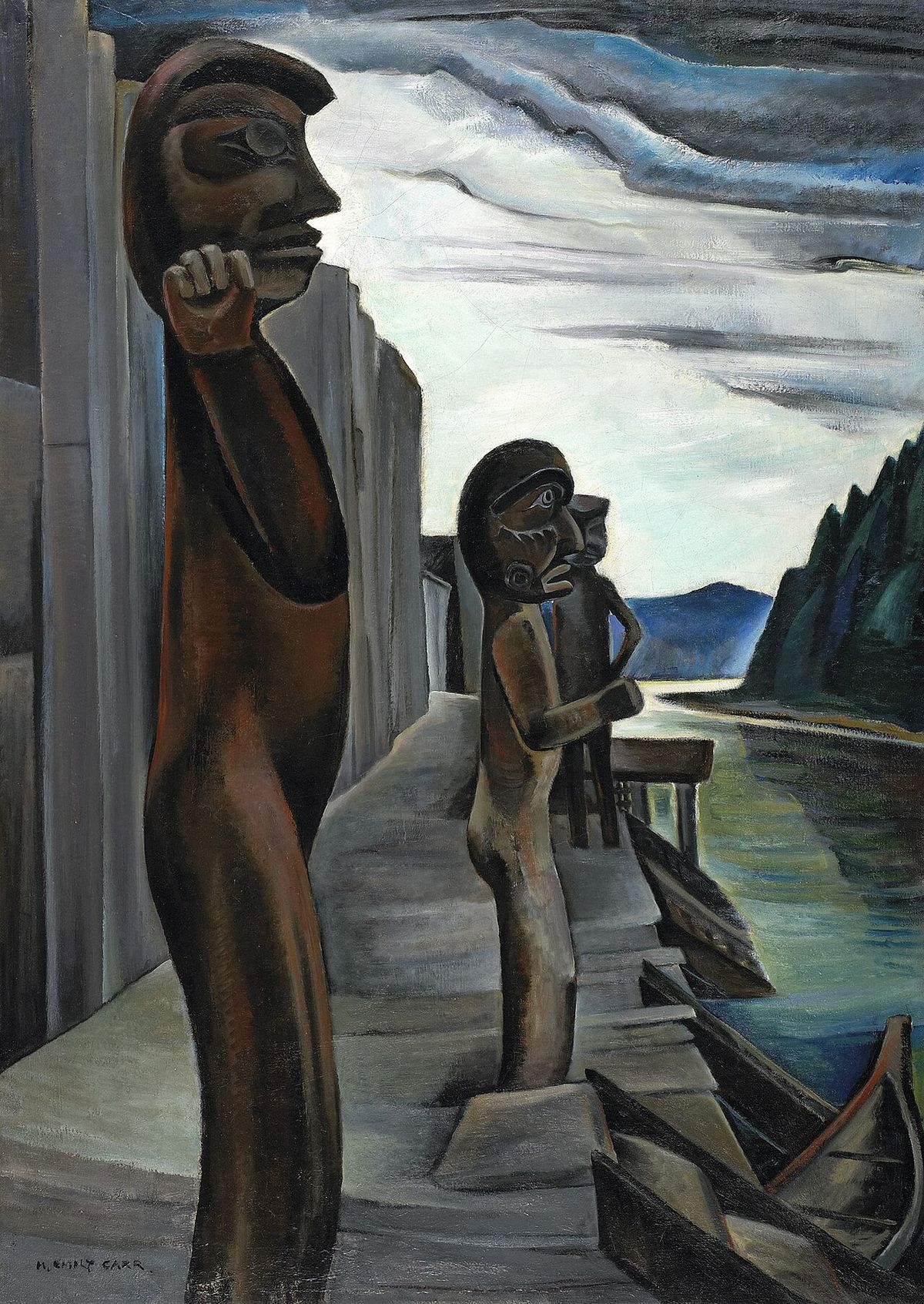
Carr's connection with First Nations cultures began in 1898 with a trip to a Nuu-chah-nulth village near Ucluelet on Vancouver Island, where she was given the Indigenous name Klee Wyck. This experience made a lasting impression on her and set a direction for her work. A 1907 sightseeing trip to Alaska with her sister Alice, where she may have met American artist Theodore J. Richardson, solidified her mission to document what she perceived as the vanishing totems and way of life. From 1908 to 1910, she undertook several trips to Indigenous communities to sketch and paint. A major expedition in 1912 took her to Haida Gwaii, the Upper Skeena River, and Alert Bay to document the art of the Haida, Gitxsan, and Tsimshian peoples, producing sketches she later developed into paintings like Big Raven and Tanoo. She later organized an exhibition of this work and delivered a detailed public 'Lecture on Totem Poles' in Vancouver's Dominion Hall, stating her desire to preserve relics of the coast's first primitive greatness for Canadians. While there was some positive reaction, Carr felt Vancouver's response was not strong enough to support her career, leading her to return to Victoria in 1913.
Modernist development in France
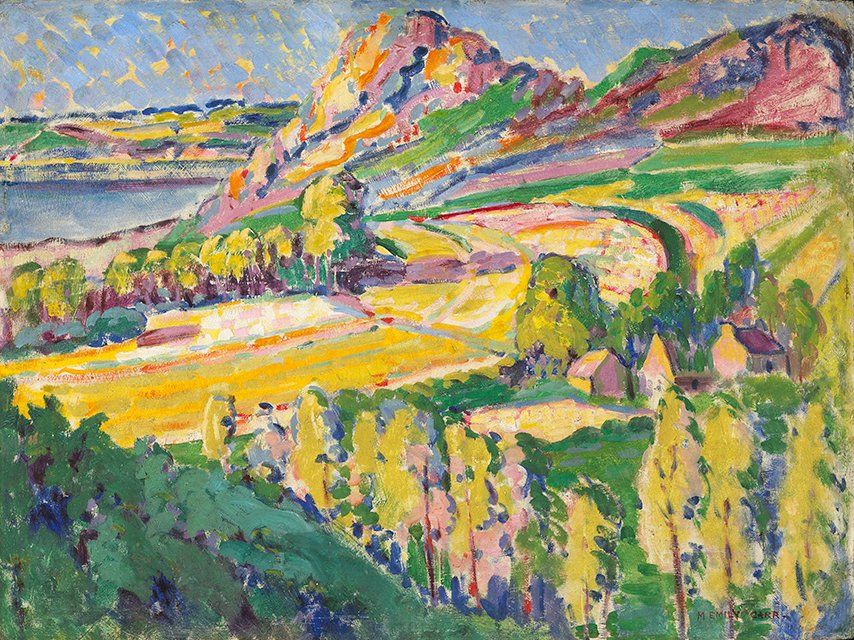
Seeking to advance her art, Carr returned to Europe in 1910 to study evolving modernist trends in Paris with her sister Alice. She met painter Harry Phelan Gibb with a letter of introduction and was shocked and intrigued by his use of distortion and strong colour in his landscapes and nudes. Carr enrolled at the Académie Colarossi, took private lessons with John Duncan Fergusson, and eventually studied with Gibb in the villages of Crécy-en-Brie and St. Efflam in Brittany. Her study with Gibb shaped her painting style, leading her to adopt a bold colour palette and embrace the Fauve style of broad brushwork. She also traveled to Concarneau to study with Frances Hodgkins. This period culminated in 1911 with the selection of two of her paintings for exhibition at the prestigious Salon d'Automne in Paris, a significant achievement for a Canadian artist.
Struggle and renewed recognition
Upon returning to Vancouver in March 1912, Carr opened a studio on West Broadway and organized an exhibition of seventy watercolours and oils representing her radical new style from France, becoming the first artist to introduce Post-Impressionism to the city. Discouraged by the local reception, she returned to Victoria in 1913 and for the next 15 years painted very little, instead running a boarding house called the 'House of All Sorts', which provided source material for a later book. Her financial circumstances were straitened, though she did produce some works from local scenes like the cliffs at Dallas Road. Her fortunes changed through the attention of supporters like artist Sophie Pemberton, photographer Harold Mortimer-Lamb, and ethnologist Marius Barbeau. Barbeau persuaded National Gallery director Eric Brown to visit Carr in 1927, which led to her invitation to participate in a major exhibition on West Coast art in Ottawa. Carr sent 65 oil paintings east, of which 31 were included in the show alongside works by Edwin Holgate and A.Y. Jackson. The exhibition later traveled to Toronto and Montreal, bringing her work to a national audience.
Association with the Group of Seven and new influences
Carr traveled east for the 1927 exhibition, where she met members of the Group of Seven, including Frederick Varley in Vancouver and Lawren Harris in Toronto. Harris became a crucial mentor and friend, telling her 'You are one of us' and welcoming her into the modernist fold, inviting her to contribute to Group of Seven shows in 1930 and 1931. This encounter ended her long artistic isolation and sparked her most prolific period. Their extensive correspondence influenced her artistic direction, with Harris advising her to seek an equivalent for the totem poles in the West Coast scenery, and introduced her to Theosophic thought, which she studied but ultimately did not fully embrace. In 1928, fellow exhibitor Mark Tobey visited her in Victoria to teach a master class, where she experimented with his methods of abstraction and Cubism, though she stated she was not ready to abandon representational forms. During this period, curator Doris Shadbolt notes Carr began to concentrate on capturing the emotional and mythological content in the totemic carvings, moving toward more stylized and abstracted geometric forms.
Later career, writing, and environmental concern
Throughout the late 1920s and 1930s, Carr continued to travel extensively, making one of her last major northern trips in the summer of 1928 to the Nass and Skeena rivers and Haida Gwaii. She visited Yuquot on Vancouver Island in 1930 and Lillooet in 1933. In the same year, she bought a caravan she nicknamed the 'Elephant' to be towed to sketching locations like Goldstream Flats and Esquimalt Lagoon. Recognition grew with her first solo show of oil on paper works at the Women's Art Association of Canada gallery in Toronto in 1935, her first annual solo exhibition at the Vancouver Art Gallery in 1938, and success at London's Tate Gallery that same year. She was a founding member of the Canadian Group of Painters in 1933 and met Georgia O'Keeffe in New York in 1930. Paintings from her last decade, such as Odds and Ends from 1939, reveal her growing anxiety about industrial logging and its ecological effects on British Columbia's forests and Indigenous communities. Her later years were marked by serious health issues, beginning with her first heart attack in 1937, and another in 1939, which forced her to move in with her sister Alice to recover.
With her ability to travel curtailed, Carr's focus shifted to writing. The editorial assistance of her friend and literary advisor Ira Dilworth enabled her to see her first book, Klee Wyck, published in 1941, which won the Governor General's Literary Award for non-fiction that same year. In 1942, she established the Emily Carr Trust and donated close to 170 paintings to the Vancouver Art Gallery. She had a successful commercial show at the Dominion Gallery in Montreal in 1944. She suffered her last heart attack and died on March 2, 1945, at the James Bay Inn in Victoria, shortly before she was to have been awarded an honorary doctorate by the University of British Columbia, and is buried at Ross Bay Cemetery.
Artistic themes, techniques, and publications
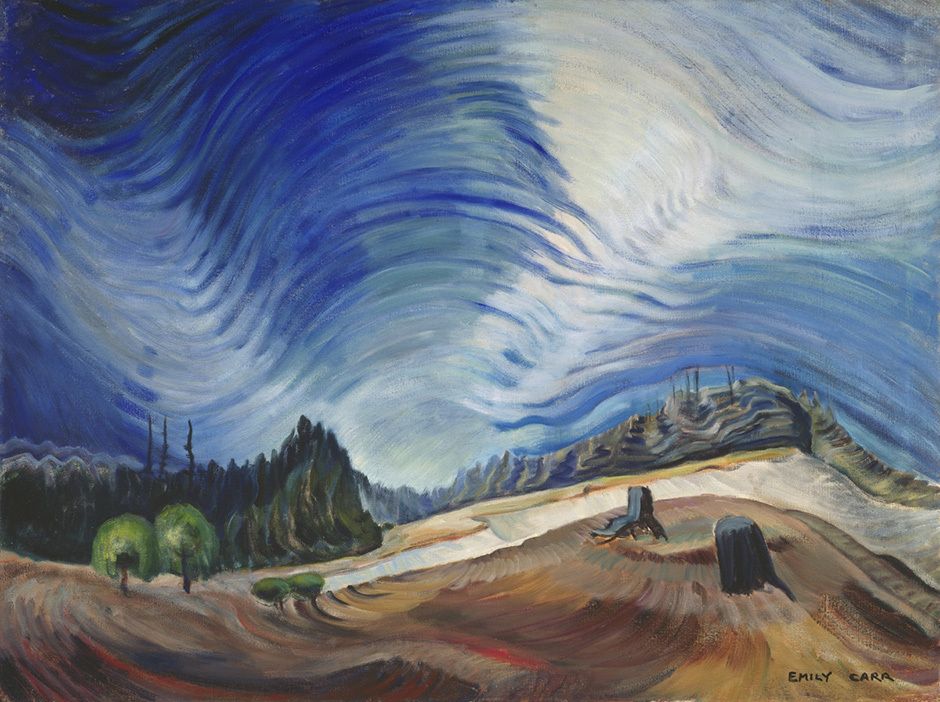
Carr's mature work is primarily known for two interwoven themes: native totem poles set in deep forest locations or sites of abandoned villages and the large rhythms of Western forests, driftwood-tossed beaches and expansive skies. She blended these themes in ways uniquely her own, constructing a new understanding of Cascadia. After visiting the Gitksan village of Kitwancool in the summer of 1928, Carr became interested in the maternal imagery in Pacific Northwest Indigenous totem poles, and her paintings began to reflect these images of mother and child. Her painting can be divided into several distinct phases: her early work before Paris. Her early paintings under Fauvist influence. A Post-Impressionist middle period. And her later, formal period under the cubist influences of Lawren Harris and Mark Tobey. For sketching, she used charcoal and watercolour, and from 1932 often used house paint thinned with gasoline on manila paper. Her major paintings were typically executed in oil on canvas or, when money was scarce, oil on paper.
Emily Carr was a vivid writer and chronicler of life in her surroundings, praised for her complete candour and strong prose. Her first book, Klee Wyck, was published in 1941 and won the Governor General's Literary Award for non-fiction. This book and others written by her or compiled from her writings are still much in demand today. Her writings were compiled from her journals and stories.
- Klee Wyck (1941), Governor General's Award winner
- The Book of Small (1942)
- The House of All Sorts (1944)
Legacy and honours
Emily Carr's legacy as a Canadian figure is firmly established, with scholars and the public regarding her as a national treasure. The Canadian Encyclopedia describes her as a Canadian icon, and one scholar noted in 2014 that 'we love her and she continues to speak to us.' Her work remains relevant to contemporary artists, such as Korean Canadian artist Jin-me Yoon, who referenced Carr's painting Old Time Coast Village in her 1996 work A Group of Sixty-Seven. Carr's paintings are held in major institutions across Canada, and her books remain in print and widely read. She is remembered as a pioneering modernist painter who helped define a uniquely West Coast aesthetic and as a gifted writer. Significant posthumous recognitions and namesakes include her designation as a National Historic Person by the Government of Canada and her childhood home being declared a National Historic Site of Canada. The minor planet 5688 Kleewyck is named after her anglicized Indigenous name, and a substantial collection of her work resides at the Vancouver Art Gallery stemming from her 1942 donation. Her papers, including her 'Lecture on Totems', are held at the British Columbia Provincial Archives in Victoria, and she is consistently featured in major exhibitions and scholarly works on Canadian art.
Questions about Emily Carr
What is Emily Carr most famous for?
Emily Carr is most famous for her powerful paintings of First Nations totem poles and the forests of British Columbia. She was a pioneering modernist artist who introduced Post-Impressionist styles to Canada's West Coast. She was a celebrated writer, winning the Governor General's Literary Award in 1941 for her first book, Klee Wyck. Her work is cherished for capturing the spirit and scenery of the Pacific Northwest.
What was Emily Carr's connection to the Group of Seven?
Emily Carr met the Group of Seven in 1927 during an exhibition in Ottawa. Lawren Harris became her mentor and friend, inviting her to contribute to their exhibitions in 1930 and 1931. This association ended a period of artistic isolation for Carr and influenced her work, encouraging her to focus on the spiritual essence of the West Coast scenery. While never an official member, she is closely associated with the group.
What did Emily Carr write?
Emily Carr authored several books, primarily later in life when heart problems limited her painting. Her first and most famous book, Klee Wyck (1941), is a collection of stories about her experiences in First Nations communities and won the Governor General's Literary Award. Other books include The Book of Small, The House of All Sorts, and Growing Pains, an autobiography. Her writing is praised for its strong, candid prose.
What health problems did Emily Carr have?
Emily Carr suffered from serious heart problems in her later years. She experienced her first heart attack in 1937, followed by others in 1939 and 1942. These health issues forced her to move in with her sister to recover and significantly limited her ability to travel and paint, which led her to focus on writing. She died from a heart attack on March 2, 1945, in Victoria.
Where can I see Emily Carr's paintings?
Emily Carr's paintings are held in major Canadian institutions, most notably the Vancouver Art Gallery, which received a donation of close to 170 paintings from the artist herself in 1942. Her work was also included in exhibitions at the National Gallery of Canada in Ottawa, such as the 1927 West Coast art exhibition, and she had a solo show at the Women's Art Association of Canada gallery in Toronto in 1935. Her first annual solo exhibition was held at the Vancouver Art Gallery in 1938, and she achieved success at the Tate Gallery in London, England. Her childhood home in Victoria, the Emily Carr House, is a museum and National Historic Site of Canada.
Why is Emily Carr considered a Canadian icon?
Emily Carr is considered a Canadian icon because she is a cherished and revered figure of Canadian arts and letters, regarded as a national treasure. The Canadian Encyclopedia explicitly describes her as a Canadian icon. Her stature as one of Canada's most important artists has grown over time, with scholars and the public alike holding her in high esteem for her paintings inspired by First Nations art and British Columbia landscapes, as well as for her vivid writing. This well-known status is further cemented by honours such as being designated a National Historic Person and having a minor planet, 5688 Kleewyck, named after her.
Sources and further reading
- Emily Carr (Wikipedia)
- Get to Know Emily Carr (vanartgallery.bc.ca)
- Emily Carr: Painter of the Canadian Wild (artismagic.online)
- Emily Carr… Victoria's free-spirited writer and painter (notesonaboardingpass.com)
Checked by the Yadude Books desk. Last updated 2026-11-03.