Grey Owl
Archibald Stansfeld Belaney, widely known as Grey Owl, was a prominent Canadian writer, public speaker, and conservationist who achieved international fame in the 1930s. Born in England, he reinvented himself as a man of Indigenous heritage, claiming to be the son of a Scottish father and an Apache mother to lend authenticity to his voice. His books, articles, and lecture tours passionately advocated for wilderness preservation and the protection of the beaver, which he argued was being hunted to extinction. While his fraudulent identity was exposed shortly after his death, his work left a significant mark on early environmental thought in Canada and beyond.
Early life and immigration
Archibald Stansfeld Belaney was born on September 18, 1888, in Hastings, England, into an upper-middle-class family. His father, George Belaney, had immigrated to the United States with his first wife and her sister Kittie, who became George's second wife and Archie's mother after the first wife's death. George returned to England only briefly for Archie's birth before departing again, leaving the boy in the permanent care of his grandmother and two aunts, Ada and Carry. Belaney attended Hastings Grammar School, where he was a withdrawn student but excelled in subjects like English, French, and chemistry, and was known for pranks involving homemade explosives he called 'Belaney Bombs'. His childhood was marked by a deep fascination with the Indigenous peoples of North America, fuelled by reading and leading to elaborate games where he called himself 'Big Chief Thunderbinder' and prepared detailed maps of tribal territories. After a brief and disastrous stint as a clerk in a lumber yard, which he ended by nearly destroying the building with fireworks, he secured permission to move to Canada at age 18, ostensibly to become a farmer. He boarded the SS Canada on March 29, 1906, arrived in Halifax on April 6, and promptly made his way to Toronto, where he worked briefly in a retail shop with no intention of pursuing agriculture.
Adopting a bush life and constructing an identity
Belaney quickly left Toronto for Lake Temagami in northern Ontario, drawn to the wilderness and the Teme-Augama Anishnabai community. He worked as a chore boy at the Temagami Inn and befriended a young Ojibwe woman named Angele Egwuna, who spoke little English. Through her family, he spent the winter of 1909 to 1910 trapping in the bush east of Lake Temagami, learning how the Ojibwe managed hunting territories by taking only what was needed. Her uncle gave him the nickname 'ko-hom-see' or little owl, a precursor to his later persona. His proficiency in the Ojibwe language and bush skills improved greatly during this period. He married Angele in a Christian ceremony on Bear Island on August 23, 1910, and their daughter Agnes was born in the spring of 1911. By this period, Belaney had begun crafting the fiction that he was the son of a Scottish man and an Apache woman from Mexico, fully shedding his English identity for his new life. He worked as a forest ranger and trapper around Biscotasing from 1912, where he began a relationship with Marie Girard, a Métis woman who joined him on his trapline during the winter of 1913 to 1914, before enlisting to fight in the First World War in June 1915.
War service and return to Canada
Belaney enlisted with the Canadian Overseas Expeditionary Force on May 6, 1915, and served as a sniper with the 13th Battalion (Royal Highlanders of Canada) in France. His fellow soldiers accepted his assumed Indigenous identity, with one noting he could move in ways 'no white man could'. He was wounded in the right wrist in January 1916 and then shot in the right foot on April 23, 1916, a serious injury from which he never fully recovered, later requiring the amputation of a toe. Convalescing in a Canadian Military Hospital in Hastings from November 1916, he renewed a childhood friendship with Ivy Holmes, a 26-year-old professional dancer. He married her on February 10, 1917, without disclosing his existing marriage and child in Canada. He returned to Canada that September, was discharged due to his injuries in November 1917, and ended his correspondence with Ivy a year later after finally admitting the truth, leading to divorce in 1922. Back in Biscotasing, he gained a reputation for drunk and disorderly conduct but also deepened his wilderness skills, living with the Indigenous Espaniel family for two winters at Indian Lake. He learned what Jim Espaniel called the 'Indian way of doing things', which white men called conservation. He worked as a deputy forest ranger on the Mississagi Forest Reserve during the summers of 1920 and 1921, where he posted homemade signs reading 'GOD MADE THIS COUNTRY FOR THE TREES DON’T BURN IT UP' in an early attempt at conservation advocacy.
Meeting Anahareo and the turn to conservation
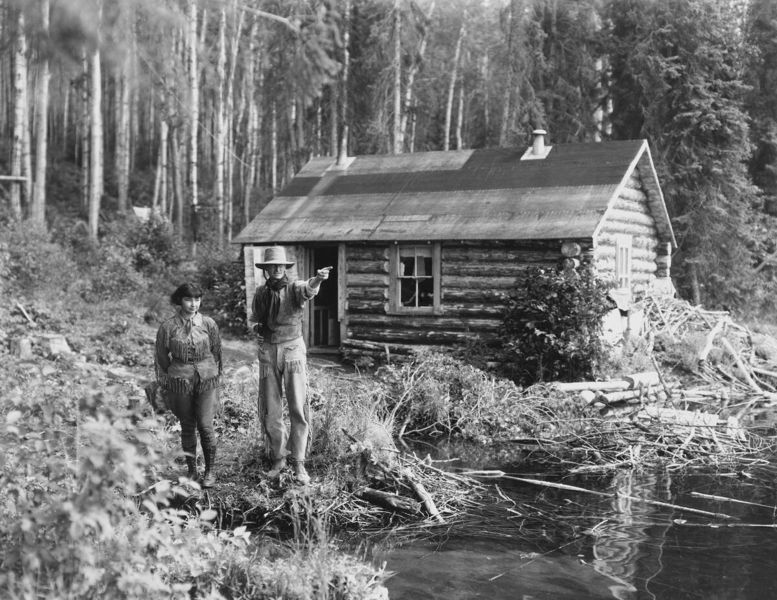
The transformation in Belaney's life began in the late summer of 1925 when he met 19-year-old Gertrude Bernard, an Algonquin and Mohawk woman who would become known as Anahareo, at Camp Wabikon on Temagami Island where he was guiding. He told her father he came from Mexico, the son of a Scotch father and an Apache mother, and she believed this story until his death. They began a relationship, and in February 1926 she joined him near Doucet in the Abitibi region of Quebec where he was trapping. Their courtship was eventful, with Anahareo later claiming she once stabbed him with a knife. Due to his undissolved marriage to Angele Egwuna, they could not legally marry, but the chief of the Lac Simon Band of Indians declared them husband and wife. In the winter of 1926 to 1927, she accompanied him on his trapline and was horrified by the suffering of animals in leg-hold traps. A specific episode, later recounted in Pilgrims of the Wild, involved him trapping a mother beaver. Moved by the cries of her orphaned kittens, which resembled human infants, and after Anahareo's pleas, he rescued the babies. The couple adopted the beaver kits, naming them McGinnis and McGinty. This experience led Belaney to abandon trapping and commit to studying and protecting wildlife instead. They moved to the Lake Témiscouata area in southeastern Quebec in 1928 with the aim of starting a beaver sanctuary, building a cabin on Birch Lake. Their plan was thwarted when a friend, David White Stone, unaware of their project, trapped the beavers intended for the colony, and their own adopted beavers later disappeared.
Literary career and rise to fame
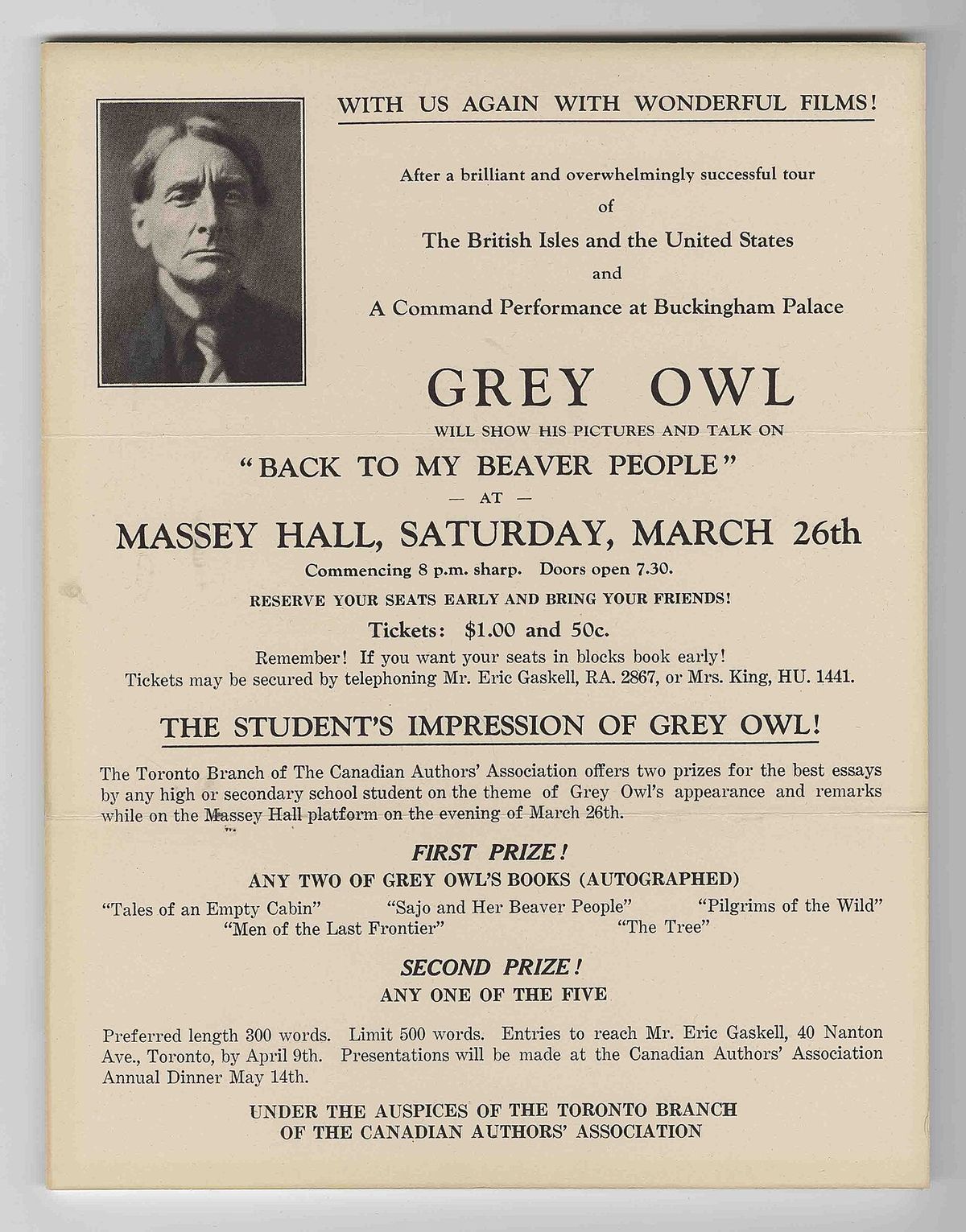
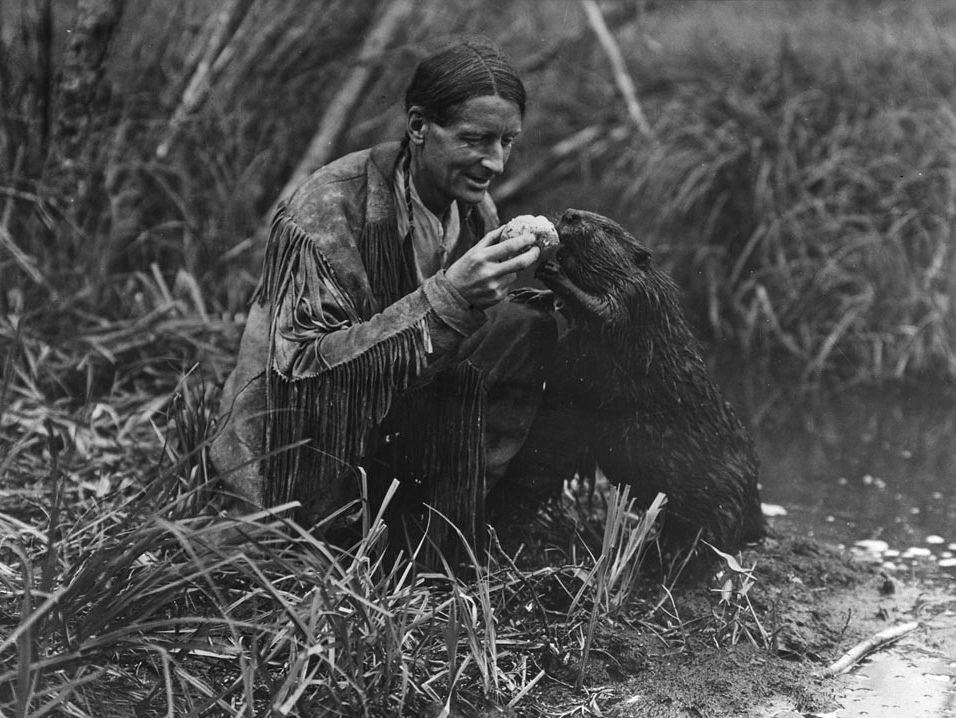
Belaney's literary career was launched when his mother, Katherine Scott-Brown, submitted his article 'The Passing of the Last Frontier' to the British magazine Country Life, which published it on March 2, 1929, initially attributing it to her. A correction later identified the author as her son, Archibald Stansfeld Belaney. The article's success led to a book contract, and in 1931 his first book, The Men of the Last Frontier, was published under the name Grey Owl. The book's foreword presented him as a 'half-breed Indian' born near the Rio Grande, cementing his public persona. His growing fame led to appointments with the Dominion Parks Branch. In 1931, he was named 'caretaker of park animals' at Riding Mountain National Park in Manitoba, and later that year he and Anahareo, with new pet beavers Jelly Roll and Rawhide, moved to a cabin on Ajawaan Lake in Prince Albert National Park in Saskatchewan. While living at Prince Albert, Grey Owl wrote his three most famous books, all of which became bestsellers, particularly in Britain. Pilgrims of the Wild (1934) recounted his conversion from trapper to conservationist and his life with Anahareo. The Adventures of Sajo and her Beaver People (1935) was a children's story based on their beaver experiences, and Tales of an Empty Cabin (1936) was a collection of essays. His work and his compelling stage presence made him a celebrity. He undertook two highly successful lecture tours of Britain in 1935 and 1937, drawing large audiences with his message of wilderness preservation and his performed Indigenous identity. He also produced several short films about beavers and wilderness life for the National Parks Service, working with directors like Bill Oliver and Gordon Sparling. His central conservation philosophy, repeated in lectures and writings, was 'Remember you belong to nature, not it to you.' He argued that the exploitation of nature, particularly through the fur trade and logging, had dire consequences for wildlife like the beaver and for humanity itself. His message found a receptive audience in 1930s Britain, where he was seen as an authentic voice from the Canadian wild.
- The Men of the Last Frontier (1931), His first book, a blend of memoir and naturalist writing on the vanishing wilderness.
- Pilgrims of the Wild (1934), An autobiographical account of his turn to conservation with Anahareo.
- The Adventures of Sajo and her Beaver People (1935), A children's novel about a girl and her beavers.
- Tales of an Empty Cabin (1936), A collection of wilderness essays and stories.
Exposure, death, and posthumous reassessment
Grey Owl died of pneumonia on April 13, 1938, in Prince Albert, Saskatchewan. On the very day of his death, the North Bay Nugget published an article exposing his true identity as Englishman Archibald Belaney. The story was rapidly picked up by newspapers across Canada and Britain, shocking the public, his publishers, and his employers in the parks service. His conservation work was largely overshadowed by the scandal of his fraud, and he was quickly labelled an imposter. In the decades that followed, his legacy became a subject of controversy, acknowledging both his significant early environmental advocacy and his harmful cultural appropriation. He had presented a romanticized, stereotypical image of Indigeneity that falsely positioned him as a spokesperson for Indigenous peoples at a time when actual Indigenous communities faced severe discrimination and were barred from accessing their traditional territories within parks like Prince Albert. Anahareo, who had believed his story, became a conservationist and author in her own right, publishing her memoir Devil in Deerskins: My Life with Grey Owl in 1972. She was an accomplished prospector and canoeist, able to paddle the interconnected waterways from Prince Albert National Park to Flin Flon, Manitoba. She was inducted into the Order of Canada in 1983 for a lifetime of work in animal rights, campaigning against the leg-hold trap and wolf poisoning. A renewed interest in Grey Owl emerged in the early 1970s with new editions of his books and a CBC documentary in 1972. Several biographies were published in the 1990s, including works by Donald B. Smith, Armand Garnet Ruffo, and Jane Billinghurst. In 1999 director Richard Attenborough released a fictionalized film biography starring Pierce Brosnan. Grey Owl, Anahareo, and their adopted daughter Shirley Dawn are all buried near their cabin on Ajawaan Lake in Prince Albert National Park.
Filmography and media portrayals
Grey Owl was involved in creating several short documentary films, primarily about beavers, during his time with the National Parks Service. These films helped visualize his conservation message for broader audiences and were part of his work as a park employee. After his death, his life story became the subject of documentaries and a major dramatic film. The 1972 CBC documentary 'Grey Owl' revisited his story and legacy. The most prominent portrayal was the 1999 feature film 'Grey Owl', directed by Richard Attenborough and starring Pierce Brosnan in the title role. This Hollywood production brought his complex story to a new international audience, though it took significant dramatic license with the historical facts. The film contributed to a renewed, if contested, public memory of his life and work.
| Title | Year | Director | Notes |
|---|---|---|---|
| The Beaver People | 1928 | Bill Oliver | Short film |
| The Beaver Family | 1929 | Bill Oliver | Short film |
| Grey Owl's Little Brother | 1932 | Gordon Sparling | Short film |
| Strange Doings in Beaverland | 1932 | Bill Oliver | Short film |
| Grey Owl's Neighbours | 1934 | Bill Oliver | Short film |
| Grey Owl's Strange Guests | 1934 | Gordon Sparling | Short film |
| Pilgrims of the Wild | 1935 | Bill Oliver | Short film |
| The Trail, Men Against the Snow | 1937 | Grey Owl | Short film |
| The Trail, Men Against the River | 1937 | Grey Owl | Short film |
| Grey Owl | 1972 | Nancy Ryley (CBC) | Documentary |
| Grey Owl | 1999 | Richard Attenborough | Feature film starring Pierce Brosnan |
Personal relationships and family
Belaney's personal life was complex and marked by a series of failed relationships and abandoned responsibilities. His first marriage was to Angele Egwuna in 1910, with whom he had a daughter, Agnes, in 1911. He left her for extended periods, and after a warrant was issued for his arrest in Biscotasing in 1925, he briefly returned to her in Temagami, where she bore a second daughter, Flora, in 1926, before he left her for the final time. His relationship with Marie Girard, which began around 1912, produced a son, John Jero, born in the fall of 1915 shortly after Marie died of tuberculosis. Belaney made little effort to connect with this son. His marriage to Ivy Holmes in 1917 was based on deception, as he hid his existing family, and ended in divorce in 1922 after he confessed in a letter. His most enduring partnership was with Gertrude Bernard (Anahareo), beginning in 1925. They lived together until 1936 and adopted a daughter, Shirley Dawn. Anahareo's influence was directly responsible for his shift from trapping to conservation. His aunts in England were furious with his treatment of Angele and Ivy, calling it 'nothing less than diabolical'. This pattern of behaviour created a personal life of chaos that contrasted sharply with the principled public image he cultivated as Grey Owl.
Questions about Grey Owl
Who was Grey Owl really?
Grey Owl was the public persona of Archibald Stansfeld Belaney, a man born in Hastings, England, on September 18, 1888. He immigrated to Canada as a young man and fabricated an Indigenous identity, claiming to be the son of a Scottish father and an Apache mother from Mexico. He maintained this false identity throughout his career as a writer and conservationist until it was exposed by the North Bay Nugget newspaper immediately after his death in April 1938. His early life in England was marked by a fascination with Indigenous cultures and a difficult family situation, being raised largely by his aunts.
What was Grey Owl famous for?
Grey Owl achieved fame in the 1930s as a bestselling author and compelling public speaker who championed wilderness conservation. He is particularly noted for his passionate advocacy to protect the beaver, which he argued was being hunted to extinction in Canada. His books, including The Men of the Last Frontier and Pilgrims of the Wild, and his successful lecture tours in Britain and Canada made him one of the country's first internationally recognized conservationists. His work for the Dominion Parks Branch at Riding Mountain and Prince Albert National Parks, where he cared for beavers, also contributed to his public profile.
What was Grey Owl's connection to Canada's national parks?
In 1931, Grey Owl was appointed by the Dominion Parks Branch as the 'caretaker of park animals'. He first worked at Riding Mountain National Park in Manitoba before moving that same year to Prince Albert National Park in Saskatchewan. He lived in a cabin on Ajawaan Lake within the park, where he wrote several of his books, hosted hundreds of visitors, and cared for his pet beavers, Jelly Roll and Rawhide, as part of a beaver conservation and public education program. His presence was a major attraction for the park during the 1930s.
Who was Anahareo and what was her role?
Anahareo was the name used by Gertrude Bernard, a Mohawk and Algonquin woman from Mattawa, Ontario, who became Grey Owl's common-law wife in 1926. She played a crucial role in his life by convincing him to stop trapping after she witnessed the suffering of animals in leg-hold traps during the winter of 1926 to 1927. Her influence led directly to his conversion to conservationism, exemplified by the rescue of beaver kittens McGinnis and McGinty. She was an accomplished prospector, canoeist, and later a published author and animal rights activist who was inducted into the Order of Canada in 1983 for her campaigns against the leg-hold trap.
How and when was Grey Owl's true identity revealed?
Grey Owl's true identity was exposed on the day of his death, April 13, 1938. The North Bay Nugget newspaper published an article revealing he was actually Englishman Archibald Belaney, not an Indigenous man as he had claimed for over two decades. The story was quickly disseminated by other newspapers across Canada and Britain, causing a public scandal and temporarily overshadowing his conservation work. Many Indigenous people who had met him had held suspicions about his ancestry claims, but the general settler public and his employers were shocked by the revelation.
What is Grey Owl's legacy today?
Grey Owl's legacy is complex and dualistic. He is recognized as a pioneering voice for wilderness conservation in Canada, credited with raising early awareness about protecting species like the beaver and promoting the idea that humans belong to nature. Simultaneously, he is a controversial figure due to his extensive cultural appropriation and fraud, which involved falsely representing himself as an Indigenous spokesperson at a time when real Indigenous communities faced severe discrimination. His life has been the subject of numerous biographies, academic studies, and a 1999 feature film, ensuring his story remains a part of Canadian cultural and environmental history.
Sources and further reading
- Grey Owl (Wikipedia)
- Archibald Belaney (Grey Owl) (thecanadianencyclopedia.ca)
- Grey Owl: Canada's great conservationist and imposter (bbc.com)
- Archibald Belaney and Gertrude Bernard (Grey Owl and ... (parks.canada.ca)
Checked by the Yadude Books desk. Last updated 2026-10-26.