John Buchan
John Buchan, 1st Baron Tweedsmuir, was a prolific Scottish author, historian, and statesman who served as the 15th Governor General of Canada from 1935 until his death in 1940. He is best known internationally as the writer of the classic spy thriller The Thirty-Nine Steps, which introduced the character Richard Hannay and has remained continuously in print for over a century. His appointment as viceregal representative marked a significant period in Canadian constitutional history, as he was the first Governor General chosen after the Statute of Westminster granted Canada greater autonomy. Buchan, who took his title from the Scottish River Tweed, was deeply committed to promoting Canadian unity, sovereignty, and cultural life during his tenure.
Early Life and Literary Beginnings
John Buchan was born in Perth, Scotland, the eldest son of a Free Church of Scotland minister. He spent formative childhood summers with his maternal grandparents in Broughton in the Scottish Borders, where he developed a lifelong love for walking and the local landscape, elements that would later permeate his novels. His family moved to Glasgow, where he attended Hutchesons' Boys' Grammar School before winning a scholarship to the University of Glasgow at age seventeen. There he studied classics under Gilbert Murray and began his career as a published author. Buchan continued his education at Brasenose College, Oxford, where he won the prestigious Stanhope Essay Prize in 1897 and the Newdigate Prize for poetry in 1898, while also serving as president of the Oxford Union. By the time he graduated in 1900, he had already published six works, including his first adventure novel, John Burnet of Barns, in 1898.
After Oxford, Buchan was called to the Bar at the Middle Temple in June 1901. His legal career was brief, as he soon travelled to South Africa in September 1901 to serve as private secretary to Alfred Milner, the High Commissioner for Southern Africa, during the reconstruction following the Boer War. This experience provided him with intimate knowledge of the country, which became a prominent setting in novels like Prester John (1910). He returned to London in 1903, resuming his work as a barrister and journalist. In December 1906, he joined the publishing firm Thomas Nelson & Sons and also served as a deputy editor for The Spectator. He married Susan Charlotte Grosvenor, a cousin of the Duke of Westminster, in July 1907, and the couple eventually had four children.
First World War and Literary Fame
The outbreak of the First World War in 1914 marked a crucial period in Buchan's life, blending his literary output with government service. Though rejected for active military service due to a duodenal ulcer, he began writing a multi-volume contemporary history of the war for Nelson's publishers, which would eventually span 24 volumes. He also worked in the Foreign Office and served as a war correspondent in France for The Times in 1915. It was during this time, while recovering from illness, that he wrote his most famous novel, The Thirty-Nine Steps, published in 1915. The book introduced the adventurous hero Richard Hannay, a character partly based on his friend from South Africa, General Edmund Ironside. The novel's success was immediate, and a sequel, Greenmantle, followed in 1916.
Recognising his talents in communication, the British government appointed Buchan to the Intelligence Corps in 1916, where he was commissioned as a second lieutenant and tasked with drafting official communiques. In 1917, the War Cabinet under David Lloyd George made him Director of Information, leading Britain's propaganda efforts. The following year, he became head of the Department of Intelligence within the newly formed Ministry of Information, reporting to the Canadian-born minister, Lord Beaverbrook. Throughout this demanding period, Buchan continued to write his history of the war and produce novels, demonstrating a formidable capacity for work. His wartime experiences in intelligence and propaganda provided rich material for his thrillers and shaped his understanding of information and public morale, skills he would later employ in Canada.
Political Career and Public Life
After the war, Buchan maintained a diverse public career encompassing politics, historical writing, and cultural patronage. He moved to Elsfield, Oxfordshire, in 1920 and became president of the Scottish Historical Society and a trustee of the National Library of Scotland. In a 1927 by-election, he was elected as a Unionist Party Member of Parliament for the Combined Scottish Universities, a seat he held until 1935. In Parliament, he was an early advocate for the establishment of a public film body akin to the BBC, and in 1933 he was appointed among the first nine Governors of the newly formed British Film Institute. Buchan also served King George V as Lord High Commissioner to the General Assembly of the Church of Scotland in 1933 and 1934. His political views evolved over time, and he described himself as becoming a 'Gladstonian Liberal' in his later years.
Buchan was also a vocal supporter of Zionism from 1930 onward, actively condemning the treatment of Jews in Nazi Germany and speaking at events for the Jewish National Fund. His name was inscribed in the Fund's Golden Book, and a contemporary Nazi publication listed him for his 'Pro-Jewish activity'. While some literary critics have debated attitudes expressed by characters in his early novels, his later public actions and writings demonstrated strong support for a Jewish homeland. In recognition of his contributions to literature and public service, King George V granted him induction into the Order of the Companions of Honour on 1 January 1932.
Major Literary Works and Adaptations
John Buchan was an extraordinarily prolific writer, authoring over one hundred books across multiple genres including thrillers, historical novels, biographies, and poetry. His literary output is often categorized by his most popular adventure novels and his scholarly historical works. His books have never gone out of print, and as of 2026, the Ottawa Public Library's online catalogue still holds 21 of his titles. The Guardian newspaper ranks The Thirty-Nine Steps 42nd on its list of the 100 best novels written in English. Buchan's adventure novels, many featuring the recurring hero Richard Hannay, are celebrated for their swift pace and detailed plots. He also authored respected biographies of figures such as Sir Walter Scott, Oliver Cromwell, and Augustus. His work was adapted for cinema during his lifetime, most notably by Alfred Hitchcock's 1935 film The 39 Steps, which starred Robert Donat, though the plot diverged significantly from the book.
- The Thirty-Nine Steps (1915), The first Richard Hannay thriller.
- Greenmantle (1916), A sequel set during the First World War.
- Mr Standfast (1919), The third Hannay novel.
- Prester John (1910), An adventure novel set in South Africa.
- Midwinter (1923), A historical novel set during the Jacobite rising.
- The Three Hostages (1924), The fourth Hannay adventure.
Appointment and Tenure as Governor General
Buchan's path to Rideau Hall began with a friendship forged with future Canadian Prime Minister William Lyon Mackenzie King. The two met in London in 1919, and King was deeply impressed by Buchan's intellect and character. In 1924, King, then Prime Minister, hosted Buchan and his wife at his Kingsmere estate during their visit to Ottawa, further solidifying the relationship. When a successor to Governor General the Earl of Bessborough was needed in 1935, King, then Leader of the Opposition, recommended Buchan to King George V. The King insisted his representative be a peer, so Buchan was made a peer as Baron Tweedsmuir of Elsfield on 1 June 1935. His official appointment as Governor General was announced in the Canadian Parliament on 27 March 1935, and he was sworn in on 2 November 1935 in Quebec City.
Lord Tweedsmuir's tenure was historically significant as he was the first Governor General of Canada appointed after the 1931 Statute of Westminster, meaning the selection was made by the monarch of Canada on the advice of his Canadian ministers, affirming the country's growing sovereignty. He arrived in Canada just after Mackenzie King's Liberals had won the October 1935 election, and he worked closely with the Prime Minister. Tweedsmuir took his vice-regal duties with great seriousness, setting a goal to travel the length and breadth of Canada, including to the Arctic, to promote Canadian unity and identity. He was a strong advocate for Canadian culture, serving as the Champlain Society's honorary president from 1938 to 1939. His wife, Lady Tweedsmuir, was equally active, famously establishing the 'Lady Tweedsmuir Prairie Library Scheme', which distributed over 40,000 books to remote communities from Rideau Hall.
Later Years, Death, and Recognition
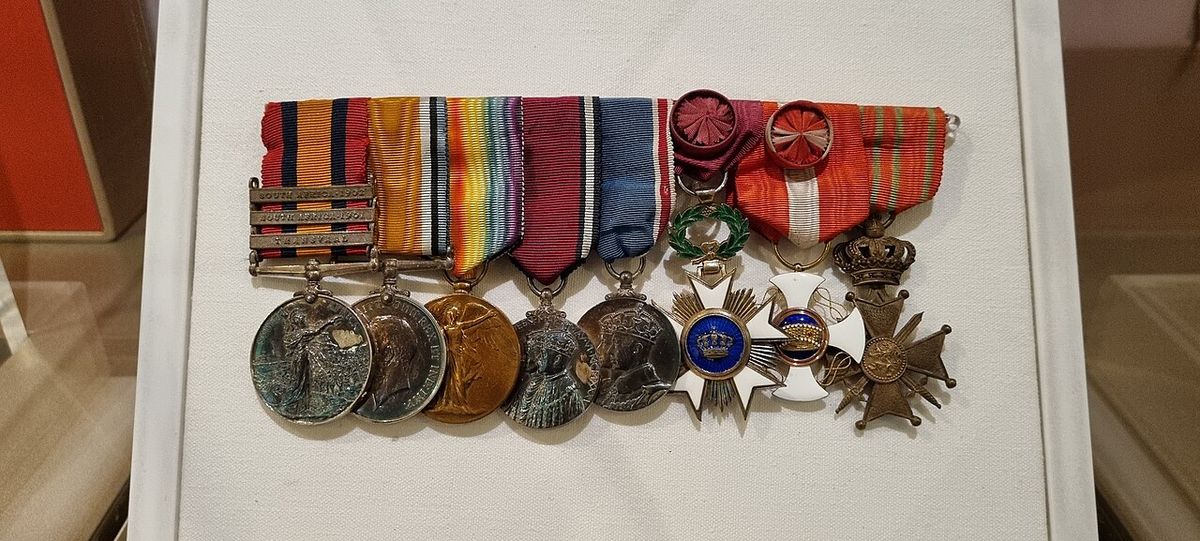
John Buchan maintained a strenuous workload throughout his time in Canada, continuing to write while fulfilling his official duties. His health, long plagued by duodenal ulcers, eventually failed. He died in office on 11 February 1940, becoming the first Governor General to die while in post since Confederation. Canada honoured him with a state funeral, following which his ashes were returned to the United Kingdom. His contributions were widely recognized by Canadian institutions, with several universities, including McGill, Toronto, and Montreal, conferring upon him honorary Doctor of Law degrees. Oxford University also made him an Honorary Fellow and awarded him an honorary Doctor of Civil Law.
Buchan's legacy is sustained by literary societies and ongoing scholarly interest. The John Buchan Society, founded to promote understanding of his life and works, continues to hold events, including one scheduled for 7 November 2026 at the Royal Canadian Military Institute in Toronto. His reputation as a writer endures, with new editions of his works, such as a 2026 release of Prester John, keeping his stories in circulation. Historians and biographers, like Bill Galbraith who authored John Buchan: Model Governor General in 2013, continue to examine his complex role as a writer, imperialist, and a governor general who helped shape modern Canadian identity during a critical pre-war period.
Selected Bibliography and Publications
John Buchan's published works span fiction, history, biography, and poetry. The following table lists a selection of his major books by year of publication, illustrating the breadth and volume of his output. Beyond his novels, Buchan's significant non-fiction includes his 24-volume Nelson's History of the War (1915 to 1919) and biographies like Sir Walter Scott (1932) and Oliver Cromwell (1934). His legal treatise, The Law Relating to the Taxation of Foreign Income, was published in 1905. The consistent republication of his works, including collected editions like The Complete Richard Hannay, attests to his enduring popularity.
| Year | Title | Genre/Notes |
|---|---|---|
| 1898 | John Burnet of Barns | First adventure novel |
| 1899 | A Lost Lady of Old Years | Historical novel (Jacobite period) |
| 1900 | The Half-Hearted | Novel |
| 1910 | Prester John | Adventure novel set in South Africa |
| 1915 | The Thirty-Nine Steps | First Richard Hannay thriller |
| 1916 | Greenmantle | Sequel to The Thirty-Nine Steps |
| 1919 | Mr Standfast | Third Richard Hannay novel |
| 1924 | The Three Hostages | Fourth Richard Hannay novel |
Questions about John Buchan
What is John Buchan most famous for?
John Buchan is most famous for writing the classic spy thriller The Thirty-Nine Steps, published in 1915. The novel introduced the character Richard Hannay and has never been out of print. It was famously adapted into a film by Alfred Hitchcock in 1935. Beyond this single work, Buchan was a prolific author of over one hundred books, including other adventure novels, histories, and biographies.
Was John Buchan involved in the First World War?
Yes, John Buchan was involved in the First World War. He wrote a multi-volume history of the war. He also served as a war correspondent for The Times in France in 1915. In 1917, he was appointed Director of Information, and in 1918 he became the head of a Department of Intelligence within the new Ministry of Information. He was also commissioned as a second lieutenant in the Intelligence Corps in 1916.
How is John Buchan remembered today?
John Buchan is remembered today as a major literary figure and a significant Governor General of Canada. Literary societies like The John Buchan Society promote his work and hold events, such as one scheduled in Toronto for November 2026. His novels, particularly The Thirty-Nine Steps, continue to be read and adapted. In Canada, he is recalled as a governor general who worked diligently to understand and unite the country during the late 1930s, leaving a lasting mark on its cultural and constitutional development.
What was John Buchan's role in Canada?
John Buchan served as the 15th Governor General of Canada from 1935 until his death in 1940. He was appointed to this vice regal position by King George V on the advice of Prime Minister R. B. Bennett and was raised to the peerage as Baron Tweedsmuir. Buchan was sworn in on 2 November 1935 in Quebec and was the first Governor General appointed after the Statute of Westminster, meaning the decision was made solely by the monarch in his Canadian council. He took his duties seriously, travelling extensively across Canada including to the Arctic to promote national unity. Buchan worked to strengthen Canada's constitutional and cultural sovereignty during his tenure.
Did John Buchan have a political career?
Yes, John Buchan had an active political career in the United Kingdom before becoming Governor General of Canada. He was elected as a Unionist Party Member of Parliament for the Combined Scottish Universities in a 1927 by election and held the seat until 1935. Buchan also served as King George V's Lord High Commissioner to the General Assembly of the Church of Scotland in 1933 and 1934. He was appointed among the first nine Governors of the British Film Institute after its formation in 1933, a role he held until 1935. His political views were of the Unionist Nationalist tradition, supporting Scotland's role within the British Empire and the United Kingdom.
What are some of John Buchan's other notable books?
Beyond The Thirty Nine Steps, John Buchan wrote over a hundred books across many genres. Notable adventure novels include Prester John (1910), set in South Africa, and Greenmantle (1916), a sequel to The Thirty Nine Steps featuring hero Richard Hannay. His historical fiction includes Midwinter (1923), set during the Jacobite era, and A Lost Lady of Old Years (1899). Buchan also produced significant non fiction, such as a multi volume History of the War about the First World War and biographies including one of former Governor General Lord Minto.
Sources and further reading
- John Buchan (Wikipedia)
- 07 Nov 2026 (johnbuchansociety.co.uk)
- Review: John Macnab by John Buchan | Scottish Classic (fictionfanblog.wordpress.com)
- John Buchan (booksfromscotland.com)
- Buchan's Talents Bedazzled Author (historicalsocietyottawa.ca)
Checked by the Yadude Books desk. Last updated 2026-10-28.