Max Aitken, 1st Baron Beaverbrook
William Maxwell Aitken, 1st Baron Beaverbrook, was a Canadian-born British newspaper publisher and politician who became one of the most influential media figures of the 20th century. He is a significant figure in Canadian history as a native of New Brunswick who leveraged his business acumen and political connections to achieve immense power in Britain. His legacy is defined by building the Daily Express into the world's largest circulation newspaper and serving as a crucial minister for industrial mobilisation during the Second World War. Beaverbrook remained a controversial yet powerful force in British media and politics, while maintaining strong ties to his Canadian roots through philanthropy and historical writing.
Early Life and Business Beginnings in Canada
Max Aitken was born in 1879 in Maple, Ontario, the son of a Presbyterian minister. When he was one year old, his family moved to Newcastle, New Brunswick, which he considered his hometown. His entrepreneurial spirit emerged early. At age 13 he founded a school newspaper called The Leader and worked delivering papers and selling subscriptions. His formal higher education was limited, as he left King's College Law School after a short time, marking the end of his academic pursuits. He worked in various roles including as a shop assistant, a life insurance salesman, and a debt collector in Chatham and Saint John, New Brunswick. He also attempted to train as a lawyer and worked briefly in the law office of R.B. Bennett, a future prime minister of Canada, managing Bennett's campaign for a seat on the Chatham town council.
Aitken's business career began in earnest in 1900 in Halifax, Nova Scotia, under the mentorship of John F. Stairs. Stairs trained him in finance and, in 1904, made him a minority shareholder and general manager of the newly launched Royal Securities Corporation. Following Stairs' unexpected death later that year, Aitken acquired control of the company and moved its operations to Montreal. There, he engineered a series of ambitious deals, founding the Montreal Engineering Company in 1907 and the Calgary Power Company Limited in 1909, which later became TransAlta Corporation and built the Horseshoe Falls hydro station. His most significant Canadian venture came in 1910 to 1911 when he amalgamated several regional cement plants, including Sir Sandford Fleming's plant at Exshaw, Alberta, into Canada Cement, gaining control of roughly four-fifths of the country's cement production. The consolidation faced criticism for irregularities in stock transfers and accusations of price-gouging, after which Aitken sold his shares for a large profit.
![Bust of Lord Beaverbrook, where his ashes are deposited, in the town square of Newcastle, Miramichi (IR Walker 2008)]]](/img/wiki/authors-and-books-max-aitken-1st-baron-beaverbrook-g1.jpg)
Move to Britain and Political Entry
After making his first visit in 1908, Aitken moved permanently to Britain in the spring of 1910, following a successful effort to amalgamate smaller steel units into the Steel Company of Canada with British capital. In Britain, he forged a crucial friendship with Andrew Bonar Law, another New Brunswick native who would become Prime Minister. With Law's support, Aitken stood for the Unionist Party in the December 1910 general election in Ashton-under-Lyne, winning the seat by 196 votes after a well-funded and energetic campaign that brought him some notoriety. He was knighted by King George V in 1911 for his promised financial support to the Unionist Party. Aitken's political influence grew as Bonar Law replaced A.J. Balfour as leader of the Unionist party late in 1911.
Aitken was a fervent advocate for Empire Free Trade, a protectionist bloc uniting the British Empire, a policy that was divisive within his own party due to the prospect of higher food prices. The great dividing line was between the 'Whole Hoggers' who accepted the idea and the 'Free Fooders' who opposed it. In 1912, he purchased all the grain terminals in Alberta, betting on the enactment of Imperial Preference tariffs. Concurrently, he began building his media empire, secretly investing £25,000 in the struggling Daily Express in January 1911 and later gaining a controlling interest in The Globe. He also purchased the Surrey estate Cherkley Court, which became a lavish venue for political entertaining and was offered in 1913 as a meeting place for negotiations between Bonar Law and Prime Minister H.H. Asquith over Irish home rule.
Intervention in Canadian Politics and Wartime Propaganda
In 1911, Aitken strongly opposed the reciprocity agreement with the United States signed by Canadian Prime Minister Sir Wilfrid Laurier, believing it threatened Canadian sovereignty. He temporarily returned to Canada to campaign for the Conservatives led by Sir Robert Borden. He enlisted his friend Rudyard Kipling to write a front-page appeal for the Montreal Daily Star on 7 September 1911, warning that Canada risked its own soul. Kipling's article was reprinted in every English-language Canadian newspaper that week and is credited with helping the Conservatives win the election. During the First World War, Aitken's organisational talents found a new outlet. He established the Canadian War Records Office in London and the Canadian War Memorials Fund, commissioning art from premier British and Canadian artists to document the war. He was innovative in employing artists, photographers and film-makers on the Western Front, at a time when British journalists were kept away by strict censorship.
He visited the front with an honorary colonel's rank in the Canadian Army and published the three-volume 'Canada in Flanders' in 1916. He became increasingly hostile to Prime Minister H.H. Asquith, whom he blamed for mismanaging the war, and his opinion worsened when Asquith blocked an attempt to secure a honour for him. After the failure of the Dardanelles campaign, Aitken offered sympathy to Winston Churchill, beginning a lifelong friendship where Aitken provided Churchill with contacts, information, and optimism. He played a minor role as a go-between in the political manoeuvrings that led to Asquith's replacement by David Lloyd George in December 1916, though he had wanted Bonar Law to take the premiership.
Peerage, Ministry of Information and Post-War Focus
In a complex political arrangement, Aitken agreed to resign his parliamentary seat so his friend Albert Stanley could take it and enter the cabinet. In return, Aitken was granted a peerage on 23 January 1917, becoming the 1st Baron Beaverbrook, a title derived from a community near his New Brunswick home after he rejected 'Lord Miramichi' on advice that it was too difficult to pronounce. In February 1918, he was appointed the first Minister of Information, responsible for propaganda in Allied and neutral countries, and was also made Chancellor of the Duchy of Lancaster and sworn of the Privy Council. His tenure was marked by conflicts with Foreign Secretary Arthur Balfour over control of intelligence and criticism from MPs wary of a press baron in government. He established the British War Memorials Committee but abandoned a related private charity scheme after conflict of interest concerns. He resigned in October 1918 due to a serious and often fatal throat infection called actinomycosis, which was cured by a Portuguese doctor administering iodine.
After the war, Lord Beaverbrook concentrated on running the Daily Express. He turned it from a dull publication into a glittering and witty journal with an optimistic attitude, filled with dramatic photo layouts and first-rate writers like Francis Williams and cartoonist David Low. He embraced new technology and bought new presses to print the paper in Manchester. The paper's circulation skyrocketed from under 40,000 daily in 1919 to 2.25 million by 1937, making it Britain's most successful newspaper and generating huge profits for Beaverbrook, whose wealth was already such that he never took a salary. His controlling stake in the Express had become public in 1917, drawing criticism from Conservatives who saw the paper as irresponsible.
- 1911: Campaigned against reciprocity, enlisted Kipling's help for Borden's Conservatives.
- 1916: Published 'Canada in Flanders' and fostered friendship with Churchill.
- December 1916: Involved in political manoeuvres leading to Asquith's fall.
- 23 January 1917: Created 1st Baron Beaverbrook.
- 10 February 1918: Appointed Minister of Information and Chancellor of the Duchy of Lancaster.
- October 1918: Resigned due to actinomycosis infection.
- Post-1918: Focused on building Daily Express circulation to 2.25 million by 1937.
Newspaper Empire and Global Circulation
Beaverbrook used the Express as a platform for his personal campaigns, most notably his long-standing advocacy for Empire Free Trade. His control expanded to include the Evening Standard and the Sunday Express. Beaverbrook never took a salary from his newspaper business, as his wealth from earlier ventures was already vast. He hired excellent writers and cartoonists, and his embrace of new printing technology allowed for national distribution that supported the paper's massive growth. The historian A.J.P. Taylor later wrote that Beaverbrook was a pathbreaker who invented all the methods of publicity used by Britain to promote the First World War, including the nation's first war artists, photographers, and film-makers.
His approach to newspaper management was hands-on and focused on appealing to a mass audience, particularly the conservative working class, with intensely patriotic news and editorials. He built the Daily Express into the most successful mass-circulation newspaper in the world, with sales of 2.25 million copies a day across Britain. The paper's success funded his political activities and ensured his public prominence for decades. He was widely disliked and distrusted by much of the political elite who sneered at 'press lords'. The Daily Express appealed to readers with its optimistic tone and array of dramatic photo layouts.
| Newspaper | Role | Key Detail | Peak Circulation |
|---|---|---|---|
| Daily Express | Proprietor | Secret investment 1911, control 1916 | 3,706,000 daily (post-WWII) |
| Evening Standard | Proprietor | Acquired later in career | Major London evening paper |
| Sunday Express | Proprietor | Launched by Beaverbrook | Part of Express group |
| The Globe | Controlling interest (1916) | London evening paper | Acquired for £17,500 |
| Canadian Century | Founder | Weekly magazine started 1910 | Early Canadian venture |
Second World War Service and Political Alliances
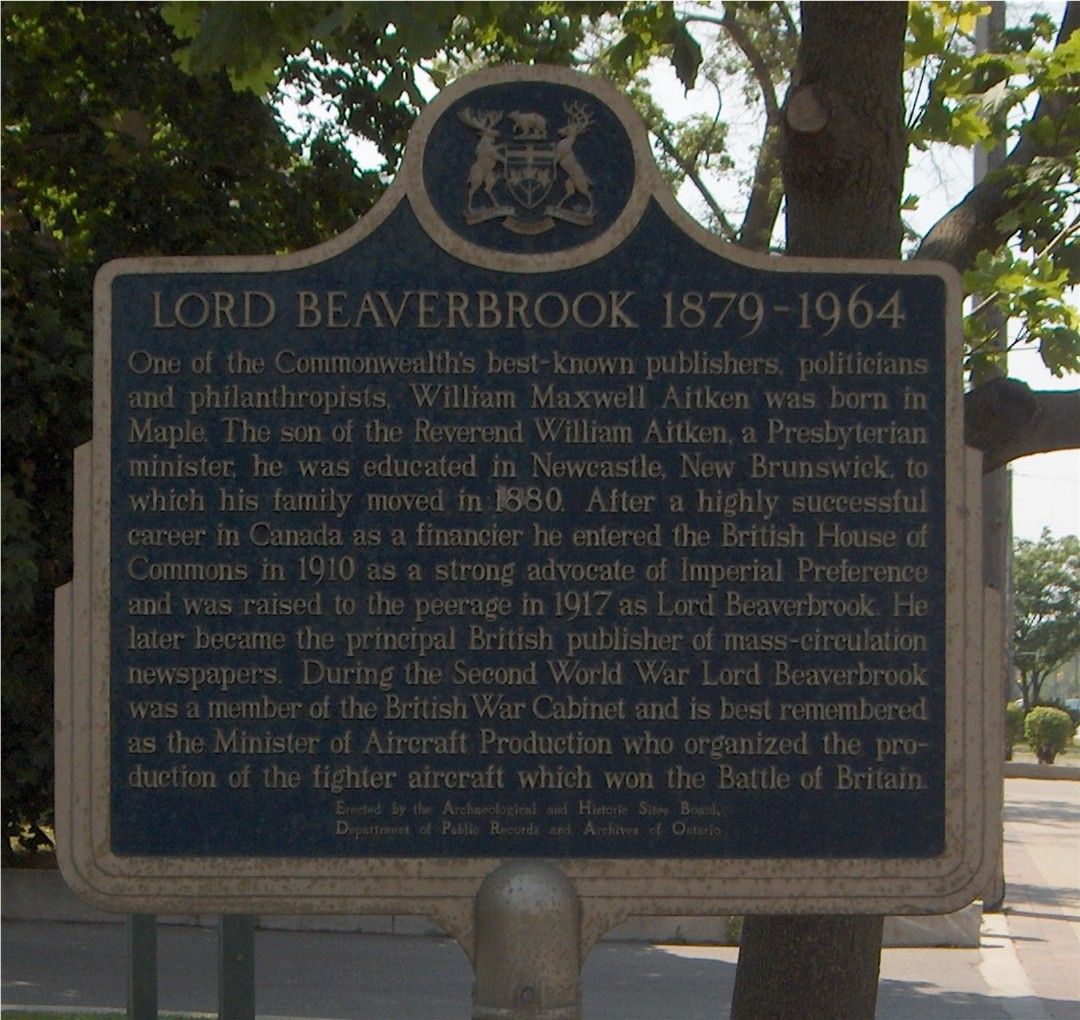
Despite supporting the governments of Stanley Baldwin and Neville Chamberlain in the 1930s, Beaverbrook was persuaded by his old friend Winston Churchill to join the war cabinet in May 1940 as Minister of Aircraft Production. In this critical role, he applied his formidable energy and organisational skills to mobilise Britain's industrial resources, dramatically increasing the output of fighter and bomber aircraft during the Battle of Britain and the Blitz. Churchill later praised his "vital and lively energy" for the war effort. Due to ill health, Beaverbrook resigned from the post in 1941, but later in the war he returned to government as Lord Privy Seal. His approach was characteristically forceful and unorthodox, bypassing bureaucracy to secure materials and streamline production, and he was especially effective in earlier years promoting the sales of war bonds to the general public.
This period represented the apex of his direct political power, moving from being a behind-the-scenes influencer to a central figure in the nation's survival. His success in this role remains one of his most celebrated contributions, overshadowing the controversies of his earlier political and business life. His relationship with Churchill, which began in 1915, endured despite volcanic quarrels, with Churchill coming to rely on him as a source of optimism, gossip, and reassurance. Beaverbrook's wartime service cemented his reputation as a man of action capable of delivering results under extreme pressure, and he allowed Churchill to stay at his house in Saint-Omer when Churchill went to the Western Front during the First World War.
Later Life, Historical Writings and Canadian Philanthropy
After the war, Beaverbrook returned to managing his newspaper empire. He also developed a reputation as a historian, authoring several books on political and military history, including 'Politicians and the Press' (1925) and 'Politicians and the War' (1928). He maintained strong connections to Canada, serving as Chancellor of the University of New Brunswick for many years. His philanthropic efforts in his home province were significant, including donations to the university and the Beaverbrook Art Gallery in Fredericton. He continued to entertain lavishly at Cherkley Court and remained an influential, though often contentious, voice in British public life until his death in 1964. His later life was spent running his newspapers and writing history, and he wrote that Empire Fiscal Union was his only reason for entering British politics and continuing in public life.
His legacy is preserved through his contributions to wartime history, his impact on British journalism, and his enduring philanthropic institutions in New Brunswick. The Beaverbrook Art Gallery and his support for the University of New Brunswick are lasting physical reminders of his origins. As a historian, he provided insider accounts of the political dramas he witnessed, contributing to the public understanding of the First World War and the press's role in politics. The British historian Neal Ascherson wrote that posh English society was no match for him, noting his charm in self-promotion and his skill in using wealth for hospitality and discreetly helping friends.
- 1925: Published 'Politicians and the Press'.
- 1928: Published 'Politicians and the War'.
- Served as Chancellor of the University of New Brunswick.
- Major donor to the Beaverbrook Art Gallery in Fredericton.
- Funded the Canadian War Memorials Fund art collection.
- Continued as newspaper proprietor until his death in 1964.
Business Ventures and Financial Methods
Before his fame as a press lord, Aitken was a financial prodigy in Canada. His early success came through the Royal Securities Corporation, where he specialised in mergers and capital reorganisations. His creation of Canada Cement in 1910 to 1911 demonstrated his knack for consolidation, though it attracted criticism for stock irregularities and accusations of price-gouging and poor management. He sold his shares for a substantial profit. His other foundational Canadian ventures included the Calgary Power Company and the Montreal Engineering Company, and he also developed business interests in Cuba and Puerto Rico. He started a weekly magazine, the Canadian Century, in 1910, invested in the Montreal Herald and almost acquired the Montreal Gazette.
In Britain, he continued to pursue business interests alongside politics. He built a significant shareholding in Rolls-Royce Limited between 1910 and 1912, buying Charles Rolls's shares, though he sold it in 1913 after Claude Johnson resisted his attempt to gain control. His secret investments in newspapers were ultimately his most lucrative and influential business decisions, creating a media empire that funded his political activities and ensured his public prominence for decades. His method involved using his wealth for strategic hospitality and discreetly helping grand friends with debts, which aided his social acceptance among British elites who found his self-promotion charming and fun. He was a millionaire by the age of 30, and his business ambitions quickly exceeded opportunities in Canada, prompting his move to Britain.
Questions about Max Aitken, 1st Baron Beaverbrook
Why is Lord Beaverbrook important to Canada?
Lord Beaverbrook is important to Canada as a native of New Brunswick who achieved extraordinary influence in Britain while maintaining strong ties to his homeland. He documented Canada's role in the First World War through the Canadian War Records Office and his book 'Canada in Flanders'. He served as Chancellor of the University of New Brunswick and was a major philanthropist, funding institutions like the Beaverbrook Art Gallery. His journey from a small Canadian town to the heart of British power remains a notable chapter in Canadian history. He also intervened directly in the 1911 Canadian election, campaigning against reciprocity and arranging for Rudyard Kipling's influential article.
What was Lord Beaverbrook's role in the Second World War?
During the Second World War, Lord Beaverbrook served as Winston Churchill's Minister of Aircraft Production from May 1940. In this crucial role, he used his dynamic energy and organisational skills to dramatically increase the production of fighter and bomber aircraft, playing a key part in mobilising Britain's industrial war effort during the Battle of Britain. He resigned due to ill health in 1941 but later served as Lord Privy Seal. His methods were unorthodox and effective, focusing on cutting bureaucracy to speed up production, which Churchill praised highly.
How did Max Aitken become Lord Beaverbrook?
Max Aitken was granted a peerage as Baron Beaverbrook on 23 January 1917. This title was a reward for his political support and a specific arrangement where he vacated his House of Commons seat for a ministerial colleague, Albert Stanley. He chose the name 'Beaverbrook' from a small community near his childhood home in New Brunswick, after rejecting 'Lord Miramichi' on advice that it was too difficult to pronounce. The name was intended to convey a distinctive Canadian ring to the title, marking his origins even as he entered the British House of Lords.
What was Empire Free Trade and why was it controversial?
Empire Free Trade was Lord Beaverbrook's lifelong political crusade for a protectionist trade bloc within the British Empire, with tariffs on goods from outside the empire. He believed this would strengthen imperial unity and economic independence. The policy was highly controversial, even within his own Conservative Party, because it would likely lead to higher food prices for the British public, derisively called 'food taxes' or 'stomach taxes'. It divided the party into 'Whole Hoggers' who supported it and 'Free Fooders' who opposed it. Beaverbrook used his newspapers to vigorously promote this cause for decades.
What were Beaverbrook's contributions to war propaganda and art?
Beaverbrook made major contributions to war propaganda and art in both world wars. In the First World War, he established the Canadian War Records Office and the Canadian War Memorials Fund, commissioning a large collection of art from leading British and Canadian artists. He was innovative in employing artists, photographers, and film-makers on the Western Front. Historian A.J.P. Taylor credited him with inventing all the methods of publicity Britain used, including the first war artists, photographers, and films. In 1918, as Minister of Information, he established the British War Memorials Committee on similar lines to document the war through art.
Sources and further reading
- Max Aitken, 1st Baron Beaverbrook (Wikipedia)
- Max Aitken, Lord Beaverbrook (thecanadianencyclopedia.ca)
- About Lord Beaverbrook (beaverbrookhouse.com)
Checked by the Yadude Books desk. Last updated 2026-11-02.