Michael Ignatieff
Michael Ignatieff is a prominent Canadian author, academic, and former politician who served as leader of the Liberal Party of Canada and leader of the Official Opposition from 2008 to 2011. A historian and public intellectual of international repute, he has held senior academic positions at prestigious institutions including the University of Cambridge, Harvard University, and the University of Toronto. Beyond politics, Ignatieff is widely known for his award-winning books on nationalism, human rights, and international affairs, as well as his work as a broadcaster and journalist. His career reflects a deep engagement with both Canadian identity and global ethical dilemmas, making him a significant figure in the nation's intellectual and political history.
Early life and education
Michael Grant Ignatieff was born in Toronto on May 12, 1947, into a family with a distinguished history in Canadian public service and Russian aristocracy. He was named after Lester "Mike" Pearson, a close friend of his parents, and his early childhood involved frequent moves abroad as his father, diplomat George Ignatieff, rose through the diplomatic ranks. His mother was Jessie Alison Grant, and his maternal uncle was the influential conservative philosopher George Grant, author of Lament for a Nation, creating a family environment steeped in political and intellectual discourse. His paternal grandfather was Count Paul Ignatieff, the Russian minister of education during the First World War, and his great-aunt Alice Parkin Massey was married to Governor General Vincent Massey. At age 11, he was sent back to Toronto to attend Upper Canada College as a boarder, where he was elected a school prefect as head of Wedd's House, captained the varsity soccer team, and served as editor-in-chief of the school yearbook.
Ignatieff's political involvement began early, as he volunteered for the Liberal Party during the 1965 federal election by canvassing in the riding of York South. He resumed this work in 1968 as a national youth organizer and delegate for Pierre Trudeau's leadership campaign. He pursued undergraduate studies in history at the University of Toronto's Trinity College, graduating with a Bachelor of Arts in 1969 and meeting future political figure Bob Rae, who was a debating opponent and his fourth-year roommate. While an undergraduate, he worked as a part-time reporter for The Globe and Mail in 1964 and 1965. He then continued his studies at the University of Oxford, where he was influenced by the liberal philosopher Sir Isaiah Berlin, whom he would later write about in a biography. Ignatieff completed his Doctor of Philosophy in history at Harvard University in 1976, and was granted a Cambridge M.A. by incorporation in 1978 upon taking up a fellowship at King's College there.
Academic and literary career before politics
Ignatieff began his academic career as an assistant professor of history at the University of British Columbia from 1976 to 1978. He then moved to the United Kingdom, where he held a senior research fellowship at King's College, Cambridge, until 1984 before moving to London to focus on writing and journalism. During this period he established himself as a versatile writer and broadcaster, becoming well known for his work on British television and radio, including the BBC discussion programme Thinking Aloud and The Late Show, and he served as an editorial columnist for The Observer from 1990 to 1993. His early written work demonstrated a range spanning history, biography, fiction, and journalism, earning him a reputation as a leading public intellectual who was named among Maclean's "Top 10 Canadian Who's Who" in 1997 and one of the "50 Most Influential Canadians" in 2002, and the magazine also named him Canada's "Sexiest Cerebral Man" in 2003.
His 1987 family memoir, The Russian Album, which documented his family's experiences in Tsarist Russia and their exile after the Bolshevik Revolution, won both Canada's Governor General's Literary Award for Non-Fiction and the British Royal Society of Literature's Heinemann Prize. In 1993, his documentary series Blood and Belonging: Journeys into the New Nationalism aired on the BBC and won a Canadian Gemini Award, and the accompanying book, exploring ethnic nationalism in the post-Cold War world, won the Gordon Montador Award for Best Canadian Book on Social Issues and the University of Toronto's Lionel Gelber Prize. His 1994 novel Scar Tissue, dealing with neurological disease, was shortlisted for the Booker Prize, and his 1998 biography of Isaiah Berlin was shortlisted for the James Tait Black Memorial Prize and the Jewish Quarterly Literary Prize for Non-Fiction. In 2000, he delivered the prestigious Massey Lectures, published as The Rights Revolution, which analyzed the evolution of rights discourse in Canada, and he was on the first panel of the BBC Radio series In Our Time in 1998.
Key literary and academic milestones from this period include his 1993 documentary series Blood and Belonging, which aired on the BBC and won a Canadian Gemini Award. The book of the same name won the Gordon Montador Award and the Lionel Gelber Prize. His memoir, The Russian Album, won Canada's Governor General's Literary Award and the British Royal Society of Literature's Heinemann Prize in 1988. His novel, Scar Tissue, was short-listed for the Booker Prize in 1994. In 2000, he delivered the Massey Lectures, entitled The Rights Revolution, which was released in print later that year. His book Virtual War: Kosovo and Beyond won the Orwell Prize for political non-fiction in 2001.
- 1987: Publication of The Russian Album, winning the Governor General's Award and the Heinemann Prize.
- 1993: BBC series and book Blood and Belonging released, winning a Gemini and the Lionel Gelber Prize.
- 1994: Novel Scar Tissue shortlisted for the Booker Prize.
- 1998: Biography of Isaiah Berlin shortlisted for the James Tait Black Memorial Prize and the Jewish Quarterly Literary Prize.
- 2000: Appointed director of the Carr Center for Human Rights Policy at Harvard University and delivered the Massey Lectures.
- 2001: Virtual War: Kosovo and Beyond wins the Orwell Prize for political writing.
In 2000, Ignatieff moved to Harvard University to become director of the Carr Center for Human Rights Policy, where his work focused heavily on humanitarian intervention and international ethics. He contributed to the influential report The Responsibility to Protect for the International Commission on Intervention and State Sovereignty with Gareth Evans, examining international involvement in Kosovo and Rwanda, and he became a participant and panel leader at the World Economic Forum in Geneva. His 2003 book, Empire Lite: Nation-Building in Bosnia, Kosovo and Afghanistan, argued America had a responsibility to create a "humanitarian empire" through nation-building and criticized the limited-risk approach practiced by NATO in conflicts like the Kosovo War. His support for the 2003 invasion of Iraq, based on the erroneous belief that Saddam Hussein possessed weapons of mass destruction, became a subject of later regret and public recantation, as he stated in 2007 that the catastrophe had condemned his own judgment. His 2004 book, The Lesser Evil: Political Ethics in an Age of Terror, philosophically examined the trade-offs democracies might have to make in combating terrorism, arguing that indefinite detention or coercive interrogations could be necessary lesser evils, a stance that drew criticism from human rights advocates like Conor Gearty and led Ignatieff to resign from the editorial board of Index on Censorship in 2005, though he maintained he supports a complete ban on torture.
Political career in Canada
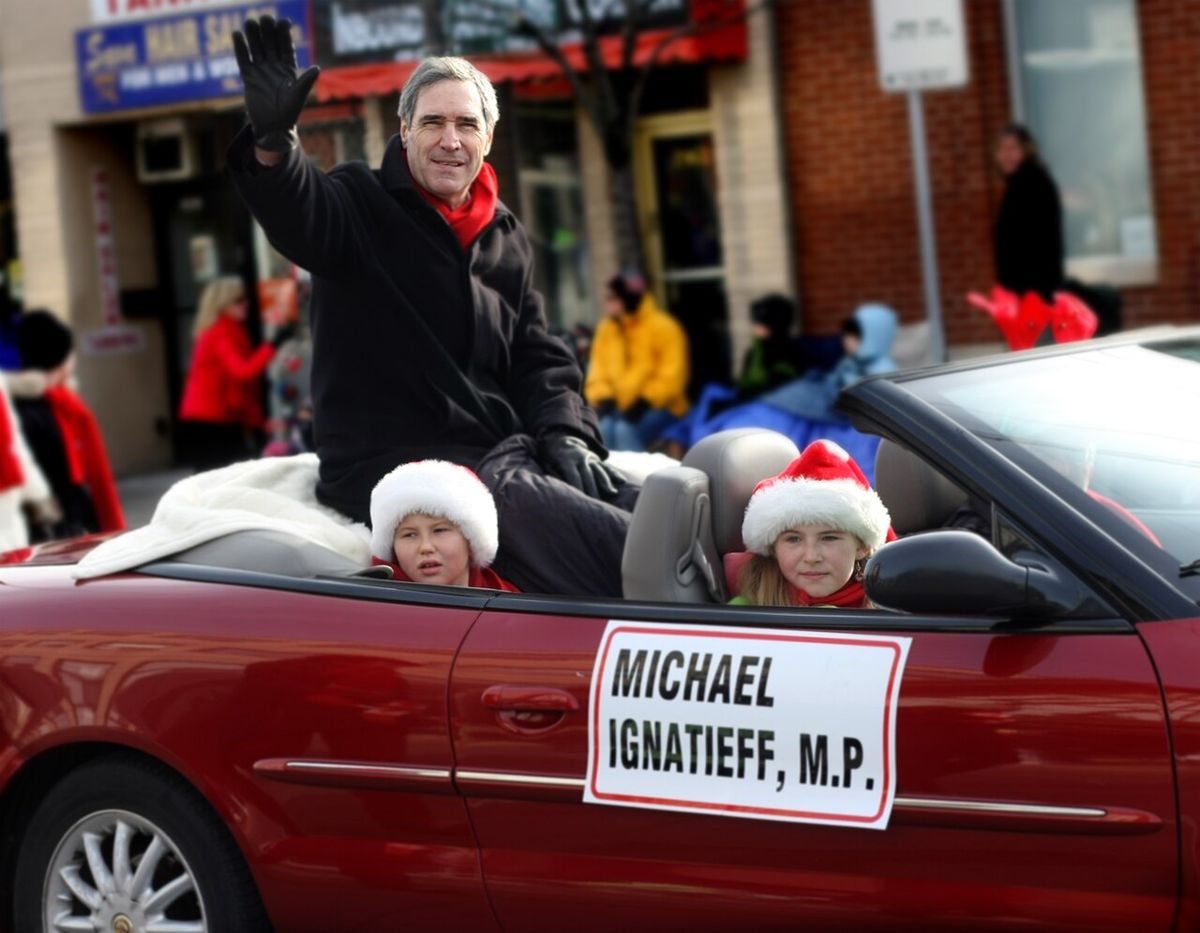
Rumours of a political career for Ignatieff intensified around 2005, the same year he was ranked 37th on a list of the world's most influential public intellectuals by Prospect and Foreign Policy magazines. He left Harvard to return to Canada and take up the Chancellor Jackman Professor in Human Rights Policy position at the University of Toronto's Munk School of Global Affairs and Public Policy, becoming a Distinguished Senior Fellow there. In the 2006 federal election, he was elected as the Liberal Member of Parliament for Etobicoke, Lakeshore. That same year, he entered the race for the leadership of the Liberal Party, ultimately losing to Stéphane Dion, after which Ignatieff served as the party's deputy leader. Following the Liberal Party's defeat in the 2008 election and Dion's resignation, Ignatieff became the party's interim leader in December 2008 and was formally elected as leader at the party's convention in May 2009, assuming the role of Leader of the Opposition. Ignatieff's tenure as Liberal leader was dominated by a minority Parliament under Conservative Prime Minister Stephen Harper, and his leadership was challenged by the political realities of a resurgent Conservative Party and a strengthened New Democratic Party. The 2011 federal election proved catastrophic for the Liberals under his command, as the party won only 34 seats, its worst result in history, finishing third behind the Conservatives and the NDP and losing its status as the Official Opposition. Ignatieff personally lost his seat in Etobicoke, Lakeshore, and he resigned as leader of the Liberal Party in May 2011, effectively retiring from active electoral politics.
| Election | Role | Result for Ignatieff | Result for Liberal Party |
|---|---|---|---|
| 2006 | Liberal leadership candidate | Lost to Stéphane Dion | , |
| 2009 | Liberal leadership election | Elected leader | , |
| 2011 | Leader, MP for Etobicoke, Lakeshore | Defeated in seat | 34 seats (Third place) |
Post-political academic work and writings
Following his departure from politics, Ignatieff returned to academia, teaching at the University of Toronto before taking up a part-time role at the Harvard Kennedy School in 2013 and returning to Harvard full-time on July 1, 2014. In 2016, he began one of his most significant academic leadership roles, becoming the president and rector of the Central European University (CEU) in Budapest, Hungary. He led the institution through a period of considerable challenge, as the Hungarian government, under Prime Minister Viktor Orbán, passed legislation targeting foreign universities, which was widely seen as an attack on the CEU. Ignatieff resigned from this position in July 2021 after a five-year tenure, having guided the university through a complex geopolitical environment.
Throughout this period, Ignatieff continued to publish and comment on international affairs and Canadian politics, contributing articles to publications including The Globe and Mail, The New Republic, and The New York Times Magazine. His body of work, comprising seventeen books, reflects his enduring concerns with human rights, nationalism, and the ethical responsibilities of democracies. In 2024, his contributions to social thought were recognized with the prestigious Princess of Asturias Award for Social Sciences, an international honour that highlights his global intellectual standing. He remains an active writer, and his works continue to be studied in university courses on political theory, Canadian studies, and international relations, and he has written seventeen books described by the British Arts Council as demonstrating extraordinary versatility in both style and subject.
Major literary works and themes
Ignatieff's literary output is diverse, encompassing history, biography, fiction, and political philosophy, and he has been described by the British Arts Council as an extraordinarily versatile writer. His works consistently explore themes of identity, belonging, moral responsibility, and the tensions within liberal democracies. His historical writing includes A Just Measure of Pain, a study of prisons during the Industrial Revolution, and his acclaimed biography of his mentor, Isaiah Berlin. His fiction, including Scar Tissue, Asya, and Charlie Johnson in the Flames, often draws from his journalistic experiences in conflict zones like the Balkans and Kurdistan, blending personal and political narratives and are to some extent autobiographical, with Charlie Johnson covering the haunting memories of a journalist in Kosovo.
His most influential works are those that address contemporary political issues. His book Blood and Belonging details the dangers of ethnic nationalism in the post-Cold War period. The Rights Revolution explores how rights discourse has shaped Canadian civic culture, identifying a secular liberal legal framework, social democratic assumptions about health care, and a particular emphasis on group rights for Quebec and Indigenous peoples. The Lesser Evil analyzes human rights in the post-9/11 world, arguing that there may be circumstances where indefinite detention or coercive interrogations may have to be used on terror suspects. This book was a finalist for the Lionel Gelber Prize and attracted considerable attention and some criticism.
Ignatieff's writings on Canada and international affairs include specific arguments about national policy and global order. In The Rights Revolution, he identified that Canadian law on moral issues approximates European standards more closely than American ones and that apart from New Zealand, no other country has given such recognition to the idea of group rights. He also stated that despite Canada's commitment to equality, society still places an unjust burden on women and gays and lesbians, and it is difficult for newcomers of non-British or French descent to form an enduring sense of citizenship. In his international studies, he advocated for more active involvement and larger scale deployment of land forces by Western nations in conflicts in the developing world, while attempting to distinguish his "empire lite" approach from neo-conservatism by stating its motives were essentially altruistic. His 2001 text Virtual War won the Orwell Prize, and his 2003 book Empire Lite attracted considerable attention for its suggestion that America, as the last remaining superpower, should create a humanitarian empire.
Personal life and family
Michael Ignatieff comes from a notable Canadian family with deep roots in public service and intellectual life. His paternal grandfather was Count Paul Ignatieff, the last Minister of Education for Tsar Nicholas II of Russia and son of statesman Count Nikolay Pavlovich Ignatyev. His mother's family includes the prominent Canadian intellectuals George Monro Grant and Sir George Robert Parkin, and her younger brother was philosopher George Grant. He is married to Hungarian-born Zsuzsanna M. Zsohar, and from his first marriage to Londoner Susan Barrowclough, he has two children, Theo and Sophie. He has a younger brother, Andrew, a community worker who assisted with his political campaigns, and a first cousin, political scientist Caroline Andrew.
Although he says he is not religious, Ignatieff was raised Russian Orthodox and occasionally attends services with family. He describes himself as neither an atheist nor a believer. His great-aunt Alice Parkin Massey was the wife of Canada's first native-born Governor General, Vincent Massey. He is also a descendant of William Lawson, the first president of the Bank of Nova Scotia. His paternal grandfather was Count Paul Ignatieff, the Russian minister of education during the First World War.
Views and intellectual legacy
Michael Ignatieff's intellectual legacy is defined by his extensive writings on human rights, nationalism, and the ethics of international intervention. His work at the Harvard Carr Center and his contribution to the Responsibility to Protect doctrine shaped academic and policy discussions on humanitarian intervention in the late 1990s and early 2000s, and he helped prepare the report examining the role of international involvement in Kosovo and Rwanda. His early support for the Iraq War, which he later fully recanted, became a central point of critique and self-criticism, with Harvard historian Samuel Moyn stating that Ignatieff was among those who "soiled their reputations" through their defence of the war and labelling his later apology embarrassingly vacuous. Ignatieff himself interpreted his error as typical of academics who generalize facts into big ideas, contrasting this with politics where specifics matter more, and he eventually recanted his support for the war entirely in a 2007 New York Times Magazine article.
His analysis in The Rights Revolution presented a portrait of Canada built on a secular liberal legal framework, social democratic assumptions, and a unique commitment to group rights for Quebec and Indigenous peoples. He argued that despite this commitment, Canadian society still placed an unjust burden on women and gays and lesbians. He also said it was difficult for newcomers of non-British or French descent to form an enduring sense of citizenship because of Canada's patch-work quilt of distinctive societies. In international affairs, his concept of an empire lite and his arguments in The Lesser Evil about democratic states using necessary evils continue to be reference points in debates.
Ignatieff's career trajectory from academic to politician and back to academic leader is relatively unique in Canada. His time as president of the Central European University placed him at the centre of a confrontation between academic freedom and illiberal governance in Hungary. The awards he has received, from the Governor General's Award in 1987 to the Princess of Asturias Award in 2024, bookend a long career of intellectual contribution that has maintained a public and international dimension. His writings, his political leadership during a difficult period for his party, and his academic appointments at world-leading institutions collectively constitute a legacy that intersects Canadian political history with global debates on rights and sovereignty, and he continues to publish articles and essays on these topics.
Questions about Michael Ignatieff
What is Michael Ignatieff best known for?
Michael Ignatieff is best known as a Canadian author, academic and former politician. He served as leader of the Liberal Party and leader of the Opposition from 2008 until 2011. He is known for his work as a historian and has held senior academic posts at the universities of Cambridge, Oxford, Harvard, and Toronto. He was rector and president of Central European University from 2016 to 2021. He is an award-winning writer whose books include The Russian Album, which won the Governor General's Literary Award, and Blood and Belonging.
Why did Michael Ignatieff resign as Liberal leader?
Michael Ignatieff resigned as leader of the Liberal Party in May 2011 following the party's disastrous performance in that year's federal election. The Liberals won only 34 seats, their worst result in history, and fell to third place in the House of Commons, losing their status as the Official Opposition to the New Democratic Party. Ignatieff also personally lost his own seat in Etobicoke, Lakeshore. This decisive defeat led to his immediate resignation from the party leadership and his retirement from active electoral politics, after which he returned to teaching at the University of Toronto.
What awards has Michael Ignatieff won?
Michael Ignatieff has won numerous prestigious awards for his writing and intellectual contributions. These include the Governor General's Literary Award for Non-Fiction for The Russian Album in 1987, the Lionel Gelber Prize and the Gordon Montador Award for Blood and Belonging, and the Orwell Prize for Virtual War in 2001. His novel Scar Tissue was shortlisted for the Booker Prize in 1994, and his biography of Isaiah Berlin was shortlisted for the James Tait Black Memorial Prize in 1998. In 2024, he was awarded the international Princess of Asturias Award for Social Sciences.
Where did Michael Ignatieff teach?
Ignatieff has held academic positions at several of the world's leading universities. Early in his career, he taught at the University of British Columbia and held a senior research fellowship at King's College, Cambridge. He later served as the director of the Carr Center for Human Rights Policy at Harvard University's Kennedy School from 2000. After his political career, he taught at the University of Toronto as the Chancellor Jackman Professor and returned to Harvard. From 2016 to 2021, he served as the president and rector of the Central European University in Budapest.
What was Michael Ignatieff's position on the Iraq War?
Michael Ignatieff's interventionist approach led him to support the 2003 Invasion of Iraq. He believed the United States had a duty to unseat Iraqi president Saddam Hussein in the interests of international security and human rights. He initially accepted the argument that containment would not prevent Hussein from selling weapons of mass destruction to terrorists. He later recanted his support for the war entirely. In a 2007 article, he wrote that the unfolding catastrophe had condemned the judgment of many, himself included, who supported the invasion.
What is Michael Ignatieff doing now?
As of recent years, Michael Ignatieff remains active as a writer and commentator on international affairs and Canadian politics. He resigned from his role as president and rector of the Central European University in July 2021 after a five-year tenure leading the institution through political challenges in Hungary. He continues to publish articles and essays in major publications like The Globe and Mail. In 2024, his lifetime of work was recognized with the Princess of Asturias Award for Social Sciences, confirming his ongoing influence as a public intellectual.
Sources and further reading
- Michael Ignatieff (Wikipedia)
- Michael Ignatieff | The Munk School (munkschool.utoronto.ca)
- Michael Ignatieff (carnegie.org)
- Michael Ignatieff, Audio Books, Best Sellers, Author Bio (audible.ca)
- Michael Ignatieff Archives (munkdebates.com)
Checked by the Yadude Books desk. Last updated 2026-11-02.