William Osler
Sir William Osler, 1st Baronet (1849 to 1919) was a pre-eminent Canadian physician whose revolutionary ideas fundamentally reshaped medical education and clinical practice worldwide. He is best known as one of the founding professors of Johns Hopkins Hospital, the creator of the modern medical residency system, and a prolific author whose textbook, "The Principles and Practice of Medicine," was a standard for generations. Osler's legacy extends beyond his clinical work to his influence on medical libraries and the history of medicine, notably through the Osler Library at McGill University. His life and work remain central to the identity of Canadian medicine, embodying a commitment to scientific rigour, compassionate patient care, and the intellectual heritage of the profession.
Early Life and Education
William Osler was born on July 12, 1849, in Bond Head, Canada West, and his family moved to Dundas, Ontario, in 1857. His father, Reverend Featherstone Lake Osler, was a former Royal Navy lieutenant who had emigrated from England to become an Anglican minister in rural Upper Canada. Osler initially followed his father's path, entering Trinity College at the University of Toronto in 1867 with the intention of joining the ministry. His career trajectory shifted decisively under the mentorship of two influential figures, the physician James Bovell and the Reverend William Arthur Johnson, who nurtured his growing fascination with science and medicine. In 1868, he left Trinity to enrol at the privately owned Toronto School of Medicine, where he was introduced to the writings of Sir Thomas Browne, whose Religio Medici made a lasting impression on the young student.
Seeking a more formal medical education, Osler transferred to the McGill University Faculty of Medicine in Montreal in 1870 and received his Doctor of Medicine and Master of Surgery (MDCM) degree in 1872. While studying at McGill, Osler lived on lower Saint Urbain Street and was a regular attendee at the Chapel of St. John the Evangelist on Dorchester Street, forming a lasting respect for its rector, Father Edmund Wood. Following graduation, Osler pursued postgraduate training in Europe, studying under the pioneering pathologist Rudolf Virchow in Berlin, which solidified his commitment to scientific medicine and comparative pathology. This European training prepared him for a return to McGill, where he would begin his academic career in 1874 as a professor, creating the first formal journal club and teaching veterinary pathology.
Academic Career and Professional Milestones
Osler's career began with a professorship at McGill University in 1874 following post-graduate training in Germany. In 1884, he was appointed Chair of Clinical Medicine at the University of Pennsylvania. He was one of the seven founding members of the Association of American Physicians in 1885. In 1889, he became the first Physician-in-Chief of the new Johns Hopkins Hospital. In 1893, he helped create the Johns Hopkins School of Medicine and became one of its first professors of medicine. In 1905, he was appointed Regius Professor of Medicine at Oxford, a position he held until his death. In 1907, he initiated the founding of the Association of Physicians in the UK and was the founding Senior Editor of its Quarterly Journal of Medicine.
- 1874: Appointed professor at McGill University Faculty of Medicine.
- 1884: Appointed Chair of Clinical Medicine at the University of Pennsylvania.
- 1885: Became a founding member of the Association of American Physicians and was elected to the American Philosophical Society.
- 1889: Became the first Physician-in-Chief of the new Johns Hopkins Hospital in Baltimore.
- 1893: Instrumental in creating the Johns Hopkins School of Medicine, becoming one of its first professors.
- 1905: Appointed Regius Professor of Medicine at Oxford University.
- 1907: Founded the Association of Physicians in the UK, serving as its Senior Editor.
- 1911: Founded the Postgraduate Medical Association and was named a baronet.
- 1919: Appointed founding President of the merged Fellowship of Postgraduate Medicine.
At Johns Hopkins Hospital, Osler presided over its first year of operation, when it had 220 beds and 788 patients were seen for a total of over 15,000 days of treatment. Sixteen years later, when he left for Oxford, over 4,200 patients were seen for a total of nearly 110,000 days of treatment. His 1889 farewell address from Philadelphia was titled 'Aequanimitas'. This address was about the imperturbability and equanimity necessary for physicians. The title of this essay is the motto on the Osler family crest.
Revolutionizing Medical Education
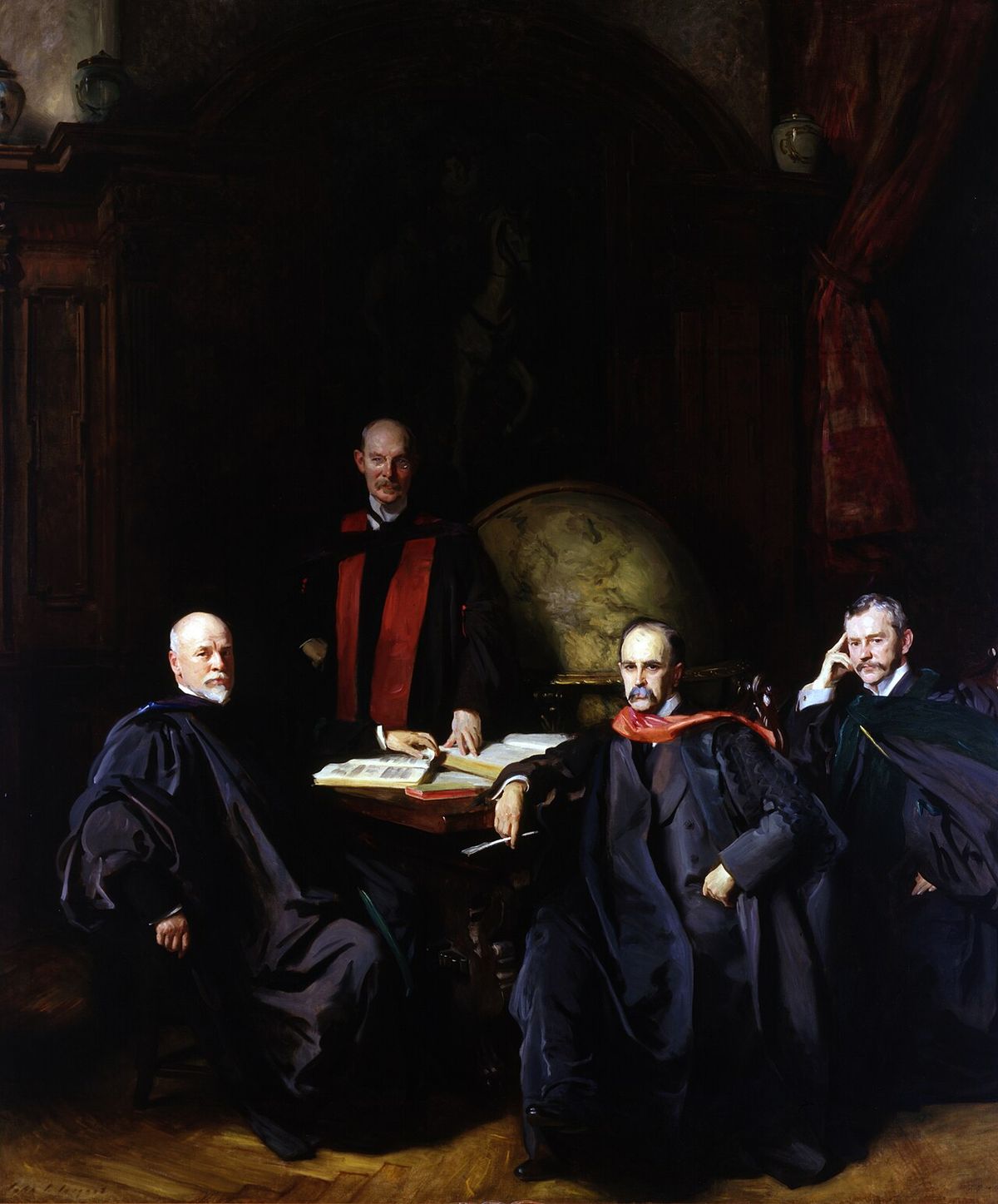
Osler's most enduring contribution was his radical overhaul of medical training. He insisted that students learn from direct patient contact early in their education, pioneering the system of clinical clerkship where third- and fourth-year students worked on the wards. He famously reduced the role of didactic lectures, championing bedside teaching where he demonstrated thorough physical examinations. Osler hoped his epitaph would read, "He brought medical students into the wards for bedside teaching." He created the first formal residency program for specialty training, a pyramidal system with many interns, fewer assistant residents, and a single chief resident. This sleep-in residency system, where physicians lived in the hospital, became the model for postgraduate medical training across the English-speaking world and remains foundational today.
His pedagogical philosophy was encapsulated in his writings and sayings. He asserted that studying medicine without books was like sailing an uncharted sea, but studying without patients meant not going to sea at all. His most famous clinical adage was to listen to the patient, as the patient is telling you the diagnosis, emphasizing the paramount importance of the patient history. Through these methods, Osler shifted medical education from a passive, lecture-based model to an active, patient-centred apprenticeship. This approach fundamentally changed medical teaching in North America and its influence spread globally, helped by disciples such as the Dutch internist P. K. Pel.
Literary Work and Contributions to Medical Libraries
Osler was a prolific author and a passionate bibliophile. His most famous work, The Principles and Practice of Medicine, published in 1892, quickly became an indispensable textbook for students and clinicians, running through many editions until 2001 and translated into numerous languages. Despite its longevity, the text notably supported the use of bloodletting as late as 1923. Osler also authored many influential essays, collected in volumes like Aequanimitas and Other Addresses. He held a deep admiration for historical medical figures, describing the Persian physician Avicenna as the author of the most famous medical textbook ever written for his Canon of Medicine.
His passion for books led to significant contributions to medical librarianship. Osler willed his extensive personal library on the history of medicine to McGill University, where it forms the nucleus of the Osler Library of the History of Medicine. He served on library committees at every university where he taught and was a member of the Board of Curators of Oxford's Bodleian Library. Osler was instrumental in founding library associations on both sides of the Atlantic.
- 1901 to 1904: Served as the second president of the Medical Library Association.
- First and only president of the Medical Library Association of Great Britain and Ireland.
- Founded the History of Medicine Society at the Royal Society of Medicine in London.
- 1913 to 1919: Served as president of The Bibliographical Society.
Osler was passionate about medical libraries and medical history. He founded the History of Medicine Society at the Royal Society of Medicine in London. He was instrumental in founding the Medical Library Association of Great Britain and Ireland. He also helped found the North American Association of Medical Librarians, later the Medical Library Association, along with three other people including Margaret Charlton, the medical librarian of McGill University. He served as the second president of the Medical Library Association in North America from 1901 to 1904.
Personal Life, Family, and Eccentricities
Osler married Grace Revere Gross, the widowed daughter-in-law of Philadelphia surgeon Samuel D. Gross and a descendant of American patriot Paul Revere, in 1892. The couple had two sons. One died shortly after birth, and their surviving son, Edward Revere Osler, was killed in action at the Battle of Passchendaele in 1917 while serving as a second lieutenant in the Royal Field Artillery. His death devastated Osler, who was anguished that his own influence had helped secure his son's commission. Osler himself died of pneumonia in Oxford on December 29, 1919, during the Spanish flu pandemic, and his and Lady Osler's ashes are interred in the Osler Library at McGill. In accordance with his pledge to the American Anthropometric Society, his brain was donated for scientific study and is stored at Philadelphia's Wistar Institute.
Osler was renowned for his humour and was an inveterate practical joker. He wrote numerous humorous pieces under the pseudonym Egerton Yorrick Davis, a fictional retired U.S. Army surgeon. In 1884, he fooled the editors of the Philadelphia Medical News into publishing a fake letter from Davis on the phenomenon of penis captivus. He further cultivated the Davis persona by signing hotel registers and conference lists with the name, eventually reporting Davis's fictional drowning in the Lachine Rapids. This playful, creative side coexisted with his deep scholarly reverence for figures like Sir Thomas Browne, whose works he cherished throughout his life.

Controversies and Complex Legacy
Osler's legacy includes significant contributions shadowed by historical views that are critically re-examined today. In a 1914 speech around the time of the Komagata Maru incident, he stated Canada should be a white man's country. In private correspondence, he expressed disdain for Latin Americans. Under his Egerton Yorrick Davis pseudonym, he penned derogatory comments about Indigenous peoples. Historical research has also uncovered that Osler facilitated the shipment of Indigenous skulls from Canada to museums in Germany, a practice now understood within the context of colonial exploitation.
Another controversy arose from his 1905 farewell address at Johns Hopkins, The Fixed Period. Drawing on an Anthony Trollope novel, Osler humorously suggested that men over 60 were less effective and that a peaceful end at age 67 might be beneficial. The popular press sensationalized this as Osler recommends chloroform at sixty, causing public alarm. In his textbook, he also referred to pneumonia as the friend of the aged for providing a quick death, a description that remains controversial. Ironically, Osler himself died of pneumonia at age 70. These aspects of his life and work are integral to a full understanding of his complex historical figure.
Honours, Memorials, and Eponyms
Osler received numerous honours during his lifetime and many posthumous memorials. He was created a baronet in 1911. In 1994, he was inducted into the Canadian Medical Hall of Fame. His life has been the subject of major biographies, including Harvey Cushing's Pulitzer Prize-winning work in 1925 and Michael Bliss's 1999 biography. Several medical conditions bear his name, ensuring his legacy in clinical medicine. Osler's sign refers to an artificially high systolic blood pressure reading due to calcified arteries. Osler's nodes are painful nodules on the fingertips or toes indicative of subacute bacterial endocarditis. Osler-Weber-Rendu disease, also known as hereditary hemorrhagic telangiectasia, is another eponymous condition.
Osler left his own large history of medicine library to McGill University, where it became the Osler Library of the History of Medicine. His and his wife Grace's ashes now rest in a niche in the Osler Library at McGill. The largest collection of his letters and papers is at the Osler Library. Another collection is held at the United States National Library of Medicine in Maryland. His most famous work, The Principles and Practice of Medicine, was a key text for students and clinicians and was published in many editions until 2001.
Questions about William Osler
What is William Osler most famous for?
William Osler is most famous for revolutionizing medical education. He created the first formal medical residency training program, which became the model used worldwide. He also pioneered bedside teaching, insisting medical students learn directly from patients early in their training. As one of the founding professors of Johns Hopkins Hospital and School of Medicine, and as the author of the hugely influential textbook The Principles and Practice of Medicine, his impact on clinical practice and medical pedagogy was extensive and lasting.
Where was William Osler born and educated?
William Osler was born on July 12, 1849, in Bond Head, Canada West (now Ontario), and was raised in Dundas, Ontario. He began his university studies at Trinity College, University of Toronto, before switching to medicine. He attended the Toronto School of Medicine and then transferred to McGill University in Montreal, where he earned his Doctor of Medicine and Master of Surgery (MDCM) degree in 1872. His postgraduate training included study under Rudolf Virchow in Berlin.
What is the Osler Library?
The Osler Library of the History of Medicine is a world-renowned library located at McGill University in Montreal. It is based on the personal collection of rare books and historical medical texts that Sir William Osler willed to his alma mater. The library serves as a major research centre for the history of medicine and also houses the ashes of Sir William and Lady Osler in a niche within its walls. It is a direct legacy of Osler's passion for medical history and bibliophily.
How did William Osler die?
William Osler died on December 29, 1919, in Oxford, England, at the age of 70. The cause of death was pneumonia, which occurred during the global Spanish flu pandemic. Coincidentally, Osler had previously described pneumonia in his writings as the friend of the aged for allowing a comparatively quick death. His death followed the personal tragedy of his son Edward Revere Osler being killed in World War I in 1917.
What are Osler's nodes and Osler's sign?
Osler's nodes and Osler's sign are medical eponyms named for William Osler. Osler's nodes are tender, raised red lesions on the pads of fingers or toes, which are a classic sign of subacute bacterial endocarditis. Osler's sign is not a symptom but a finding during blood pressure measurement. It refers to an artificially high systolic reading obtained because of calcified, non-compressible arteries in older patients, indicating advanced atherosclerosis.
What was the 'Fixed Period' controversy?
The 'Fixed Period' controversy stemmed from a farewell address Osler gave in 1905 when leaving Johns Hopkins. In this speech, he humorously referenced Anthony Trollope's novel 'The Fixed Period', which envisaged a college where men retired at 67 and were later euthanized. Osler claimed the world's vital work is done between ages twenty five and forty. The popular press sensationalized his remarks with headlines like 'Osler recommends chloroform at sixty', causing public outcry. While Osler had a humorous side and was in his mid fifties at the time, his comments sparked lasting debate about ageism and euthanasia. Coincidentally, Osler himself later died of pneumonia, which he had once described as 'the friend of the aged' for allowing a quick death.
Sources and further reading
- William Osler (Wikipedia)
- Sir William Osler, 1849 to 1919 (rsc-src.ca)
- The wisdom of Sir William Osler (pubmed.ncbi.nlm.nih.gov)
- About William Osler | Libraries (mcgill.ca)
- Physicians in Canadian History, Sir William Osler (physiciansforyou.com)
Checked by the Yadude Books desk. Last updated 2026-11-03.