Home Depot
The Home Depot, Inc. is an American multinational home improvement retail corporation and the largest home improvement retailer in the United States. Founded in 1978, the company operates a vast network of big-box format stores across all ten Canadian provinces, serving millions of Canadian customers. Home Depot sells tools, construction products, appliances, and services including tool and vehicle rentals, catering to both do-it-yourself homeowners and professional contractors. For the fiscal year 2024, the company reported revenue of $159.5 billion and employed approximately 470,100 associates globally. Its headquarters are in Cobb County, Georgia, with an Atlanta mailing address, and it operates stores in the United States, all of Mexico, and Canada.
Founding and Early Growth
The Home Depot was co-founded by Bernard Marcus, Arthur Blank, Ron Brill, Pat Farrah, and investment banker Ken Langone in 1978 with the goal of building home-improvement superstores larger than existing competitors. The first two stores opened on June 22, 1979, in metro Atlanta in Doraville and Decatur, located in spaces leased from J.C. Penney that were originally Treasure Island hypermarket stores. The company went public on the NASDAQ on September 22, 1981, raising $4.093 million, and later joined the New York Stock Exchange on April 19, 1984. Expansion beyond Georgia began in 1981 with stores opening in Hollywood and Fort Lauderdale, Florida, and by 1984 the company operated 19 stores with sales exceeding $256 million. To enter the Dallas market, The Home Depot acquired Bowater Home Center from Bowater Inc. on October 31, 1984, for $40 million.
Rapid expansion in the mid-1980s created financial difficulties, with earnings falling by 42 percent and debt rising to $200 million, which also caused the stock price to decline. Only 10 new stores were opened in 1986, the same year the company conducted a stock offering of 2.99 million shares at $17 per share to help restructure its debts. By 1989, The Home Depot had surpassed Lowe's to become the largest home improvement store in the United States. The 1990s involved efforts to redefine its marketplace, including the 1991 launch of the EXPO Design Center subsidiary for high-end products and design services and the 1995 publication of a 480-page book, Home Improvement 1-2-3. The company's major entry into Canada occurred in 1994 with the $150 million acquisition of the Aikenhead's Hardware chain, gaining a 75 percent share, and all stores were later converted to The Home Depot banner. Former General Electric executive Robert Nardelli became CEO and president of the company in 2000.
Strategic Shifts and Leadership Changes
The late 1990s and early 2000s saw a series of acquisitions aimed at serving professional customers and expanding product categories. The Home Depot purchased the San Diego maintenance and repair supplies company Maintenance Warehouse in 1997 for $245 million and acquired Atlanta-based wholesale plumbing distributor Apex Supply in 1999. These were rebranded in 2004 as "The Home Depot Supply." In 2001, the company acquired Your Other Warehouse, a large plumbing distributor, and reorganized its EXPO Design Center division into three regional divisions based in South Plainfield, New Jersey. Orange, California. And Atlanta, Georgia. Robert Nardelli's six-year tenure as CEO ended on January 2, 2007, when he and the company mutually agreed on his resignation amid complaints about his management style and a compensation package worth $123.7 million over five years, coupled with the stock's underperformance versus Lowe's.
Nardelli's severance package of $210 million was widely criticized. He was succeeded by Frank Blake, previously the company's vice chairman and executive vice president, who agreed to a more conservative, performance-dependent compensation package. Blake repudiated many of Nardelli's strategies, and the two men reportedly have not spoken since the departure. Under Blake's leadership, the company closed 54 stores, including the entire EXPO Design Center chain, in 2008 and 2009 due to the housing market downturn, though affected associates were allowed to reapply for jobs without losing tenure. Frank Blake stepped down as CEO on November 1, 2014, and was replaced by Craig Menear, a company veteran who joined in 1997 and had served as president of U.S. Retail, with Blake continuing as chairman.
Craig Menear's tenure as CEO included the company's data breach in September 2014 and the acquisition of Interline Brands in August 2015. In January 2022, The Home Depot announced Craig Menear would step down as CEO and president effective March 1, 2022, while continuing to serve as the chairman of the board. He was replaced by former executive vice president Ted Decker. Another notable executive is Ann-Marie Campbell, who became head of Home Depot's U.S. stores division in February 2016 after over 30 years with the company, beginning as a cashier in a branch in South Florida.
Operations and Customer Segments
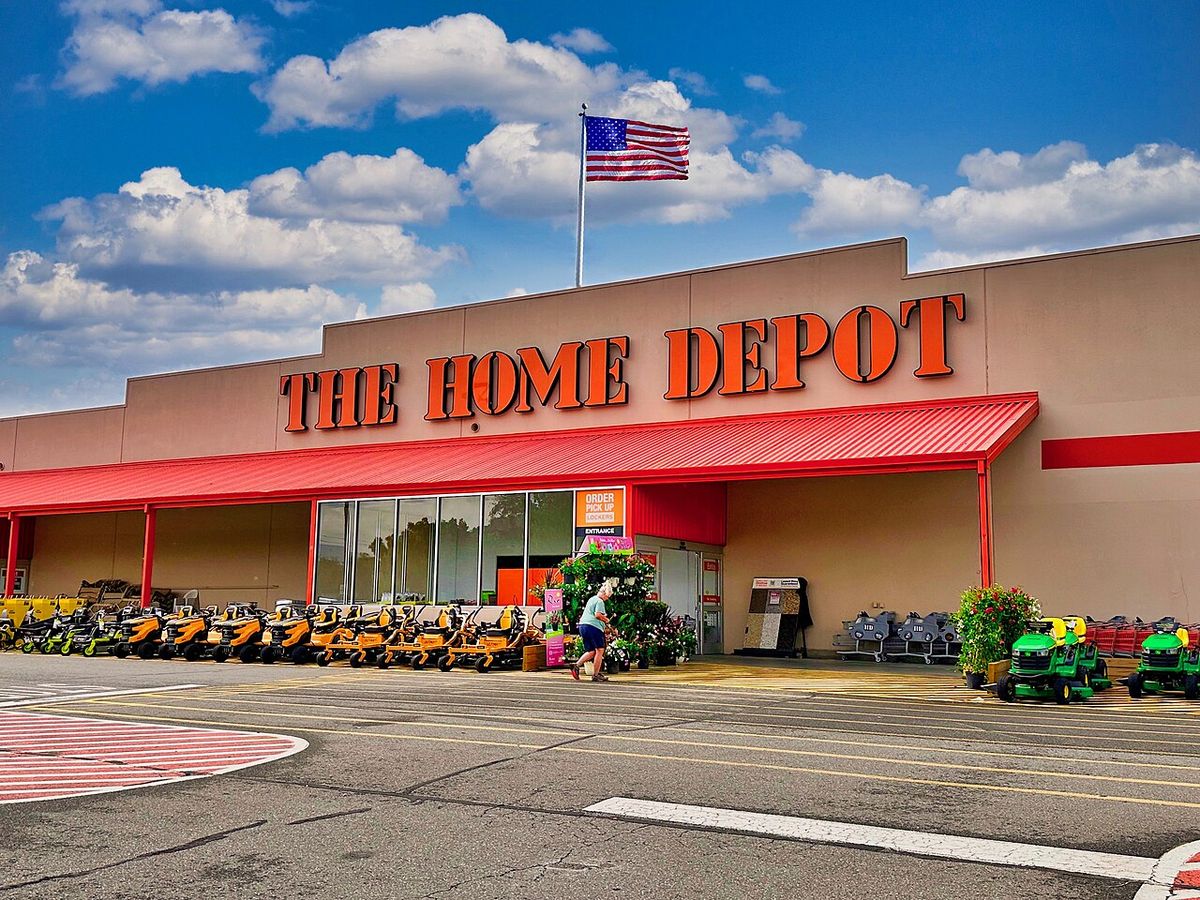
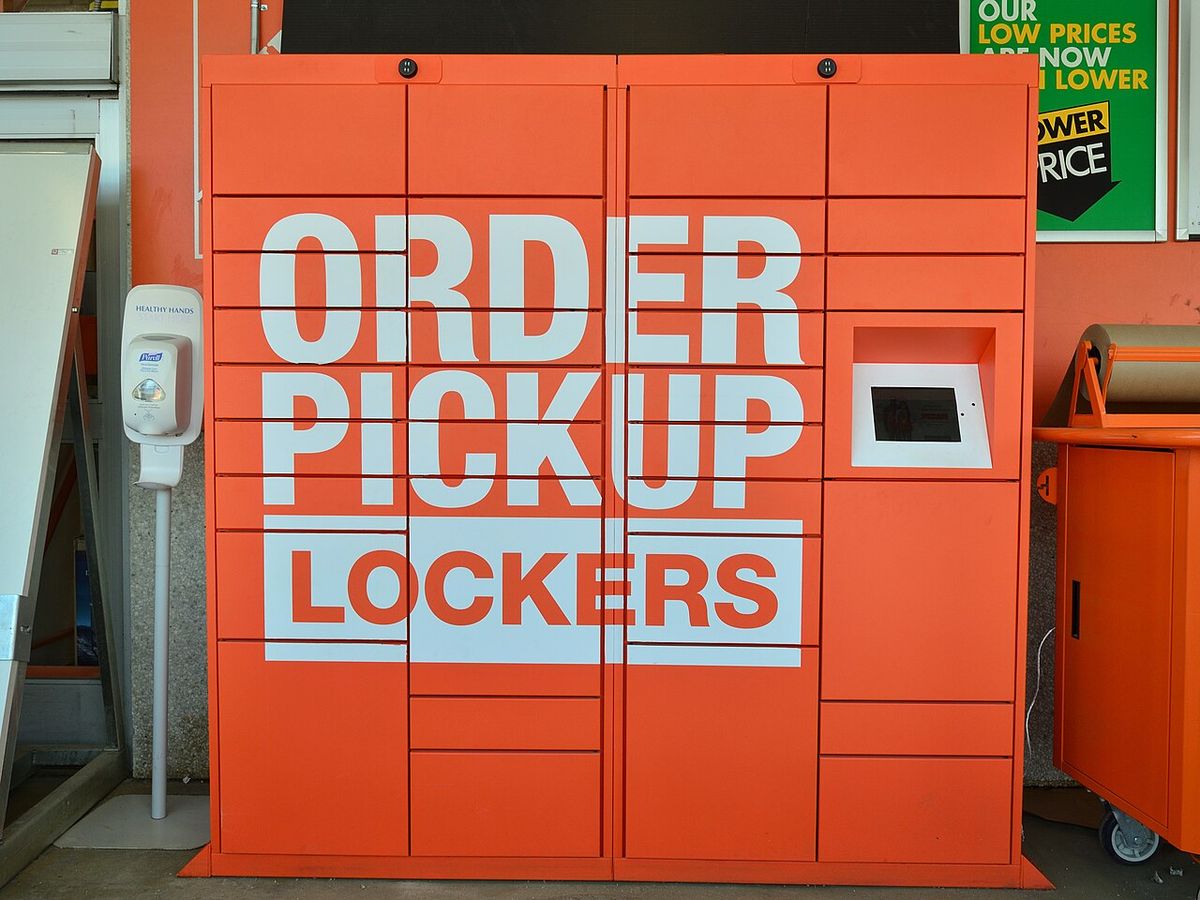
Home Depot stores average 105,000 square feet in size and are organized in a warehouse-style format, stocking a vast range of supplies. The company's signature bright orange colour, PMS 165, is used on signs, equipment, and employee aprons. The two largest stores are located in Vauxhall, New Jersey, at 217,000 square feet, and Anaheim Hills, California, at 204,000 square feet. The company operates over 90 distribution centres throughout the United States to serve its network of more than 2,000 stores, and in Canada, stores are located in all ten provinces. The online platform, homedepot.com, attracted at least 120 million visitors annually by 2008 and is supported by U.S. call centres in Kennesaw, Atlanta, and Marietta, Georgia. Ogden, Utah. And Tempe, Arizona, offering in-store pickup and online returns.
The company strategically serves two main customer groups: do-it-yourself homeowners and professional contractors. While contractors represent only about five percent of customers, they account for an estimated 45 percent of annual sales, which were $132 billion at the time of that metric. To better serve professional customers, the company has invested in building dedicated flatbed distribution centres designed for contractors who arrive in flatbed trucks. Most locations also offer tool, vehicle, and equipment rentals, including flatbed trucks, cargo vans, and box trucks in various sizes, as well as professional-grade construction and landscaping equipment on 4-hour, daily, weekly, and monthly terms. The company tested fuel centres at some stores starting in 2006, with the first two in Tennessee and prototypes in Acworth and Greensboro, Georgia, and Smyrna and Winchester, Tennessee, but by 2012 stated it had no plans for additional fuel centres.
Marketing strategies have evolved with various slogans over the decades. The current slogan, "How Doers Get More Done," was introduced on December 5, 2019, replacing "More saving. More doing," which was introduced on March 18, 2009. That slogan had replaced "You can do it. We can help," used from 2003 to 2009. Other past slogans include "The Home Depot, Low prices are just the beginning" in the early 1990s, "When you're at the Home Depot, You'll feel right at home" in the late 1990s, and "The Home Depot: First In Home Improvement!" from 1999 to 2003. The company's mascot, Homer D. Poe, created by illustrator Gwyn Raker to be a funny guy next door, has been used in advertising since 1981 and is featured on signage, awards, and as a life-size costume. The mascot has a wife named Daisy and a dog named Carl, and the associate charity is named The Homer Fund.
Recent Acquisitions and Professional Business Expansion
Home Depot has aggressively expanded its professional customer business through a series of major acquisitions. On August 24, 2015, the company completed its $1.6 billion acquisition of Interline Brands, a maintenance, repair, and operations supplier, from P2 Capital Partners and Goldman Sachs. Interline Brands was rebranded as The Home Depot Pro in 2018 and operates over 90 distribution centres in the United States, Canada, and Puerto Rico. In December 2020, Home Depot repurchased HD Supply, which it had sold in 2007, for $8 billion. A landmark deal was announced in March 2024: the acquisition of SRS Distribution, a professional roofing and building products distributor based in McKinney, Texas, for $18.25 billion.
In March 2026, SRS Distribution, a subsidiary of Home Depot, agreed to acquire Mingledorff's Inc., a wholesale distributor of heating, ventilation, and air conditioning equipment, parts and supplies, operating 42 locations across five southeastern states, completing the acquisition in May 2026. In late June 2025, Home Depot agreed to buy Gypsum Management & Supply, Inc. (GMS) of Tucker, Georgia for approximately $4.3 billion, finalizing the acquisition in September 2025. In July 2026, Home Depot announced an organizational realignment focused on expanding its professional-customer business. The company renamed its Office of Integration as the Office of Pro Acceleration, led by chief financial officer Richard McPhail, to coordinate operations across Home Depot Pro, HD Supply, SRS Distribution, and Construction resources.
Other acquisitions include the online division of The Company Store, a home textiles seller founded in 1911, in 2017, though the deal did not include its five physical stores. The company acquired Blinds.com, an e-commerce window coverings retailer founded in 1993, in January 2014. Blinds.com had received the Marketer of the Year Award from the American Marketing Association in 2009. The company also acquired Compact Power Equipment Inc., a rental equipment provider, on July 6, 2017. These moves collectively aim to deepen the company's reach into specialty trade segments and e-commerce.
Subsidiaries and Owned Brands
The Home Depot operates several wholly owned subsidiaries that complement its core retail business and expand its market reach into specialized areas. These subsidiaries operate across e-commerce, equipment rental, and professional supply distribution, creating a diversified corporate portfolio. Blinds.com was acquired in January 2014 and is an e-commerce retailer specializing in window blinds and coverings, founded by Jay Steinfeld in 1993 and ranked 186th on the Internet Retailer Top 500 Guide by 2006. Compact Power Equipment Inc. was acquired on July 6, 2017, and prior to 2017 provided equipment to rental departments in over 1,000 Home Depot stores across North America.
The Home Depot Pro, formerly Interline Brands, operates over 90 distribution centres supplying maintenance, repair, and operations products. Its portfolio includes brands such as Wilmar Industries for MRO, Barnett for contractor supplies, Maintenance USA for MRO, SupplyWorks for janitorial and packaging, US Lock for security devices, Hardware Express for hardware, and Leran Gas Products for propane accessories. The Company Store is an online seller of home textiles and decor, whose online division was acquired in 2017, with the company originally founded in 1911. These entities allow Home Depot to serve niche markets and professional customers more effectively, moving beyond the traditional big-box retail model into dedicated distribution and specialized e-commerce.
Financial Performance and Corporate Rankings
The Home Depot is a financial giant in the retail sector, consistently ranking high on major corporate lists. As of 2020, it was ranked 26th on the Fortune 500 list of the largest United States corporations by total revenue. In 2023, the company held the 67th position on the Forbes Global 2000. The company's financial performance saw significant boosts during the COVID-19 pandemic, as consumer spending shifted towards home improvement. For the second quarter of 2020, ending August 2, the company reported sales of $38.1 billion, a 23.4 percent growth from the same period the previous year, with net earnings rising 27 percent to $4.3 billion.
Revenue remained strong in the third quarter of 2020, ending November 1, reaching $33.5 billion, a 24 percent year-over-year increase. In the fiscal year ending February 2009, sales totalled $71.288 billion, a decline of over $20 billion from the peak two years earlier due to the sale of HD Supply and falling revenue in the retained business. The company's revenue for the full 2024 fiscal year was reported at $159.5 billion. The company is the seventh largest United States-based employer globally, with approximately 470,100 associates as of 2024.
Notable Events and Initiatives
The Home Depot has been involved in several notable events that have shaped its operations and public perception. In September 2014, the company experienced a significant data breach. A contributing factor was the practice of entering credit card numbers directly into computers at service desks and in specialty departments like flooring, kitchen cabinets, appliances, and millwork, rather than using point-of-sale terminals. The company halted this practice and offered a year of free credit monitoring through AllClearID to any customers who requested it, with additional reports of card numbers being stolen from online purchases on Homedepot.com.
In February 2023, Home Depot announced that it would spend $1 billion to raise hourly employee wages. In 2004, Home Depot employees at a suburban Detroit store in Harper Woods, Michigan, rejected a bid to be represented by a labor union, voting 115 to 42 against joining the United Food and Commercial Workers. If the union had won, the Michigan store would have been the first Home Depot to have union representation. The company's charitable arm, The Homer Fund, a for-associate charity, is named after the mascot Homer D. Poe, who has been a part of Home Depot culture since 1981.
The company has entered and exited several business ventures over the years. It launched Home Depot Landscape Supply in 2002 to integrate professional landscapers and upscale plants, but closed all stores in late 2007 after just five years, with only a few stores in metro Atlanta and Dallas. It launched an online home-furnishings store, 10 Crescent Lane, and an online lighting store, Paces Trading Company, in 2005, and acquired Home Decorators Collection in 2006. The company closed its big-box style stores in China in 2012 but kept smaller, specialized stores open there. It established two large distribution centres in Atlanta and Los Angeles in 2013.
Leadership and Management Structure
The leadership of The Home Depot has transitioned through several key executives since its founding, each shaping the company's strategy during their tenure. The co-founders, Bernard Marcus and Arthur Blank, led the company from its 1978 inception through its initial public offering and rise to market leadership by 1989. Robert Nardelli served as CEO and president from 2000 until his resignation in January 2007. Frank Blake succeeded Nardelli as CEO, serving from January 2007 until November 1, 2014, when he was replaced by Craig Menear but remained as chairman. Craig Menear, a longtime Home Depot executive who joined in 1997, became CEO on November 1, 2014, and stepped down as CEO and president on March 1, 2022, continuing as chairman. Ted Decker, former executive vice president, succeeded Menear as CEO on March 1, 2022.
Other notable executives have led major divisions. Marc Powers became the head of Home Depot's U.S. stores division in 2014, replacing Marvin Ellison who left to become chief executive of J.C. Penney. In January 2016, Powers departed and was replaced by Ann-Marie Campbell, a veteran employee who began as a cashier in South Florida over 30 years prior and was most recently president of the Southern division. Richard McPhail serves as chief financial officer and, as of July 2026, leads the Office of Pro Acceleration. The head of the U.S. stores division change was effective February 1, 2016.
Questions about Home Depot
What is Home Depot's current slogan?
The Home Depot's current slogan is "How Doers Get More Done," which was announced on December 5, 2019. This replaced the previous slogan, "More saving. More doing," that had been introduced on March 18, 2009. That slogan had itself replaced "You can do it. We can help," which was used from 2003 to 2009, following earlier slogans from the 1990s.
Who is the CEO of Home Depot?
As of March 2022, the CEO of The Home Depot is Ted Decker. He succeeded Craig Menear, who stepped down from the CEO and president roles on March 1, 2022, but remained as chairman of the board. Decker was previously an executive vice president at the company. Frank Blake served as CEO from 2007 to 2014, and Robert Nardelli was CEO from 2000 to 2007 following the founding leadership.
What was the Home Depot data breach?
The Home Depot experienced a data breach in September 2014. The breach was facilitated in part by the practice of entering credit card numbers directly into computers at service desks, pro desks, and in specialty departments rather than using point-of-sale terminals. The company stopped this practice and offered a year of free credit monitoring through AllClearID to any customers who requested it. There were also confirmed reports of credit card numbers being stolen from purchases made on Homedepot.com during this incident.
What recent acquisitions has Home Depot made?
Home Depot has made several major acquisitions to boost its professional customer business. In March 2024, it announced the acquisition of SRS Distribution for $18.25 billion. In late June 2025, it agreed to buy Gypsum Management & Supply for about $4.3 billion, finalizing the deal in September 2025. SRS Distribution, now a subsidiary, acquired Mingledorff's Inc., an HVAC distributor with 42 locations, in May 2026. The company also repurchased HD Supply in December 2020 for $8 billion and acquired Interline Brands in 2015 for $1.6 billion.
When did Home Depot first open stores in Canada?
Home Depot first opened stores in Canada in 1994. This occurred through the acquisition of the Canadian hardware chain Aikenhead's Hardware for $150 million, which gave Home Depot a 75 percent share. Following the acquisition, all Aikenhead's Hardware stores were subsequently converted to The Home Depot brand. The company now operates its big box format stores in all 10 provinces of Canada. This expansion was part of Home Depot's growth beyond the United States, which also includes operations in Mexico.
Does Home Depot rent trucks and tools?
Yes, The Home Depot rents trucks, tools, and equipment at most of its locations. The vehicle rental options include flatbed trucks, cargo vans, and box trucks in various sizes. Professional quality construction, landscaping, and household equipment are also available for rent. These rentals are offered in terms of 4-hour, daily, weekly, and monthly durations. This tool, vehicle, and equipment rental service is part of the company's broader offerings, which also include selling tools, construction products, and appliances.
Sources and further reading
- Home Depot (Wikipedia)
- About Us (corporate.homedepot.com)
- For the Pro, Homedepot.ca (homedepot.ca)
Checked by the Yadude Books desk. Last updated 2026-10-18.