Sam's Club
Sam's Club is an American membership only warehouse retail chain operated as a subsidiary of Walmart Inc. It was founded in 1983 by Walmart founder Sam Walton and was originally named Sam's Wholesale Club. As of January 31, 2025, Sam's Club ranked second in sales volume among warehouse clubs with 90.2 billion dollars in sales, behind its main rival Costco. Sam's Club had six locations in Canada from 2003 to 2009, but it has no current retail presence there. The chain consolidated its private labels under the Member's Mark brand in 2017 and has focused on integrating technology such as mobile scan and go apps and AI powered receipt verification.
History and Expansion
Sam Walton opened the first Sam's Wholesale Club on April 7, 1983, in Midwest City, Oklahoma, over two decades after founding Walmart. The chain expanded rapidly through acquisitions, purchasing the 24-store SuperSaver Wholesale Warehouse Club chain in 1987 from Alton Hardy Howard and his son John, and acquiring the PACE Membership Warehouse from Kmart in 1993, converting a majority of those locations into Sam's Club stores. The company entered the Northeastern United States in 1989 with a club in a former Two Guys/Jefferson Ward store in Delran, New Jersey, which was Walmart's first expansion into that region. The name was shortened from Sam's Wholesale Club to Sam's Club in 1990, the same year the first club opened in Pennsylvania.
A significant but ultimately temporary international expansion occurred in 2003 when Sam's Club entered the Canadian market, opening six locations in Southern Ontario, primarily in the Greater Toronto Area and Golden Horseshoe region. The Canadian venture lasted six years before Walmart Canada announced the closure of all six Sam's Club locations on February 26, 2009. The company cited a strategic shift toward other superstore formats, though industry observers noted stiff competition from the well-established Costco and the non-membership Real Canadian Superstore. Two planned but unopened Canadian locations were rebranded as Walmart stores, and in January 2010, it was announced that ten U.S. clubs would also close, including four in California, while six new clubs opened at various American locations.
The chain has continued to refine its United States footprint, closing underperforming locations while opening new ones. The latest flagship club opening as of September 13, 2007, was in Fayetteville, Arkansas. The largest Sam's Club store is located in Pineville, North Carolina, with 185,000 square feet of retail space that was formerly an Incredible Universe. Leadership changes have marked the chain's evolution, with Rosalind Brewer becoming CEO on February 1, 2012. John Furner replaced Brewer as CEO of Sam's Club on February 1, 2017. Kathryn McLay succeeded Furner as CEO of Sam's Club on November 15, 2019. McLay announced plans in 2023 for the company to build 30 stores, and she became CEO of Walmart International in 2023 and was succeeded as Sam's Club CEO by Christopher Nicholas.
The chain has undergone significant workforce adjustments. On January 24, 2010, it was announced that approximately 11,200 Sam's Club employees would be laid off. The layoffs resulted from the decision to outsource product sampling duties to an outside company and to eliminate New Business Membership Representative positions throughout the chain. Most of the laid off employees were part time and represented about 10 percent of the total Sam's Club workforce. On January 24, 2014, it was announced that Walmart would cut 2,300 jobs at underperforming Sam's Club locations. On January 11, 2018, Walmart announced that 63 Sam's Club locations would be closing, and Business Insider magazine calculated that over 11,000 workers would be affected. Walmart said that ten of the stores would become e commerce distribution centers and employees could reapply to work at those locations.
Operations and Store Format
As of May 18, 2026, Sam's Club operates 602 membership warehouse clubs across 44 U.S. states and Puerto Rico, with no presence in Alaska, Massachusetts, Oregon, Rhode Island, Washington, or Vermont. The clubs are large, no-frills warehouses where merchandise is often sold in bulk directly from shipping pallets or steel storage racks. Typical store sizes range from 32,000 to 168,000 square feet, with an average size of approximately 134,000 square feet. Most locations feature dedicated departments including Pharmacy, Tire and Battery, Optical, Bakery, Café, and Floral, though photo services were largely discontinued in late 2019.
The product assortment is broad, designed for both small businesses and individual members, and includes jewelry, designer goods, sunglasses, crystal, collectibles, electronics, floral, apparel, food, and meats sold in bulk quantities. The chain also offers car wash services at gasoline stations located at 41 of its clubs. In 2017, Sam's Club consolidated its private-label offerings under the single Member's Mark brand, distinguishing it from Walmart stores which sell Sam's Choice and Great Value products. The chain's design philosophy emphasizes efficiency and volume, with merchandise stocked in warehouse-style steel bins to facilitate quick restocking and a high-volume sales environment.
Sam's Club has actively developed and deployed technology to streamline the shopping experience, beginning with a dedicated mobile scan-and-go app rolled out in 2016 that allowed shoppers to scan items and pay via their phone, bypassing traditional checkouts, with availability at all U.S. locations by December 2016. In 2019, the dedicated scanning app was deprecated and its features were incorporated into the main Sam's Club app. A major technological initiative began in January 2024 with the testing of an artificial intelligence-based receipt verification system at 10 stores, which required customers to pass through a portal for purchase validation. By April 2025, the company announced the nationwide implementation of this AI receipt-checking technology across all approximately 600 U.S. locations at that time.
International Presence and Special Formats
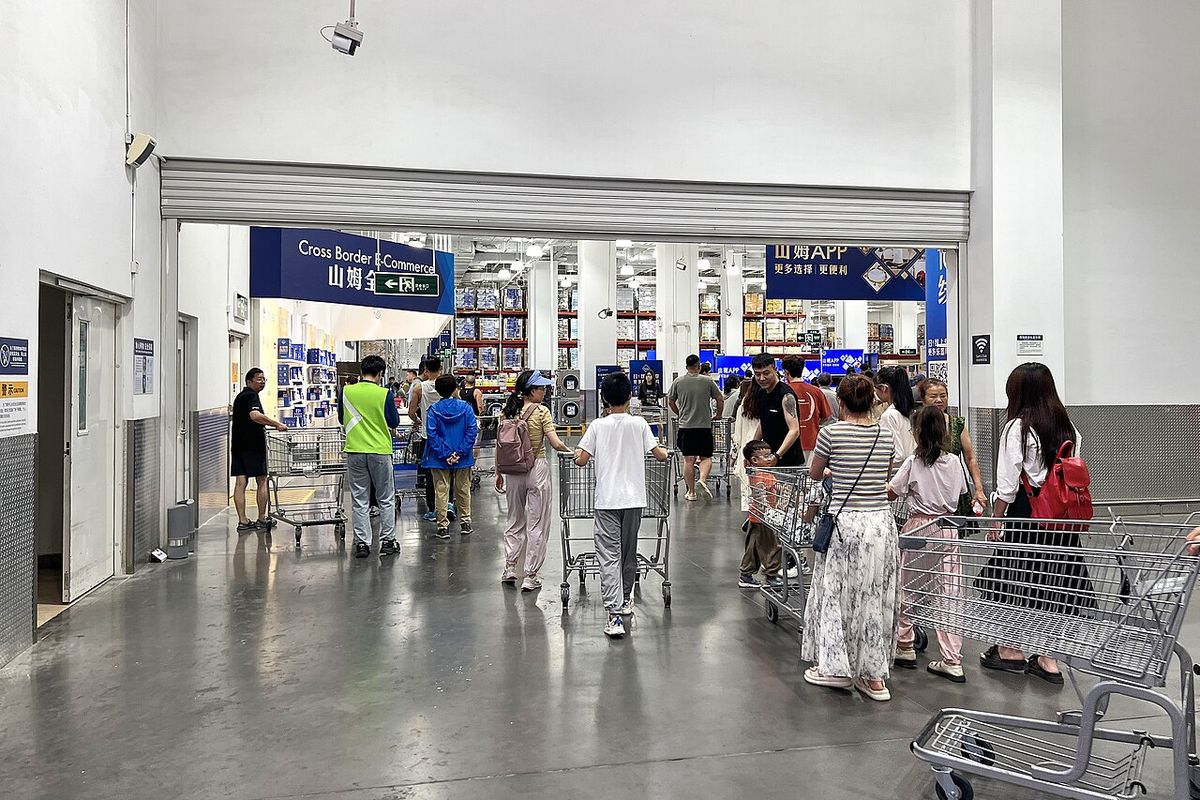
Outside the United States, Sam's Club maintains a substantial international footprint through company-owned stores and licensing agreements. As of 2026, it operates 173 locations in Mexico and 48 in China. In Brazil, 58 stores operate under the Sam's Club name under a license held by Grupo Big, formerly Walmart Brazil, which became part of the Carrefour Group after being de-consolidated from Walmart in August 2018. The chain has experimented with specialized retail formats tailored to specific markets or shopping behaviours, though these have often been limited in scope and duration.
In Houston, Sam's Club opened Más Club in August 2009, a club geared towards the Hispanic population. Membership in Más Club was separate from membership in Sam's Club. The store eventually began a liquidation sale in December 2013, and was closed in February 2014. In October 2018, Sam's Club opened Sam's Club Now, a mobile first retail store where customers use the Sam's Club Now mobile app to scan and pay for merchandise. Customers can also order items ahead of time with same day curbside pickup at the store, which is located in Dallas, Texas.
Outside of the United States, Sam's Club operates 173 locations in Mexico and 48 locations in China. Grupo Big, formerly Walmart Brazil, which was de consolidated from Walmart in August 2018 and since then is part of Carrefour Group, also operates 58 Sam's Club locations in Brazil, using the Sam's Club name under license. In December 2021, Sam's Club took a number of Xinjiang produced goods off the shelves, claiming an inventory issue. This removal sparked public outcry and boycott in China, and a number of Chinese consumers cancelled or suspended their membership cards.
Financial Performance and Market Position
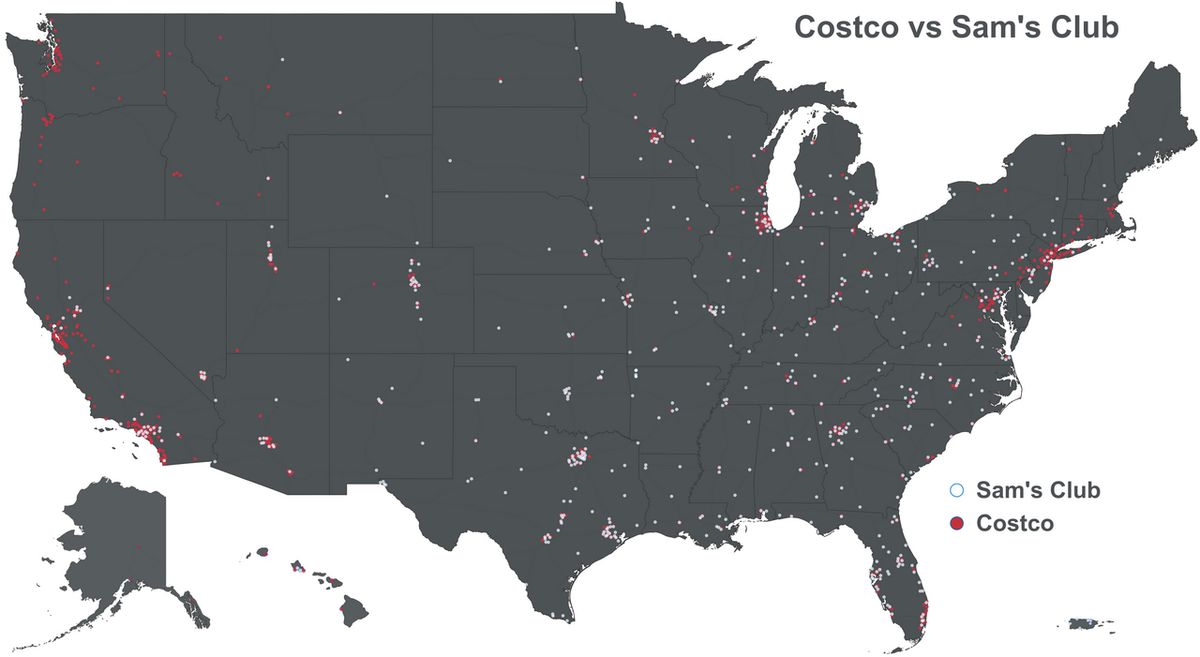
Sam's Club holds a strong position as the number two warehouse club chain in the United States by sales volume. For the fiscal year ending January 31, 2025, the chain reported sales of $90.2 billion. This places it ahead of BJ's Wholesale Club but behind its primary competitor, Costco Wholesale. The chain's performance is a key component of its parent company Walmart's overall retail portfolio, and strategic decisions regarding the chain, including potential sale or spinoff, have been subjects of market speculation since at least April 2007.
As of May 18, 2026, Sam's Club operated 602 membership warehouse clubs in the United States across 44 states and Puerto Rico, with no locations in Alaska, Massachusetts, Oregon, Rhode Island, Washington, or Vermont. As of January 31, 2025, Sam's Club ranked second in sales volume among warehouse clubs with 90.2 billion dollars in sales, ahead of BJ's Wholesale Club but behind its main rival Costco. Outside of the United States, Sam's Club operates 173 locations in Mexico and 48 locations in China. Grupo Big also operates 58 Sam's Club locations in Brazil under license.
| Metric | Figure | Notes / Period |
|---|---|---|
| U.S. Store Count | 602 | As of May 18, 2026 |
| Licensed Stores (Brazil) | 58 | Operated by Grupo Big under license |
| Annual Sales | $90.2 billion | Fiscal year ending Jan 31, 2025 |
| Average Club Size | ~134,000 sq ft | Approximately 12,400 square metres |
| Largest Club Size | 185,000 sq ft | Pineville, North Carolina location |
The chain's growth strategy has involved periodic store openings and closures. Kathryn McLay announced plans in 2023 for the company to build 30 stores. This followed the closure of 63 Sam's Club locations announced on January 11, 2018. On the same day as the 2018 closure announcement, Walmart announced that as a result of the new tax law, it would be raising Walmart starting wages, distributing bonuses, expanding its leave policies and contributing toward the cost of employees' adoptions. The chain's logo was updated to a new serif font design unveiled on September 24, 2006.
Notable Incidents and Controversies
Sam's Club has been involved in several notable incidents that have drawn public and international attention. In March 2020, a store in Midland, Texas, was the site of a violent stabbing that wounded three members of an Asian family, including two young children. The 19-year-old suspect allegedly targeted the family, believing Chinese people were responsible for the COVID-19 pandemic. This tragic event highlighted issues of racial violence and scapegoating during the global health crisis and occurred on the premises of a major retail outlet.
In December 2021, Sam's Club took a number of Xinjiang produced goods off the shelves, claiming an inventory issue. China's Central Commission for Discipline Inspection called the removal of goods malicious, claiming that it exposes their stupidity and shortsightedness and that Sam's Club will surely suffer the consequences. The removal sparked public outcry and boycott in China. A number of Chinese consumers cancelled or suspended their membership cards.
Internal operational controversies have occurred. On January 11, 2018, some of the 63 closing Sam's Club stores had already liquidated, without notifying employees, and some employees learned by a company wide email delivered that day. The substantial layoffs in 2010, which affected about 10 percent of the Sam's Club workforce, drew attention to the chain's labour practices. The layoffs resulted from the decision to outsource product sampling duties to an outside company, Rogers, Arkansas based Shopper Events, which already performed in store product demonstrations for Walmart.
Key Leadership and Technological Milestones
The leadership of Sam's Club has seen several transitions, each bringing strategic shifts. Rosalind Brewer's appointment as CEO effective February 1, 2012, marked a significant change, followed by John Furner on February 1, 2017. Kathryn McLay took over on November 15, 2019, and spearheaded a new store growth plan before moving to become CEO of Walmart International in 2023, at which point Christopher Nicholas succeeded her as head of Sam's Club. Under these leaders, the chain has pursued major technological initiatives to modernize the shopping experience and improve operational efficiency across its network of clubs.
The development of digital tools and in-store systems has been a consistent priority for the chain, with a series of rollouts and tests aimed at reducing checkout friction and enhancing security. The chain's technological milestones include the nationwide rollout of a dedicated mobile scan-and-go app in 2016 for skipping checkout lines, completed by December 2016. In 2019, the scan-and-go features were integrated into the main Sam's Club app, deprecating the standalone application. The launch of the 'mobile-first' Sam's Club Now test store in Dallas, Texas, occurred in October 2018 as a prototype for app-centric shopping.
More recent advancements include the use of artificial intelligence based receipt checking technology. As of January 2024, Sam's Club used this technology at 10 stores that required customers to move through a portal to verify purchases. The company announced plans to put the technology in all of its stores by the end of 2024. In April 2025, Sam's Club announced the nationwide implementation of its AI powered receipt verification technology across all 600 US locations. The closure of the photo department in most clubs by late 2019 also demonstrates a change in services.
Corporate Structure and Brand Evolution
Sam's Club operates as a subsidiary of Walmart under the legal name Sam's West, Inc., doing business as Sam's Club. This structure places it within the larger Walmart corporate hierarchy, subject to the strategic and financial oversight of the parent company. The chain was named after Walmart's founder, Sam Walton, to leverage the recognition and values associated with the parent brand. Its operations are distinct from Walmart's discount stores and supercentres, focusing exclusively on the membership warehouse club model which requires an annual fee for shopping privileges.
The brand has undergone visual and strategic evolution since its founding. It was founded in 1983 as Sam's Wholesale Club. In 1990, Sam's Wholesale Club was renamed Sam's Club, dropping off Wholesale. A visual rebranding occurred on September 24, 2006, with the unveiling of a new logo with an updated serif font. The private label strategy was consolidated in 2017 with the creation of the Member's Mark brand, which replaced previous club specific labels.
Speculation about the chain's corporate future has periodically arisen. Starting in April 2007, there was speculation of a possible sale or spinoff of Sam's Club from parent company Wal Mart Stores, Inc. The closure of the Canadian operation occurred in 2009 when Walmart Canada announced that it would be closing all six of its Canadian Sam's Club locations. The 2018 conversion of some closed United States stores into e commerce distribution centres demonstrates how its corporate strategy adapts. On January 11, 2018, Walmart said that ten of the 63 closing stores would become e commerce distribution centers.
Questions about Sam's Club
Does Sam's Club have stores in Canada?
Sam's Club does not currently operate any stores in Canada. The chain had a brief presence in the country, operating six locations in Southern Ontario from 2003 until February 2009. Walmart Canada announced the closure of all Canadian Sam's Club locations at that time to focus on other superstore formats. Industry analysts noted the chain faced strong competition from the established Costco and The Real Canadian Superstore, which had a well-established history in the country.
How does Sam's Club compare to Costco?
Sam's Club is the second-largest membership warehouse club chain in the United States by sales, behind Costco. For the fiscal year ending January 31, 2025, Sam's Club reported sales of $90.2 billion. While both sell bulk goods to members, they are separate companies. Costco is an independent publicly traded company, whereas Sam's Club is a subsidiary of Walmart. As of May 2026, Sam's Club operated 602 U.S. locations across 44 states and Puerto Rico.
What is the Member's Mark brand?
Member's Mark is the exclusive private-label brand for Sam's Club. The chain consolidated all its private-label products under this single brand name in 2017. It encompasses a wide range of goods sold in clubs, from groceries to household items. This brand is distinct from the private labels found in Walmart stores, such as Great Value and Sam's Choice, which are not sold at Sam's Club locations.
What happened with Sam's Club in China in 2021?
In December 2021, Sam's Club removed a number of Xinjiang produced goods from its shelves, claiming an inventory issue. China's Central Commission for Discipline Inspection criticized the removal, calling it malicious and stating the company would suffer consequences. This action sparked a significant public outcry and boycott within China. As a result, many Chinese consumers cancelled or suspended their Sam's Club membership cards in protest.
What is Sam's Club's scan-and-go technology?
Sam's Club's scan and go technology is a mobile application feature that allows users to scan items while shopping and pay for them, skipping the checkout line. The company first rolled out a dedicated mobile application for this purpose in 2016. By December 2016, this app could be used at all Sam's Club locations in the United States. In 2019, the dedicated scanning app was deprecated, and its scan and go features were incorporated into the main Sam's Club app for member use.
Sources and further reading
- Sam's Club (Wikipedia)
- Sam's Club (corporate.walmart.com)
Checked by the Yadude Books desk. Last updated 2026-10-21.