Toronto Eaton Centre
The CF Toronto Eaton Centre, commonly known as the Eaton Centre, is a major shopping mall and office complex in downtown Toronto, Ontario. Owned and managed by Cadillac Fairview, it is one of North America's busiest retail destinations, attracting millions of visitors annually due to its central location atop two subway stations and proximity to Union Station. The complex, named after the historic Eaton's department store chain, functions as a significant economic hub and a popular tourist attraction within the city. Its distinctive multi-level galleria with a vaulted glass ceiling has been an influential model for shopping centre architecture across the continent.
Location and physical layout
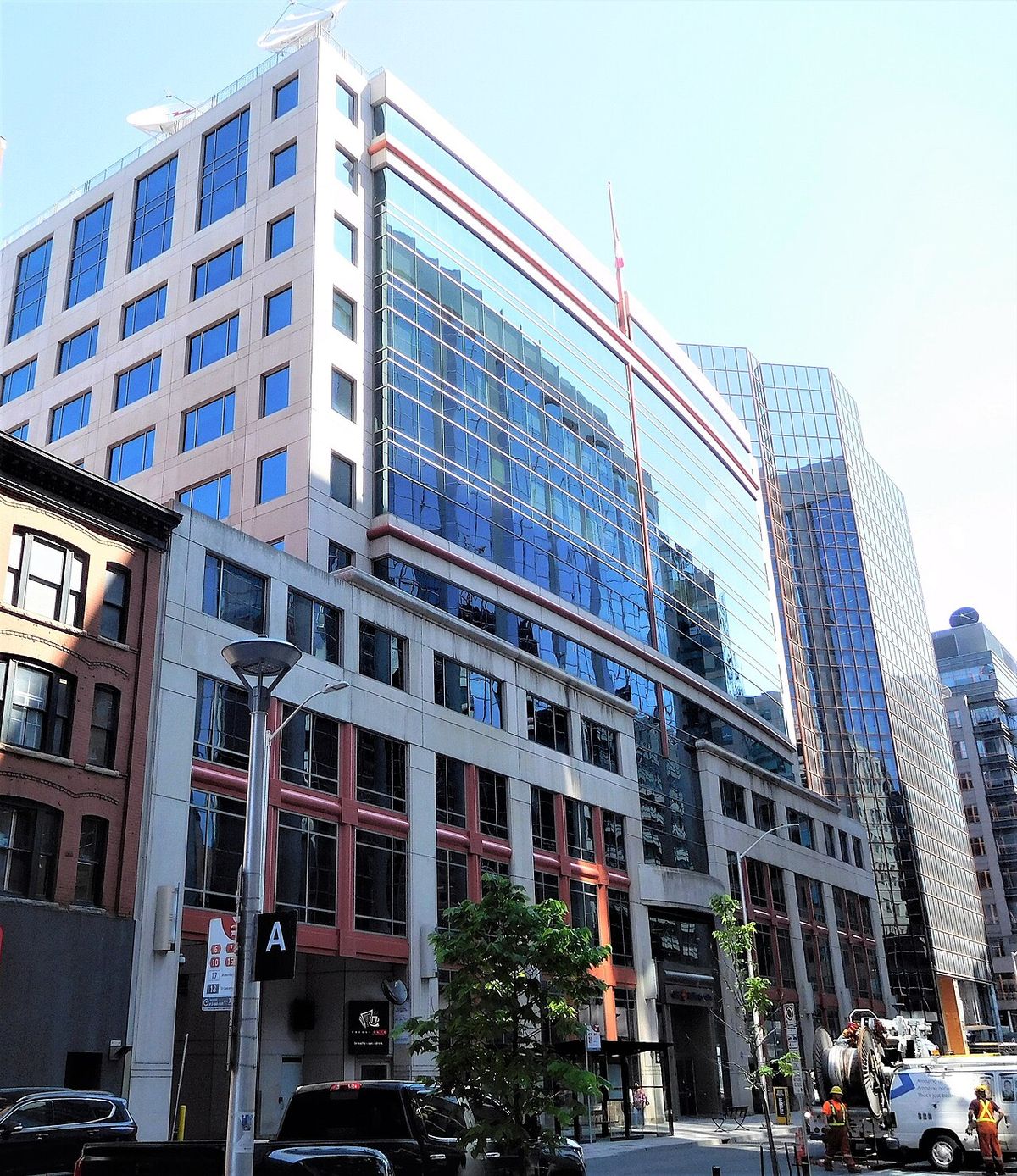
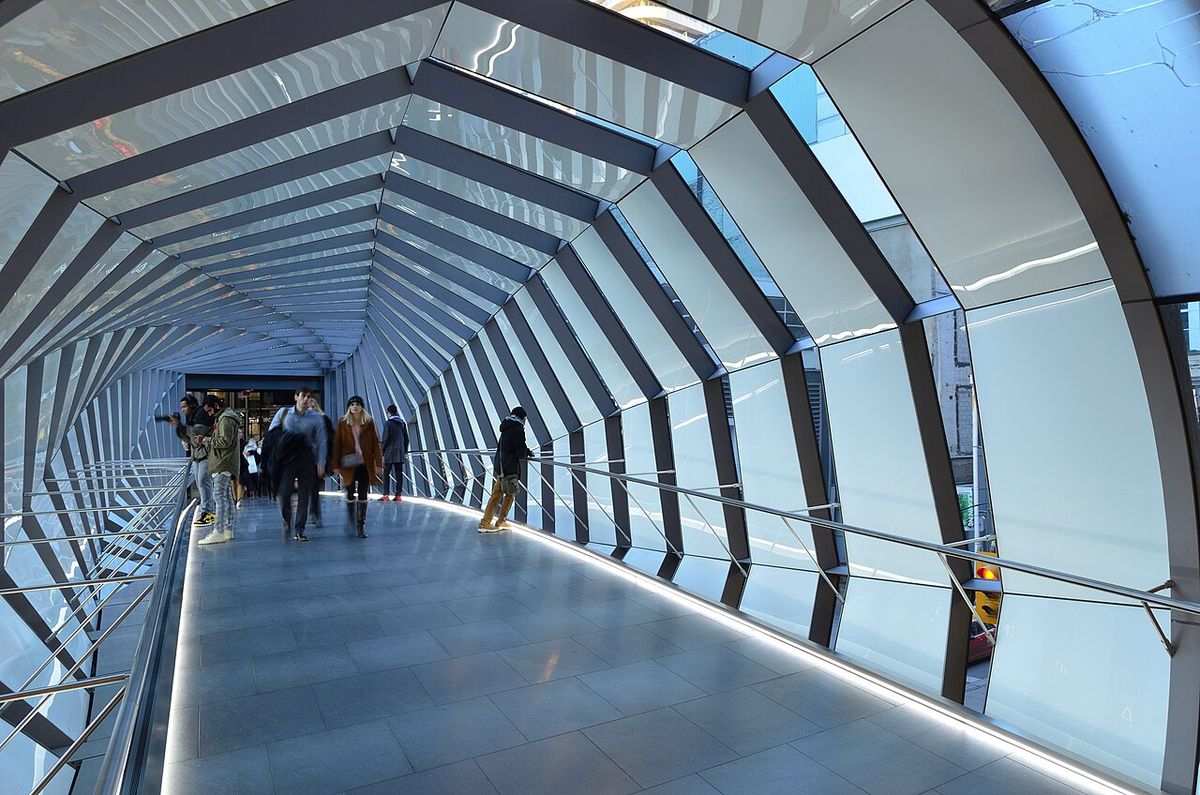
The main retail portion of the Toronto Eaton Centre is bounded by Yonge Street to the east, Queen Street West to the south, Dundas Street West to the north, and James Street and Trinity Square to the west. The complex is organized around a long, multi-level galleria running parallel to Yonge Street, with its north entrance on Dundas Street situated one level higher than its south entrance on Queen Street due to the site's gentle slope over the former path of Taddle Creek. The centre includes four major office towers and is integrated with Toronto Metropolitan University's Ted Rogers School of Management. To the south, the Hudson's Bay Queen Street department store and Simpson Tower office building, purchased by Cadillac Fairview in 2014, are managed as part of the Eaton Centre and connected via a skywalk over Queen Street and the underground Path network. The complex's interior forms a key part of the Path system and is directly served by two Toronto Transit Commission subway stations, TMU and Queen, on Line 1 Yonge-University. The Hudson's Bay Queen Street block itself is bounded by Yonge Street to the east, Queen Street West to the north, Richmond Street West to the south, and Bay Street to the west, creating a substantial contiguous retail and office footprint.
Historical development and planning
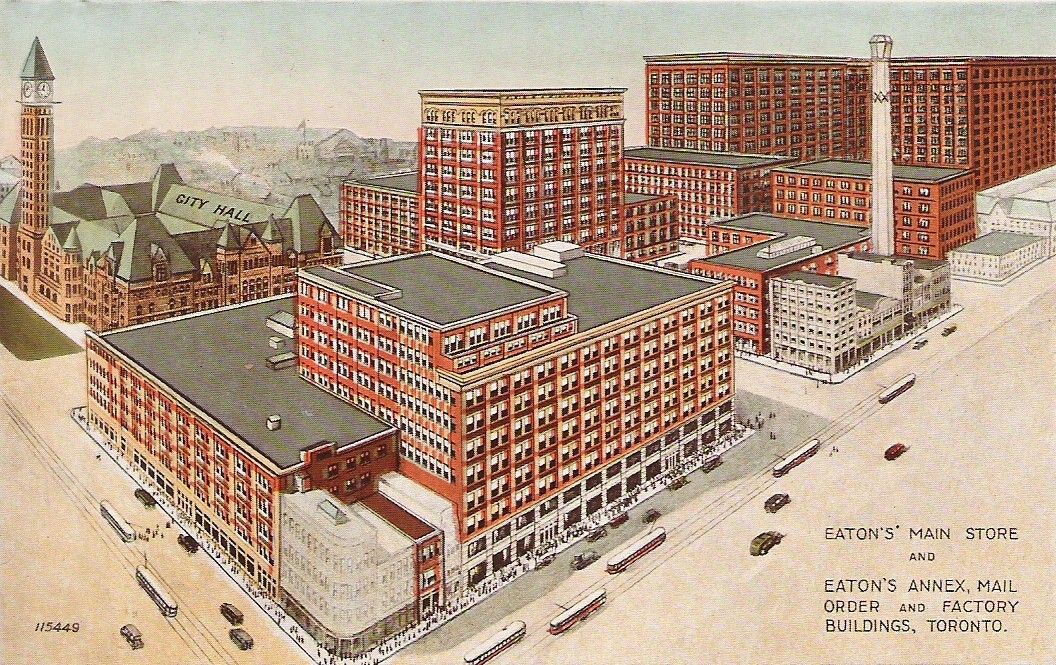
The site's history is deeply tied to the Eaton's department store chain, which owned most of the land bounded by Yonge, Queen, Bay, and Dundas streets by the mid-20th century, with the notable exceptions of Old City Hall and the Church of the Holy Trinity. In the mid-1960s, Eaton's announced ambitious plans for a massive office and shopping complex that initially called for the demolition of Toronto's Old City Hall, save for its clock tower and cenotaph, and the Church of the Holy Trinity. The plan required the closing of several small city streets within the block, including Albert Street, Louisa Street, Terauley Street, James Street, Albert Lane, Downey's Lane and Trinity Square. These plans sparked fierce public debate and were put on hold in 1967. Revised plans in 1971 preserved both historic buildings, leading to three major design changes. The new Eaton's store was relocated north to Dundas Street, as the preserved Old City Hall prevented building a large enough store at the Queen Street location opposite its rival Simpson's. The office component was reduced in scale, abandoning an attempt to extend the financial district north of Queen Street. Finally, the bulk of the centre was shifted east to the Yonge Street frontage, eliminating any frontage along Bay Street. The final design, a partnership between Eaton's, Cadillac Fairview, and the Toronto-Dominion Bank, was created by Eberhard Zeidler and Bregman + Hamann Architects, modelled after the Galleria Vittorio Emanuele II in Milan.
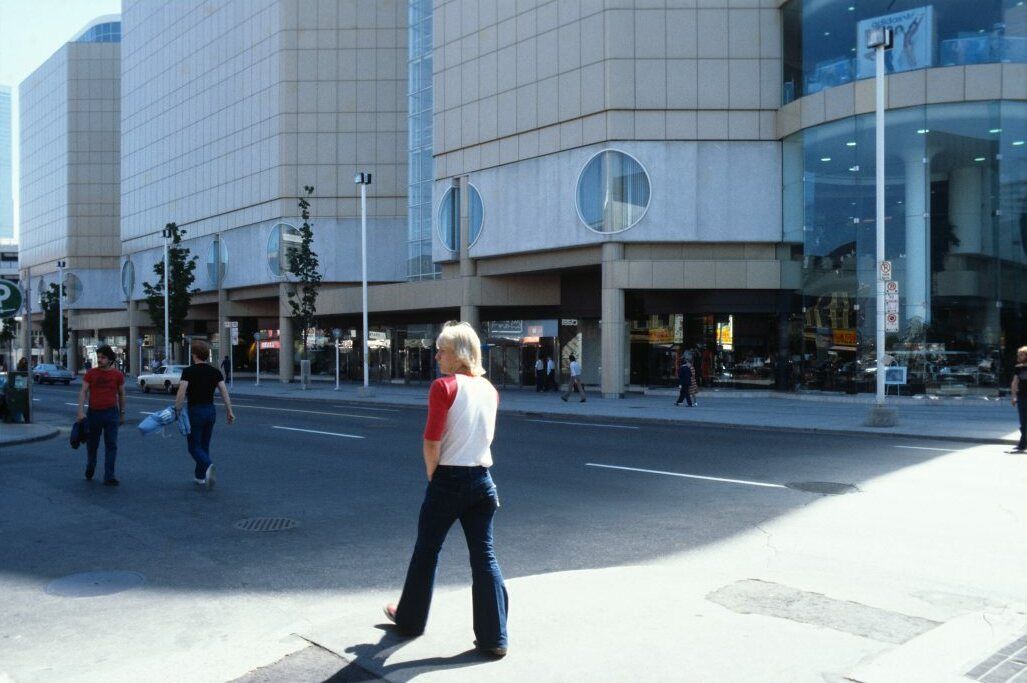
Construction occurred in phases, with the first phase including the nine-storey, 1,000,000-square-foot Eaton's store opening in 1977. A temporary wall at the south end was mirrored to give an impression of the completed galleria. The south half of the complex opened in 1979 after the demolition of the old Eaton's store at Yonge and Queen streets. The same year, the north end added an 18-screen Cineplex multiplex, then the world's largest. Several small streets, including Terauley, Louisa, Downey's Lane and Albert Lane, were closed and disappeared from the city grid. Albert Street and James Street were preserved only around Old City Hall, though a pedestrian passage where Albert Street once was remains accessible at all times per an agreement with the Church of the Holy Trinity. Trinity Square lost its public access to Yonge Street, becoming a pedestrian-only square accessible from Bay Street. The original exterior design was inwardly focused, with much of the Yonge Street façade dominated by a nine-storey parking garage and few street-facing retail entrances, a design later lamented by urban planners.
Ownership, naming, and rebranding
Upon its opening in 1977, the complex was marketed as The Eaton Centre. In the early 1990s, the name was changed to Toronto Eaton Centre to distinguish it from other Eaton Centres across Canada. Despite the bankruptcy of the Eaton's department store chain in 1999 and the subsequent closure of a short-lived Sears Canada-owned revival in 2002, the mall retained the name as a tribute to founder Timothy Eaton and the small shop he once opened at this location. The name was used under licence from Sears Canada, which had acquired the Eaton's trademarks and other intellectual property, until December 2016 when mall owner Cadillac Fairview acquired the Eaton's IP outright. In early 2014, mall management began an effort to enforce usage of the full Toronto Eaton Centre name, though exterior signage was inconsistent at the time. In September 2015, Cadillac Fairview announced it was rebranding all of its mall properties by adding the prefix CF, leading to the current official name, CF Toronto Eaton Centre. This branding was phased in on signage over the following year as renovations in the former Sears wing concluded.
Major renovations and expansions
The mall has undergone significant changes and expansions since its opening, reflecting retail trends and urban design philosophies. In the early 2000s, owner Cadillac Fairview redesigned the mall's Yonge Street façade, bringing it closer to the street and making it more closely resemble an urban shopping district, with stores opening directly onto the street and presenting a variety of façades. Further redevelopments in the late 1990s and early 2000s added new retail space, including an expansion on the west side of the complex opposite Albert Street. The glass atrium at the northeast corner at Yonge and Dundas streets was redesigned, relocating tenants like a Toronto Police Service office to make way for H&M's Canadian flagship store designed by Queen's Quay Architects International Inc. One of the mall's two parking garages, the nine-storey Dundas Parkade on Dundas Street with its spiral ramps and the multiplex cinema below, was demolished in 2003. In its place and on a vacant site at Dundas and Bay, a new wing opened in 2006, containing Canadian Tire, Best Buy and Mark's, with Toronto Metropolitan University's Faculty of Business and a new 574-space parking garage on the upper levels, designed by Queen's Quay Architects International Inc. with Zeidler Partnership Architects.
In June 2010, Cadillac Fairview announced a comprehensive CA$120 million, two-year renovation and revitalization plan for the mall. The project included numerous upgrades designed to modernize the visitor experience and infrastructure. The scope of work for the 2010 revitalization was extensive and covered multiple aspects of the complex's common areas and facilities. The key components of this renovation included:
- New flooring installed throughout the entire mall.
- Complete redevelopment of the centre's two existing food courts.
- Upgrades and expansions to all public washroom facilities.
- Improvements to lighting systems for better ambience and energy efficiency.
- Installation of new railings and new entry doors.
- Implementation of various green initiatives to improve sustainability.
Further integration occurred in 2014 when Cadillac Fairview purchased and incorporated the Hudson's Bay block at Queen and Yonge streets into the complex's management. This addition brought the Simpson Tower offices and the flagship Hudson's Bay department store into the Toronto Eaton Centre's portfolio. The Hudson's Bay Queen Street complex has been managed as part of the Eaton Centre since 2014. By 2014, the retail complex occupied about 160,000 square metres, making it the second-largest mall in Ontario at that time. It was larger than Yorkdale Shopping Centre but smaller than Square One Shopping Centre in Mississauga.
Notable features, art, and legal precedent
One of the mall's most prominent and recognizable features is the group of fibreglass Canada geese hanging from the glass ceiling, a sculpture named Flight Stop by Canadian artist Michael Snow. This artwork was the subject of an important intellectual property court ruling in the case of Snow v Eaton Centre Ltd. One Christmas season, the management of the centre decided to decorate the geese with red ribbons without consulting Snow. The artist sued, arguing that the ribbons made his naturalistic work ridiculous and harmed his reputation. The court ruled that even though Eaton Centre Limited owned the sculpture, the ribbons had infringed Snow's moral rights, and they were ordered removed. This case established a significant precedent for artists' rights in Canada regarding the treatment of their work after sale. The mall's profits in its early years were said to be so substantial that they have often been credited with keeping the Eaton's chain afloat for another two decades before its 1999 bankruptcy. Following the chain's collapse, the statue of Timothy Eaton was moved from the Dundas Street entrance to the Royal Ontario Museum.
Significant incidents and events
The centre has been the site of several notable and tragic events that have entered public record. On June 2, 2012, a shooting took place in the Urban Eatery food court while the mall was heavily crowded with shoppers. Seven people were shot, resulting in the death of 24-year-old Ahmed Hassan at the scene and 22-year-old Nixon Nirmalendran in hospital on June 11, 2012. Others were injured in the panic as people fled, including a 28-year-old pregnant woman who began undergoing labour but did not give birth. A highly publicized coincidence involved 24-year-old Jessica Ghawi, who had left the food court minutes prior and was killed seven weeks later in the Aurora, Colorado movie theatre shooting. The perpetrator, Christopher Husbands, turned himself in two days later. He was initially found guilty of second-degree murder in 2015 and sentenced to 30 years-to-life, but was granted a new trial in 2017. In late November 2019, he was found guilty of two counts of manslaughter, five counts of aggravated assault and one count each of criminal negligence causing bodily harm and reckless discharge of a firearm, receiving a life sentence with parole eligibility by 2021.
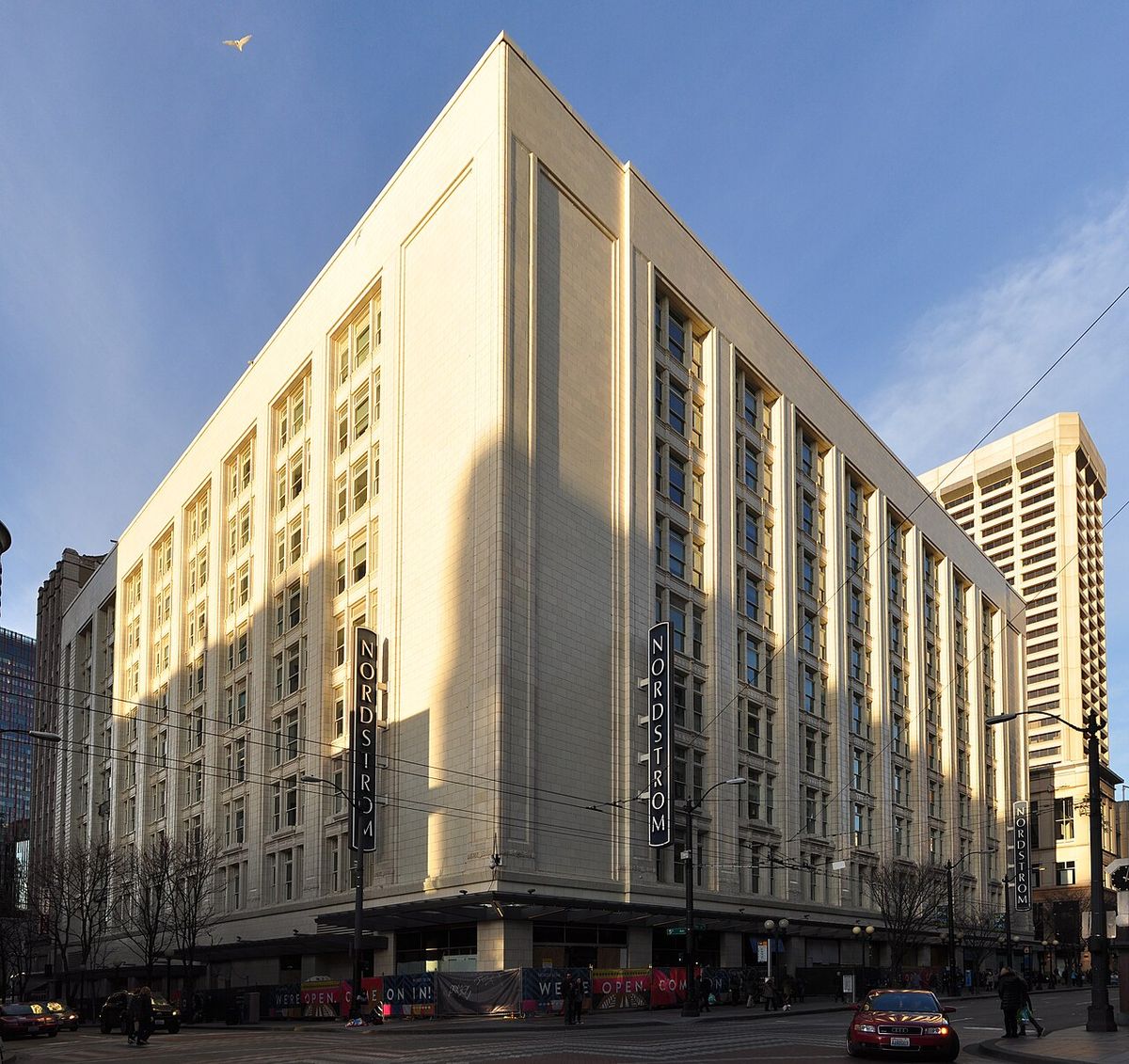
In June 2010, during the G20 Summit protests, the mall entered a lockdown. A would-be shopper, Lee Zaslofsky, a Canadian anti-war activist, was filmed shouting at the locked doors of an entrance, and the video was uploaded to YouTube, quickly becoming an internet meme. Zaslofsky, who protested the Western occupation of Iraq, died on August 24, 2024. The centre also faced a major tenant transition when Sears Canada announced the closure of its flagship location on October 29, 2013, ending its presence that began in 2002 after acquiring the Eaton's lease. On January 15, 2014, Nordstrom announced it would be taking over the space, marking another shift in the mall's anchor tenancy.
Anchor tenant history and commercial evolution
The mall's anchor tenancy has seen significant transitions reflecting the changing fortunes of Canadian department stores. Eaton's anchored the north end from the mall's 1977 opening until its bankruptcy in 1999. Many of Eaton's corporate assets were then acquired by Sears Canada, which included the lease on the nine-storey department store space. Sears briefly ran the store as part of an upscale eatons mini-chain before rebranding it to Sears by 2002. Sears converted the uppermost four floors to corporate offices, replacing their previous headquarters at 222 Jarvis Street, and converted the lowest floor to mall retail, leaving a four-level department store that was still Sears' largest in the world at about 75,981 square metres. The south end has been continuously anchored by the Hudson's Bay store, originally Simpson's, since the mall's opening. The entire Hudson's Bay block, including the Simpson Tower offices completed in 1969, became part of the Toronto Eaton Centre upon Cadillac Fairview's acquisition in 2014. This purchase integrated the flagship Hudson's Bay location fully into the mall's management and connected it via the skywalk and Path.
Commercial significance, statistics, and office component
The Toronto Eaton Centre is a commercial powerhouse and a central feature of Toronto's downtown core, often cited as attracting more visitors than any of the city's tourist attractions. As of 2014, the retail complex encompassed approximately 160,000 square metres of space, making it the second-largest shopping mall in Ontario at that time, after Square One in Mississauga and ahead of Yorkdale Shopping Centre. The mall housed over 230 stores and restaurants in 2014. Its location atop major transit lines and its integration with the Path network ensure exceptionally high foot traffic, combining daily commuters with tourist visitors, which contributes to its status as one of the busiest shopping malls in North America. The complex also includes substantial office space across its four towers, contributing to its role as a mixed-use urban hub. The office towers were constructed over several years, each with distinct architectural contributions. The following table outlines the completion dates, heights, and design firms for its major office towers:
| Building Name | Completion Year | Storeys | Design Architects |
|---|---|---|---|
| One Dundas West | 1977 | 29 | B+H Architects and Zeidler Partnership Architects |
| Cadillac Fairview Tower | 1982 | 36 | Bregman + Hamann Architects, and Zeidler Partnership Architects |
| 250 Yonge Street (Eaton Tower) | 1992 | 35 | Zeidler Partnership Architects, and Crang & Boake |
| Simpson Tower (401 Bay Street) | 1969 | 33 | Became part of Toronto Eaton Centre in 2014 |
The integration of the Simpson Tower in 2014 further expanded the centre's office footprint and solidified its connection to the Bay Street financial district. The complex is also linked to a 17-storey Marriott hotel on Bay Street, adding to its mixed-use character. The mall's initial inward orientation and setback from Yonge Street, insisted upon by the Metro Toronto government to allow for a potential extra traffic lane, were later addressed in façade redesigns to improve its street presence. The centre's success in its early years led to the construction of additional shopping centres across Canada bearing the Eaton brand name.
Questions about Toronto Eaton Centre
Why is it called the Eaton Centre?
The mall is named after the Eaton's department store chain, which anchored it from its opening in 1977 until the chain's bankruptcy in 1999. The name was retained as a tribute to founder Timothy Eaton and his original store on the site. The name was used under licence from Sears Canada, which owned the trademarks, until Cadillac Fairview purchased the Eaton's intellectual property outright in December 2016. The complex was originally marketed as The Eaton Centre, then became Toronto Eaton Centre in the early 1990s, and finally CF Toronto Eaton Centre after a 2015 rebranding.
What happened in the 2012 Eaton Centre shooting?
On June 2, 2012, a shooting occurred in the mall's Urban Eatery food court. Seven people were shot, resulting in the deaths of 24-year-old Ahmed Hassan at the scene and 22-year-old Nixon Nirmalendran in hospital on June 11. The perpetrator, Christopher Husbands, turned himself in and was initially convicted of second-degree murder in 2015. After a retrial was ordered in 2017, he was found guilty in November 2019 of two counts of manslaughter, five counts of aggravated assault and one count each of criminal negligence causing bodily harm and reckless discharge of a firearm. He was sentenced to life in prison with parole eligibility in 2021.
How do I get to the Toronto Eaton Centre by transit?
The centre is directly served by two Toronto Transit Commission subway stations on Line 1 Yonge-University: Toronto Metropolitan University (TMU) station and Queen station. TMU station is connected to the mall's Level 1 (a walkway under the platform) and Level 2 (platform level), while Queen station is connected to Level 1. The complex is also a major node in Toronto's underground pedestrian network, the Path, and is within walking distance of Union Station, the city's main transit hub. Its placement over these stations is a key reason for its exceptionally high visitor traffic.
What major stores have anchored the mall?
The north anchor was originally the nine-storey Eaton's department store from 1977 to 1999. Sears Canada then operated a store there from 2002, after a brief eatons format, until its closure was announced in 2013. Nordstrom subsequently took over the space. The south end has been continuously anchored by the Hudson's Bay department store, which was originally the Simpson's store, since the mall's opening. The Hudson's Bay block, including the Simpson Tower, was purchased by Cadillac Fairview and fully integrated into the mall's management in 2014.
What was the 2010 revitalization project and other major expansions?
In June 2010, owner Cadillac Fairview announced a CA$120 million, two-year renovation plan. The project included new flooring, redeveloped food courts, upgraded washrooms, improved lighting, new railings and doors, and green initiatives. Earlier, a major expansion opened in 2006 after the 2003 demolition of the Dundas Parkade. That new wing added retailers Canadian Tire, Best Buy and Mark's, along with Toronto Metropolitan University's Faculty of Business and a new parking garage. The Yonge Street façade was also redesigned in the early 2000s to add street-level storefronts.
What is the Flight Stop sculpture?
Flight Stop is a group of fibreglass Canada geese sculptures hanging from the glass ceiling of the Toronto Eaton Centre. This prominent artwork was created by Canadian artist Michael Snow. The sculpture was central to an important intellectual property court ruling. One Christmas, mall management decorated the geese with red ribbons without consulting Snow. In the case Snow v Eaton Centre Ltd, the court ruled this action infringed the artist's moral rights by making his naturalistic work look ridiculous and harming his reputation. The court ordered the ribbons to be removed.
Sources and further reading
- Toronto Eaton Centre (Wikipedia)
- CF Toronto Eaton Centre Directory | Popular Stores & Top ... (shops.cadillacfairview.com)
- CF Toronto Eaton Centre Unveils New Era of Retail with ... (cadillacfairview.com)
Checked by the Yadude Books desk. Last updated 2026-11-05.