Warby Parker
Warby Parker is an American eyewear brand and retailer that has become a significant player in the Canadian optical market through its direct-to-consumer model and expanding physical presence. Founded in 2010 by four MBA students, the company disrupted the traditional eyewear industry by selling stylish, affordable prescription glasses, sunglasses, and contact lenses primarily online before expanding into a vast network of retail stores. Its appeal to Canadian consumers is bolstered by its social mission, the 'Buy a Pair, Give a Pair' program, and its innovative use of technology for virtual try-ons and vision tests. The company, which became a publicly traded public benefit corporation in 2021, operates numerous locations across Canada and continues to grow its customer base and product offerings.
Founding and early growth
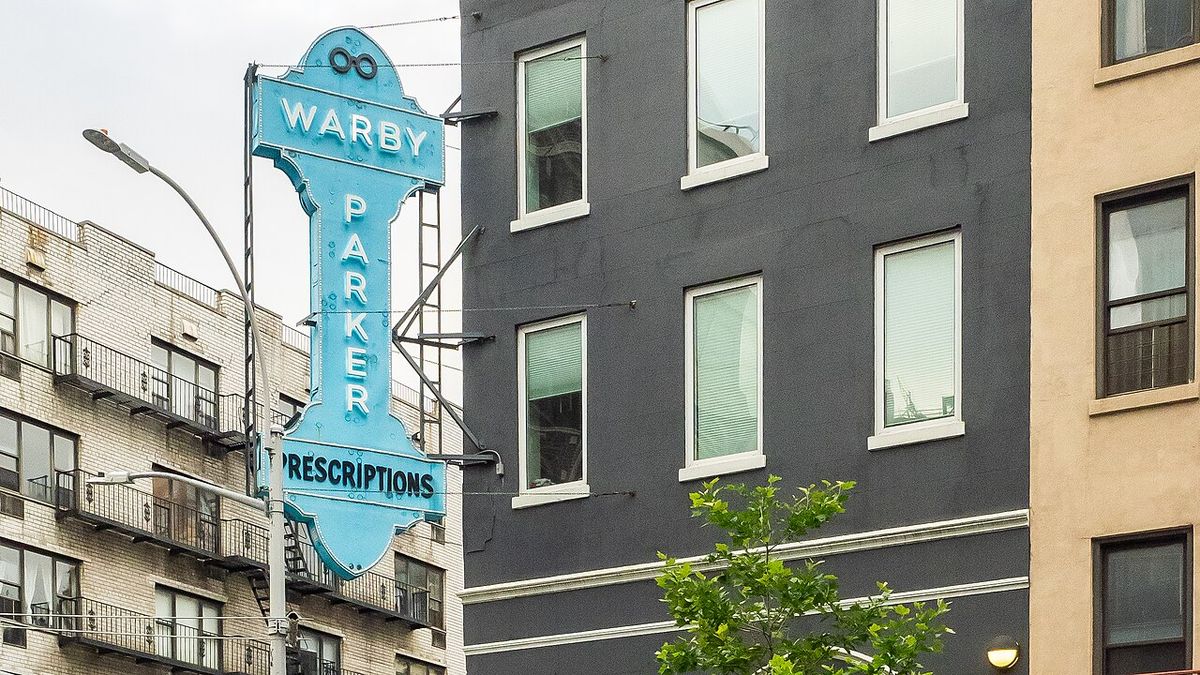
Warby Parker was founded in Philadelphia in February 2010 by Neil Blumenthal, Andrew Hunt, David Gilboa, and Jeffrey Raider, who were all MBA students at the Wharton School of the University of Pennsylvania. The venture began with a $2,500 seed investment from the school's Venture Initiation Program and gained immediate media attention with coverage in Vogue and GQ shortly after launch. The company's name is derived from two characters found in journals written by the author Jack Kerouac, reflecting the founders' interest in a distinctive brand identity. In its first full year, 2011, the company shipped more than 100,000 pairs of glasses and employed about 60 people, demonstrating rapid initial traction in the online eyewear space.
The company's growth was fueled by several significant rounds of venture capital funding in its early years. It raised $2.5 million in May 2011, followed by a $12.5 million Series A round in September 2011 and a $37 million Series B round in September 2012. An additional $4 million investment came from American Express and Mickey Drexler in February 2013. By the end of 2012, the employee count had grown to around 100. A major milestone was reached in April 2015 when a $100 million funding round led by T. Rowe Price valued the company at $1.2 billion, cementing its status as a unicorn startup. The company's early product lineup even included prescription monocles, sold as a whimsical nod to its fun brand ethos.
Evolution of the retail model
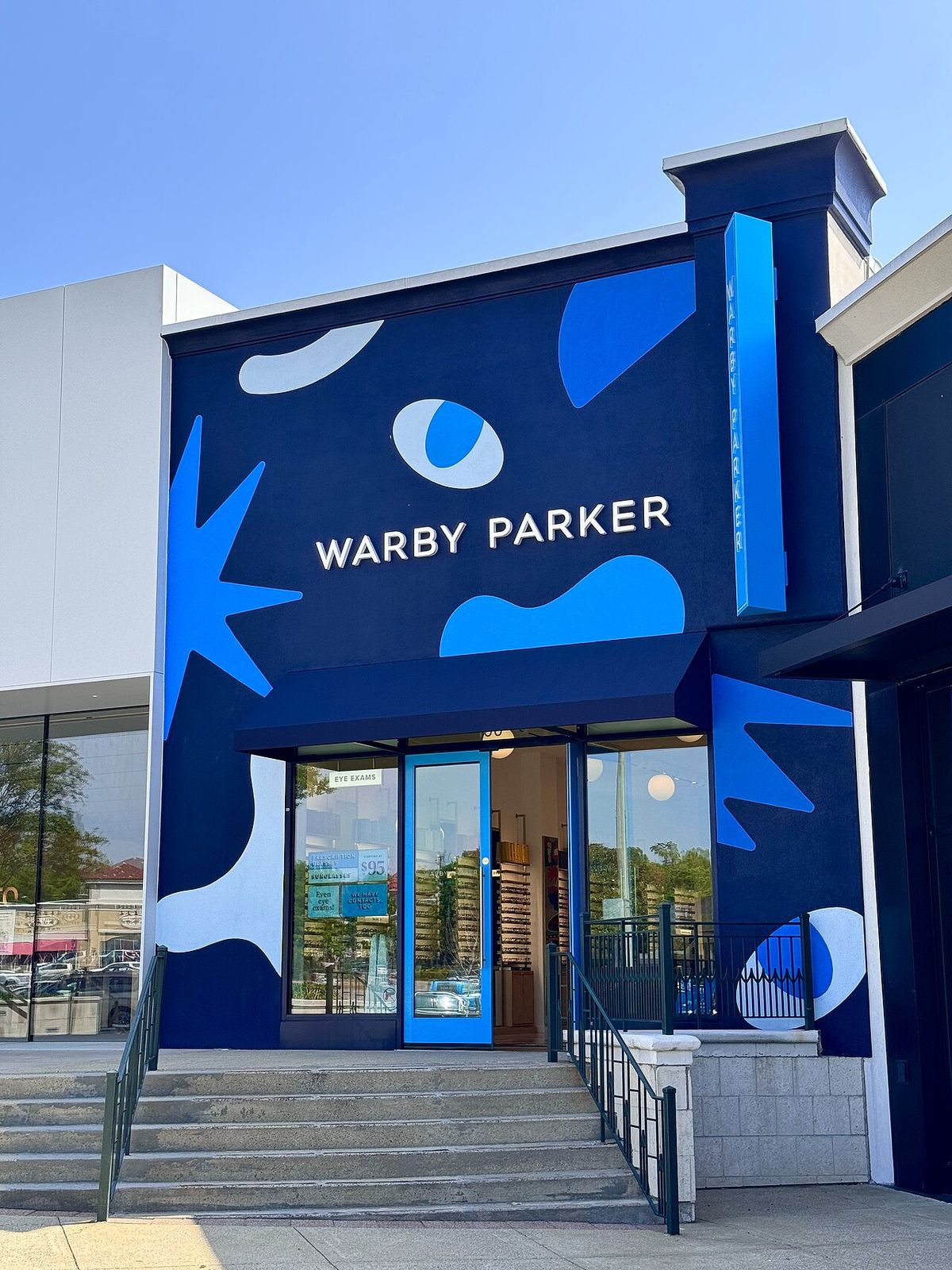
Warby Parker launched as an online-only retailer, using a pioneering Home Try-On program that allowed customers to select five frames to try at home for five days free of charge. This program ended at the close of 2025 as the company shifted its focus to other digital and physical retail strategies. As revenue grew, the company experimented with various physical retail concepts, beginning with pop-up showrooms in boutiques. In 2012, it launched the Class Trip, a mobile store built inside a retrofitted yellow school bus that toured the United States. The first permanent brick-and-mortar store opened in New York City in April 2013, marking a decisive turn toward an omnichannel strategy.
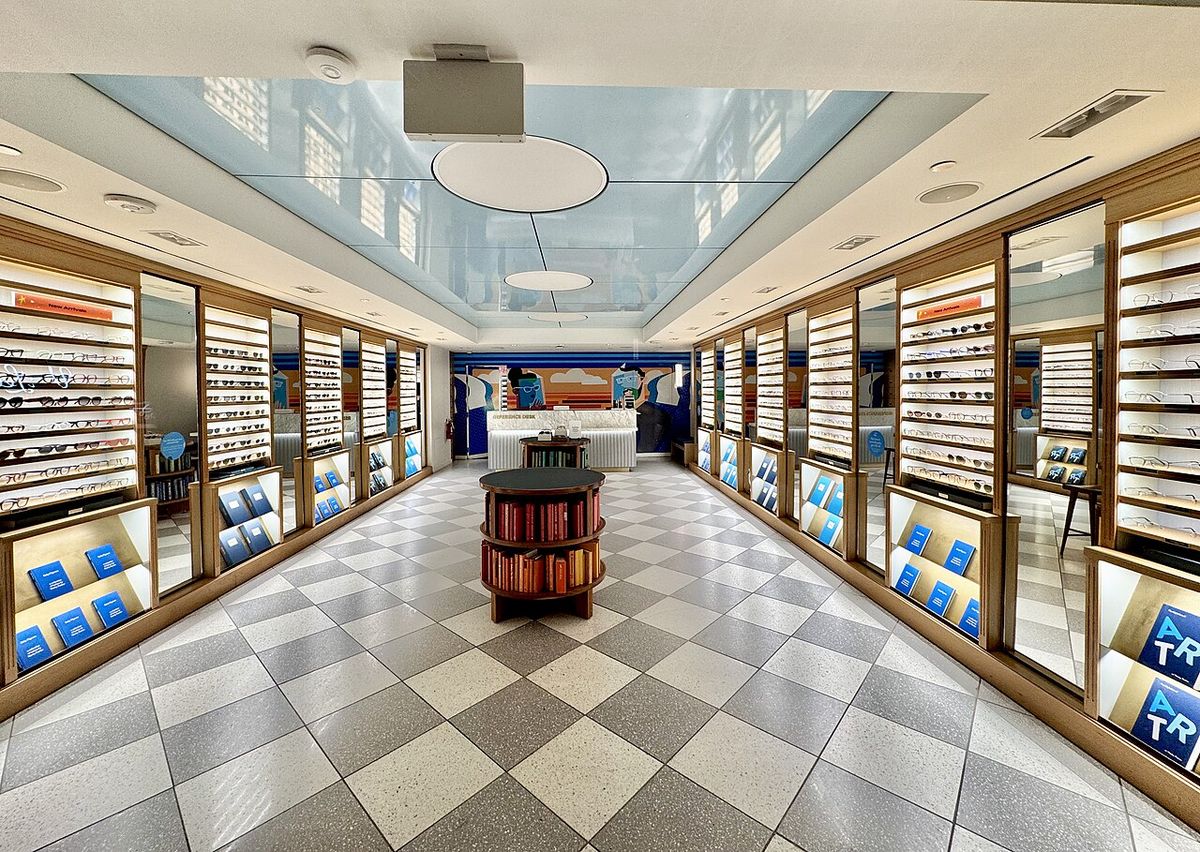
The company's physical footprint expanded steadily across North America. By January 2017, it operated approximately 41 stores in 28 U.S. states along with its initial Canadian locations in Toronto and Vancouver. Store growth accelerated significantly, with 2025 being a record year that saw the opening of 47 new stores. By the end of 2025, Warby Parker operated 323 stores total and had grown its active customer base to 2.69 million, a 7 percent increase from the previous year. That same year, the brand also expanded its reach by opening locations inside select Target stores. The company developed its own point-of-sale system, which was fully implemented by 2015 to support its growing retail network.
Product development and technological innovation
Warby Parker designs its eyewear in-house and works directly with manufacturing partners in Italy, Vietnam, Japan, and China, often utilizing the same factories as larger competitors. The core product lines include prescription glasses, sunglasses, and contact lenses, all sold directly to consumers. The company expanded its offerings with the release of its first kids' line of glasses in January 2018 and launched its own brand of daily contact lenses, called Scout by Warby Parker, in November 2019. A major component of its service model is providing eye exams, which it offers in its retail stores.
The company has consistently invested in technology to enhance the customer experience. It introduced virtual prescription check tests in 2017, which evolved into the Virtual Vision Test app launched in July 2021 for iPhone users to update eyeglass and contact lens prescriptions. In February 2019, Warby Parker released a Virtual Try-On feature that uses augmented reality and the iPhone's facial-mapping technology to show how frames would look at a realistic scale on a user's face. The company also operates sophisticated optical labs, opening a 34,000-square-foot, $16 million lab in Rockland County, New York, in 2017 and a second, 69,000-square-foot lab in Summerlin, Nevada, in November 2021 to serve customers in the western United States.
- Virtual prescription checks introduced (2017)
- First kids' glasses line launched (January 2018)
- Virtual Try-On with AR released (February 2019)
- Scout daily contact lenses launched (November 2019)
- Virtual Vision Test app for iPhone introduced (July 2021)
- Second U.S. optical lab opened in Nevada (November 2021)
Social mission and corporate structure
Central to Warby Parker's brand identity is its social entrepreneurship model, known as Buy a Pair, Give a Pair. For every pair of glasses purchased, the company funds the production and distribution of a pair of eyeglasses for someone in need through nonprofit partners like VisionSpring and Restoring Vision. The company announced it had distributed one million pairs through this program by June 2014. As of May 2026, the initiative has distributed over 25 million pairs of glasses in more than 80 countries. The company also claims to be 100 percent carbon neutral across its direct operations. In 2015, it launched the Pupils Project, which provides free vision screenings, eye exams, and glasses to students in U.S. public schools.
The company's corporate structure reflects its commitment to social responsibility. It received B Corp certification soon after its founding in 2010 but later let the status lapse. In mid-2021, prior to its direct listing, Warby Parker reincorporated as a public benefit corporation and regained its B Corp certification. To coincide with going public, the company established the Warby Parker Impact Foundation and authorized up to 1 percent of its outstanding shares for future grants to the foundation. This made Warby Parker the first public benefit corporation to go public via a direct listing when it debuted on the New York Stock Exchange on September 29, 2021.
Strategic partnerships and recent initiatives
Warby Parker has engaged in several key partnerships to expand its reach and innovate its product lineup. Its first national retail partnership was established with Nordstrom in 2015, leading to six pop-up shops across the United States. A significant technological partnership was announced with Google at the Google I/O 2025 conference. The collaboration involves developing AI-powered smart glasses based on the Android XR platform, supported by the Gemini AI assistant, with Google investing up to $150 million in the initiative. At Google I/O 2026, the first Warby Parker-branded Android XR intelligent eyewear models were unveiled, with a launch planned for fall 2026 offering support for both prescription and non-prescription lenses.
In 2025, Warby Parker launched Book Report, a public event series at its flagship store in New York City that hosts conversations with authors. Participants in this series have included Lena Dunham and Gloria Steinem. From April 1 to 8, 2024, the company made free solar eclipse glasses available at its U.S. retail stores to provide safe viewing of the Great North American Eclipse. In October 2023, a federal appeals court ruled that the company's use of the keyword 1-800 Contacts in search engine optimization to redirect search engine users to its website was not in violation of U.S. trademark law.
Financial performance and market position
Warby Parker's financial history is marked by substantial venture capital investment leading to its public market debut. Following its early funding rounds, the company raised $75 million in Series E funding in March 2018, bringing its total funding to approximately $300 million. A major valuation jump occurred in August 2020 when it raised $245 million in a combined Series F and Series G round that valued the company at $3 billion. The direct listing on the New York Stock Exchange in September 2021 provided a liquidity event for early investors and employees without the company issuing new shares. The following table outlines key funding milestones and the corresponding company valuations where publicly disclosed.
| Year | Funding Round / Event |
|---|---|
| 2011 | First round |
| 2011 | Series A |
| 2012 | Series B |
| 2015 | Funding round |
| 2018 | Series E |
| 2020 | Series F & G |
| 2021 | Direct listing |
The company's shift from a pure online player to a retailer with a large physical footprint is reflected in its store growth and customer metrics. The addition of 47 new stores in 2025 represented its largest annual expansion, bringing the total to 323 locations by year's end. Its active customer base reached 2.69 million at the same time. This growth highlights the success of the company's omnichannel strategy, which blends digital innovation with accessible retail locations across the United States and Canada. The company's revenue, which started from online sales, now comes primarily from its physical retail stores.
Questions about Warby Parker
Does Warby Parker have stores in Canada?
Yes, Warby Parker has a physical retail presence in Canada. The company first expanded into the Canadian market with stores in Toronto and Vancouver, which were operational by January 2017. These locations are part of the company's broader North American retail network, which totalled 323 stores by the end of 2025. Canadian customers can visit these stores for eye exams, frame selection, and fittings, in addition to using the company's online platform.
What is Warby Parker's Buy a Pair, Give a Pair program?
Buy a Pair, Give a Pair is Warby Parker's social entrepreneurship model where for every pair of glasses purchased, the company pays for the production of another pair to be distributed to someone in need. The company partners with nonprofits like VisionSpring and Restoring Vision to facilitate the distributions globally. As of May 2026, the program has distributed over 25 million pairs of glasses in more than 80 countries. The initiative is a core part of the company's identity as a public benefit corporation.
When did Warby Parker go public?
Warby Parker became a publicly traded company on September 29, 2021, through a direct listing on the New York Stock Exchange. This method allowed existing shareholders to sell their shares directly to the public without the company issuing new stock. The listing was historic as Warby Parker was the first public benefit corporation to go public via a direct listing. Prior to the listing, the company reincorporated as a public benefit corporation and regained its B Corp certification.
What are Warby Parker's smart glasses with Google?
In 2025, Warby Parker announced a partnership with Google to develop AI-powered smart glasses based on the Android XR platform, supported by the Gemini AI assistant. Google committed up to $150 million to the initiative. The first Warby Parker-branded Android XR intelligent eyewear models were unveiled at Google I/O 2026, with a planned launch for fall 2026. These glasses will support both prescription and non-prescription lenses, blending Warby Parker's optical expertise with Google's advanced computing and AI technology.
Can I get an eye exam at Warby Parker?
Yes, Warby Parker offers eye exams. The company began offering virtual prescription check tests in 2017 as part of its services. In July 2021, it introduced the Virtual Vision Test app, a successor to the 2017 service, which allows iPhone users to update their eyeglass and contact lens prescriptions remotely. This digital tool complements the in person eye exams available at their retail locations. Warby Parker's expansion into eye care services aligns with its broader offerings of prescription glasses, contact lenses, and sunglasses. The company operates both online and through physical stores across the United States and Canada.
How does Warby Parker's Virtual Try-On work?
Warby Parker's Virtual Try On feature uses augmented reality and the iPhone's facial mapping technology to display frames at a realistic scale and placement on a user's face. This feature was released in February 2019. The technology allows customers to see how different eyewear styles look on them digitally before making a purchase. The company also has programs where customers can upload a photo to try on frames virtually through the mobile app. This virtual fitting service is part of Warby Parker's direct to consumer retail model, which includes both online sales and physical store locations. It provides an alternative to the now concluded Home Try On program.
Sources and further reading
- Warby Parker (Wikipedia)
- How Warby Parker grew from eyeglasses upstart to ... (cnbc.com)
- Warby Parker Inc Company Profile, Overview (globaldata.com)
- Business Case Study: Warby Parker (causeartist.com)
- Warby Parker, Wharton Magazine, University of Pennsylvania (magazine.wharton.upenn.edu)
Checked by the Yadude Books desk. Last updated 2026-11-03.