Woolworth
The F. W. Woolworth Company, commonly known as Woolworth's or Woolworth, was an American retail pioneer that shaped modern shopping. Founded by Frank Winfield Woolworth in 1879, it became a global giant by popularizing the five-and-dime store model, where goods were sold at fixed low prices and customers could browse merchandise freely. For Canadians, Woolworth was a familiar downtown and suburban anchor for decades, with its stores serving as community hubs and its Woolco discount chain becoming a major retail force before being sold to Walmart. The company's legacy continues through its corporate successor, Foot Locker, Inc., which was acquired by rival Dick's Sporting Goods in 2025.
Origins and the Five-and-Dime Model
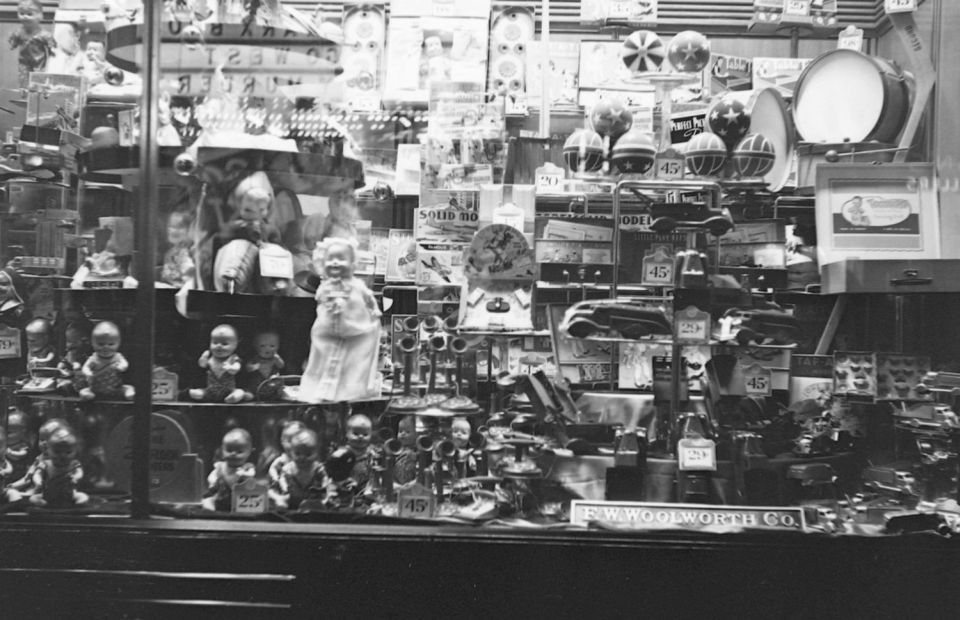
Frank Winfield Woolworth opened his first store, the Woolworth's Great Five Cent Store, in Utica, New York, on February 22, 1879, but it failed and closed after only three months. His second attempt in Lancaster, Pennsylvania, on June 21, 1879, proved successful and established the foundational retail model that would define the company. Woolworth pioneered the concept of fixed-price merchandise, initially at five and ten cents, which undercut local merchants and attracted a broad customer base. Crucially, he was among the first American retailers to allow customers to handle and select goods without assistance from a clerk, moving away from the traditional counter-service system where all items were kept behind a counter. This innovative approach created a new, accessible shopping experience that would define the variety store for a century and was widely imitated by competitors.
Expansion was initially familial and syndicated through a network of friendly rivals. Woolworth opened a second store in Harrisburg, Pennsylvania, in 1879, managed by his brother Charles Sumner Woolworth, though it later closed after a dispute with the landlord. After some early closures, the brothers found lasting success with a store in Scranton, Pennsylvania, which opened on November 6, 1880, and fully developed the combined "5¢ & 10¢" merchandising model. Charles later bought out Frank's share of the Scranton store in two installments in 1881 and 1882, becoming the company's first franchisee. By the early 1880s, a syndicate of chains operated similar stores under different founders' names, including a partnership between Charles and wholesaler Fred Morgan Kirby called "Woolworth and Kirby" in Wilkes-Barre, Pennsylvania. This cooperative network pooled inventory and purchasing power, laying the groundwork for a national corporation.
Rise to a Global Retail Powerhouse
The various syndicate chains formally merged into the incorporated F. W. Woolworth Company on February 16, 1905. By 1912, the merger was complete, uniting 596 stores under one corporate banner with Frank Woolworth as president and his brother Charles, Fred Kirby, Seymour H. Knox I, Earle Charlton, and William Moore as directors and vice presidents. The company's growth was physically symbolized by the Woolworth Building in New York City, commissioned by Frank and designed by architect Cass Gilbert, which was completed in 1913 and paid for entirely in cash. This pioneering early skyscraper was the world's tallest building until 1930 and served as the corporate headquarters for most of the century. The company expanded internationally, opening its first United Kingdom store in 1909, followed by Ireland in 1914, Germany in 1927, and Mexico in 1956, building a truly global retail presence.
Woolworth stores evolved beyond their strict price-limited origins to meet changing consumer demands. In the spring of 1932, the company added a 20-cent line of merchandise, and by November 13, 1935, its directors decided to discontinue selling-price limits altogether. The stores also became important community centres, notably with the introduction of lunch counters, a concept imported from the successful UK stores which served as general gathering places and a precursor to the modern food court. These counters served as social gathering spots and, significantly, as stages for the civil rights movement, with the Greensboro, North Carolina, lunch counter being the site of the historic 1960 sit-in protest against racial segregation policies. The company's sales were enormous, reaching $253 million in 1925 and $239 million in 1926, and by its 100th anniversary in 1979, it was recognized by the Guinness Book of World Records as the largest department store chain in the world.
Diversification and the Birth of Foot Locker
In the 1960s, Woolworth diversified its retail formats to compete in a changing market dominated by new discount chains. In 1962, it launched Woolco, a chain of large, single-floor discount department stores, the same year competitors S.S. Kresge opened Kmart, Dayton's opened Target, and Sam Walton opened his first Walmart. A more enduring strategic move came in 1963 with the purchase of the Kinney Shoe Corporation, which marked the company's expansion into the shoe store business. This acquisition paved the way for the company's future, leading to the founding of the athletic retailer Foot Locker in 1974 under the Kinney division, a brand that would eventually subsume the entire corporation. Throughout the 1980s, Woolworth aggressively pursued a strategy of operating multiple specialty store formats within enclosed shopping malls, including Champs Sports, Northern Reflections, Afterthoughts, and Rx Place.
The company also experimented with revising its core dime store model to suit mall environments, creating Woolworth Express, a small mall-oriented variant described as a specialty variety store. It stocked everyday convenience items like health and beauty aids, greeting cards, and school supplies, somewhat akin to mall-based drug stores. The corporate aim was to have ten different store concepts in each major mall, though this never came to pass as Woolworth did not develop that many successful formats. The sporting goods division, particularly Foot Locker, flourished while the general merchandise business faced stiff competition, and this period of diversification ultimately set the stage for the company's complete transformation. The successful athletic segment would eventually become the company's sole focus, leading to the abandonment of the Woolworth name.
- 1962: Launch of the Woolco discount department store chain.
- 1963: Acquisition of Kinney Shoe Corporation.
- 1974: Founding of the Foot Locker retail chain under Kinney.
- 1980s: Expansion into mall-based specialty formats like Champs Sports, Afterthoughts, and Northern Reflections.
- 1980s: Creation of the Woolworth Express mall convenience store concept.
Decline of the Department Stores and Canadian Operations
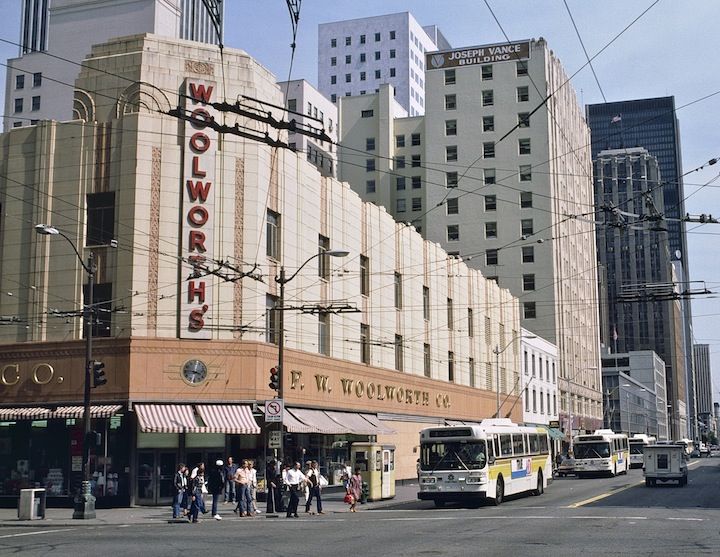
The Woolworth company's strategic shift away from its five-and-dime roots contributed to the decline of its signature variety stores as it placed less emphasis on the department store chain. It struggled to compete with expanding big-box discounters like Walmart and supermarkets that began stocking similar general merchandise, eroding its market share. The Woolco chain, while successful in Canada, closed in the United States in 1983, and the British operation was separated from the parent company in 1982, later becoming Woolworths plc. In a major restructuring announced on October 15, 1993, the company declared it would close half of its 800-plus US general merchandise stores and convert its Canadian operations to a closeout division named The Bargain! Shop.
The Canadian operations were significantly restructured in 1994, with the majority of Canadian Woolco stores sold to Walmart. The remaining Woolco locations that Walmart did not purchase were either converted to The Bargain! Shop, sold to the Zellers chain, or closed permanently. Approximately 100 traditional Woolworth stores in Canada were rebranded as The Bargain! Shop, marking the end of the Woolworth name's presence in Canadian retail. The final US Woolworth department stores closed on July 17, 1997, and analysts at the time cited lower prices from large discount stores and supermarket expansion as key factors in the brand's demise. The company had already begun focusing on athletic goods, acquiring the mail-order catalog retailer Eastbay on January 30, 1997, and on March 17, 1997, Walmart replaced Woolworth on the Dow Jones Industrial Average.
Rebranding to Venator and Foot Locker
After exiting the general merchandise business, the corporation reinvented itself entirely around sporting goods, divesting its remaining international Woolworth businesses in Mexico in 1997 and Germany in 1998. On June 12, 1998, the F. W. Woolworth Company changed its corporate name to Venator Group, Inc., a Latin word meaning "sportsman." The company moved its offices from the historic Woolworth Building to offices on 34th Street in New York City in 1999, and the building itself was sold. After selling its remaining non-athletic businesses, including a number of Burger King franchises, the transformation culminated on October 20, 2001, when Venator changed its name to Foot Locker, Inc., adopting the name of its top-performing retail chain.
Foot Locker, Inc. is the legal continuation of the original Woolworth corporation and retains its pre-1997 stock price history. The Woolworth lineage continued through Foot Locker's operations in the 21st century, and in 2012 the company celebrated F. W. Woolworth's centennial on the New York Stock Exchange by featuring a 1912 store alongside a 2012 Foot Locker. In 2023, Foot Locker announced a plan to close up to 400 underperforming stores by 2026, some of which were former Woolworth locations. The final corporate chapter for the entity began on May 15, 2025, when rival Dick's Sporting Goods announced it would acquire Foot Locker, Inc. and its brands, including Foot Locker, for $2.4 billion.
Cultural Impact and Historical Significance
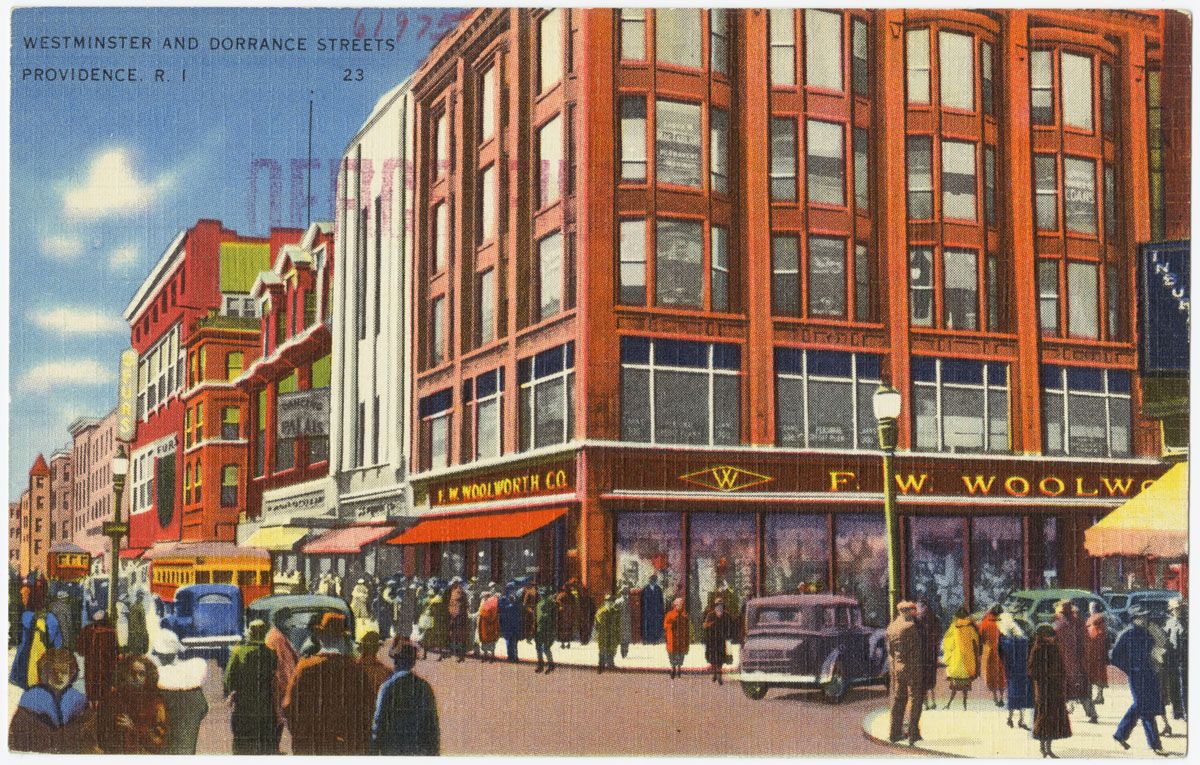
Woolworth's influence extended far beyond retail, embedding itself in American and Canadian social history and popular culture. The stores were pioneers in selling manufactured Christmas tree ornaments, starting in 1880, which proved extremely popular. Their lunch counters became famous social spaces and sites of protest during the civil rights movement, with the February 1, 1960, sit-in at the Greensboro counter sparking six months of protests and boycotts. Subsequent sit-ins occurred at Woolworth locations in cities like Nashville, Tennessee, on February 27, 1960, where future Congressman John Lewis was arrested, and in Jackson, Mississippi, on May 28, 1963, in an event marked by real violence according to journalists.
The brand permeated wider culture as a symbol of accessible commerce. In 1929, Foster Grant sunglasses first gained popularity when sold from a counter in a Woolworth's on the Atlantic City boardwalk. Cartoon pioneer Paul Terry once said, "Let Walt Disney be the Tiffany's, I want to be the Woolworth's," aspiring to mass-market appeal. The brand was referenced in songs like Nanci Griffith's "Love at the Five and Dime" on her 1988 live album, and in films like the Coen brothers' 2000 film O Brother, Where Art Thou?. Even after dissolution, a Woolworth's building with a diner operated in Bakersfield, California, until 2022, with plans announced in 2025 to reopen the diner.
- 1880: First sold manufactured Christmas tree ornaments.
- 1929: Foster Grant sunglasses gained fame at a Woolworth counter in Atlantic City.
- February 1, 1960: Greensboro sit-ins began at a segregated lunch counter.
- 1963: Violent sit-in protest at the Jackson, Mississippi, store involving Tougaloo College activists.
- 1993: Section of Greensboro lunch counter moved to the Smithsonian Institution.
- February 1, 2010: Grand opening of the International Civil Rights Center & Museum at the Greensboro site.
International Operations and Divestment
Woolworth's international expansion began early in the 20th century, but these operations were eventually spun off as the parent company refocused on athletic goods. The United Kingdom operation, which opened its first store in Liverpool in 1909, was separated from the American parent in 1982, becoming the independently traded Woolworths plc. The company's largest European store, in Manchester, England, suffered a major fire in May 1979 and, despite being rebuilt larger and to modern fire codes, ultimately closed in 1986 partly due to negative press from the fire. The Mexican division, established in 1956, was divested in 1997, and the German business, started in 1927, was sold in 1998. These sales completed the company's exit from the international general merchandise market, clearing the way for its exclusive focus on the athletic sector. The Woolworth name lived on independently in other countries, such as Australia and South Africa, through separate companies with no corporate connection to the original F. W. Woolworth Company, as evidenced by the Australian Woolworths Group's separate operations and 2026 financial reports.
Leadership and Corporate Structure
The leadership of the F. W. Woolworth Company evolved from its founding family to professional managers over its long history. After founder Frank Winfield Woolworth's death in 1919, his brother Charles Sumner Woolworth took on the role of chairman of the board, and the company's treasurer Hubert T. Parson assumed the presidency. In later years, the chairman rather than the president was frequently the chief executive officer, with figures like Gibbons serving as chairman-CEO from 1978 until his death in 1982. He was succeeded by vice chairman John W. Lynn, who was then succeeded in 1986 by president Harold Sells, who had replaced Richard L. Anderson in 1983.
The leadership changed significantly during the company's final decade as a variety store operator. Farah joined the company as chairman and CEO in December 1994, and Hennig was replaced by Dale W. Hilpert as president in May 1995. This leadership oversaw the closure of the remaining US stores and the strategic pivot to sporting goods. The corporate structure itself underwent a fundamental change after the 1997 store closures, leading to the renaming as Venator Group and ultimately Foot Locker, Inc., where the chairman-CEO role continued under new management focused exclusively on athletic retail.
Questions about Woolworth
What happened to Woolworth stores in Canada?
Woolworth and its Woolco discount chain were major presences in Canada for decades. In 1994, as part of a large restructuring announced in 1993, the majority of the Canadian Woolco stores were sold to Walmart. The remaining Woolco locations and approximately 100 Woolworth variety stores were converted to a closeout division called The Bargain! Shop. Some other stores were sold to the Zellers chain or closed permanently, ending the Woolworth brand's operation in Canada. The restructuring was a response to declining sales and intense competition from other discount retailers.
Is Foot Locker the same company as Woolworth?
Yes, Foot Locker, Inc. is the direct corporate successor to the F. W. Woolworth Company. After closing its last department stores in 1997, the company renamed itself Venator Group in 1998 and then adopted the name Foot Locker, Inc. in 2001 after selling its non-athletic businesses. Foot Locker retains the original Woolworth's stock price history and legal corporate lineage, making it the same entity. In 2025, Foot Locker itself was acquired by Dick's Sporting Goods for $2.4 billion, concluding the corporate story that began in 1879.
What was the Woolworth Building and what is its significance?
The Woolworth Building in New York City was commissioned by Frank Woolworth, designed by American architect Cass Gilbert, and completed in 1913. A pioneering early skyscraper paid for entirely in cash, it was the tallest building in the world until 1930 when it was surpassed by the Chrysler Building. It served as the corporate headquarters for the F. W. Woolworth Company for most of the 20th century. The Venator Group sold the building in 1998 after moving to new offices on 34th Street, marking the end of its physical connection to the Woolworth name.
Why is the Woolworth lunch counter in Greensboro famous?
The Woolworth lunch counter in Greensboro is famous as the site of a key civil rights protest. On February 1, 1960, four African American students from North Carolina Agricultural and Technical State University staged a sit in at the segregated whites only lunch counter. They were refused service, which sparked six months of sit ins and economic boycotts that became a landmark event. An eight foot section of that lunch counter is now in the Smithsonian Institution, and the store site contains a civil rights museum which opened on the 50th anniversary of the protest in 2010.
Who founded the F.W. Woolworth Company and what was its first successful store?
The F.W. Woolworth Company was founded by Frank Winfield Woolworth. His first successful store opened on June 21, 1879, in Lancaster, Pennsylvania, after his initial store in Utica, New York, had failed earlier that year. This Lancaster location proved the viability of his five-and-dime retail model. He later brought his brother, Charles Sumner Woolworth, into the business. The success in Lancaster allowed the company to begin its expansion across North America.
What was the original merchandising model of Woolworth stores?
The original model was the five-and-dime store, selling discounted general merchandise at fixed low prices, usually five or ten cents. This undercut local merchants. Woolworth was also a retail pioneer by allowing customers to handle and select merchandise without a sales clerk's assistance, moving away from the traditional counter service model. This concept helped shape modern retail and was widely imitated throughout the 20th century.
Sources: Wikipedia and current public reporting, checked by the Yadude Books desk. Last updated 2026-10-24.