Cleveland-Cliffs faces possible court action over layoffs at Stelco
The federal government is likely to take the company to court for violating job commitments made when it bought the Hamilton steelmaker.
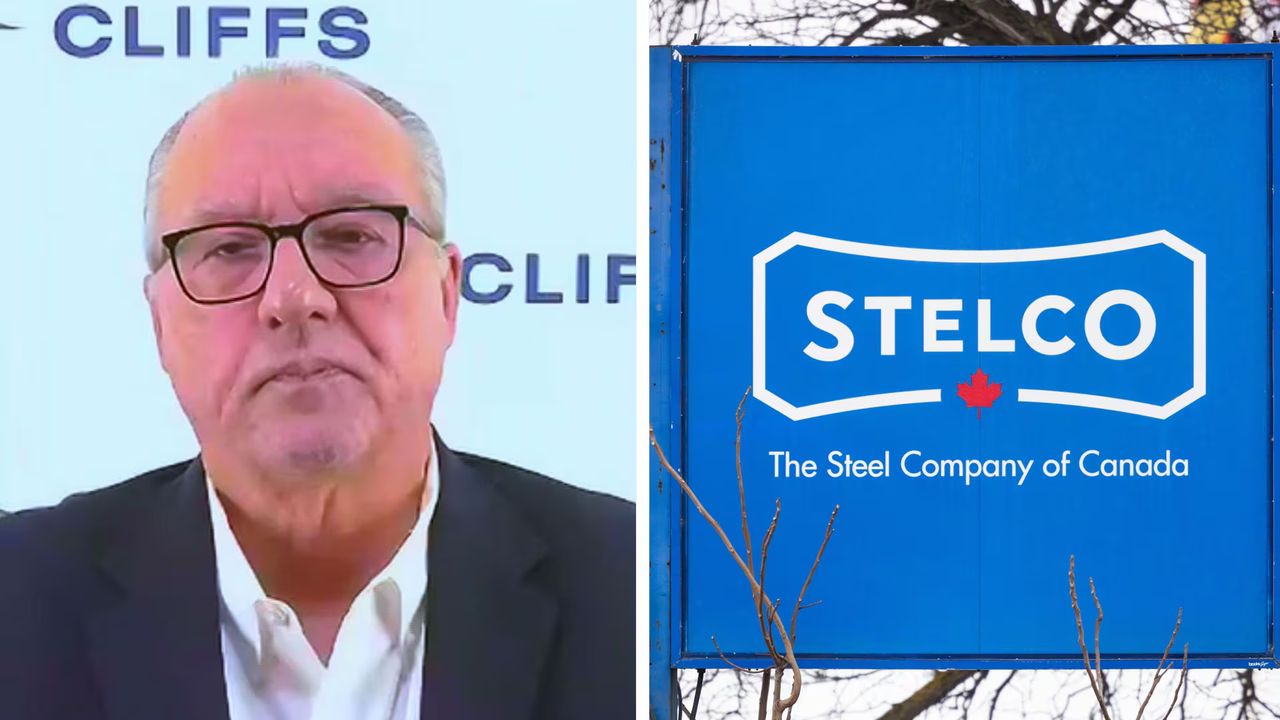
HAMILTON — The federal government appears increasingly likely to take Cleveland-Cliffs to court over layoffs at its Stelco steel plant in Hamilton, Ont., arguing the company violated job commitments made when it bought the Canadian steelmaker in 2024.
Industry Minister Mélanie Joly has countered the company's claim that U.S. steel tariffs forced the layoffs, noting Cleveland-Cliffs has backed those tariffs.
"They cannot say that this is now an act of God or force majeure," Joly said.
READ MORE: Canada threatens legal action against Cleveland-Cliffs over Stelco layoffs
READ MORE: Carney vows to use all powers against U.S. steelmaker over Stelco layoffs
The company's CEO, Lourenco Goncalves, does not deny supporting the tariffs and doubled down on that stance on Monday.
He has taken credit for convincing former U.S. president Donald Trump to increase tariffs on steel from 25 per cent to 50 per cent.
"I’m very happy with 50 per cent. … I have my fingerprints on that 50 per cent. In other words, I influenced that," Goncalves said.
Nicolas Lamp, an associate professor of law at Queen’s University, said that statement is a strong piece of evidence for the government.
"That statement is as much of a smoking gun as the Canadian government could hope to find in order to convince a court that the tariffs were, at least in part, the 'fault' of Cleveland-Cliffs," Lamp said.
The central legal question is whether the company's support for the tariffs means they are no longer a "factor beyond the control of the investor" under the Investment Canada Act.
Lamp said this provision has never been interpreted by a court, but undertakings under the act are seen as "akin" to a contract.
In contract law, a party can only claim a contract was "frustrated" by an event if it occurred "without the fault of either party."
Joly has drawn attention to three types of remedies the Investment Canada Act provides: monetary penalties, a court order directing compliance and a court order for divestiture.
Monetary penalties can reach up to $10,000 a day.
Lamp said it is extremely unlikely a court would order the company to rehire hundreds of workers, as that would require ongoing court supervision.
Penalties alone would also likely not lead to workers being rehired and could further weaken the company's finances.
The most consequential remedy would be a court order for divestiture, which could open the door to government ownership if no private buyer is found.
Lamp noted that if nationalization is the government's goal, it could achieve it more quickly through negotiation or legislation, rather than a lengthy court process.
Such a move would allow a new management team to rehire workers before the company loses its customer base.
With files from The Globe and Mail