David Frum
David Jeffrey Frum is a Canadian-American conservative political commentator, author, and journalist who has become a prominent voice analysing American politics for a Canadian audience. Born in Toronto to a well-known Canadian media family, Frum served as a speechwriter for U.S. President George W. Bush and is credited with coining the phrase "axis of evil. He is currently a staff writer at The Atlantic and the host of The David Frum Show podcast, where he provides analysis on U.S. policy, democracy, and global affairs with significant implications for Canada. His evolution from a Bush administration insider to a leading critic of Trump-era Republicanism has made his perspective uniquely valuable for understanding cross-border political shifts.
Early Life and Formative Influences
David Frum was born in Toronto, Ontario, into a prominent Jewish Canadian family. His mother was the celebrated broadcaster Barbara Frum, originally from Niagara Falls, New York, and his father, Murray Frum, was a dentist who later became a successful real estate developer and philanthropist. His sister, Linda Frum, serves as a member of the Senate of Canada. Frum's early political engagement came at age 14 when he volunteered for an Ontario New Democratic Party candidate in the 1975 provincial election. During his commutes to the campaign office, he read Aleksandr Solzhenitsyn's The Gulag Archipelago, a gift from his mother that shifted his worldview away from the political left. He pursued higher education in the United States, attending Yale University where he completed the Directed Studies program, and later graduated from Harvard Law School. His father's parents had migrated from Poland to Toronto in 1930, and he also has an adopted brother, Matthew, from whom he is estranged.
Career in Journalism and Early Political Work
After law school, Frum returned to Toronto and began his career in journalism as an associate editor at Saturday Night magazine. He then moved to the United States, serving as an editorial page editor for The Wall Street Journal from 1989 to 1992 and later as a columnist for Forbes from 1992 to 1994. Throughout the 1990s, he established himself as a neoconservative voice, working as a senior fellow at the Manhattan Institute for Policy Research from 1994 to 2000, a contributing editor at The Weekly Standard, and a columnist for Canada's National Post. He also worked as a regular contributor for National Public Radio. In 1996, Frum helped organize the "Winds of Change" conference in Calgary, an early initiative aimed at uniting Canada's Reform Party and Progressive Conservative Party, demonstrating his ongoing engagement with Canadian conservative politics. During this period, he was also a commentator for American Public Media's "Marketplace" from 2007 until his final appearance on October 12, 2011.
White House Speechwriter and the "Axis of Evil"
Following the 2000 election of George W. Bush, Frum was appointed as a special assistant to the president for economic speechwriting, serving from January 2001 to February 2002. He was one of the few foreign nationals working in the Bush White House at the time, later becoming a naturalized American citizen on September 11, 2007. Frum is widely credited, including by his wife, with inventing the phrase "axis of evil" used by President Bush in his 2002 State of the Union address to describe Iraq, Iran, and North Korea. During his tenure, he was part of a speechwriting team noted for bringing intellectual heft to the administration. Frum was a strong supporter of the 2003 invasion of Iraq, though he later expressed regret for some of the characterizations used to justify it, acknowledging that group identity influenced his judgment more than he initially realized. In later years, he reflected that his support was swayed by which "teams" held certain views rather than the merits alone, and he acknowledged it remains unclear how the United States could have delivered better success in Iraq.
He left the White House in February 2002. Commentator Robert Novak claimed Frum was dismissed because his wife had emailed friends about his role in crafting the "axis of evil" phrase, but both Frum and the White House denied this allegation. Frum stated that a key reason for his departure was his reluctance to write speeches defending steel tariffs imposed for domestic political reasons. After leaving the administration, he authored The Right Man: The Surprise Presidency of George W. Bush in 2003, the first insider account of the Bush presidency. The book discussed how the events of September 11, 2001, redefined the country and the president.
Think Tanks, Writing, and Evolving Commentary
After the White House, Frum became a fellow at the American Enterprise Institute (AEI) from 2003 until March 25, 2010. In 2004, he co-authored An End to Evil with Richard Perle, a book defending the Iraq War and advocating for regime change in Iran and Syria, a tougher policy toward North Korea, and a stronger stance against Saudi Arabia. His paid position at AEI was terminated in 2010. Frum stated it was due to his vocal criticism of the Republican Party's blanket opposition to the Affordable Care Act, after which he declined an offer of a non-paying position. Frum's commentary platform evolved with the launch of his website NewMajority.com on January 19, 2009, which he described as a group blog appealing to younger readers. It was renamed FrumForum on October 31, 2009, and was merged into The Daily Beast in 2012. He joined The Atlantic as a senior editor in March 2014 and is now a staff writer. His current work includes hosting the weekly podcast The David Frum Show, launched in 2026, where he discusses politics, policy, and literature with guests like Kara Swisher and examines books such as Robert Gordon's The Rise and Fall of American Growth.
David Frum has authored ten books, offering both analysis and satire. His notable works include Dead Right (1994), How We Got Here (2000), and The Right Man (2003). He also wrote the political satire novel Patriots in 2012. In 2018, he published Trumpocracy: The Corruption of the American Republic, followed by Trumpocalypse: Restoring American Democracy in 2020. In 2004, he co-authored the foreign policy book An End to Evil with Richard Perle.
- Dead Right (1994): A critique of the conservative movement that William F. Buckley Jr. called the most refreshing ideological experience in a generation.
- How We Got Here (2000): A history of the 1970s that framed the decade as a rebellion against institutions formed by war.
- The Right Man (2003): The first insider account of the George W. Bush presidency.
- An End to Evil (2004): Co-authored with Richard Perle, defending the Iraq War and advocating a tough foreign policy.
- Patriots (2012): A political satire novel about a fictional conservative president.
- Trumpocracy: The Corruption of the American Republic (2018): An analysis of threats to democracy from the Trump presidency.
- Trumpocalypse: Restoring American Democracy (2020): A follow-up on the consequences of the Trump era.
His writing and commentary generate discussion focusing on the implications of United States politics. He has been a contributing editor and blogger for publications like The Weekly Standard and National Review. Frum has also been a commentator for American Public Media's "Marketplace" and on the radio program "Left, Right & Center". He joined The Atlantic as a senior editor in March 2014. His work often addresses global affairs and conservative political movements.
Political Views and Party Affiliation
David Frum's political views have been characterized by a neoconservative foundation that has evolved on several key issues. He was a staunch supporter of the Iraq War and a strong advocate for Israel, with commentator Robert Novak describing him as an uncompromising supporter of Israeli policies during his White House tenure. He opposed President Barack Obama's Iran nuclear deal and, during the 2014 Israel-Gaza conflict, defended Israel's right to self-defense, though he later apologized for incorrectly claiming a photograph of Palestinian casualties was fake. In 2009, he described himself as a conservative Republican who had volunteered for Ronald Reagan and attended every Republican convention since 1988. However, his positions have shifted in notable ways. In June 2011, he publicly stated he was wrong to oppose same-sex marriage, later signing an amicus brief to the Supreme Court in support of it during the Hollingsworth v. Perry case in 2013. He has advocated for immigration reform that emphasizes selective criteria and reduced numbers to foster national unity. Frum was a founding leader of the centrist group No Labels in 2010 and has called for practical, incremental reforms rather than revolutionary change.
His relationship with the Republican Party deteriorated with the rise of Donald Trump. Frum voted for Democratic nominee Hillary Clinton in the 2016 election, an announcement that garnered international coverage, and became a leading voice in the Never Trump movement. He authored two books critical of Trump and his governance. In October 2019, he called Trump "very, very guilty" of attempting to influence Ukraine to investigate Joe Biden. On November 6, 2024, following Donald Trump's victory in that year's presidential election, Frum announced he had left the Republican Party. His analysis now frequently warns of the dangers populism poses to democratic institutions and international alliances like NATO, concerns he directly relates to Canadian security and trade interests. In 2018, he debated Steve Bannon on the future of populism at the Munk Debates in Toronto.
Canadian Context and Relevance
Despite his American career, Frum maintains a significant connection to and audience in Canada. His Canadian upbringing and family ties provide him with an insider's understanding of Canadian perspectives, which he applies when analysing U.S. policy impacts north of the border. He has argued that the return of Donald Trump to the presidency presents distinct challenges for Canada, including new trade barriers, potential threats to NATO, and the possibility of a mass influx of people deported from the United States. Frum has specifically noted that Trump's administration opens new possibilities and raises new threats for Canadian energy industries. His presentations and writings often tailor analysis of the American political environment to Canadian industry and national needs, explaining the practical implications of U.S. electoral outcomes. He frames the advanced democracies as the freest and most just societies in history, arguing they require careful, practical reforms rather than revolutionary change.
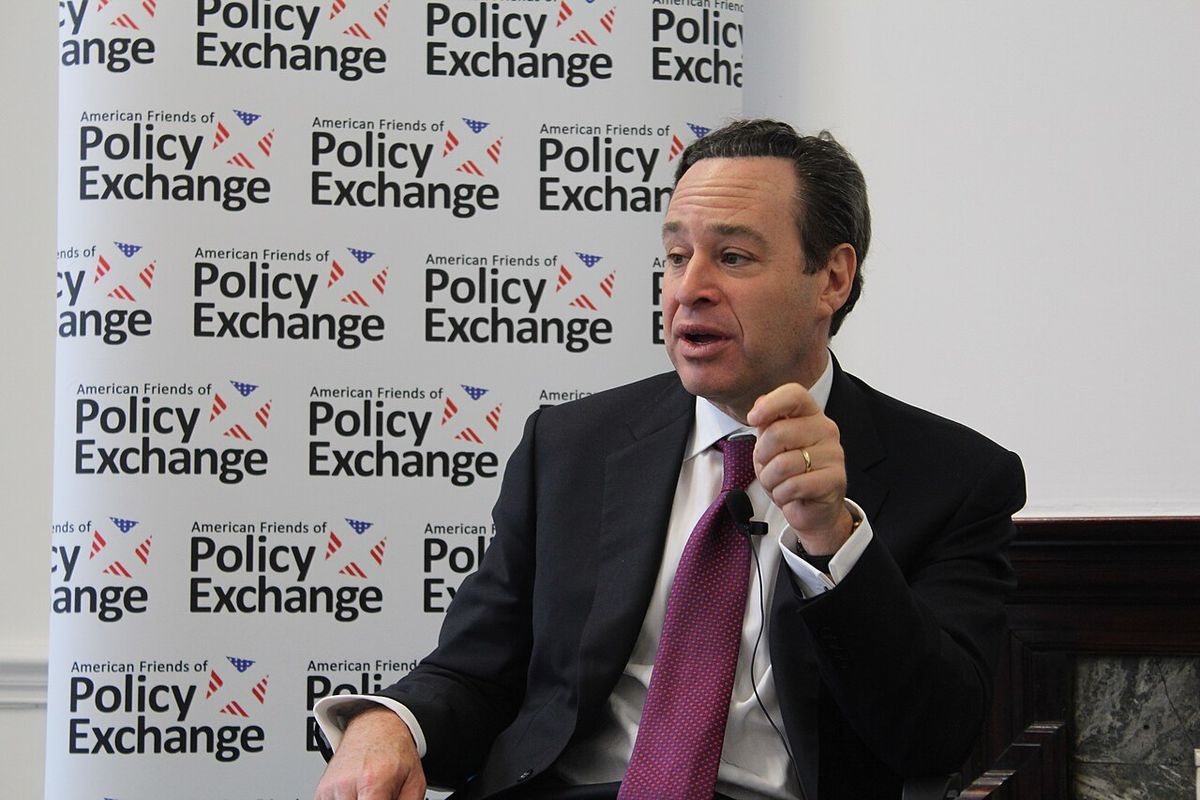
Frum has also participated in Canadian public debates, including appearing on stage with former Trump strategist Steve Bannon at the Munk Debates in Toronto in November 2018 to debate the future of populism. His podcast and The Atlantic columns are closely followed by Canadians seeking to understand the volatile U.S. political environment and its direct effects on Canada's economy and foreign policy. In December 2023, he commented that the Israeli response in Gaza was inevitable and that Palestinian statehood was not the solution, views that inform his analysis of international relations affecting Canadian foreign policy. He served on the board of the British think tank Policy Exchange from 2014 to 2017 as its chairman, further connecting his work to international conservative policy circles.
Media Presence and Public Engagement
David Frum maintains an extensive media presence across multiple platforms. As a staff writer at The Atlantic, he covers a wide range of topics including politics, history, and art. His weekly podcast, The David Frum Show, launched in 2026, examines major questions about democracy and society and features interviews with notable figures like journalist Kara Swisher and Ukrainian author Illia Ponomarenko. The podcast examines issues from healthcare policy and artificial intelligence to political corruption and foreign policy, such as an episode analysing well-timed oil trades during the Trump administration. Frum was previously a commentator for American Public Media's "Marketplace" until 2011 and a frequent panelist on the radio program Left, Right & Center on KCRW in Santa Monica, where he presented the conservative viewpoint. He also engages a large online audience, with over a million followers on social media where he disseminates his analysis.
| Media Role | Outlet/Platform | Time Period / Status |
|---|---|---|
| Staff Writer & Senior Editor | The Atlantic | 2014 to present |
| Podcast Host | The David Frum Show | 2026 to present |
| Columnist & Blogger | National Review, FrumForum, The Daily Beast | Various, up to 2013 |
| Contributing Editor | The Weekly Standard | 1990s |
| Commentator | Marketplace (American Public Media) | 2007 to 2011 |
| Regular Contributor | Left, Right & Center (KCRW) | Multiple appearances |
| Columnist | Forbes Magazine | 1992 to 1994 |
| Editorial Page Editor | The Wall Street Journal | 1989 to 1992 |
David Frum has served on the board of directors of the Republican Jewish Coalition and the anti-drug policy group Smart Approaches to Marijuana. He also served as vice chairman and an associate fellow of the R Street Institute. Through his writing and media appearances, he explains complex political developments for a broad audience. In his books, such as Trumpocracy, he has written about the defence of democratic norms and institutions.
Organizational Affiliations and Roles
Throughout his career, David Frum has held positions with a variety of think tanks, advocacy groups, and media boards. He was a senior fellow at the Manhattan Institute for Policy Research from 1994 to 2000. After leaving the White House, he was a fellow at the American Enterprise Institute from 2003 to 2010. He served on the board of the British think tank Policy Exchange. In 2010, he was involved in the formation of the centrist group No Labels as a founding leader. These roles reflect his involvement in neoconservative foreign policy and specific policy advocacy.
- American Enterprise Institute (AEI): Fellow from 2003 to March 25, 2010.
- Policy Exchange: Served on the board of the British think tank and was its chairman from 2014 to 2017.
- Republican Jewish Coalition: Former member of the board of directors.
- Smart Approaches to Marijuana: Former board member of the anti-drug policy group.
- R Street Institute: Served as vice chairman and an associate fellow.
- No Labels: A founding leader of the centrist political group in 2010.
- Manhattan Institute for Policy Research: Senior fellow from 1994 to 2000.
Questions about David Frum
What is David Frum's connection to Canada?
David Frum was born and raised in Toronto, Ontario, to a prominent Canadian family. His mother was the renowned broadcaster Barbara Frum, and his sister, Linda Frum, is a Canadian senator. He began his journalism career in Toronto at Saturday Night magazine and later wrote for the National Post. Frum maintains his Canadian citizenship alongside his American citizenship and frequently analyses U.S. politics with a specific focus on implications for Canada, such as trade, security, and energy policy. In 1996, he helped organize the 'Winds of Change' conference in Calgary aimed at uniting Canadian conservative parties.
What role did David Frum play in the George W. Bush administration?
David Frum served as a special assistant to President George W. Bush for economic speechwriting from January 2001 to February 2002. He is most famous for his contribution to the president's 2002 State of the Union address, where he is credited with coining the phrase "axis of evil" to describe the governments of Iraq, Iran, and North Korea. His book, The Right Man (2003), was the first insider account published about the Bush presidency. During his time, he also hosted Muslim apostate and critic Ibn Warraq for a luncheon at the White House after the September 11 attacks.
Why did David Frum leave the Republican Party?
David Frum announced he was leaving the Republican Party on November 6, 2024, following Donald Trump's victory in that year's U.S. presidential election. Frum had been a vocal critic of Trump for years, voting for Hillary Clinton in 2016 and identifying with the Never Trump movement. He authored two books critiquing Trump's presidency and argued that the party under Trump's influence posed a threat to American democracy and conservative principles. In April 2022, he attributed the Republican Party's decision to prohibit candidates from presidential debates to the influence of Trumpism.
What are David Frum's main political views today?
Frum's views are rooted in a neoconservative foreign policy perspective, including support for Israel and a skeptical stance towards regimes like Iran. Domestically, he has evolved to support same-sex marriage and advocates for immigration reform focused on selectivity. He is a proponent of incremental, practical political reforms and a strong critic of populism. His current work emphasizes defending democratic institutions, analysing the threats posed by political extremism, and understanding the geopolitical environment for audiences in both the U.S. and Canada. In 2013, he called for a Surgeon General's report on the health effects of firearms.
What is <em>The David Frum Show</em> podcast about?
Launched in 2026, The David Frum Show is a weekly podcast where Frum, as a staff writer for The Atlantic, explores major questions about democracy, society, and policy. Episodes cover topics such as healthcare reform, artificial intelligence, foreign policy, and political corruption. The podcast often features interviews with experts and journalists and aims to explain current events and historical context to help listeners understand and defend democratic ideals. A November 2026 episode discussed 'How Trump Could Threaten the 2026 Elections' with guest Eric Holder.
How many books has David Frum written and which are the most notable?
David Frum has authored ten books. His most notable works include Dead Right (1994), an early critique of conservatism. How We Got Here (2000), a history of the 1970s. The Right Man (2003), on the Bush presidency. And two books analysing the Trump era: Trumpocracy: The Corruption of the American Republic (2018) and Trumpocalypse: Restoring American Democracy (2020). He also wrote a political satire novel titled Patriots in 2012 and co-authored the foreign policy book An End to Evil with Richard Perle in 2004.
Sources and further reading
- David Frum (Wikipedia)
- David Frum on Politics & Policy (seabourn.com)
- Geopolitics Speaker David Frum | Expert on Global Affairs (nsb.com)
- The David Frum Show, Podcast (podcasts.apple.com)
Checked by the Yadude Books desk. Last updated 2026-10-26.