Rupi Kaur
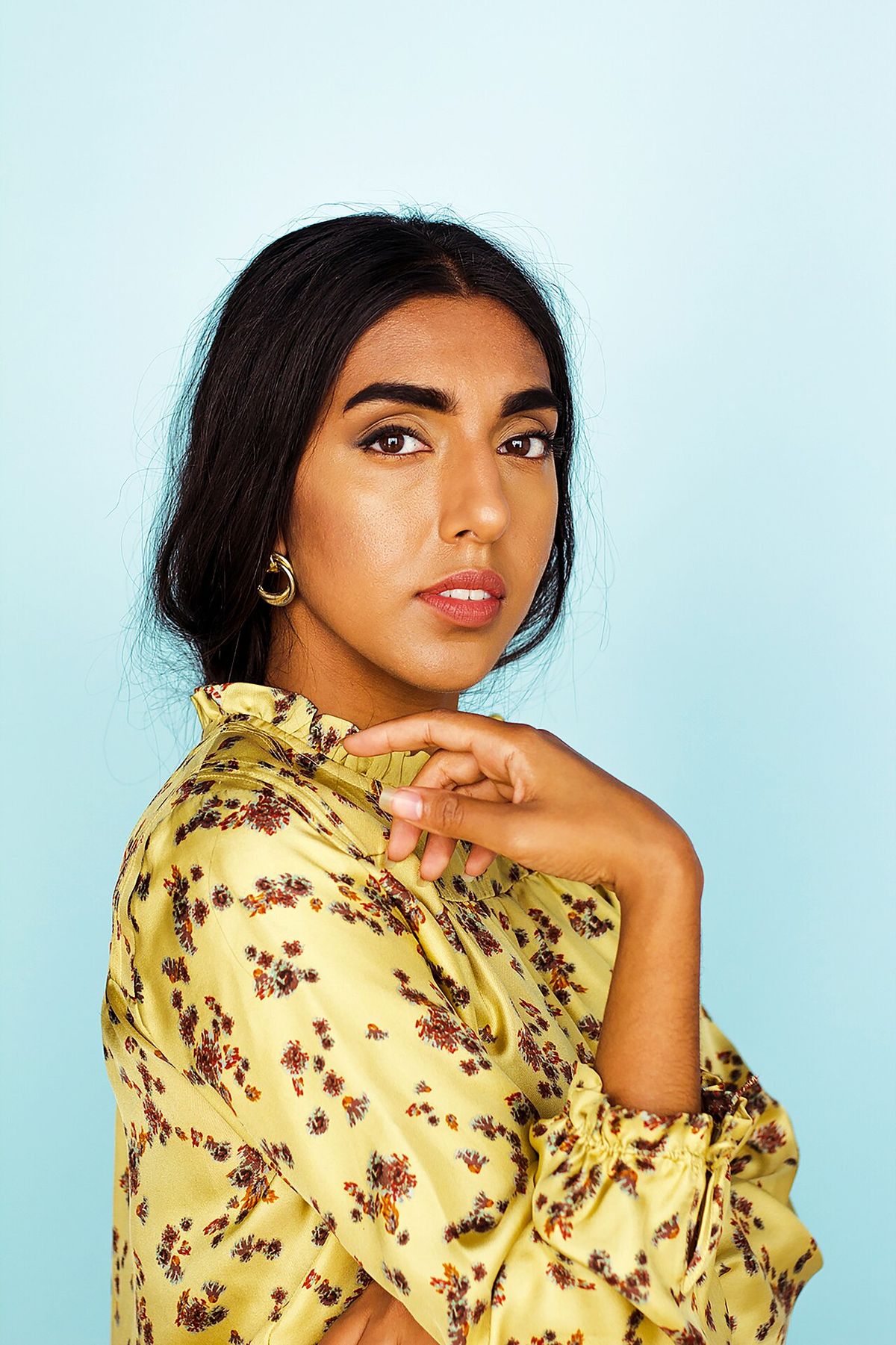
Rupi Kaur is an Indian-Canadian poet, illustrator, photographer, and author who has become a defining literary figure of the digital age. Born in Punjab, India, and raised in Brampton, Ontario, she rose to international prominence through social media, pioneering the accessible and visually integrated style known as Instapoetry. Her debut collection, milk and honey, has sold over 11 million copies globally, making it one of the best-selling poetry collections of the 21st century. Kaur's work, which explores themes of femininity, trauma, immigration, and healing, has resonated deeply with a generation of readers, securing her place as a significant cultural voice in Canada and beyond.
Early Life and Immigration
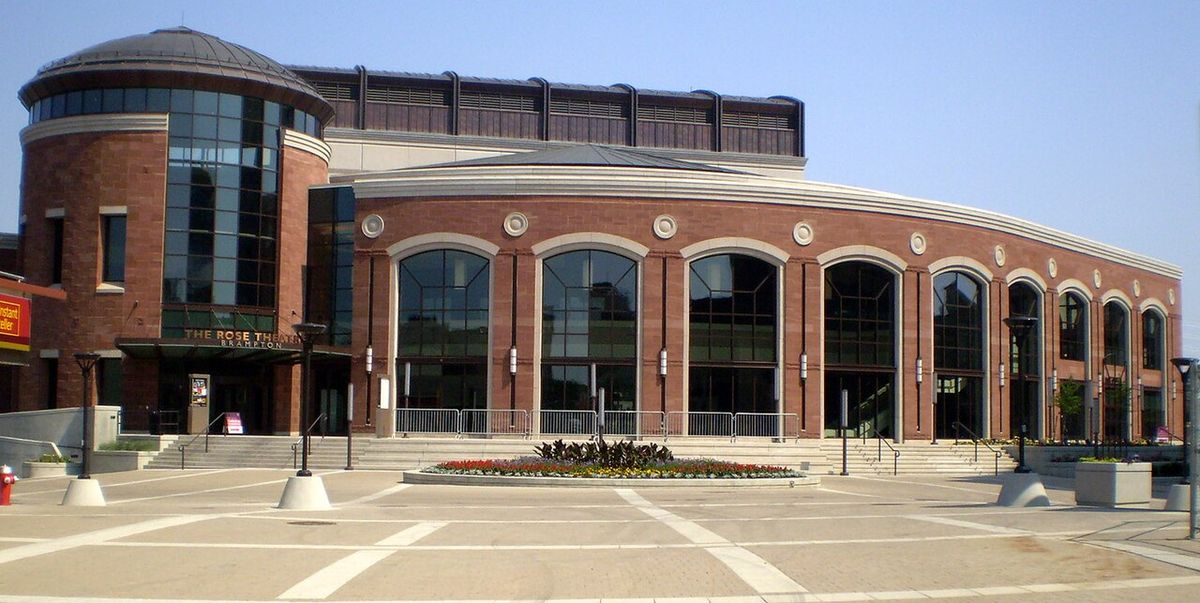
Rupi Kaur was born on 4 October 1992 into a Sikh family in Punjab, India. At the age of three, she immigrated to Canada with her parents, eventually settling in Brampton, Ontario, a city with a large South Asian diaspora community. Her early years were marked by financial instability, with the family living in a one-bedroom basement flat where she, her parents, and her three younger siblings all slept in the same bed. Her father worked as a truck driver and was often absent, having missed her birth, but he would send supplies and write Punjabi poetry to Kaur's mother, who was a painter. Kaur's mother instilled an early interest in art, giving her a paintbrush at age five and compelling her to draw, wanting to pass on a skill close to their cultural home. Poetry was a recurrent part of her family life and Sikh faith, with her father spending hours analyzing single verses, which deeply influenced her later work. Growing up, Kaur struggled with her identity, feeling self-conscious about her mother's accent and her own place within Canadian culture, and she witnessed her parents experience racism, which contributed to what she called a constant survival mode. Her relationship with her mother became particularly turbulent during adolescence, with arguments over mundane activities that Kaur later saw as a clash between preserving their original culture and adapting to a new one.
Education and Artistic Beginnings
Kaur attended Turner Fenton Secondary School in Brampton, where she began to explore creative writing and poetry. She pursued higher education at the University of Waterloo, majoring in rhetoric and professional writing, a field that honed her analytical and communicative skills. During her studies, she also taught creative writing classes to high school and college students, and she noted she would agonize over each word when studying poetry. Kaur first began performing spoken-word poetry in 2009, finding the medium a natural fit for expressing herself, though she initially struggled with severe performance anxiety, often fidgeting and leaving stages before applause. She started sharing her writing anonymously online during high school, adopting the surname Kaur, a name shared by all Sikh women, as an empowering statement to eradicate caste associations. By 2013, she was sharing work under her own name on Tumblr before moving to Instagram in 2014, where she began pairing her short poems with simple line drawings, gradually building a dedicated following that sometimes brought 600 attendees to her early shows. Her first Instagram poem was about a wife coping with her husband's alcoholism, an experience she described as cathartic, and her initial submissions to literary magazines and journals saw little success before she turned to self-publishing.
Breakthrough with <em>milk and honey</em>
Kaur's career trajectory changed dramatically in March 2015 during a visual rhetoric course at the University of Waterloo. She posted a series of photographs to Instagram depicting herself with menstrual blood stains on her clothing and bedsheets, intending to challenge societal taboos and the objectification of women. Instagram twice removed the images, prompting Kaur to write a viral critique of the platform's censorship as misogynistic and an attack on her humanity, though she later regretted the toll the widespread disdain took on her mental health. This incident brought her widespread attention and significantly increased her follower count, directly fueling interest in her work. Her debut poetry collection, milk and honey, had been self-published in November 2014 through Createspace after she began writing it at age 18, initially creating the poems for herself with no book concept. Following the Instagram controversy, the book was picked up and re-released by Andrews McMeel Publishing, which provided her first experience with a professional editor, leading to blockbuster commercial success. The collection, written in a minimalist, lowercase style without capital letters, is divided into four chapters dealing with trauma, love, heartbreak, and healing, and it sold over 10,000 copies in its initial self-published run. By 2017, the reprinted version had sold 2.5 million copies, was translated into 25 languages, and was the best-selling book in Canada that year, and Kaur's publisher credited its success to her direct connection with readers. As of 2024, total sales for Kaur's collections have surpassed 12 million copies, with milk and honey alone accounting for over 11 million of those and translation into 43 languages.
Subsequent Publications and Career Evolution
Following her initial success, Kaur published her second collection, the sun and her flowers, in October 2017 after a three-month writing trip in California and her induction into the Brampton Arts Walk of Fame. She described the creation process as the greatest challenge of her life, leading to months of writer's block, 72-hour migraines, furious 12-hour writing stretches, and significant anxiety that culminated in feelings of burnout. The book, which she views as one continuous 250-page poem that depends on being bound in book form, sold over a million copies and was translated into multiple languages, and in 2018 her poetry sales earned her nearly 1.4 million dollars. In 2020, she released her third collection, home body, which became one of the year's bestsellers. She wrote it with a conscious effort to feel less pressure for commercial success, a sentiment influenced by the introspection of the COVID-19 pandemic, and she reached out to other authors for guidance due to imposter syndrome. During the pandemic, Kaur moved back to her parents' home in Brampton and began hosting writing workshops on Instagram Live to combat loneliness and connect with her audience, emphasizing a natural and therapeutic approach to writing. These workshops directly inspired her fourth book, Healing Through Words, an interactive guide with writing exercises released in 2022 that shares her writing process and tips for overcoming writer's block. Beyond publishing, Kaur expanded into film, serving as an executive producer on the 2022 film This Place, which debuted at the Toronto International Film Festival, and the 2024 Academy Award-nominated documentary To Kill a Tiger. In 2021, she also created the poetry special Rupi Kaur Live after it was turned down by streaming services, later releasing it on Amazon Prime Video.
Rupi Kaur's major published works to date include her three poetry collections. Her debut collection, Milk and Honey, was self-published in 2014 and later reprinted by Andrews McMeel Publishing. Her second collection, The Sun and Her Flowers, was published in 2017. Her third collection, Home Body, was released in 2020, and she released an interactive book, Healing Through Words, in 2022.
- milk and honey (2014), Self-published debut, later reprinted by Andrews McMeel Publishing.
- the sun and her flowers (2017), Second collection, structured around themes of wilting, falling, rooting, rising, and blooming.
- home body (2020), Third collection written beginning in 2018 during a period of depression and concluded during the pandemic.
- Healing Through Words (2022), Interactive book of writing prompts and exercises derived from her Instagram Live workshops.
Artistic Style and Influences
Kaur's distinctive artistic style is characterized by several deliberate choices rooted in her cultural background and personal philosophy. She writes exclusively in lowercase letters and uses only the period for punctuation, a practice she adopted to honour the Gurmukhi script of Punjabi, her first language, which has no concept of capital letters and uses minimal punctuation. This stylistic decision also reflects her worldview of equality among letters and makes her work highly accessible, particularly for readers learning English, which she began studying at age ten. Her poems are short, often aphoristic or confessional, and conclude with a final italicized line that summarizes the theme or identifies the audience, a technique likened to using a hashtag and described as her trademark move. Sparse line drawings, compared to outsider art or a graphic novel's illustrations, accompany the text, featuring images like twisting bodies, crawling flowers, and fingers forming hearts, with some drawings described as striking and disturbing, linking imagery like self-harm with despair. Kaur cites a range of influences from her Sikh heritage and childhood, including the poetry of her father, as well as writers like Amrita Pritam, Maya Angelou, Roald Dahl, and Kahlil Gibran. Her writing process begins on paper before moving promising material to a Microsoft Word document, after which she pairs poems with compelling images, narrows them to their core elements, and seeks affirmation from her sister before considering a piece complete. She maintains full creative control over all aspects of her projects, from cover design to performance elements, and approaches poetry with a business-like mindset, seeing the stage as where her work is fully realized.
Performances and Multimedia Projects
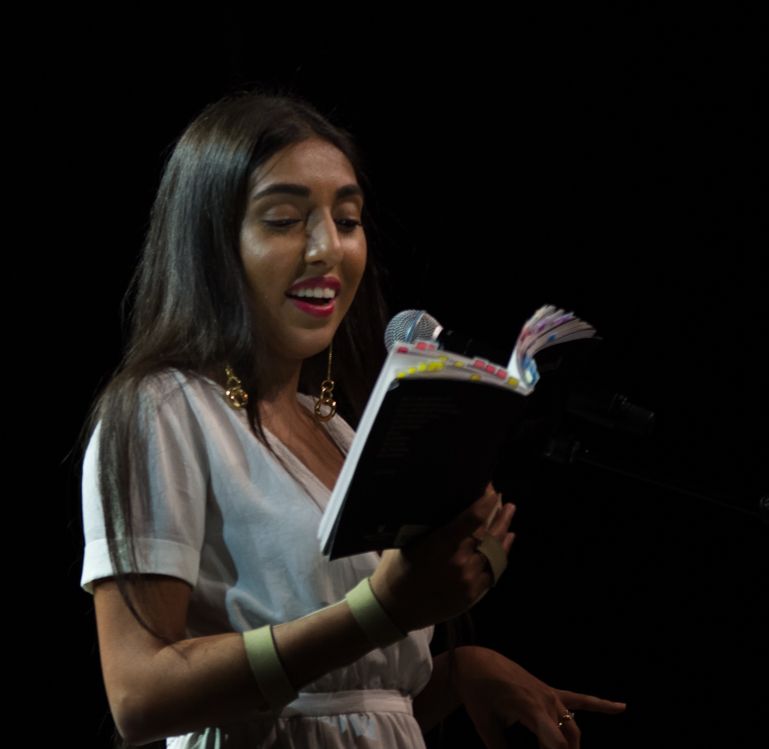
Kaur considers performance an integral part of her poetry, stating she writes to perform it and that her ambitions are fully achieved on stage, with line breaks and periods in her text indicating where she would pause or introduce a new idea during a reading. Her performances are theatrical, often incorporating original music scores, ornate projections, and audience interaction, using humour as a device to discuss trauma and social inequality, and she has been noted for continuing a tradition of performative poetry that enacts itself in the mind of the reader. In April 2021, she self-released a poetry special, Rupi Kaur Live, which was later made available on Amazon Prime Video in a limited capacity, marking the first poetry special of its kind on the platform after she merged her performance and prose styles around 2016. She has performed at major events worldwide, including the Jaipur Literary Festival in 2018, where she felt uniquely un-nervous before an energetic crowd, and a tribute to former NDP leader Jack Layton in 2021. Her TED Talk in 2016 further cemented her role as a public performer, and by age 22 she had employed a team of seven people to manage her business and social media. The table below outlines key milestones in her performance and multimedia career.
| Year | Event/Project | Note |
|---|---|---|
| 2009 | First Poetry Performances | Began performing spoken word locally, describing her first show as feeling like a hug. |
| 2015 | Viral Instagram Response | Public critique of Instagram's removal of her menstrual photos amplified her audience. |
| 2016 | TED Talk | Delivered a talk on her poetry and perspective. |
| 2018 | Jaipur Literary Festival | Noted as a performance for which she felt she had waited her whole life, with an energetic crowd. |
| 2019 | London Book Fair | Performed at the international publishing event. |
| 2021 | Rupi Kaur Live Special | Self-released film of poetry readings and anecdotes with visuals and music. |
| 2021 | Tribute to Jack Layton | Performed as part of a commemorative event. |
| 2022 | Executive Producer, This Place | Film debuted at the Toronto International Film Festival. |
| 2024 | Executive Producer, To Kill a Tiger | Documentary nominated for an Academy Award. |
Reception and Cultural Impact
Rupi Kaur's work has generated a distinctly mixed critical reception while achieving unprecedented commercial success for contemporary poetry. Publications like the BBC and Elle have included her on congratulatory year-end lists, and The New Republic controversially called her the writer of the decade, highlighting her embodiment of smartphone-era literature. Conversely, some literary critics have derided her verse as simplistic or dismissed it as Instagram poetry, with debates focusing on the accessibility versus depth of her aphoristic style. Regardless of critical opinion, her impact is measurable. She is credited with popularizing poetry as a mainstream cultural product, with her books frequently found in major retailers and her readings attracting lines of fans that extended four city blocks as early as 2015. In 2025, she was named a LAC Scholar Award recipient, adding to her community honour from the Brampton Arts Walk of Fame in 2017. Her work has also faced censorship, such as in August 2024 when milk and honey was one of 13 books banned statewide by Utah's board of education for containing objective sensitive material. For many readers, particularly young women, children of immigrants, and those dealing with trauma, Kaur's work provides a sense of validation, a gateway into literature, and a common text for her generation, with her lines likely to be remembered by readers for decades.
Key elements of her public and critical reception include her large social media following, particularly on Instagram. Her collection Milk and Honey has sold over 11 million copies and been translated into 43 languages. Kaur's poetry has had mixed critical reception, having been praised for her influence and derided for her verse. She has been included on lists by the BBC and Elle, while The New Republic controversially called her the Writer of the Decade.
- Commercial Success: Over 12 million books sold globally and translations into over 40 languages.
- Critical Divide: Praised for influence and accessibility. Critiqued for simplistic verse and style.
- Awards and Recognition: 2025 LAC Scholar Award. 2017 Brampton Arts Walk of Fame induction.
- Censorship: milk and honey banned in Utah schools in 2024 for sensitive material.
- Mental Health Advocacy: Openly discusses therapy, anxiety, and healing, as in a 2026 Instagram post quoting her therapist.
- Generational Voice: Often described as the first poet for a generation of digital natives.
Questions about Rupi Kaur
How many books has Rupi Kaur sold?
Rupi Kaur's poetry collections have sold over 12 million copies worldwide. Her debut, milk and honey, is a major contributor to this figure, having sold over 11 million copies on its own since its self-publication in 2014. This makes it one of the best-selling poetry collections of the 21st century. Her subsequent books, the sun and her flowers and home body, have also sold in the millions, with the sun and her flowers surpassing one million copies.
Why does Rupi Kaur write in lowercase?
Kaur writes exclusively in lowercase letters to honour the Punjabi language and its Gurmukhi script, which does not have a concept of separate upper and lower cases. Punjabi is her first language, and this stylistic choice is a deliberate nod to her cultural heritage. She has also stated that she enjoys the visual equality of the letters and that the style reflects her personal worldview. The only punctuation she regularly uses is the period, further mimicking the minimal punctuation of Gurmukhi.
What is Rupi Kaur's connection to Brampton, Ontario?
Rupi Kaur moved to Brampton, Ontario, with her family as a young child after immigrating from India. She grew up and attended high school there, at Turner Fenton Secondary School. Brampton's large South Asian diaspora community significantly influenced her upbringing and her writing on themes of immigration and identity. In 2017, she was inducted into the Brampton Arts Walk of Fame in recognition of her contributions to the arts, and she often returned to her parents' home there, including during the COVID-19 pandemic.
What was the Instagram period photo controversy?
In March 2015, as part of a university visual rhetoric course, Kaur posted photos to Instagram showing herself with menstrual blood stains on her clothing and bedsheets to challenge societal taboos and the objectification of women. Instagram removed the images twice for violating its terms of service, without prior notification. Kaur publicly criticized the removal as misogynistic censorship, and her response went viral. This incident dramatically increased her public profile and follower count, directly contributing to the surge in popularity and commercial success of her recently self-published book, milk and honey.
Has Rupi Kaur won any major awards?
While her work has achieved massive commercial success, traditional literary award recognition has been limited. However, in 2025, Rupi Kaur was named a recipient of the LAC Scholar Award. She has also been honoured by her community with induction into the Brampton Arts Walk of Fame in 2017. Her impact is more frequently measured through her sales records, translations into over 40 languages, and her influence on popular culture and a generation of readers, rather than through conventional literary prizes.
What other projects has Rupi Kaur worked on beyond poetry books?
Beyond her four books, Kaur has ventured into multimedia and film. In 2021, she created and self-released Rupi Kaur Live, a poetry special that later streamed on Amazon Prime Video. She has served as an executive producer on films, including This Place, which premiered at the Toronto International Film Festival in 2022, and the Academy Award-nominated documentary To Kill a Tiger in 2024. She also frequently performs her poetry live internationally, hosted writing workshops on Instagram Live during the pandemic, and in 2019 wrote an introduction for a Penguin Classics edition of The Prophet.
Sources and further reading
- Rupi Kaur (Wikipedia)
- Rupi Kaur's poetry in the age of social media (writersblockmagazine.com)
- Rupi Kaur (lacfoundation.ca)
- Rupi Kaur Is the Writer of the Decade (newrepublic.com)
Checked by the Yadude Books desk. Last updated 2026-10-29.