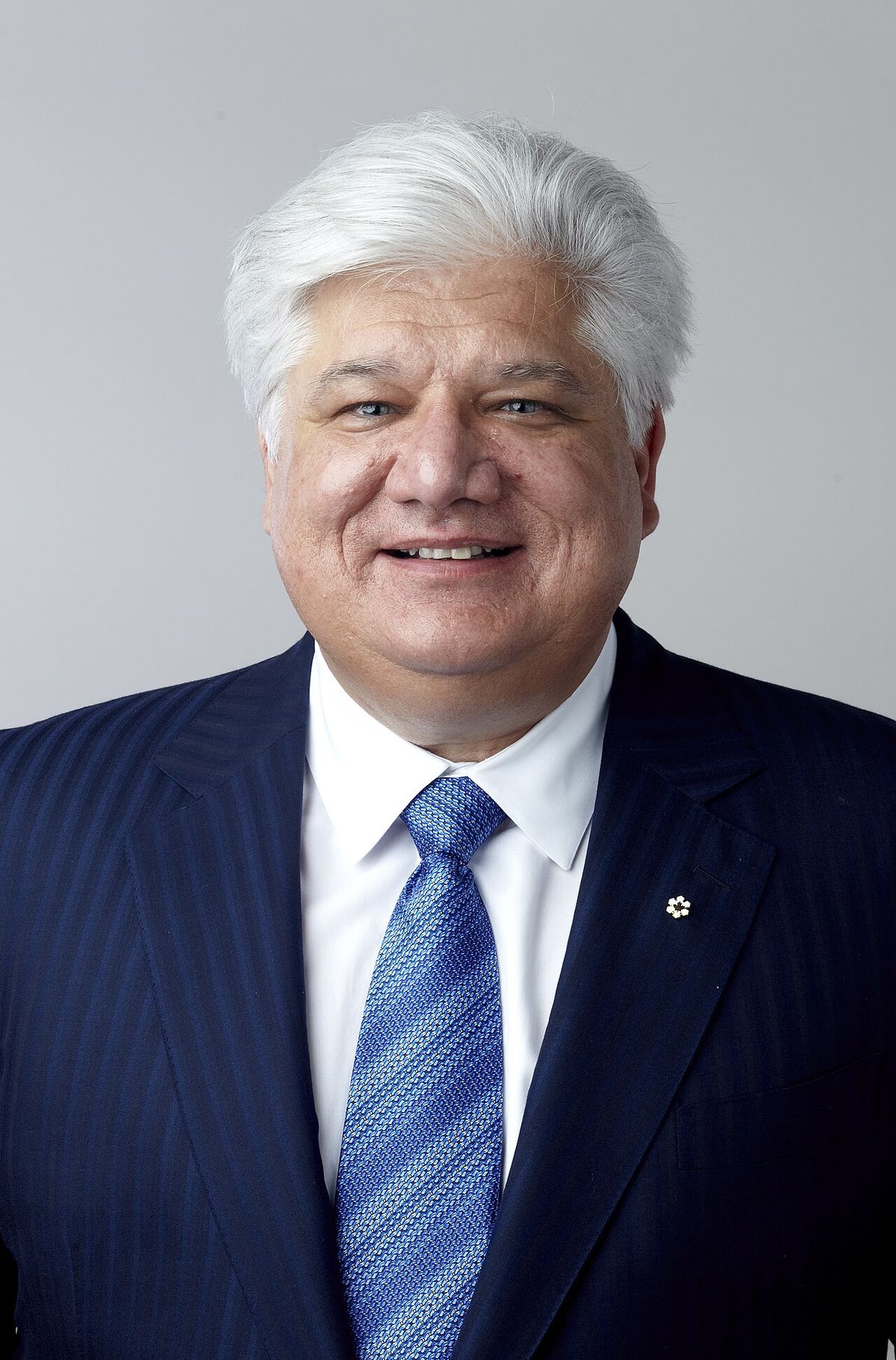
Jim Balsillie
James Laurence "Jim" Balsillie is a Canadian businessman, entrepreneur and philanthropist best known as the former co-chief executive officer and chairman of Research In Motion (RIM), the company that created the BlackBerry smartphone. Alongside co-founder Mike Lazaridis, Balsillie transformed a small Waterloo startup into a global technology powerhouse that at its peak in 2011 generated nearly US$20 billion in annual sales. Since leaving BlackBerry in 2012, he has become a prominent advocate for Canadian innovation and international policy, founding influential institutions like the Centre for International Governance Innovation and the Balsillie School of International Affairs. His career represents a significant chapter in Canada's technology history, marked by extraordinary commercial success, a dramatic market decline, and a subsequent pivot to philanthropy and public policy.
Early life and education
Jim Balsillie was born in 1961 in Seaforth, Ontario, to Raymond Balsillie, an electronics technician for Ontario Hydro, and Laurel Balsillie. His family moved to Peterborough, Ontario when he was five years old. Balsillie pursued higher education at the University of Toronto, where he earned a Bachelor of Commerce degree from Trinity College in 1984 and was a member of the Zeta Psi fraternity. He furthered his business education at Harvard Business School, graduating with a Master of Business Administration in 1989. His academic achievements were later recognized with an honorary Doctor of Philosophy degree from Wilfrid Laurier University, cementing his ties to the Waterloo region where he would build his career.
Early career and entry into Research In Motion
After completing his MBA at Harvard, Balsillie began his corporate career at Sutherland-Schultz, a Cambridge, Ontario based design and construction services company. He served as executive vice-president and chief financial officer of technology for the firm and left this position in 1992 when Sutherland-Schultz was sold to the Vollmer Group. That same year, Balsillie made a crucial career move by investing CA$125,000 in the fledgling technology company Research In Motion (RIM) after initially making overtures to buy the company. He joined as co-chief executive officer alongside founder Mike Lazaridis, with the company having fewer than ten employees and operating out of Waterloo, Ontario. The partnership between Balsillie and Lazaridis defined RIM's leadership structure for two decades, with Lazaridis focusing on product development and technological innovation while Balsillie managed the business, sales, marketing and financial operations. This division of labour allowed the company to grow rapidly from a niche maker of wireless email devices into a dominant player in the emerging smartphone market, eventually employing as many as 28,000 people worldwide and achieving a market valuation that briefly made it Canada's most valuable company.
Leadership at BlackBerry and market challenges
As co-CEO, Balsillie was instrumental in building BlackBerry into an international brand synonymous with secure mobile communication, particularly in corporate and government sectors. The company's annual sales peaked at US$19.9 billion in 2011, and Balsillie's management style was described as intense and demanding, with The Globe and Mail contending he infused RIM with an "institutional arrogance" as he remade the smartphone industry. He was known to be feared and respected by senior managers within the company hierarchy, and during his tenure, Balsillie commercialised 44,000 patents, describing himself as the largest commercial intellectual property protagonist in Canada's history. The company faced significant governance challenges during Balsillie's leadership, including his resignation as chairman in March 2007 after RIM reported over US$250 million in past stock option accounting errors, though he retained his co-CEO role.
The Ontario Securities Commission later called this a fundamental failure of governance, and in February 2009, as part of a settlement with the OSC, Balsillie was forced to resign as a director, though he was reappointed to the board in May 2010 after sanctions expired. The twin-CEO structure with Lazaridis eventually became viewed as cumbersome, particularly as competition intensified with the 2007 launch of Apple's iPhone and the rise of Google's Android operating system. BlackBerry's market position deteriorated rapidly from 2010 onward, with its operating system market share falling from a peak of over 22 percent in 2009 as Android gained dominance. By the end of 2011, BlackBerry's share value had tumbled from $137.41 in 2008 to $14.80, and the company cut 2,000 employees while both Balsillie and Lazaridis reduced their salaries to $1.
On January 22, 2012, Jim Balsillie and co-CEO Mike Lazaridis resigned from their positions and were replaced by RIM Chief Operating Officer Thorsten Heins. Two months later, on March 29, 2012, RIM announced that Balsillie would be stepping down from the board of directors. He resigned from the board due to strategic differences with Heins, who abandoned the licensing strategy that Balsillie was pursuing. The decline was steep for RIM, as the company had gone from Canada's most valuable property to a tenth of its former value in the span of five years. One publication blamed managerial gridlock and deteriorating product quality for BlackBerry's fall from grace in the years from 2010 to 2013 and beyond.
Bids for National Hockey League franchises
Parallel to his technology career, Balsillie pursued a highly publicized quest to acquire a National Hockey League franchise and relocate it to Hamilton, Ontario. His first attempt came in October 2006 with a US$185 million bid to purchase the Pittsburgh Penguins from owners Mario Lemieux and Ronald Burkle, but he withdrew his bid in December 2006 after the NHL indicated it would negotiate an arena deal on his behalf and wanted the right to take over the team if necessary. In May 2007, Balsillie reached a tentative agreement to buy the Nashville Predators from Craig Leipold, though the deal collapsed the following month when Leipold decided not to sign a binding agreement. Although Balsillie publicly stated he would keep the team in Nashville, he had reactivated a deal to become the primary tenant of Hamilton's Copps Coliseum and had begun selling season tickets there, which influenced the decision to deny him the franchise.
On May 5, 2009, Jim Balsillie made an offer of US$212.5 million to purchase the Phoenix Coyotes following the team's filing for bankruptcy protection in Arizona. The offer to purchase was conditional on relocation to Southern Ontario. At the request of then-owner Jerry Moyes, Balsillie agreed to post debtor-in-possession financing of $17 million to allow the Coyotes to operate. On June 15, 2009, Judge Redfield T. Baum rejected Balsillie's bid to purchase the Coyotes, stating he did not have the power to force the team to move and that Balsillie's deadline did not give the court enough time. On September 30, 2009, Balsillie's bid was again rejected by Judge Baum, this time with prejudice, preventing him from making another bid for the Coyotes. It was also rumoured that Balsillie made an unnamed bid to purchase the Buffalo Sabres in 2011 and was interested in the Atlanta Thrashers prior to their 2011 relocation, but neither rumour was confirmed.
Philanthropy and post-BlackBerry career
Since departing from BlackBerry, Balsillie has focused on philanthropy and advocacy in Canadian innovation and global governance. In 2007, he donated CA$50 million as part of a $100 million initiative to create the Balsillie School of International Affairs, a partnership between the University of Waterloo, Wilfrid Laurier University and the Centre for International Governance Innovation (CIGI), which he also founded. He established the Canadian International Council through a partnership with the Canadian Institute of International Affairs and CIGI, and Balsillie serves as chair of the Canadian Council of Innovators, an organization he founded to advocate for technology companies in Canada. His philanthropic contributions extend to organizations including the Waterloo Children's Museum, Grand River Hospital and the Canadian Olympic Foundation, demonstrating a broad commitment to community and national initiatives.
In June 2013, the Harper government appointed Jim Balsillie as Chair of Sustainable Development Technology Canada. In October 2022, he published an op-ed in The Globe and Mail critical of the Trudeau government for proposing the Digital Charter Implementation Act 2022. He wrote that it normalizes and expands surveillance and treats privacy as an obstacle to corporate profits, not as a fundamental human right. Balsillie has been named to Time Magazine's "100 Most Influential People" list and three times to Barron's "World's Top CEOs." He continues to speak about Canada's innovation challenges, arguing that more Canadian businesses could achieve global scale if they avoided common strategic mistakes.
Personal life and public persona
Jim Balsillie married his wife Heidi in Hamilton, Ontario in 1989, and the couple had two children before separating in 2011. He holds an honorary military appointment as the Honorary Captain of HMCS Star in the Royal Canadian Navy, and when asked about potential political aspirations, Balsillie has stated he would be "the worst politician in the world" because he cannot hide when he does not like people. He maintains that all three major Canadian political parties have unsuccessfully attempted to recruit him, preferring to influence policy from outside formal political structures. Balsillie entered popular culture through his portrayal by actor Glenn Howerton in the 2023 film BlackBerry, which dramatized the rise and fall of the company.
Jim Balsillie has stated that Glenn Howerton's portrayal of him in the 2023 film BlackBerry is inaccurate and exaggerated. Balsillie was portrayed as arrogant, rude, and aggressive in the film, while being extremely effective. He has said the consensus on his characterisation is that it was 5% accurate and 95% made up. Balsillie also said he could take being teased, having lived 60 years with his last name containing the words balls and silly. He helped promote the film by doing television interviews and attending premieres. Balsillie praised Howerton's performance as brilliant.
Questions about Jim Balsillie
Why did Jim Balsillie leave BlackBerry?
Jim Balsillie resigned as co-CEO of Research In Motion on January 22, 2012, alongside co-founder Mike Lazaridis. Two months later, in March 2012, he stepped down from the board of directors. He resigned from the board due to strategic differences with the new CEO, Thorsten Heins, who abandoned a licensing strategy Balsillie was pursuing. The company was facing severe decline in competition with Apple's iPhone and Google's Android devices, and its share value had tumbled dramatically.
Did Jim Balsillie try to buy an NHL team?
Yes, Jim Balsillie made three major attempts to purchase National Hockey League franchises with the intention of moving a team to Hamilton, Ontario. He bid on the Pittsburgh Penguins in 2006, the Nashville Predators in 2007, and the Phoenix Coyotes in 2009. His US$212.5 million bid for the bankrupt Coyotes was rejected by a United States bankruptcy court judge in 2009, with the ruling stating the court did not have the power to force a relocation. All his bids were ultimately unsuccessful.
What philanthropic work has Jim Balsillie done?
Jim Balsillie is a significant philanthropist, particularly in education and international affairs. In 2007, he donated CA$50 million to help create the Balsillie School of International Affairs, a partnership between the University of Waterloo, Wilfrid Laurier University and the Centre for International Governance Innovation, which he also founded. He has supported numerous other organizations including the Waterloo Children's Museum, Grand River Hospital and the Canadian Olympic Foundation. He also founded and chairs the Canadian Council of Innovators.
Was Jim Balsillie accurately portrayed in the 'BlackBerry' movie?
According to Jim Balsillie himself, his portrayal by actor Glenn Howerton in the 2023 film BlackBerry was largely inaccurate. Balsillie estimated the characterization was only about five percent accurate, with the remainder being exaggerated or invented for dramatic effect. The film depicted him as arrogant, rude and aggressive, though effective. Despite his criticism of the accuracy, Balsillie praised Howerton's performance as brilliant and participated in promoting the film through interviews and premieres.
What does Jim Balsillie do now?
Since leaving BlackBerry, Jim Balsillie has focused on philanthropy, public policy and advocating for Canadian innovation. He serves as chair of the Canadian Council of Innovators, an organization he founded to support technology companies. He remains involved with the Centre for International Governance Innovation and the Balsillie School of International Affairs, which he established. He also speaks and writes frequently on technology policy and Canada's economic challenges, having been critical of recent federal digital legislation.
Sources: Wikipedia and current public reporting, checked by the Yadude Books desk. Last updated 2026-10-18.