American Apparel
American Apparel Inc. is a clothing retailer and brand founded in 1989 by Canadian entrepreneur Dov Charney. Initially known for its vertically integrated, "Made in USA" manufacturing and provocative advertising, the company became a significant player in the wholesale and retail fashion sectors. Following financial struggles and bankruptcy, the brand was acquired in 2017 by Canadian sportswear manufacturer Gildan Activewear, which now produces most of its apparel in Central America. The company's history, from its Montreal-born founder to its eventual purchase by a Canadian corporation, holds particular relevance for Canadian business and fashion observers.
Founding and early growth
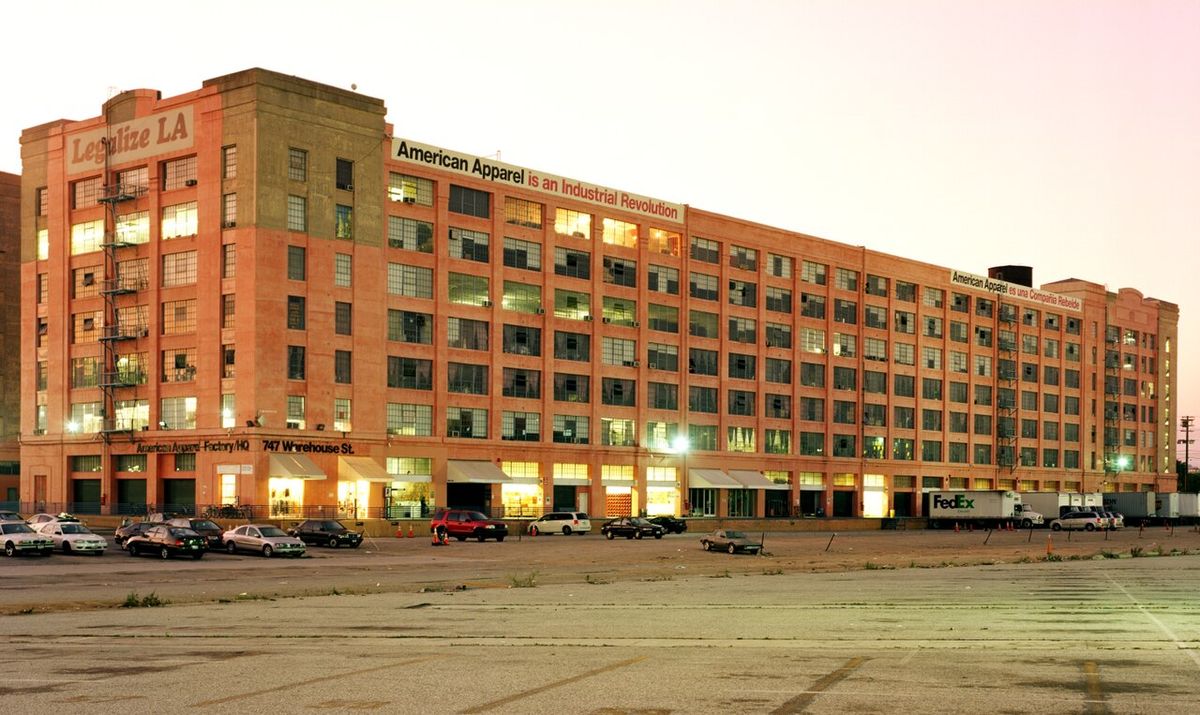
Canadian businessman Dov Charney founded American Apparel in the spring of 1989. The company's initial production took place in South Carolina before a major move to Los Angeles in 1997. In Los Angeles, Charney initially subcontracted sewing to a small shop run by Sam Lim, and the two soon became partners. The business grew primarily as a wholesale operation, selling blank T-shirts to screenprinters and other brands from its base in the historic Alameda Square complex in downtown Los Angeles, a location it moved into in 2000. This period established the company's core identity as a vertically integrated manufacturer controlling much of its supply chain. By 2005, American Apparel's rapid expansion was recognized when Inc. magazine ranked it as the 308th fastest-growing company in the United States, citing a three-year growth rate of 440 percent and annual revenues exceeding $211 million. The company went public in late 2006 through a reverse merger, securing a listing on the American Stock Exchange. In 2007, the company exported approximately $125 million worth of domestically manufactured clothing, positioning itself as one of the few significant exporters of "Made in the USA" apparel goods at the time.
Business challenges and leadership changes
American Apparel faced significant financial and governance challenges in the 2010s. In 2010, its auditor, Deloitte & Touche, resigned after raising concerns about the reliability of the company's 2009 financial statements, prompting investigations by the U.S. Securities and Exchange Commission and the U.S. attorney's office for the Southern District of New York. To raise capital, the company sold 15.8 million shares at 90 cents each to a group of Canadian investors led by Michael Serruya and Delavaco Capital in April 2011, securing $14.9 million and granting warrants for up to 27.4 million additional shares. The board of directors ousted founder and CEO Dov Charney in June 2014 following allegations of misconduct, appointing CFO John Luttrell as interim CEO and Allan Mayer and David Danziger as co-chairmen. Charney contested his removal as illegal, but the company formally replaced him with fashion executive Paula Schneider in December 2014. Financial pressures mounted, and in August 2015 the company warned it might not have enough cash to continue operations, which raised substantial doubt about its ability to remain a going concern. This led to a Chapter 11 bankruptcy filing on October 5, 2015, as the company needed to repay a $15.4 million debt due that month and struggled to find funds. The company rejected a $300 million takeover bid from investment firms Hagan Capital Group and Silver Creek, which were aligned with Dov Charney, in January 2016. Ultimately, Canadian manufacturer Gildan Activewear acquired the American Apparel brand and certain assets for $88 million in January 2017.
Provocative advertising and branding
American Apparel's in-house advertising was known for its sexually charged and controversial imagery, largely driven by Dov Charney's vision of the brand as a "heritage brand" akin to "liberty, property, pursuit of happiness. The campaigns often featured non-professional models recruited from the street or company stores, highlighting their blemishes and asymmetrical features without airbrushing and attaching brief personal descriptions. This approach earned both criticism and praise for its perceived honesty, with a 2007 survey by Outlaw Consulting ranking American Apparel as the 8th most trusted brand among young adults, ahead of H&M and Levi's. The company frequently used adult film actors and models like Lauren Phoenix, Charlotte Stokely, and Sasha Grey in its ads, leading the Adult Video News trade magazine to describe its website as one of the finer softcore sites going. Several campaigns were banned by advertising authorities, including a 2009 ad in VICE Magazine banned in the UK for potentially sexualizing a childlike model and a 2014 mini-skirt ad banned for normalizing predatory behaviour. Beyond sexuality, the branding also focused on political and social advocacy. The company launched the "Legalize LA" campaign advocating for immigration reform, maintaining a dedicated portion of its website with related news, and the "Legalize Gay" campaign following California's Proposition 8, selling T-shirts printed with "Repeal Prop 8. The brand's impact was recognized with awards like "Marketer of the Year" at the 2005 LA Fashion Awards and "Label of the Year" by The Guardian in 2008, and it was listed as the number two Top Trendsetting Brand by the Intelligence Group in 2008, behind only Nike.
American Apparel is known for its provocative and controversial advertising campaigns, which have often been banned by advertising authorities. In 2009, an ad in VICE Magazine was banned in the UK for sexualising a model who appeared to be a child. In 2014, an ad for mini skirts was banned for potentially normalising predatory sexual behaviour. The company also faced a major lawsuit from Woody Allen in 2007 over the unauthorised use of his image on billboards, which was settled for $5 million in 2009.
- In 2007, the company erected billboards in New York and Los Angeles featuring Woody Allen's character from Annie Hall, leading to a $10 million lawsuit settled for $5 million by its insurer in 2009 after Allen called the ads "sleazy" and "infantile" in a deposition.
- A 2013 ad depicting a model lying on a bed without pants was criticized by the UK Advertising Standards Authority as "voyeuristic" and making her appear "vulnerable."
- The company ran a 2014 ad with a topless model and the words "Made in Bangladesh" across her chest to contrast its own labour practices.
- In 2008, it published political ads featuring its corporate logo and calling U.S. immigration laws an "apartheid system."
- In 2013, the company was criticized for a "culturally insensitive display" in a New York store using imagery associated with Haitian Vodou, Louisiana Voodoo, and Cuban Santería.
- For a brief period, American Apparel also experimented with virtual world marketing, opening a store called Lerappa in Second Life in June 2006, which was designed by Aimee Weber, attacked by virtual protesters, and closed in late 2007.
Corporate culture, labour practices and lawsuits
American Apparel's corporate culture was unconventional and centred on its vertically integrated factory in downtown Los Angeles, with a banner proclaiming it an "Industrial Revolution." Founder Dov Charney promoted the idea of knowing workers personally by keeping production in-house, branding the operation as "sweatshop free." The company highlighted its control over the supply chain from raw materials to finished product to ensure responsible and sustainable practices, fair wages, and fair benefits, though it did use select contractors who had to comply with its code of conduct and international standards like the Worldwide Responsible Accredited Production (WRAP) and the Fair Labor Association (FLA). Hiring for creative and retail roles often emphasized personal style and cultural fit over formal resumes, a practice for which the company was also criticized. Charney described the culture as open about sexuality because "young people like honesty," but this culture was also the source of significant controversy and legal action. Charney admitted to sexual relationships with employees and was reported to have engaged in sexual acts during an interview with a writer for Jane magazine. The company faced multiple sexual harassment lawsuits, though many were dismissed, settled without monetary liability to the company, or sent to arbitration due to employee agreements waiving legal claims. One high-profile 2012 lawsuit by four former models, including one seeking $250 million and involving mutual nude photographs and sexual text messages, was dismissed by a New York City judge. In another case, the company was reprimanded by the Second Appellate District for issuing a press release about a settlement with an employee, Ms. Nelson, that referenced an arbitration hearing which never occurred because her lawyer, Keith Fink, did not show up. Fink later represented Dov Charney in defending against allegations of sexual harassment and assault.
Production evolution and the Gildan era
The fundamental identity of American Apparel shifted dramatically after its acquisition by Gildan Activewear. Originally, the brand was built on vertical integration and domestic manufacturing, exporting over $125 million of U.S.-made clothing in 2007 and controlling almost every step of its supply chain. Following the 2017 acquisition, production was moved to Gildan's facilities in Honduras and Nicaragua. The company now markets itself with the phrase "Ethically Made, Sweatshop Free," reflecting Gildan's own sourcing and labour standards. This transition marked the end of the large-scale Los Angeles manufacturing operation that had been central to the brand's story and marketing. Dov Charney, after his departure, started a new company called Los Angeles Apparel in 2016, which utilizes many of the same manufacturing methods as the original American Apparel. The current American Apparel brand operates as a label under the Gildan umbrella, focusing on wholesale blank apparel and direct-to-garment printing, a return to its original wholesale roots but with an entirely different geographic and corporate structure. The brand's previous reliance on its downtown Los Angeles factory as a single production hub was a defining feature that is no longer part of its operational model.
Cultural impact and Canadian connection
American Apparel secured a notable place in pop culture, referenced in songs by major artists. Kanye West mentioned "that American Apparel girl in just tights" in his 2010 song "Gorgeous" from the album My Beautiful Dark Twisted Fantasy, and the band 5 Seconds of Summer had a 2014 hit with "She Looks So Perfect," which featured the line "in my American Apparel underwear." The brand's aesthetic also inspired a 2013 parody song titled "American Apparel Ad Girls" by drag performers Willam Belli, Courtney Act, and Alaska Thunderfuck 5000 after being referenced in the Capital Cities song "Farrah Fawcett Hair." The company's Canadian roots were a point of pride and marketing. Founder Dov Charney was a Montreal native, and a 2010 ad in Canadian alternative weeklies described American Apparel as "a majority-owned Canadian company, founded and operated by Dov Charney, a Montrealer" and stated that its Canadian heritage was an important thing that made it special. This connection was further cemented when the brand was ultimately purchased by Montreal-based Gildan Activewear. The company's advocacy, particularly its "Legalize Gay" campaign, led to it being named one of TheStreet.com's "8 Pro-Gay Companies" in 2013. In the summer of 2013, the company also expressed a desire for more "transexy" models, continuing its trend of leveraging sexuality and identity in its branding.
Financial performance and market position
American Apparel's financial trajectory was marked by rapid growth followed by steep decline. Its peak in the mid-2000s saw it as a leading fast-growing company, with 2005 revenues surpassing $211 million. The company's status as a major exporter of American-made goods was notable, with $125 million in overseas sales in 2007. However, by 2015, the situation had reversed dramatically. The table below outlines key financial events and figures during its independent operation.
| Year | Key Financial Event or Figure |
|---|---|
| 2005 | Revenue over $211 million. 440% three-year growth |
| 2006 | Went public via reverse merger on AMEX |
| 2007 | $125 million in exported "Made in USA" goods |
| 2011 | Raised $14.9 million from Canadian investors |
| 2013 | Issued $206 million in senior secured notes to repay Lion Capital debt |
| 2014 | Lion Capital demanded early repayment of a $10 million loan after Charney's ouster, threatening a default on a $50 million line with Capital One |
| 2015 | Filed for Chapter 11 bankruptcy in October. Warned of going concern doubts in August |
| 2016 | Rejected $300 million takeover bid in January |
| 2017 | Acquired by Gildan Activewear for $88 million |
In January 2017, American Apparel was acquired for $88 million by the Canadian sportswear manufacturer Gildan Activewear. Following its bankruptcy and sale, the company markets itself as ethically made and most of its apparel is made in Honduras and Nicaragua. In April 2013, American Apparel issued a private offering of $206 million in senior secured notes to repay a long standing, high interest credit facility from Lion Capital and Crystal Financial. By September 2015, American Apparel struggled to avoid bankruptcy as it needed to repay a debt of $15.4 million due the following month.
Questions about American Apparel
Is American Apparel a Canadian company?
American Apparel was founded by Canadian Dov Charney and historically highlighted its Canadian roots in advertising, calling itself a "majority-owned Canadian company. However, it was headquartered in Los Angeles and publicly traded on the American Stock Exchange. Since January 2017, the American Apparel brand has been owned by the Canadian corporation Gildan Activewear, which is headquartered in Montreal. Therefore, while the original operating company was American, the brand is now under Canadian ownership.
Why was American Apparel controversial?
American Apparel was controversial for several reasons. Its advertising campaigns were frequently sexually explicit and led to multiple bans by advertising standards authorities for being voyeuristic or normalizing predatory behaviour. Founder and CEO Dov Charney faced numerous allegations of sexual misconduct and inappropriate behaviour with employees, which contributed to his ouster in 2014. The company's unconventional corporate culture, which included Charney's admission of sleeping with employees, was also widely criticized. Some of its political ads and a culturally insensitive store display sparked debate and outrage.
What happened to the founder of American Apparel?
Dov Charney, the Canadian founder of American Apparel, was removed as chairman and CEO by the company's board of directors in June 2014 following allegations of misconduct. He was formally replaced as CEO by Paula Schneider in December 2014. After the company's bankruptcy and sale to Gildan, Charney started a new clothing company called Los Angeles Apparel in 2016. This venture utilizes a similar vertically integrated, made-in-Los Angeles manufacturing model that defined the original American Apparel, and he has been involved in legal battles over his ouster.
What does 'Legalize LA' mean?
"Legalize LA" was an advertising and advocacy campaign launched by American Apparel focused on immigration reform. The campaign included advertisements in major newspapers like The New York Times, billboards, bus ads, posters, and T-shirts. It argued for changes to U.S. immigration laws, which the company once referred to in an ad as an "apartheid system. The campaign was part of the brand's broader effort to tie its identity to progressive political and social causes, alongside its later "Legalize Gay" campaign, and it maintained a dedicated news section on the company website.
Where are American Apparel clothes made now?
Following its acquisition by Gildan Activewear in 2017, most American Apparel apparel is made in Honduras and Nicaragua. The company now markets itself as 'Ethically Made, Sweatshop Free'. This represents a significant shift from its original identity as a vertically integrated 'Made in USA' company. Prior to its bankruptcy and sale, the company was known for manufacturing domestically, having sold about $125 million of domestically made clothing outside America in 2007. The change in production locations occurred after the brand was sold to the Canadian sportswear manufacturer.
When did American Apparel go bankrupt?
American Apparel filed for Chapter 11 bankruptcy on October 5, 2015. The company had warned investors in August 2015 that it might not have enough cash to sustain operations for the next twelve months. By September 2015, it was struggling to avoid bankruptcy as it needed to repay a $15.4 million debt due the following month. In January 2016, the company rejected a $300 million takeover bid from investment firms aligned with founder Dov Charney. Ultimately, in January 2017, American Apparel was acquired for $88 million by Gildan Activewear, concluding its bankruptcy process.
Sources and further reading
- American Apparel (Wikipedia)
- What ever happened to American Apparel? - Glossy (glossy.co)
- Our History (retail.americanapparel.com)
Checked by the Yadude Books desk. Last updated 2026-11-03.