Blockbuster
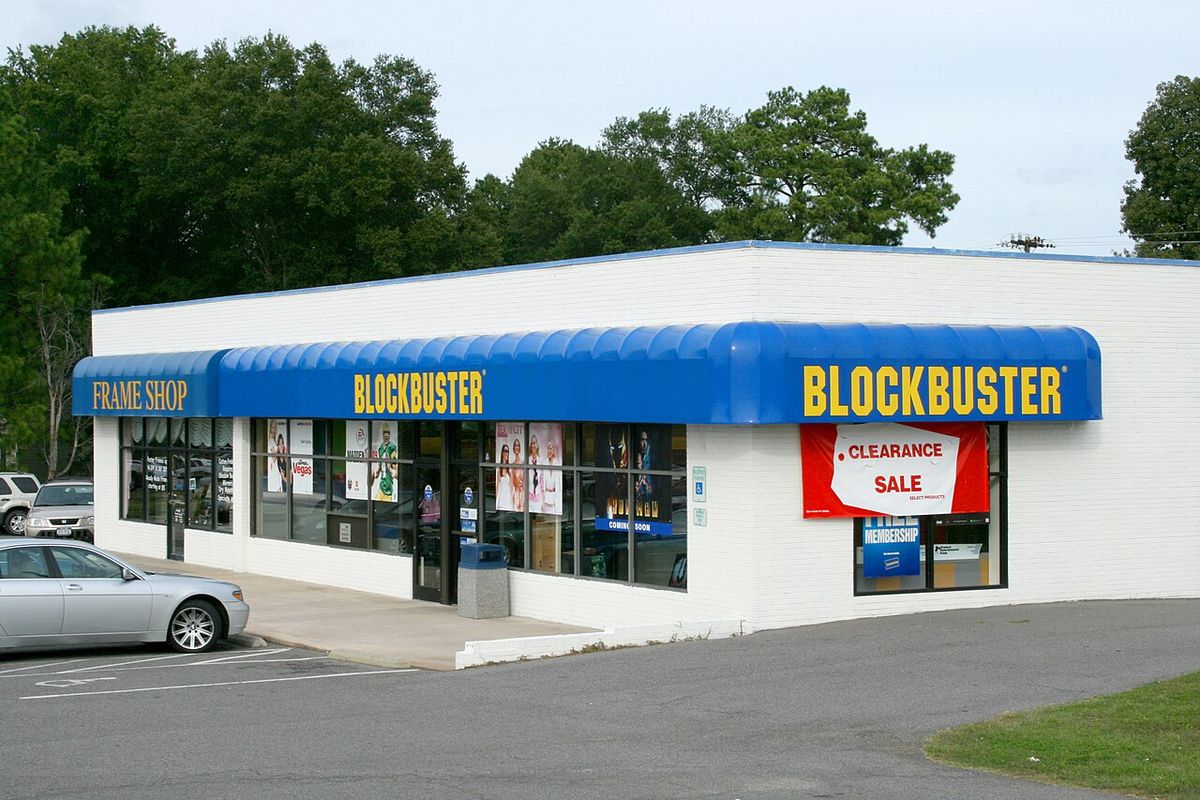
Blockbuster was an American home entertainment brand that grew from a single video rental store in 1985 to become the world's dominant video rental chain. For a generation of Canadians, Blockbuster was synonymous with weekend movie nights, its bright blue and yellow storefronts serving as community hubs for renting VHS tapes, DVDs, and video games. The company's rapid expansion in the 1990s and early 2000s was followed by a precipitous decline due to technological shifts, competition from services like Netflix, and financial mismanagement, leading to bankruptcy in 2010. While the corporate chain is defunct, the brand persists in cultural memory, and as of 2025, a single franchised store remains open in Bend, Oregon.
Founding and explosive growth under Wayne Huizenga
Blockbuster Video was founded by David Cook, who opened the first store on October 19, 1985, in Dallas, Texas. The initial inventory consisted of 8,000 VHS and 2,000 Beta tapes, and Cook applied his background in database management to tailor store inventories to local neighbourhood demographics. The chain's name was derived from the Hollywood term for a major commercial success. In 1987, Waste Management co-founder Wayne Huizenga, along with associate John Melk, acquired a stake in the then 19-store chain, attracted by its efficient operations and family-friendly image that excluded pornography. Huizenga applied aggressive expansion tactics, at one point opening a new store every 24 hours, and spent the late 1980s acquiring rivals like Major Video to fuel growth. A significant legal victory came in 1989 when Nintendo lost a series of lawsuits and lobbying efforts aimed at banning video game rentals, which secured Blockbuster's future in that lucrative market.
The company's growth continued through strategic acquisitions in the early 1990s. In 1990, Blockbuster purchased the mid-Atlantic chain Erol's, which had over 250 stores. It expanded beyond video in 1992 by acquiring the Sound Warehouse and Music Plus chains to form Blockbuster Music. Further diversification came in October 1993 with a controlling interest in Spelling Entertainment Group, the media company run by producer Aaron Spelling, and the November 1993 purchase of Super Club Retail Entertainment Corp., which added hundreds of music and video stores. Despite becoming a multibillion-dollar company, Huizenga grew concerned about emerging threats from cable television and video on demand. Unable to devise a long-term strategy to counter these trends, he orchestrated the sale of Blockbuster to media conglomerate Viacom in 1994 for $8.4 billion, a deal primarily intended to help Viacom finance its acquisition of Paramount Pictures.
The Viacom era and missed opportunities
Under Viacom's ownership, Blockbuster continued to expand but also faced critical strategic missteps. The company moved its headquarters from Fort Lauderdale, Florida, to the Renaissance Tower in downtown Dallas in November 1996, a relocation that required hiring 500 to 600 new employees as most Florida staff declined to move. In 1997, John Antioco resigned as president of Taco Bell to become Blockbuster's CEO. That same year, Warner Bros. offered Blockbuster an exclusive deal for new DVD releases, which would have given the rental chain a window before DVDs went on sale to the public in exchange for 40% of rental revenues. Blockbuster rejected the offer, leading Warner Bros. to lower wholesale DVD prices for retailers. This decision allowed mass retailers like Walmart to sell DVDs as loss leaders, rapidly surpassing Blockbuster as the largest revenue source for film studios and severely undermining the rental chain's business model.
Blockbuster launched a customer loyalty program called Blockbuster Rewards in late 1998, which went nationwide in 1999 after a test launch where one employee in Alabama sold over 1,800 memberships in a year. In a moment that would later be seen as a major error, the company turned down an opportunity to purchase the fledgling Netflix for $50 million in 2000. Also in 2000, Blockbuster partnered with Enron in a failed 20-year attempt to create a video-on-demand service, which Enron terminated in March 2001 over doubts about Blockbuster's ability to provide sufficient films. The company was spun off from Viacom in October 2004, regaining its independence. At its peak that year, Blockbuster operated 9,094 stores worldwide and employed 84,300 people. In December 2004, it announced a hostile takeover bid for its major U.S. competitor, Hollywood Video, but withdrew due to opposition from the Federal Trade Commission, allowing a smaller rival, Movie Gallery, to acquire Hollywood Video instead.
The battle with Netflix and financial turmoil
The rise of Netflix's DVD-by-mail service presented an existential threat. In 2005, financier Carl Icahn won a proxy fight to join Blockbuster's board, clashing with CEO John Antioco over strategy and criticizing Antioco's $51.6 million compensation for 2004. Antioco had scrapped late fees and launched an online service, while Icahn favoured selling the company to a private equity firm. The 'No more late fees' campaign proved controversial and led to lawsuits from over 40 states for false advertising, as customers were charged the full price of a movie after eight days unless they returned it and paid a 'restocking' fee, resulting in a settlement requiring refunds and clearer policy explanations. In 2007, Antioco launched a costly billion-dollar 'Total Access' program that allowed online rentals to be returned in stores for a free movie, a tactic that cost the company two dollars per free movie. When Netflix CEO Reed Hastings proposed a partnership to buy Blockbuster's online business, board member Icahn intervened, Antioco was forced out with a $24.7 million severance package, and his successor, former 7-Eleven CEO James Keyes, ended the program and raised online rental prices.
Keyes pursued a new direction, acquiring the online movie download service Movielink for $6.6 million in August 2007 to build a streaming platform, as Movielink had been created by five major studios and had a library of over 6,000 films. He also downplayed Netflix and Redbox, identifying Apple and Walmart as primary competitors. In February 2008, Blockbuster made an unsuccessful bid to buy the struggling electronics retailer Circuit City, which analysts viewed as a desperate effort to save two failing retailers rather than a sound turnaround plan. The company's financial situation deteriorated rapidly during the Great Recession. By the beginning of 2010, it had over 6,500 stores globally, but planned to close hundreds of U.S. locations and install thousands of 'Blockbuster Express' kiosks. In March 2010, its auditor expressed substantial doubt about its ability to continue, and Carl Icahn resigned from the board and sold his stock.
Bankruptcy, acquisition by Dish, and store closures
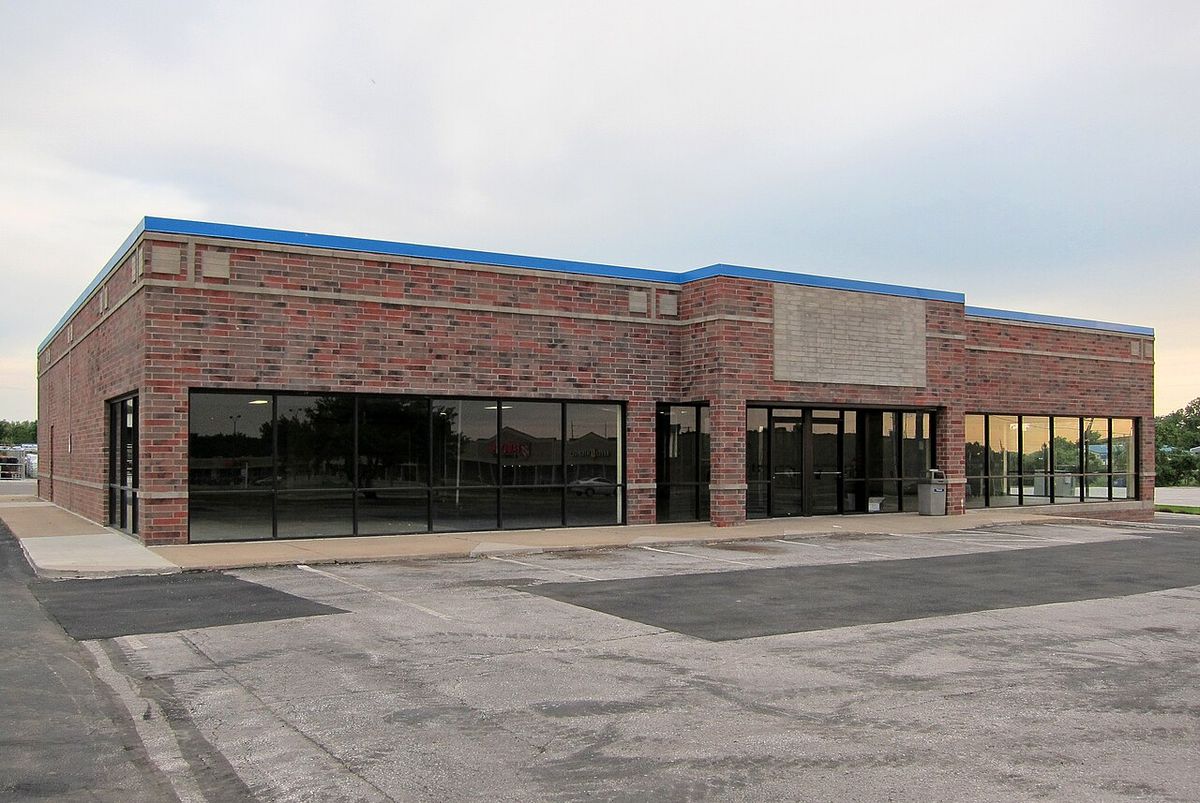
The bankruptcy process allowed the company to restructure and close hundreds of underperforming stores, with its U.S. store count falling to 3,425 by late October 2010. Dish's initial plan was to integrate Blockbuster's streaming and mail-order services with its satellite TV offerings to compete directly with Netflix. However, this strategy failed to gain traction in a rapidly changing market dominated by digital streaming. Dish began shuttering the remaining corporate-owned stores, and by 2014, the last 300 company-owned Blockbuster locations in the United States were closed, marking the effective end of the corporate chain.
Although corporate support ended, Dish retained a handful of franchise agreements, allowing independently owned stores to continue operating under the Blockbuster brand. Following a series of closures in 2019, only one franchised store remained open worldwide. This last location, in Bend, Oregon, became a novelty and tourist attraction. The original corporate entity that owned Blockbuster prior to the Dish acquisition continued to exist as a shell company named BB Liquidating, Inc. This company gained unexpected notoriety in January 2021 during the GameStop short squeeze, as its stock, which was still traded over-the-counter, experienced a massive, albeit brief, surge in price driven by retail investors.
Business operations and innovations
Blockbuster's core business was the rental and sale of home video formats, evolving from VHS and Beta to DVD and Blu-ray. The company was an early adopter of Blu-ray, announcing in June 2007 that it would stock the format in almost 5,000 stores across the United States, Canada, the United Kingdom, Mexico, and Australia after a successful pilot program in 250 stores. Beyond rentals, Blockbuster experimented with various retail and entertainment concepts. In 1994, it test-marketed the 'Blockbuster Block Party,' an adult-oriented entertainment complex in Albuquerque and Indianapolis featuring restaurants, games, laser tag, and simulator rides housed in a windowless building the size of a city block. The company also ventured into music retail with Blockbuster Music, which it sold in 1998, and into film production through DEJ Productions, which acquired 225 films to provide exclusive content for stores before being sold in 2005.
Key operational innovations included the Blockbuster Rewards loyalty program and the later 'Total Access' program bridging online and in-store rentals. The company also developed specialised store concepts like 'Game Rush,' a store-within-a-store for video games rolled out to 450 locations in 2004, and began DVD and game trading in select stores that same year. In studying future business models, Blockbuster acquired the Movie Trading Company chain in 2002 to explore DVD and game trading, a concept it later sold to Vintage Stock in 2006. Its foray into streaming began with the acquisition of Movielink, which had a library of over 6,000 films, though this move came too late to alter its competitive trajectory against Netflix's established service.
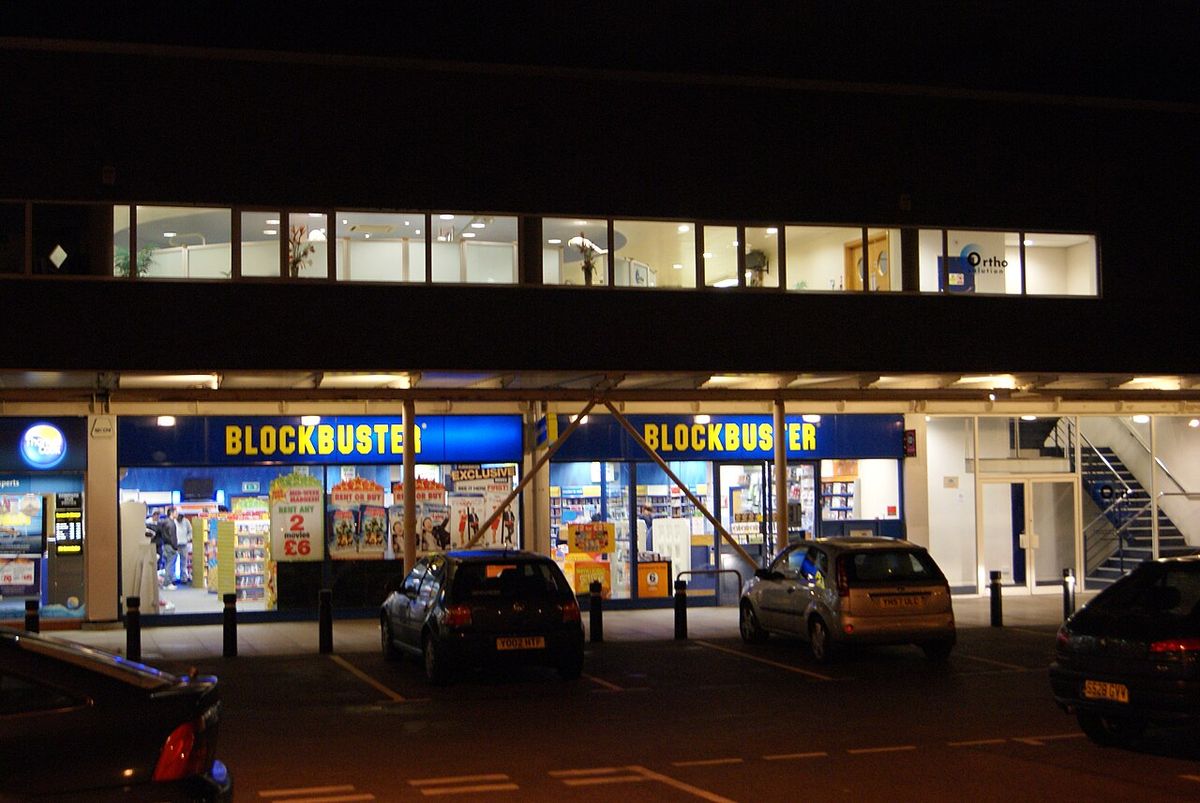
Cultural impact and presence in Canada
For many Canadians, Blockbuster was an integral part of 1990s and early 2000s pop culture, representing the ritual of browsing physical shelves for weekend entertainment. The stores were community fixtures where families and friends would gather to choose movies and games, with more than 43 million U.S. households having memberships at the company's height. The brand's signature blue and yellow colour scheme and cartoonish movie ticket logo became instantly recognisable. Blockbuster's presence in Canada mirrored its expansion in the United States, with hundreds of stores operating in major cities and suburban plazas at the chain's peak. Canadian stores followed the same operational model, offering rentals, late fees (and the subsequent controversial 'No more late fees' policy), and membership cards, and they also implemented the 'Additional Daily Rates' system for overdue rentals that was used in other international markets like the UK.
The chain's decline and disappearance from the Canadian landscape was a visible symbol of the digital disruption of the entertainment industry. As Netflix's streaming service and Redbox kiosks gained popularity, Blockbuster stores in Canada began closing throughout the late 2000s, with the final corporate stores shuttering by 2014. The brand's demise is often cited as a classic case study of a market leader failing to adapt to technological innovation, with its failed partnership with Enron and rejection of the Netflix purchase offer serving as textbook examples of missed opportunities. Despite its end, Blockbuster maintains a strong nostalgic presence, referenced in television shows, films, and by a generation that recalls the distinct experience of video rental stores.
Key dates in Blockbuster history
Blockbuster was founded by David Cook in 1985 as a single home video rental shop in Dallas, Texas. The company expanded rapidly throughout the 1990s, becoming a multibillion dollar public store chain with international operations. Major events in its history include acquisitions like Erol's and Spelling Entertainment, strategic errors such as turning down Netflix, and financial milestones like its 1994 sale to Viacom. The company's journey concluded with its 2010 bankruptcy filing, the 2011 sale of its remaining stores to Dish Network, and the eventual survival of only one franchised store.
- October 19, 1985: David Cook opens the first Blockbuster Video store in Dallas, Texas.
- 1987: Wayne Huizenga and John Melk acquire a stake, beginning a period of hyper-expansion.
- 1994: Viacom acquires Blockbuster for $8.4 billion.
- 2000: Blockbuster turns down an offer to buy Netflix for $50 million.
- October 2004: Blockbuster is spun off from Viacom. Reaches peak of 9,094 stores globally.
- 2005: Carl Icahn joins the board. The 'No more late fees' campaign sparks widespread lawsuits.
- 2007: CEO John Antioco is ousted. James Keyes takes over and acquires Movielink.
- 2014: Dish closes the last 300 corporate-owned Blockbuster stores.
- 2019: After franchise closures, only one store remains in Bend, Oregon.
Blockbuster's initial success was built on rapid store expansion and acquisitions under leaders like Wayne Huizenga. The company failed to adequately respond to emerging competitors like Netflix's mail order service and Redbox automated kiosks. It also struggled to adapt to new technologies such as video on demand and streaming. This inability to adapt, combined with poor leadership and the impact of the Great Recession, led to the company's eventual collapse.
Store count and financial decline (2004 to 2010)
The following table illustrates Blockbuster's precipitous decline in its number of stores in the years leading up to its bankruptcy, highlighting the rapid erosion of its physical retail footprint as customers shifted to digital alternatives. This contraction was a direct result of massive financial losses, the burden of debt, and an accelerating shift of customers to mail-order and streaming services. The closure of its primary competitor, Movie Gallery, in May 2010 provided a temporary reprieve but could not reverse the broader industry trends working against the brick-and-mortar rental model. The company's stock was delisted from the New York Stock Exchange in July 2010 after shareholders rejected a reverse stock split plan, a clear sign of its failing financial health and the market's loss of confidence in the brand.
| Year | Approximate Global Store Count | Key Event |
|---|---|---|
| 2004 | 9,094 | Peak store count. Spun off from Viacom. |
| Early 2010 | Over 6,500 | Announces plan to close 810 to 960 U.S. stores. |
| Late October 2010 | 3,425 (U.S. only) | Post-bankruptcy restructuring underway. |
| April 2011 | ~1,700 | Number of stores acquired by Dish Network. |
At its peak in 2004, Blockbuster operated 9,094 stores worldwide. By the beginning of 2010, that number had fallen to over 6,500 stores, with just 4,000 in the United States. Significant loss of revenue occurred during the late 2000s, leading to mounting debt. The company filed for bankruptcy protection in 2010. The next year, satellite television provider Dish Network bought its remaining 1,700 stores.
Questions about Blockbuster
Is there still a Blockbuster store open?
Yes, as of 2025, one Blockbuster store remains in operation. It is a franchised location in Bend, Oregon, that continues to rent DVDs and video games. This store is independently owned and operated under a franchise agreement retained by Dish Network after it closed all corporate-owned stores by 2014. It has become a novelty destination and a symbol of the bygone video rental era.
Why did Blockbuster go out of business?
Blockbuster failed due to a combination of technological disruption, poor strategic decisions, and massive debt. The company underestimated the threat from Netflix's mail-order and later streaming services, and it turned down a chance to buy Netflix in 2000. Leadership struggles, a controversial elimination of late fees, and a failed expensive program to compete with Netflix further weakened the company. The Great Recession exacerbated its financial troubles, leading to a bankruptcy filing in 2010 with nearly $1 billion in debt.
How many stores did Blockbuster have at its peak?
At its peak in 2004, Blockbuster operated 9,094 stores worldwide. The company employed 84,300 people at that time. This massive global footprint was the result of aggressive expansion throughout the 1990s. The chain had expanded internationally via growth tactics and acquisitions of rivals.
Did Blockbuster have a streaming service?
Yes, but it was launched too late to be competitive. In August 2007, Blockbuster acquired the online movie download service Movielink for $6.6 million to build a digital platform. This move came after it had already partnered with Enron on a failed video-on-demand venture in 2000. The company also operated a DVD-by-mail service called Blockbuster Online. However, these digital initiatives were poorly managed and could not catch up to the established lead and superior technology of Netflix's streaming service.
Who owns Blockbuster now?
The Blockbuster brand and remaining assets are owned by satellite television provider Dish Network, which purchased them in 2011. Dish Network closed the last company owned stores by 2014. While corporate support ended, Dish retained franchise agreements allowing some privately owned stores to operate. The original corporation that owned Blockbuster before Dish remains as a shell company named BB Liquidating, Inc. This shell company gained notoriety during the 2021 GameStop short squeeze. As of the latest information, only one franchised store remains open in Bend, Oregon.
What was Blockbuster's 'No more late fees' policy?
Blockbuster's 'No more late fees' policy was a controversial marketing campaign launched in 2005. The policy eliminated traditional per day late fees but charged customers the full retail price of a movie or game if they kept it for over eight days. Customers could cancel this charge by returning the product, but they still had to pay a separate fee. Over 40 American states filed lawsuits against Blockbuster for false advertising related to this campaign. The company ultimately settled these suits by agreeing to provide refunds and to better explain the policy terms to customers.
Sources and further reading
- Blockbuster (Wikipedia)
- Blockbuster: The rise and fall of the movie rental store ... (businessinsider.com)
Checked by the Yadude Books desk. Last updated 2026-10-20.