Chevron Corporation
Chevron Corporation is an American multinational energy corporation and one of the world's largest integrated oil and gas companies. With roots tracing back to the 1870s in California, it is a direct descendant of Standard Oil and operates in over 180 countries. For Canadians, Chevron is a significant player in the global energy market whose operations, investments, and environmental record have broad economic and climate implications. The company is involved in hydrocarbon exploration, production, refining, marketing, and chemicals manufacturing, and has increasingly focused on alternative energy and acquisitions in the 2020s.
Historical origins and the Standard Oil legacy
The origins of Chevron Corporation lie in the early oil discoveries of California in the late 19th century. One of its earliest predecessors, Star Oil, struck oil at the Pico Canyon Oilfield north of Los Angeles in 1876, an event considered by some as the start of California's modern oil industry. In 1879, investors including Charles N. Felton and Lloyd Tevis formed the Pacific Coast Oil Company, which acquired Star Oil's assets. This company grew to become the largest oil interest in California before being acquired by John D. Rockefeller's Standard Oil for $761,000 in 1900. Following the landmark 1911 breakup of Standard Oil under the Sherman Antitrust Act, one of the resulting entities was the Standard Oil Company of California, which would evolve into Chevron. This company was part of the group known as the Seven Sisters that dominated the global oil industry for much of the 20th century. The company changed its name to Standard Oil Company of California in 1926, though it was restricted to using the Standard name only in specific western U.S. states.
Chevron's historical growth was propelled by strategic discoveries and partnerships abroad. In 1933, the company secured an oil concession in Saudi Arabia, leading to the discovery of oil in 1938 and the massive Ghawar Field in 1948. Its subsidiary there evolved into the Arabian American Oil Company (ARAMCO), which was fully nationalized by Saudi Arabia by 1980. The company also had a long standing relationship with Texaco, forming the Caltex joint venture in 1936 to operate in Saudi Arabia. For decades, the two firms were sometimes called the terrible twins for their aggressive business tactics. The Chevron brand name itself entered use for retail products in the 1930s, with Calso also used in some regions from 1946 to 1955. A major transformation came in 1984 when Standard Oil of California merged with Gulf Oil in what was then the largest merger in history, leading the company to change its legal name to Chevron Corporation the following year.

Major mergers, acquisitions and portfolio shifts
The company dramatically expanded in 2001 with the $45 billion acquisition of Texaco, briefly operating as ChevronTexaco until 2005. This deal created the second largest oil company in the United States at the time. In 2005, Chevron further bolstered its reserves by purchasing Unocal Corporation for $18.4 billion, a move that also made it a major producer of geothermal energy due to Unocal's Asian operations. The 2010s saw a strategic shift toward domestic natural gas, including the $3.2 billion acquisition of Atlas Energy Inc. in 2011 to gain access to the Marcellus Shale. Concurrently, Chevron reduced its retail footprint, ending operations at 1,100 stations in the Mid Atlantic United States in 2010 and selling its North Sea operations in 2019.
The 2020s have been defined by both large scale acquisitions and a strategic pivot toward new energy ventures and specific geographic focuses. In 2020, Chevron acquired Noble Energy for $5 billion. Its most significant deal of the decade was the October 2023 announcement of a $53 billion all stock acquisition of Hess Corporation, which grants Chevron major stakes in prolific oil regions like the U.S. shale plays and offshore Guyana. Hess shareholders approved the merger in May 2024, though it faced an arbitration claim from ExxonMobil. Alongside traditional oil and gas, Chevron has actively invested in alternative energy, including acquiring biodiesel producer Renewable Energy Group in 2022 and taking a majority stake in a large Utah hydrogen storage facility in 2023. The company has also invested in fusion power companies like Zap Energy and TAE Technologies.
Global operations and strategic focus areas
Chevron operates a vertically integrated business model across more than 180 countries, encompassing exploration, production, refining, marketing, and chemicals. Its manufacturing and sales of fuels, lubricants, and petrochemicals are concentrated in several key regions including Western North America, the U.S. Gulf Coast, Southeast Asia, South Korea, and Australia. In 2018, the company's net production in the United States averaged 791,000 barrels of oil equivalent per day. The company's strategic focus has evolved in recent years, with a pronounced shift toward the Americas and a gradual pullback from certain international regions. This has been accompanied by a continued, though lessened, interest in natural gas and a growing portfolio of alternative energy investments.
Chevron's recent operational moves highlight its changing geographic priorities. In the Americas, a significant development has been the relaxation of U.S. sanctions allowing Chevron to resume limited oil pumping in Venezuela through joint ventures like Petropiar, though with strict profit restrictions. The company also acquired the Beyond6 network of compressed natural gas stations in the U.S. in 2022. Conversely, Chevron has exited or reduced exposure in other parts of the world, announcing the end of all operations in Myanmar in 2022 citing human rights abuses following the 2021 coup. That same year, it was reported to be exploring the sale of its stakes in oil fields in Equatorial Guinea, and it temporarily decreased production at Kazakhstan's Tengiz Field due to political protests.
- Key Manufacturing & Sales Regions: Western North America, U.S. Gulf Coast, Southeast Asia, South Korea, Australia.
- Major 2020s Acquisition: Hess Corporation (2023, $53 billion), providing access to U.S. shale and Guyana.
- Alternative Energy Investments: Renewable Energy Group (biodiesel), Utah hydrogen storage, stakes in Zap Energy and TAE Technologies (fusion).
- Recent Exits/Reductions: Operations in Myanmar (2022), stakes in Equatorial Guinea fields (2022), North Sea operations (sold 2019).
- Strategic Focus in Americas: Limited resumed operations in Venezuela, expansion in U.S. natural gas via acquisitions.
Financial performance and market position
Chevron is a financial giant within the global energy sector, consistently ranking among the world's largest corporations. In 2023, the company held the 10th position on the Fortune 500 list. It is the second largest oil company in the United States by revenue, trailing only ExxonMobil, another Standard Oil descendant. Chevron also holds the distinction of being the last remaining oil and gas component of the Dow Jones Industrial Average since ExxonMobil's exit from the index in 2020. The company's financial results are heavily influenced by global commodity prices and geopolitical events, leading to significant volatility in its revenue and profit figures from year to year. The table below illustrates Chevron's record breaking financial performance in 2022, a year marked by high energy prices following the Russian invasion of Ukraine, which led to substantial profits and a major increase in its shareholder return program that attracted considerable public and political scrutiny.
| Financial Metric | 2022 Result |
|---|---|
| Total Revenue | $246.3 billion |
| Net Income (Profit) | $36.5 billion |
| Notable Corporate Action | $75 billion stock buyback program announced |
Chevron announced reductions of 10 to 15 percent of its workforce due to the COVID 19 pandemic and a 2020 oil price war between Russia and Saudi Arabia. During the pandemic, Chevron considered a merger with rival ExxonMobil in 2020 during the early stages of the COVID 19 pandemic that drove oil demand sharply down. It would have been one of the largest corporate mergers in history. A combined Chevron and ExxonMobil would have been the second largest oil company in the world, trailing only Saudi Aramco.
Environmental record and controversies
Chevron has been the subject of numerous environmental and social controversies, many relating to its impact on climate change and local ecosystems. The company's 2024 carbon dioxide emissions were reported at 512 million tonnes, accounting for approximately 1.33 percent of global CO2 emissions. Chevron has faced persistent criticism and legal battles over ecological damage, most notably from activities inherited from Texaco in the Lago Agrio oil field in Ecuador. This long running case involved lawyer Steven Donziger and became a widely covered incident on social media. The company has also drawn negative attention for oil extraction projects within the Los Angeles metropolitan area and in the Eastern Mediterranean region. Regulatory and legal challenges have resulted in significant financial penalties for the company, such as the $118 million settlement in March 2022 for violating the Clean Air Act at three Texas chemical plants.
Beyond specific incidents, Chevron, along with other major oil companies, faced immense public and political backlash in 2022 for reporting record profits during a global energy crisis exacerbated by the war in Ukraine. The announcement of a $75 billion stock buyback program days before its full year earnings report drew a heated response from the Biden administration and U.S. commentators. The U.S. Department of Justice and Environmental Protection Agency found Chevron and its partner failed to properly operate flare systems at the Texas plants, causing excess air pollution, and required them to install new pollution control systems as part of the settlement. During the pandemic, Chevron also began requiring some employees, including those on offshore platforms, to receive COVID 19 vaccinations to protect key operations.
Corporate identity and branding
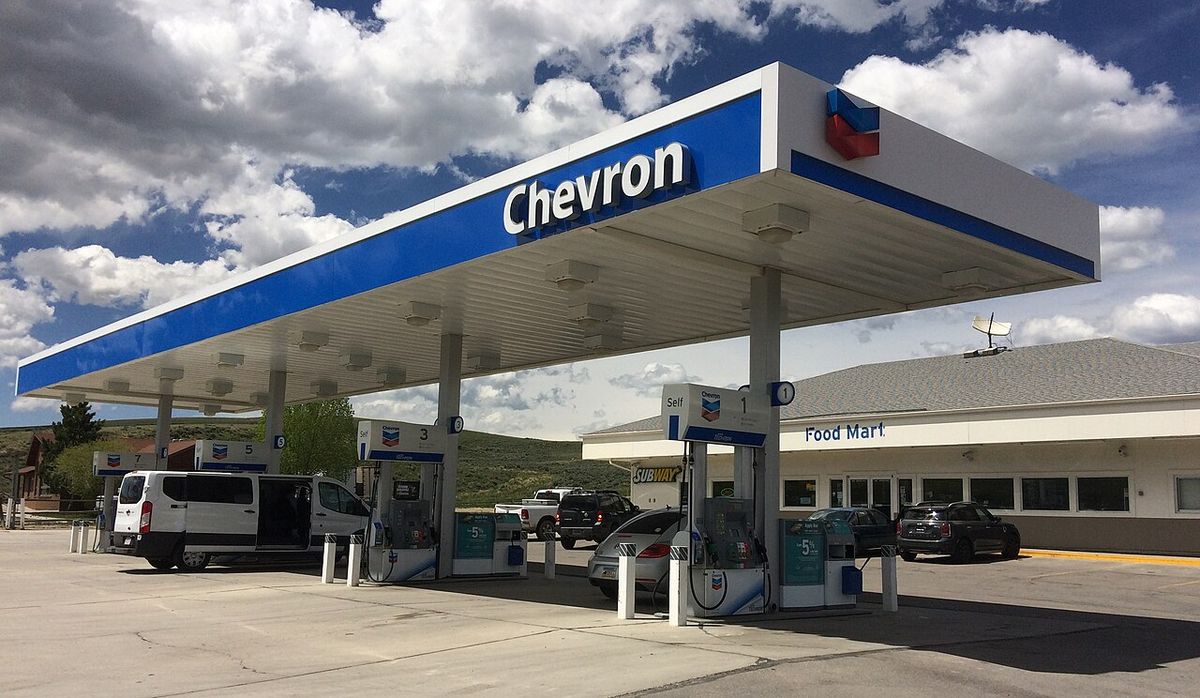
The Chevron Corporation's name and branding have evolved significantly from its origins as a Standard Oil company. The well known Chevron name and logo first came into use for retail products in the 1930s. Following the 1984 merger with Gulf Oil, the company officially changed its legal name from Standard Oil Company of California to Chevron Corporation in 1985. However, due to American trademark law, Chevron retains ownership of the Standard Oil trademark in 16 western and southeastern U.S. states. To maintain these rights, the company operates one Standard branded Chevron station in each of those states. The Texaco brand, acquired in 2001, continues to be used by Chevron for many of its fueling stations across the United States and elsewhere.
Chevron's branding portfolio has been shaped by acquisitions and divestments over the decades. After merging with Gulf Oil, Chevron was required to sell off many of Gulf's assets, including its retail outlets in the Pittsburgh area. The Gulf Oil trademarks for the entire United States were eventually sold to Cumberland Farms in 2010. Similarly, the acquisition of Unocal in 2005 did not include the Union 76 brand, which had been sold earlier and is now owned by Phillips 66. The company's retail strategy has seen consolidation, such as the 2010 removal of the Chevron and Texaco brands from 1,100 stations in the Mid Atlantic U.S., reflecting a broader shift in its business focus.
Questions about Chevron Corporation
What is Chevron Corporation's connection to Standard Oil?
Chevron Corporation is the second largest direct descendant of Standard Oil. It was originally known as the Standard Oil Company of California. In 1911, the federal government broke Standard Oil into several pieces under the Sherman Antitrust Act. One of those pieces, Standard Oil Co. (California), went on to become Chevron. Today, Chevron is the owner of the Standard Oil trademark in 16 states in the western and southeastern United States.
What are some of Chevron's major acquisitions?
Chevron has grown through several landmark acquisitions. The $45 billion purchase of Texaco in 2001 created one of the world's largest oil companies. In 2005, it acquired Unocal Corporation for $18.4 billion, gaining significant geothermal assets. More recently, Chevron acquired Noble Energy for $5 billion in 2020 and announced its largest deal yet in 2023: a $53 billion all stock acquisition of Hess Corporation, which provides major stakes in U.S. shale and offshore Guyana oil fields.
What is Chevron's stance and investment in alternative energy?
In the 2020s, Chevron has increased its focus on alternative energy solutions as part of its business strategy. Key investments include the 2022 acquisition of biodiesel producer Renewable Energy Group, taking a majority stake in a large Utah hydrogen storage facility in 2023, and investing in fusion power companies like Zap Energy and TAE Technologies. The company has also invested in carbon capture technology through Carbon Clean Solutions. These moves represent a strategic diversification alongside its core oil and gas operations.
What controversies is Chevron known for?
Chevron has been involved in numerous environmental and legal controversies. A major ongoing issue stems from ecological damage in Ecuador's Lago Agrio oil field, a legacy of Texaco's operations, which involved a protracted legal battle with lawyer Steven Donziger. The company has also paid large penalties for environmental violations, including a $118 million settlement in 2022 for Clean Air Act breaches at Texas chemical plants. Chevron also faces criticism for its carbon emissions, which amounted to 1.33 percent of the global total in 2024, and for recording massive profits during the 2022 energy crisis.
What was the significance of Chevron's deal with Hess?
The October 2023 agreement to acquire Hess Corporation for $53 billion is one of Chevron's largest and most strategic deals. It provides Chevron with significant access to high growth oil regions, particularly offshore Guyana where Hess is a partner with ExxonMobil and CNOOC in projects producing 400,000 barrels per day. The acquisition also expands Chevron's position in U.S. shale plays. Hess shareholders approved the merger in May 2024, though it was temporarily held up by an arbitration claim from ExxonMobil over pre emptive rights to Hess's Guyana assets.
Does Chevron operate in Canada?
Yes, Chevron has held assets in Canada. In October 2014, the company announced the sale of a 30 percent holding in its Canadian oil shale holdings to Kuwait's state owned Kuwait Oil Company for $1.5 billion. Chevron is an American multinational energy corporation active in over 180 countries. Its operations are vertically integrated, encompassing hydrocarbon exploration, production, refining, marketing, and transport. While the 2014 sale indicates a divestment of some Canadian assets, the company's global presence includes extensive activities across the oil and gas industry.
Sources and further reading
- Chevron Corporation (Wikipedia)
- Chevron Canada, Chevron Corporation (canada.chevron.com)
- United States Highlights of Operations (chevron.com)
- Chevron Corporation (CVX) Stock Price, News, Quote & ... (ca.finance.yahoo.com)
- Chevron Corporation | Business and Management (ebsco.com)
Checked by the Yadude Books desk. Last updated 2026-10-20.