Sotheby's
Sotheby's is a British-founded multinational corporation and one of the world's oldest and largest brokers of fine and decorative art, jewellery, watches, and collectibles. Founded in London in 1744, the company is now headquartered in New York City and operates 80 locations across 40 countries. For Canadian collectors, investors, and art enthusiasts, Sotheby's provides a critical gateway to the global art market through its auctions, private sales, and advisory services, with significant sales of Canadian art and artefacts regularly appearing in its international catalogues. The company's operations include high-profile public auctions, a growing private sales business, and subsidiaries like Sotheby's International Realty and Sotheby's Institute of Art.
Historical Foundations and Evolution
Sotheby's origins trace back to 11 March 1744, when London bookseller Samuel Baker conducted his first auction of valuable libraries. The firm evolved through partnerships, becoming Baker & Leigh in 1767 and Leigh and Sotheby in 1778 after Baker's nephew, John Sotheby, inherited his share. For over a century, the company focused primarily on books and prints, establishing itself as a leading auction house in that field. It was not until the 20th century that Sotheby's significantly expanded into fine art, with a major early success being the 1913 sale of a Frans Hals painting for nine thousand guineas. The company moved to its enduring London base at 34-35 New Bond Street in 1917, setting the stage for its rivalry with Christie's. A critical moment in its global expansion came in 1964 with the purchase of Parke-Bernet, then the largest fine art auctioneer in the United States, which cemented Sotheby's presence in the crucial American market.
The late 20th century saw Sotheby's aggressively grow its international footprint and business model. It opened offices in Paris and Los Angeles in 1967, became the first international auction house to operate in Hong Kong in 1973, and entered Moscow in 1988. The company also diversified beyond traditional auctioneering, acquiring art galleries and forming partnerships with dealers to bolster its private sales operations. For instance, in 1990 it teamed with dealer William Acquavella to form a subsidiary that purchased the contents of the Pierre Matisse Gallery for $143 million. Throughout the 1990s and early 2000s, Sotheby's invested heavily in its physical infrastructure, completing a $140 million expansion of its New York headquarters on York Avenue in 2001, which added significant gallery and storage space. The company later sold that building in 2002 for $175 million and continued to seek new locations, eventually agreeing to purchase the former Breuer museum building at 945 Madison Avenue in 2023 for a new global headquarters.
- 1744: Samuel Baker founds the company in London.
- 1913: Holds its first major fine art sale (a Frans Hals painting).
- 1964: Acquires Parke-Bernet, entering the U.S. market dominantly.
- 1973: Becomes the first international auction house to operate in Hong Kong.
- 2001: Completes a $140 million expansion of its New York headquarters.
- 2019: Acquired by French-Israeli businessman Patrick Drahi for $3.7 billion.
- 2023: Agrees to purchase 945 Madison Avenue (the former Breuer museum) for a new global headquarters set to open in 2025.

Ownership and Corporate Structure
Sotheby's has transitioned between public and private ownership several times in its modern history. It became a publicly traded company in the United Kingdom in 1977. In 1983, a consortium led by American businessman Alfred Taubman purchased and privatized the firm, incorporating it in Michigan as Sotheby's Holdings, Inc. Taubman then took the company public again in 1988, listing its shares on the New York Stock Exchange under the ticker symbol 'BID', making it the oldest publicly traded company on the NYSE at that time. The corporate structure was streamlined in June 2006 when it reincorporated in Delaware and was renamed simply Sotheby's. This public era ended in June 2019 when French-Israeli telecommunications magnate Patrick Drahi acquired the company for approximately $3.7 billion, representing a 61% premium over its market price, and returned it to private ownership.
Under Drahi's control, Sotheby's underwent significant executive and operational changes aimed at improving profitability. In October 2019, Drahi appointed Charles F. Stewart as the new Chief Executive Officer, replacing Tad Smith. A series of cost-cutting measures followed, including senior executive layoffs in 2019, further job and salary reductions during the 2020 pandemic, and a shift towards online auctions. In 2022, the company announced it would end its employee pension plan. Despite these internal changes, the company's market performance remained strong, overtaking Christie's in total sales in 2020 for the first time since 2011. In 2024, the Abu Dhabi Investment Authority (ADIA) acquired a minority stake in Sotheby's with an investment of approximately $1 billion, providing further capital and signaling continued confidence in the luxury asset market.
Business Operations and Sales Performance
Sotheby's core business is divided between public auctions and private sales, supported by a wide array of client services. Public auctions are typically free and open to the public, concluding when a single bidder remains at a declared price, known as the hammer price. The company has developed extensive digital tools for bidders, including the MySotheby's online system for tracking lots and the BIDnow service for real-time online bidding during broadcast auctions. Alongside auctions, private sales represent a substantial and growing segment, where transactions are conducted confidentially between buyers and sellers. In 2011, private sales accounted for 16.5% of total sales, a figure that has grown significantly, reaching a record $826 million in the first half of 2026 alone. The company facilitates these through dedicated gallery spaces like S2 in New York and a gallery on George Street in London.
The company's financial performance demonstrates its leading position in the global art market. After a contraction during the 2008 financial crisis, the market and Sotheby's fortunes rebounded. The first half of 2026 results showed a powerful recovery, with total turnover reaching $4.4 billion, a 58% increase over the same period in 2025. This total comprised $3.4 billion in public auction sales and the record $826 million in private sales. The sell-through rate for auction lots was a high 90%. These figures highlight a market driven by high-value collections and trophy lots, such as the $173 million sale of the late dealer Robert Mnuchin's collection in May 2026 and the $406.2 million Lewis collection sale in London in June 2026, the highest-value sale of its kind ever staged in Europe. The company's performance in luxury categories like watches and classic cars also contributed significantly to this growth.
| Category | H1 2026 Sales | Notes |
|---|---|---|
| Total Turnover | $4.4 billion | Up 58% from H1 2025 |
| Public Auction Sales | $3.4 billion | Up 59% from H1 2025 |
| Private Sales | $826 million | Record high for a half-year period |
| Sell-Through Rate (Lots) | 90% | Indicates strong market demand |
Specialized Divisions and Luxury Sales
Beyond fine art, Sotheby's has cultivated a dominant presence in the broader luxury goods market, a segment that has shown remarkable growth and serves as an entry point for new, younger collectors. The company's luxury division encompasses jewellery, watches, wine and spirits, classic cars, handbags, and memorabilia. In the first half of 2026, luxury sales were a major contributor, with Christie's reporting $539 million in the category and Sotheby's also noting exceptional performance. Key drivers include watches, where Sotheby's has seen a surge in interest from Millennial and Gen Z bidders, who now account for roughly one-third of participants. The average bidder spend in watches increased by about 60% year-on-year to $129,000 in this period, with growing demand for independent makers like F.P. Journe. The memorabilia category has also seen a boom, exemplified by the July 2026 sale of businessman Jim Irsay's Americana collection, which totalled $105.2 million across five auctions.
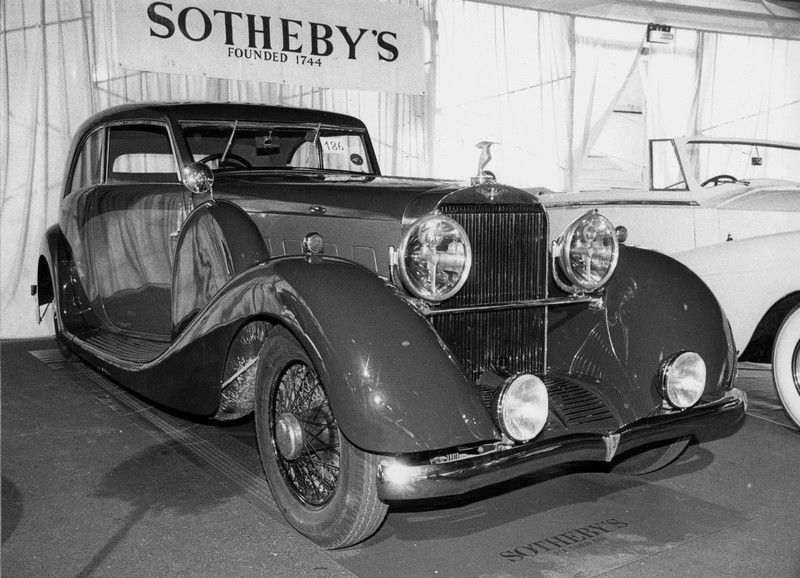
Notable record sales demonstrate the strength of this segment. In April 2026, a 1961 Ferrari 250 GT SWB California Spider achieved €16.7 million at an RM Sotheby's sale in Monte Carlo. That same month in Hong Kong, a Cartier Tutti Frutti pendant necklace sold for $2.8 million. Perhaps the most headline-grabbing sale of 2026 was that of 'Gus', a highly complete Tyrannosaurus rex skeleton, which Sotheby's sold for US$50.1 million in July, demonstrating the house's ability to generate excitement and record prices across an incredibly diverse range of collectibles. These sales reflect a market where buyers are highly informed and focused on craftsmanship and rarity, particularly in categories like independent watchmaking.
- Watches & Jewellery: Cartier Tutti Frutti necklace ($2.8m, 2026). Growing young collector base.
- Classic Cars (RM Sotheby's): 1961 Ferrari 250 GT SWB California Spider (€16.7m, 2026).
- Wine & Spirits: Record $35,000 for a bottle of tequila (2026).
- Memorabilia: Jim Irsay's Americana collection ($105.2m total, 2026).
- Natural History: 'Gus' T. rex skeleton ($50.1m, 2026).
Subsidiaries and Partner Organizations
Sotheby's has expanded its brand into several related sectors through subsidiaries and franchise partnerships. The Sotheby's Institute of Art, founded in London in 1969, is an accredited educational institution that offers master's degrees and a range of courses in art business, art history, and curation. It represents the company's commitment to art scholarship and professional development. In the real estate sector, Sotheby's International Realty was established in 1976 as a luxury real estate brand. It operates as a global franchise network, marketing high-end residential properties and, as of early 2026, claimed the top spot for press mentions in the luxury real estate sector. Its 2026 Luxury Outlook report analyses trends like multigenerational living and the demand for energy-autonomous homes, providing clients with strategic market insights.
Another significant partnership is RM Sotheby's, which specializes in the auction of classic and vintage automobiles. This venture began in February 2015 when Sotheby's acquired a 25 percent stake in classic and vintage automobile auctioneer RM Auctions. RM Sotheby's is a subsidiary or partner organisation. Sotheby's also has other subsidiaries or partner organisations such as Sotheby's Institute of Art and Sotheby's International Realty. These organisations operate in areas like education, real estate, and automotive collecting.
Services and Client Offerings
Sotheby's provides a comprehensive suite of services designed to support every aspect of collecting, selling, and managing valuable assets. Advisory services offer clients expert guidance on building and managing collections, while the Fiduciary Client Group assists with estate planning and wealth management involving art and collectibles. Financial Services, established in 1988, is a critical offering, providing loans using art as collateral. This includes advances on consigned property and term loans for works clients do not intend to sell immediately, a service that helps build long-term client relationships. The company also offers fine art storage, scientific research for authentication, and valuation services for insurance, estate, or sale purposes.
Other specialized services include restitution assistance, helping to research the provenance of works with potentially disputed ownership histories, and tax and heritage advice, particularly relevant for transactions involving cultural property. Sotheby's Wine offers advisory services and sales, and in October 2019, the company launched its own Sotheby's Own Label Collection of wines, curated from its best-selling producers. The company also maintains an active publishing arm, having produced the Sotheby's Wine Encyclopedia since 1988 and a bimonthly online magazine, Sotheby's Magazine, since late 2018. These services collectively position Sotheby's not just as a sales platform, but as a full-service partner for high-net-worth individuals in the complex world of tangible assets.
Questions about Sotheby's
How does Sotheby's private sales business work?
Sotheby's Private Sales connects buyers and sellers for confidential transactions outside of public auctions. The identities of both parties are not disclosed. This service accounted for a record $826 million in sales in the first half of 2026. The company facilitates these sales through dedicated gallery spaces like S2 in New York and a gallery on George Street in London, tailoring the process to client needs for discretion and privacy.
What are Sotheby's main subsidiary companies?
Sotheby's operates several key subsidiaries. Sotheby's Institute of Art, founded in 1969, is an educational institution offering art-related degrees and courses. Sotheby's International Realty, established in 1976, is a global franchise network for luxury real estate. RM Sotheby's is a partnership specializing in classic car auctions, formed after Sotheby's acquired a stake in RM Auctions in 2015. Each extends the brand into complementary luxury markets.
How did Sotheby's perform financially in the first half of 2026?
Sotheby's reported strong financial results for the first half of 2026, with total turnover reaching $4.4 billion, a 58% increase over the same period in 2025. This included $3.4 billion in public auction sales and a record $826 million in private sales. The sell-through rate for auction lots was 90%, indicating high market demand. The performance was driven by high-value collections and growth across luxury categories like watches, jewellery, and classic cars.
When was Sotheby's founded and by whom?
Sotheby's was founded on 11 March 1744 in London by Samuel Baker, a bookseller. The company's first major auction involved selling several hundred valuable books from the library of Sir John Stanley. In 1767, the firm became Baker & Leigh after George Leigh became a partner. After Baker's death in 1778, his nephew John Sotheby inherited his share, leading to the name Leigh and Sotheby. This established the foundation for what would become one of the world's oldest and largest brokers of fine art, jewellery, and collectibles.
Who owns Sotheby's?
Sotheby's is owned by French-Israeli businessman Patrick Drahi, who acquired the company in June 2019 at a 61 percent market premium. This acquisition returned Sotheby's to private ownership after it had been a publicly traded company on the New York Stock Exchange since 1988. In 2024, the Abu Dhabi sovereign wealth fund ADIA acquired a minority stake in Sotheby's with an investment of approximately $1 billion. Prior to Drahi's ownership, a group of investors including Alfred Taubman had purchased and privatized the company in 1983 before taking it public again five years later.
Sources and further reading
- Sotheby's (Wikipedia)
- Christie's and Sotheby's 2026 half year results: trophy lots ... (theartnewspaper.com)
Checked by the Yadude Books desk. Last updated 2026-10-28.