Resident Evil (2002 film)
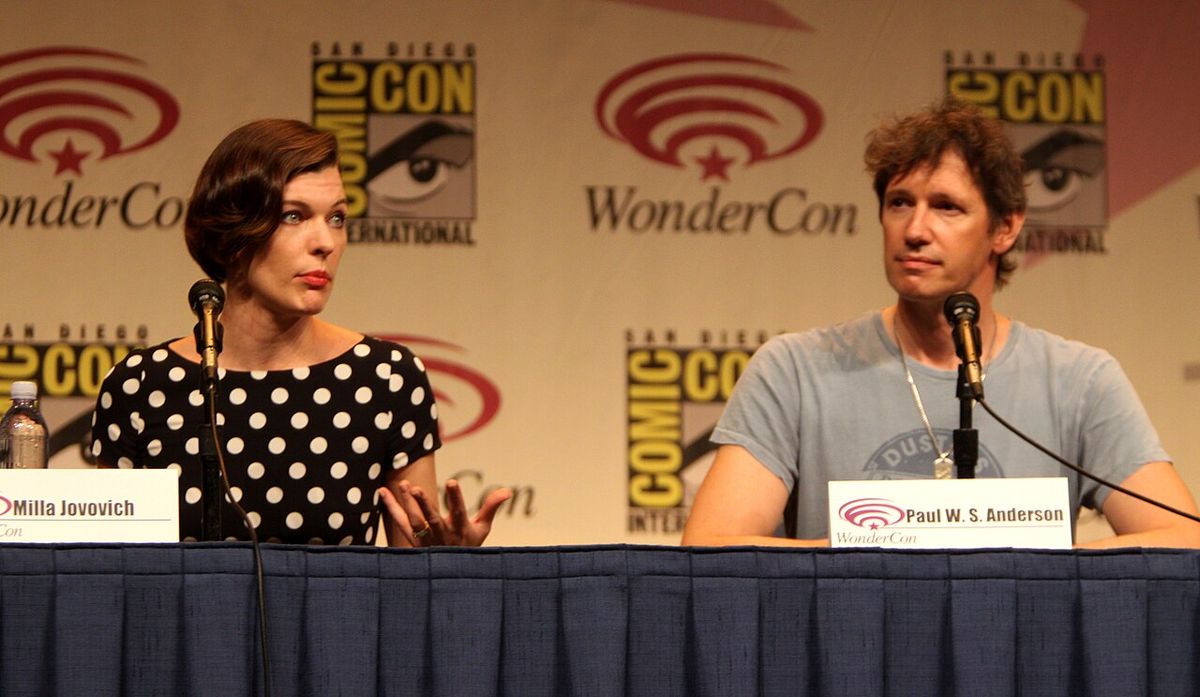
Resident Evil is a 2002 action horror film written and directed by Paul W. S. Anderson. The film stars Milla Jovovich, Michelle Rodriguez, Eric Mabius, James Purefoy, Martin Crewes, and Colin Salmon. It is the first installment in the Resident Evil film series, which is loosely based on the video game series of the same name. Borrowing elements from the video games Resident Evil and Resident Evil 2, the film follows amnesiac heroine Alice and a band of Umbrella Corporation commandos as they attempt to contain the outbreak of the T-virus at a secret underground facility.
Development and pre-production
The journey of Resident Evil to the screen began in January 1997 when German production company Constantin Film acquired the live-action film rights to the video game series. The studio initially hired screenwriter Alan B. McElroy to draft a script, which was completed in May 1997 and closely followed the plot of the first game. McElroy's script was ultimately rejected, as was a subsequent screenplay written by legendary horror director George A. Romero, who was hired in 1998 after impressing Sony with a commercial he directed for Resident Evil 2. Romero wrote five or six drafts that incorporated characters like Chris Redfield and Jill Valentine, but Constantin head Bernd Eichinger rejected them, fearing the film would receive an NC-17 rating. In 2000, director Jamie Blanks was briefly attached to an adaptation drawing from later games before Paul W. S. Anderson took over the project. Anderson had previously directed the successful video game adaptation Mortal Kombat in 1995 and wrote a script titled Undead inspired by Resident Evil, which he developed into the final film. He deliberately chose to create new characters for the film to maintain suspense over who would survive.
Casting and principal photography
Casting for Resident Evil was finalized in early 2001, with Milla Jovovich, Michelle Rodriguez, and James Purefoy among the first actors signed. Eric Mabius was cast in March 2001 as Matt Addison after David Boreanaz turned down the role to continue working on the television series Angel. Heike Makatsch was cast as Matt's sister, Lisa. Jovovich undertook martial arts training for her role as Alice, guided by actor and martial artist Robin Shou. Principal photography commenced on March 5, 2001, and took place primarily in Berlin, Germany. Key filming locations included the then-unfinished U-Bahnhof Bundestag subway station, Landsberger Allee, Kaserne Krampnitz, and Schloss Lindstedt. The production utilized professional dancers to portray zombies due to their superior body control, with extensive makeup effects creating the undead appearances. During filming, a shortage of zombie extras led to appearances by Capcom executives and producers, including Jeremy Bolt and members of his family.
Plot summary
The film is set primarily in the Hive, a vast underground genetic research facility owned by the sinister Umbrella Corporation, located beneath Raccoon City. After a thief steals and intentionally releases the genetically engineered T-virus in the Hive, the facility's artificial intelligence, known as the Red Queen, seals all exits and kills the entire staff to prevent the virus from escaping. The story begins as Alice, suffering from amnesia, awakens in a deserted mansion. She is joined by an amnesiac man named Spence and a group of Umbrella Corporation commandos, led by James "One" Shade, who enter the mansion to investigate the Hive lockdown. The team descends into the Hive via a secret train, where they encounter another individual, Matt Addison, who claims to be a police officer. As they move through the facility, they face deadly security systems, including a laser hallway that kills several commandos. Against the Red Queen's warnings, the team disables her, causing a power failure that releases the zombified former staff and monstrous creatures known as Lickers. The survivors, including Alice, Rain, Kaplan, and Matt, fight their way through the Hive while racing against a one-hour lockdown timer. Alice gradually recovers her memories, recalling she was an undercover operative working with Matt's sister, Lisa, an environmental activist who infiltrated Umbrella. Spence's memory also returns, revealing he was the thief who caused the outbreak. After numerous confrontations with zombies and the Licker, the remaining survivors reach the escape train. On the surface, they are captured by Umbrella scientists, who reveal Matt will be used in the Nemesis Program. The film concludes with Alice awakening in a hospital in a now-devastated Raccoon City, arming herself with a shotgun from an abandoned police car.
Relationship to the video game series
While Resident Evil features an original story and characters, it incorporates numerous elements and references from the Capcom video game series. The film borrows concepts from Resident Evil 2 and Resident Evil 3: Nemesis, such as the viral outbreak in Raccoon City and Alice waking up in the city's hospital. Key organizations from the games are present, most notably the Umbrella Corporation and its Nemesis program. Visual and narrative callbacks are scattered throughout the film. The underground train bears the name "Alexi-5000," a reference to a similar train in Resident Evil 2 and the villain Alexia Ashford from Resident Evil Code: Veronica. The police car from which Alice retrieves a shotgun features the "STARS" logo on its hood, referring to the games' Special Tactics and Rescue Service. Other references include the presence of crows outside the mansion, a wedding photo spliced in the style of the first game's photographs, and a newspaper headline reading "Horror in Raccoon City!" Director Paul W. S. Anderson also incorporated cinematic techniques meant to evoke the fixed camera angles of the original games, such as the close-up of Alice's eye mirroring the first game's title screen. The film includes several specific homages to game mechanics and plot points.
- The disappearance of bodies from the laser hallway trap is a reference to enemies' bodies vanishing in the games.
- The final escape sequence with a countdown timer mirrors the timed escape at the end of the first Resident Evil game.
- The character of the Red Queen was added as an homage to Lewis Carroll's Alice in Wonderland, tying into the protagonist's name.
- An uncredited cameo by Jason Isaacs as a masked doctor is a reference to the game character William Birkin.
- The statue Alice sees in the mansion garden is designed similarly to a statue found in the first game's mansion.
- Alice hears a creepy sound upon waking, a direct reference to the audio design of the first game.
Release and marketing
Resident Evil was originally slated for an October 26, 2001 release under the working title Resident Evil: Ground Zero. Following the September 11 attacks, the subtitle was dropped. The film's official website launched in March 2001 and was fully operational by July, offering plot details, character bios, and downloads. In a unique marketing move, Sony ran a competition in December 2001 inviting fans to design the film's poster, with the winner receiving a cash prize and a free screening. Nick Des Barres, a 23-year-old aspiring actor and former video game magazine designer, was announced as the winner on February 16, 2002. The film was rated R in the United States, though director Paul W. S. Anderson noted it originally received an NC-17 rating, requiring cuts to achieve the R rating. An uncut version was teased but never officially released. Resident Evil premiered in Germany on March 12, 2002, distributed by Constantin Film Verleih. It was released in the United Kingdom on July 12, 2002, by Pathé Distribution, and in North America on March 15, 2002, by Sony Pictures Releasing. The film's release was supported by a promotional campaign that included several key events and decisions.
- The official website was set up in March 2001, revealing an original October 2001 release date.
- In December 2001, Sony launched a fan competition to design the film's theatrical poster.
- Nick Des Barres was announced as the poster competition winner on February 16, 2002.
- Trailers and film clips were released to the public in late January and early February 2002.
- Pathé and FilmFour acquired British theatrical distribution rights in December 2001.
- The film's rating was confirmed as R by the MPAA in January 2002.
Home media releases
Resident Evil has seen numerous home video releases across various formats since its theatrical run. The initial Special Edition was released on VHS and DVD by Columbia TriStar Home Entertainment in the United States on July 30, 2002. This release included several behind-the-scenes featurettes covering the film's production, score, costume and set design, zombie makeup tests, and the music video for a remix of Slipknot's "My Plague." A Deluxe Edition DVD followed on September 7, 2004, featuring new extras such as an alternate ending with an introduction by director Paul W. S. Anderson, a featurette on adapting the game to film, and specific featurettes on creatures and key scenes. In September 2007, Screen Gems released the Resident Evil: Resurrected Edition, a two-disc set containing both Resident Evil and its first sequel, Apocalypse. The film entered the high-definition market with a Blu-ray release of the first three films on January 1, 2008. Most recently, the entire six-film series was released on Ultra HD Blu-ray on November 17, 2020.
| Release Title | Format | Release Date | Distributor |
|---|---|---|---|
| Resident Evil: Special Edition | VHS/DVD | July 30, 2002 (US) | Columbia TriStar Home Entertainment |
| Resident Evil: Special Edition | DVD | April 14, 2003 (UK) | 20th Century Fox Home Entertainment |
| Resident Evil: Deluxe Edition | DVD | September 7, 2004 | Columbia TriStar |
| Resident Evil: Resurrected Edition | DVD | September 4, 2007 | Screen Gems |
| Resident Evil Trilogy | Blu-ray | January 1, 2008 | Sony Pictures |
| Resident Evil 6-Film Collection | Ultra HD Blu-ray | November 17, 2020 | Sony Pictures |
Reception and box office performance
Resident Evil received generally negative reviews from film critics upon its release, with many criticizing its plot and character development. However, the film was a definitive commercial success, performing strongly at the worldwide box office. Produced on a budget of $33 million, the film grossed approximately $103 million globally. This financial return demonstrated the viability of video game adaptations and ensured the production of sequels. The film's performance in the United Kingdom was notable for its television broadcast, where it was watched by 2.8 million viewers in the first half of 2005, ranking as the eighth most-watched film on UK television during that period. The box office success directly led to the creation of a film series, with five sequels produced: Resident Evil: Apocalypse (2004), Resident Evil: Extinction (2007), Resident Evil: Afterlife (2010), Resident Evil: Retribution (2012), and Resident Evil: The Final Chapter (2016). These sequels established their own continuity separate from the video games but maintained the core character of Alice, played by Milla Jovovich.
Music and sound
The score and soundtrack for Resident Evil were composed during mid-2001 by Marco Beltrami and rock musician Marilyn Manson. Manson described his contributions as more electronic in nature compared to his previous work. The soundtrack featured a remixed version of the Slipknot song "My Plague," which was included on the film's home media releases along with its music video. The collaborative score aimed to enhance the film's tense, atmospheric, and action-oriented sequences, blending orchestral elements with electronic music to complement the sci-fi horror setting of the Hive. The film's sound design also played a crucial role in building tension, with specific audio cues referencing the creepy sounds heard in the original video game.
Questions about Resident Evil (2002 film)
Is the 2002 Resident Evil film a direct adaptation of the video games?
No, the 2002 Resident Evil film is not a direct adaptation of any single video game. While it is loosely based on the Capcom video game series and borrows elements from Resident Evil, Resident Evil 2, and Resident Evil 3: Nemesis, it features an original story with new characters. The film introduces Alice as the protagonist and is set as a prequel to the events of the games, exploring the outbreak of the T-virus in the Umbrella Corporation's Hive facility. It includes numerous references to the games, such as the Umbrella Corporation, the Nemesis program, and visual callbacks, but it establishes its own continuity.
Who directed and wrote the 2002 Resident Evil movie?
The 2002 Resident Evil film was both written and directed by Paul W. S. Anderson. Anderson came onto the project in late 2000 after earlier scripts by Alan B. McElroy and George A. Romero were rejected by the production company, Constantin Film. Anderson had previously directed the successful video game adaptation Mortal Kombat in 1995. He developed the film from a script he originally titled Undead, which was inspired by the Resident Evil games, and he made the deliberate choice to create new characters for the cinematic story.
Who stars in the main cast of Resident Evil (2002)?
The film stars Milla Jovovich as the amnesiac heroine Alice. The supporting cast includes Michelle Rodriguez as commando Rain, Eric Mabius as activist Matt Addison, and James Purefoy as commando Spencer. Other key cast members are Martin Crewes as commando Kaplan, Colin Salmon as commando leader James "One" Shade, and Heike Makatsch as Lisa Addison. The role of Matt was originally offered to David Boreanaz, but he declined, leading to Eric Mabius being cast in March 2001.
Where was Resident Evil (2002) filmed?
Principal photography for Resident Evil began on March 5, 2001, and took place primarily in Berlin, Germany. Key filming locations included the then-unfinished U-Bahnhof Bundestag station of the Berlin U-Bahn, which served as a setting for the underground facility. Other locations were Landsberger Allee, Kaserne Krampnitz, and Schloss Lindstedt. The production was based at Adlershof Studios in Berlin, where half of the film was shot.
What is the Red Queen in Resident Evil?
The Red Queen is the artificial intelligence that controls the Hive, the Umbrella Corporation's underground research facility. When the T-virus is released, the Red Queen seals the facility and kills all personnel inside to prevent the virus from escaping to the surface. She becomes a central antagonist and obstacle for the commando team, who must disable her to move through the Hive. The character's name is an homage to Lewis Carroll's Alice in Wonderland, connecting to the protagonist's name, Alice.
How much money did Resident Evil (2002) make at the box office?
Resident Evil grossed $103 million worldwide against a production budget of $33 million. The film was released theatrically in Germany on March 12, 2002, and later in the United Kingdom on July 12, 2002. Despite receiving generally negative reviews from critics, it was a commercial success. This financial performance justified the production of five sequels, establishing its own film continuity separate from the video games. The film's profitability helped launch a major action horror franchise.
Sources and further reading
- Resident Evil (2002 film) (Wikipedia)
- Resident Evil (2002) directed by Paul W. S. Anderson (letterboxd.com)
- Resident Evil (2002) (Film) (tvtropes.org)
- 'Resident Evil' (2002) Review: An Unfaithful but Fun Horror ... (filmfocusonline.com)
Checked by the Yadude Books desk. Last updated 2026-10-20.