The Lighthouse (2019 film)
The Lighthouse is a 2019 psychological horror film directed by Robert Eggers, co-written with his brother Max Eggers. It stars Willem Dafoe and Robert Pattinson as two lighthouse keepers, or 'wickies,' whose four-week assignment on a remote New England island in the 1890s descends into a storm-locked nightmare of paranoia, madness, and myth. The film is a significant work in modern Canadian cinema due to its extensive production in Nova Scotia, which provided key locations and a substantial tax subsidy. Acclaimed for its stark black-and-white cinematography, intense performances, and atmospheric dread, the film earned an Academy Award nomination for Best Cinematography.
Plot Summary
Set in the 1890s, the film follows Ephraim Winslow, who arrives for a four-week stint as an assistant lighthouse keeper on a desolate island off the coast of New England. He works under the supervision of Thomas Wake, a veteran and superstitious former sailor. Winslow is assigned menial tasks like emptying chamber pots and carrying kerosene, while Wake forbids him from entering the lantern room at the top of the lighthouse. As the days pass, Winslow begins to experience disturbing hallucinations, including visions of a mermaid and sea monsters, and becomes obsessed with a small scrimshaw carving. A conflict over a one-eyed seagull, which Wake warns is a reincarnated sailor, escalates the tension between the two men.
The day before Winslow's scheduled departure, a violent storm strands the pair on the island. With their supplies spoiled and the relief boat unable to reach them, Winslow and Wake descend into heavy drinking and increasingly erratic behaviour. Their relationship cycles through moments of camaraderie and violent hostility. Winslow, whose real name is revealed to be Thomas Howard, confesses he assumed the identity of a cruel foreman named Ephraim Winslow after letting him drown during a log drive in Canada. As the storm rages on, the men run out of alcohol and resort to drinking turpentine, accelerating their mental deterioration.
In the climactic sequence, Howard discovers Wake's logbook, which portrays him as an incompetent drunk. A physical confrontation ensues, culminating in Howard beating Wake and taking the keys to the lantern room. After a final, fatal struggle, Howard ascends the lighthouse. He gazes directly into the brilliant Fresnel lens before falling down the stairs. The film ends with Howard's nude, lifeless body on the rocks below, his organs being pecked by seagulls, as the lighthouse beam continues to sweep the sea.
Development and Influences
The film's concept originated from a script by Max Eggers, initially titled Burnt Island, which was loosely based on Edgar Allan Poe's unfinished short story 'The Light-House.' Director Robert Eggers later developed the plot further after researching a 19th-century Welsh legend about an accident at Smalls Lighthouse involving two keepers both named Thomas. This detail inspired the film's central theme of identity. The project was temporarily shelved while Eggers secured financing for his first feature, The Witch. Following the success of that film, Eggers used his increased industry credibility to revive The Lighthouse and enter negotiations with studios.
Eggers and his brother conducted extensive research to create an authentic period atmosphere. They studied photographs of 1890s New England, maritime-themed French films from the 1930s, and symbolist art for visual reference. The dialogue was heavily influenced by the local colour writings of author Sarah Orne Jewett, whose work captured the dialects of coastal Maine fishermen and farmers. The brothers also drew from the existential and psychological themes found in the works of playwrights Samuel Beckett, Harold Pinter, and Sam Shepard. This blend of historical detail and theatrical intensity shaped the film's unique voice and claustrophobic drama.
Production in Nova Scotia
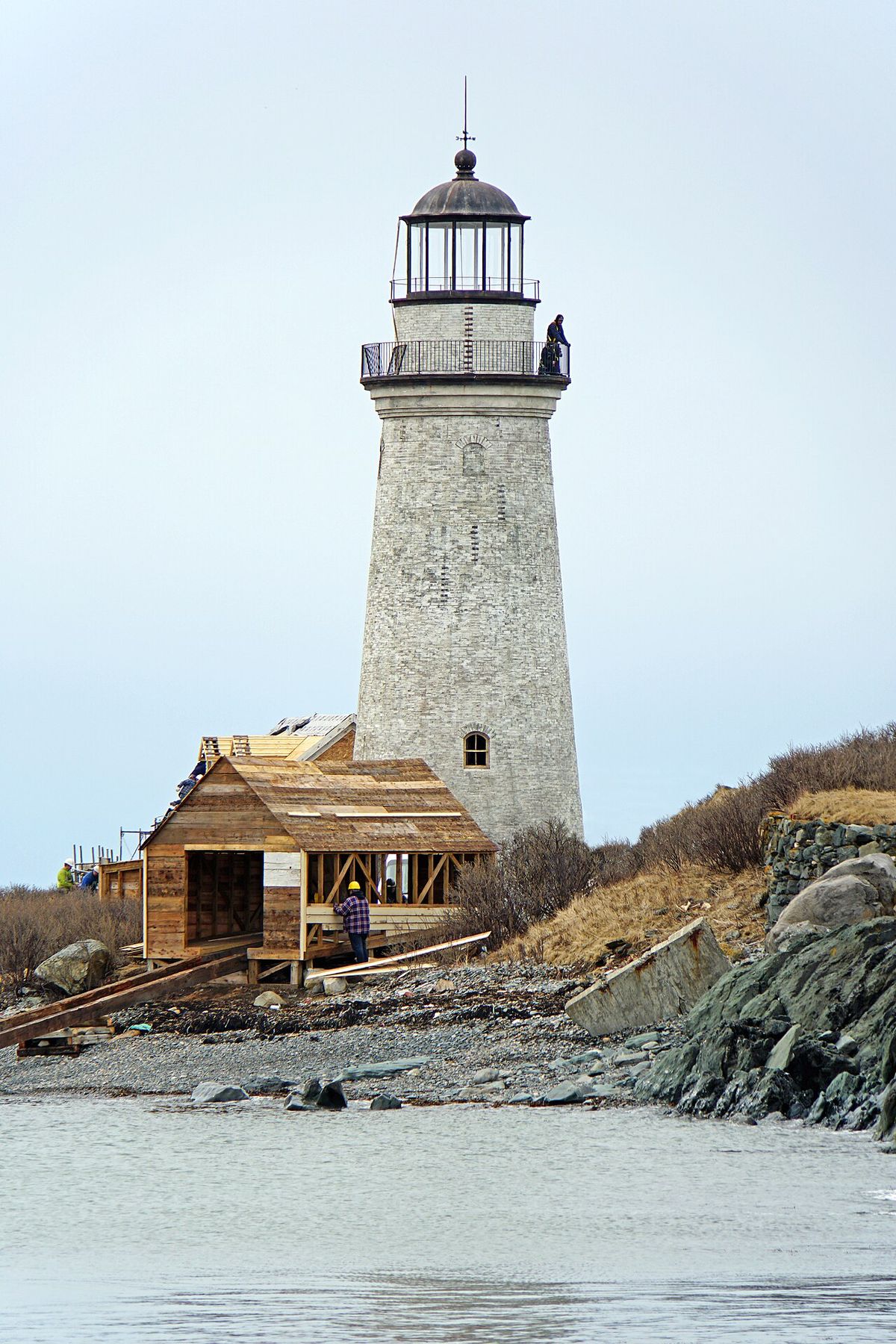
Principal photography for The Lighthouse took place entirely in Nova Scotia, Canada, beginning on April 9, 2018. The production qualified for a $1.673 million tax subsidy from the provincial government. Unable to find a suitable existing lighthouse, the crew constructed a 70-foot tall temporary lighthouse structure on Cape Forchu in Yarmouth County's Leif Erikson Park. This set was outfitted with a custom-built plexiglass replica of a 3rd-order Fresnel lens, designed to have an octopus-like appearance. Most interior scenes were filmed on soundstages built inside a hangar at Yarmouth Airport and in facilities near Halifax.
The 35-day shoot faced significant logistical challenges, including harsh weather, the remote location of the lighthouse set, and the technical demands of the black-and-white cinematography. A large pool used for training emergency responders was employed to film ocean scenes. Additional photography was later conducted in Pinewood Studios and Brooklyn. The production's commitment to filming in Nova Scotia not only provided authentic coastal scenery but also represented a substantial investment in the local film industry.
Cinematography and Visual Style
Director of photography Jarin Blaschke, collaborating with Eggers for the third time, shot the film on 35 mm black-and-white film using Panavision Panaflex Millennium XL2 cameras. They employed vintage Bausch and Lomb Baltar lenses to achieve a period-accurate look. A defining creative choice was the use of a nearly square 1.19:1 aspect ratio, a format briefly used in early sound cinema. Eggers and Blaschke found this tall, narrow frame effectively conveyed the lighthouse's verticality and the intense isolation of the two characters. The visual style was influenced by films such as M (1931), Man of Aran (1934), and the works of Ingmar Bergman.
To create the stark, high-contrast look reminiscent of orthochromatic film, Blaschke developed a complex filtration process. He used Kodak Vision3 500T 5219 and Eastman Double-X 5222 film stocks alongside custom-made shortpass filters from Schneider Kreuznach, which blocked light above the yellow spectrum. Lighting the film was particularly difficult due to the low sensitivity of the black-and-white stock. The crew used powerful 9K and 18K HMI lamps for exterior night scenes and lit interior scenes primarily with a single lantern fitted with 500- and 800-watt halogen bulbs, which were often so bright the crew wore sunglasses on set.
Cast and Performances
The film features a minimal cast led by Willem Dafoe and Robert Pattinson, who both pursued the project independently. Pattinson initially met with Eggers to discuss a different role but was drawn to the challenging script for The Lighthouse. To express his understanding of the part, he showed Eggers a video clip of an intoxicated man screaming. Dafoe agreed to join the project after learning of Pattinson's involvement, noting Eggers's direct and uncompromising approach to the film's vision. The supporting cast includes Valeriia Karaman as the Mermaid and Logan Hawkes as the real Ephraim Winslow.
Each actor employed distinct rehearsal techniques. Dafoe, with his background in experimental theatre with The Wooster Group, favoured a spontaneous approach. Pattinson planned his rehearsals meticulously through script analysis. Their performances are central to the film, depicting a volatile relationship that oscillates between father-son intimacy, bitter rivalry, and shared madness. The intense, dialect-heavy dialogue required mastery of a specific maritime vernacular, which both actors delivered to widespread critical acclaim.
Music and Sound Design
Composer Mark Korven, reuniting with Eggers after scoring The Witch, created a distinct auditory landscape for The Lighthouse. The goal was to evoke the sounds and mythologies of the sea, moving away from the string-based score of the previous film. Early temp music included sea shanties, ancient Greek conch music, and works by avant-garde composer Giacinto Scelsi. The final score was recorded using an unconventional ensemble including cello, double bass, brass, percussion, woodwinds, harmonica, and mallets rubbed on rough surfaces to create friction noises. A key instrument employed was a homemade acoustic device developed by a luthier at Korven's request.
Mark Korven developed the film's score, which evoked the sounds and mythologies of the sea. He found scoring the film's climactic ending scene the most difficult part of his work. The official soundtrack was released digitally by Milan Records on October 18, 2019, which coincided with the film's theatrical release. An LP version of the soundtrack followed from Sacred Bones Records.
Reception and Accolades
The Lighthouse premiered at the Cannes Film Festival on May 19, 2019, before its wide theatrical release in the United States on October 18, 2019, by distributor A24. It was a critical success, earning particular praise for Eggers's direction, Blaschke's cinematography, and the lead performances. The film grossed over $18 million worldwide against a production budget of $11 million. Its accolades include a nomination for Best Cinematography at the 92nd Academy Awards and a nomination in the same category at the 73rd British Academy Film Awards.
The film has defied genre categorization in media, leading to multiple interpretations from critics. Critics struggled to categorize the film definitively, with descriptions ranging from psychological horror to a study in mutual insanity. Reviews highlighted the film's muscular performances, exquisite visual craft, and powerful, unsettling atmosphere. The film's critical acclaim cemented Robert Eggers's reputation as a distinctive auteur.
Key Filmmaking Collaborators
The production of The Lighthouse relied on a dedicated team of artists and technicians who realized Eggers's distinctive vision. Robert Eggers directed, produced, and co-wrote the screenplay, driving the project from concept to completion. Max Eggers co-wrote the screenplay, originating the initial concept based on Edgar Allan Poe. Jarin Blaschke served as the director of photography, crafting the film's black-and-white visual aesthetic. Mark Korven composed the film's atmospheric and dissonant musical score. Linda Muir designed the costumes, creating period-accurate workwear and oilskins for the characters. Artworks Florida built the custom plexiglass Fresnel lens used in the lighthouse set. This collaborative effort, centred on a production based in Nova Scotia, was essential in creating one of the most visually and aurally distinctive films of 2019.
Major Influences and Inspirations
The creative direction of The Lighthouse was shaped by a diverse range of literary, historical, and cinematic sources. The filmmakers drew from photography of 1890s New England, maritime-themed French films from the 1930s, and symbolist art for visual reference. They also studied the dialect-heavy writing of Sarah Orne Jewett and the works of playwrights like Samuel Beckett. This research helped build the film's unique atmosphere, dialogue, and psychological depth.
- Edgar Allan Poe's 'The Light-House': The unfinished short story provided the initial narrative concept for Max Eggers's script.
- Smalls Lighthouse Legend: A 19th-century Welsh tale of two keepers named Thomas inspired the plot's central conflict and theme of identity.
- Sarah Orne Jewett's Writings: Her local colour works set in coastal Maine provided the dialect and speech patterns for the characters.
- Samuel Beckett, Harold Pinter, Sam Shepard: The existential and psychological themes of these playwrights influenced the film's dramatic structure.
- 1930s French Maritime Films: These works served as a key visual reference for the film's aesthetic.
- Symbolist Art: This artistic movement informed the film's visual composition and metaphorical imagery.
The synthesis of these diverse influences allowed Robert Eggers to create a work that feels historically grounded. The film's plot was developed from a nineteenth-century legend of an accident at a Welsh lighthouse. The rigorous research into period details provided a strong foundation. This approach contributed to a film with psychological depth that resonates beyond its specific setting.
Principal Cast and Characters
The film features a small, focused cast, with the two lead actors carrying the vast majority of the screen time. It stars Willem Dafoe as Thomas Wake and Robert Pattinson as Ephraim Winslow, who is later revealed to be Thomas Howard. Valeriia Karaman plays the Mermaid, and Logan Hawkes portrays the real Ephraim Winslow. Other performers include Kyla Nicolle, Shaun Clarke, Pierre Richard, Preston Hudson, and Jeff Cruts in supporting roles.
- Robert Pattinson as Ephraim Winslow (fake) / Thomas Howard: The troubled assistant keeper who assumes a dead man's identity.
- Willem Dafoe as Thomas Wake: The veteran, superstitious head keeper who guards the lantern room.
- Valeriia Karaman as the Mermaid: A supernatural figure who appears in Winslow's hallucinations.
- Logan Hawkes as Ephraim Winslow (real): The cruel Canadian foreman whose identity Thomas Howard steals.
- Kyla Nicolle as the Woman on the Rocks: An additional spectral vision encountered on the island.
- Shaun Clarke as the Departing Wickie: Wake's previous assistant, who is said to have died of lunacy.
The intense dynamic between Robert Pattinson and Willem Dafoe forms the core of the film's dramatic power. Their performances received particular praise from critics. The secondary performances, though brief, provide impactful support to the main narrative. The film's success is largely built upon the central performances of its two lead actors.
Questions about The Lighthouse (2019 film)
Where was The Lighthouse filmed?
The Lighthouse was filmed primarily in Nova Scotia, Canada. Key locations included Cape Forchu in Yarmouth County, where a 70-foot temporary lighthouse was constructed, and soundstages at Yarmouth Airport and near Halifax. The production received a $1.673 million tax subsidy from the Nova Scotian government. Additional photography took place in Pinewood and Brooklyn.
What awards did The Lighthouse win?
The Lighthouse received widespread critical acclaim and several major award nominations. Its most prominent recognition was a nomination for Best Cinematography at the 92nd Academy Awards. The film also earned a nomination for Best Cinematography at the 73rd British Academy Film Awards. It did not win in these categories but the nominations highlighted the film's exceptional technical and artistic achievements.
Is The Lighthouse based on a true story?
The Lighthouse is not a direct adaptation of a true story, but it is heavily inspired by historical sources and a specific legend. The original idea came from a script by Max Eggers based on Edgar Allan Poe's unfinished short story 'The Light-House'. During research, director Robert Eggers was drawn to a nineteenth century myth about an accident at Smalls Lighthouse in Wales, where two keepers, both named Thomas, were stranded by a storm. This detail influenced the film's themes of identity. While the plot and characters of Thomas Wake and Ephraim Winslow are fictional, they are rooted in extensive period research into 1890s New England life, maritime history, and specific dialects.
Why is The Lighthouse in black and white?
The Lighthouse was filmed in black and white to achieve a specific historical and psychological aesthetic. Director Robert Eggers and cinematographer Jarin Blaschke insisted on this choice for artistic integrity, despite studio concerns about distribution. They shot on 35 mm film using vintage Bausch and Lomb Baltar lenses and custom filters to mimic the look of orthochromatic film from the 1890s setting. This stark visual palette, inspired by early photography and filmmakers like Ingmar Bergman, creates a period accurate, nightmarish quality that enhances the film's themes of isolation and madness, distancing it from a modern colour saturated look.
Who composed the music for The Lighthouse?
The music for The Lighthouse was composed by Mark Korven, marking his second collaboration with director Robert Eggers after The Witch. Korven created a distinctive score designed to evoke the sounds and mythologies of the sea and the characters' psychological states. The soundtrack avoids traditional string arrangements, instead using a dissonant ensemble of cello, double bass, brass, percussion, woodwinds, a harmonica, and custom mallets. A key instrument was a unique acoustic device built by a luthier at Korven's request. The score was released digitally by Milan Records and on LP by Sacred Bones Records.
What is the aspect ratio of The Lighthouse?
The Lighthouse was shot in an unusual 1.19:1 aspect ratio, a nearly square format rarely used since the early sound era of cinema. Cinematographer Jarin Blaschke initially suggested it as a joke, but they found it effectively conveyed the lighthouse's vertical orientation and the intense isolation of the characters. This confined frame enhances the claustrophobic feeling when the two men are together and emphasizes the tall, narrow structure of the lighthouse itself. The decision was a deliberate artistic choice to support the film's themes and visual style, drawing influence from classic films like M (1931).
Sources and further reading
- The Lighthouse (2019 film) (Wikipedia)
- The Lighthouse (2019) directed by Robert Eggers (letterboxd.com)
- The Lighthouse review, Robert Pattinson shines in ... (theguardian.com)
Checked by the Yadude Books desk. Last updated 2026-10-25.