Alex Lifeson
Alex Lifeson, born Aleksandar Živojinović on August 27, 1953, is a Canadian musician and songwriter best known as the guitarist and co-founder of the rock band Rush. His inventive playing, characterized by complex arrangements and a wide palette of sounds, was a fundamental part of the band's progressive rock identity for nearly five decades. Alongside bandmates Geddy Lee and Neil Peart, Lifeson helped propel Rush to international fame, earning the group induction into the Rock and Roll Hall of Fame and making them Officers of the Order of Canada. After the band's initial dissolution in 2015 and Peart's death in 2020, Lifeson continued his musical journey with the band Envy of None before reuniting with Lee in 2025 for a new chapter of Rush.
Early life and musical beginnings
Aleksandar Živojinović was born in Fernie, British Columbia, to Serbian immigrants Nenad and Melanija Živojinović, and was raised in Toronto. His stage name, Lifeson, is a direct English translation of his surname, which means 'son of life'. His initial musical training was on the viola, but he switched to guitar at age twelve after being inspired by his brother-in-law's flamenco playing. His first guitar was a Kent classical acoustic, a Christmas gift from his father, later replaced by a red 1967 Canora hollowbody. As a teenager, Lifeson was largely self-taught, drawing inspiration from guitarists like Jimi Hendrix, Eric Clapton, Pete Townshend, Tony Iommi, Jeff Beck, and Ritchie Blackmore. He would painstakingly learn solos by moving the needle on his record player, noting that Clapton's solos seemed more approachable than Hendrix's. He met future Rush drummer John Rutsey at school in 1963, and their shared interest in music led them to form their first band together. A 1973 documentary, Come On Children, captured a heated argument between the 17-year-old Lifeson and his parents about his desire to drop out of high school to pursue music, a clip later featured in the Rush documentaries Beyond the Lighted Stage and Time Stand Still.
Career with Rush
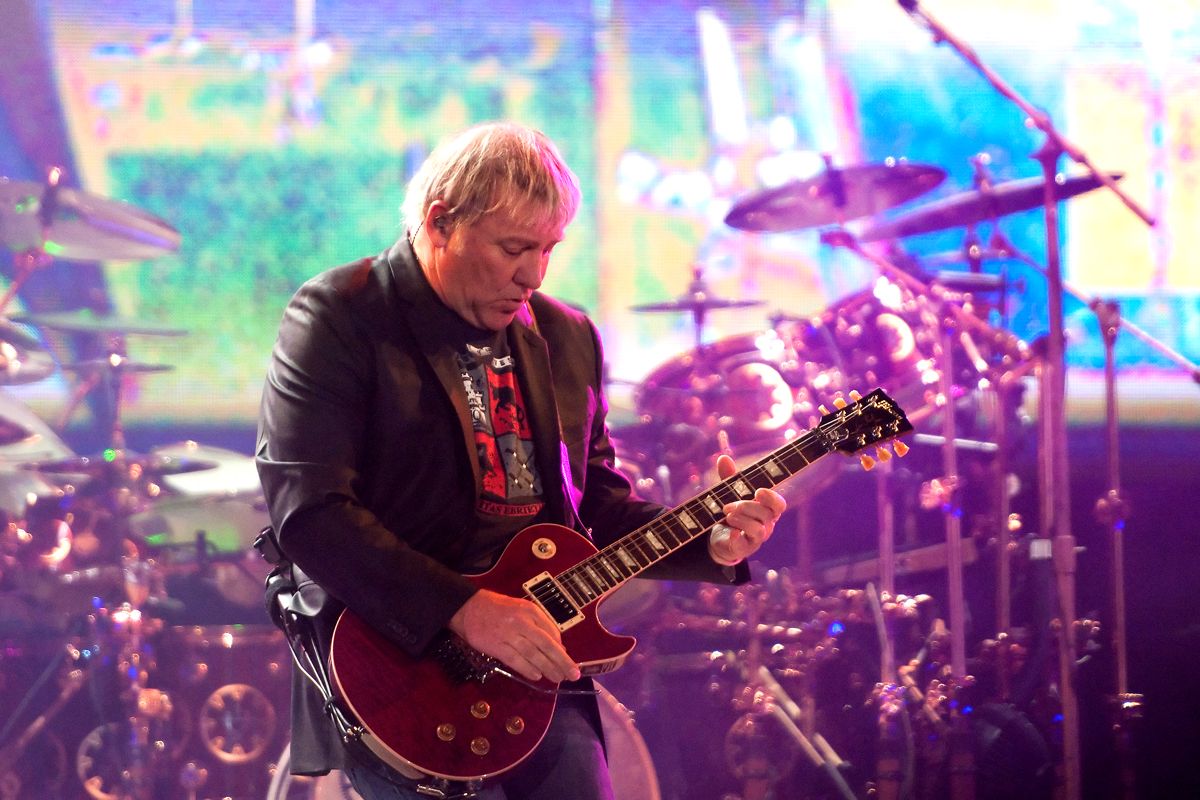
Alex Lifeson co-founded the band that would become Rush in August 1968 with drummer John Rutsey and original bassist and vocalist Jeff Jones. Jones was succeeded within a month by Lifeson's high school friend Geddy Lee, and in 1974, Neil Peart succeeded Rutsey, solidifying the classic Rush lineup that would remain for over four decades. As the band's guitarist, Lifeson was responsible for a vast array of sounds, playing electric and acoustic guitars, mandola, mandolin, and bouzouki across their studio albums. He also provided backing vocals in live performances and on select studio recordings, and used MIDI controllers and Korg pedals to trigger sampled instruments and synthesizer parts in real time. The band entered a hiatus in 1997 following personal tragedies in Peart's life, during which Lifeson did not play guitar for about a year. They returned to record 2002's Vapor Trails, an album on which Lifeson employed over 50 different guitars in an experimental, riff-light approach that focused on tonality. Rush continued to record and tour until Peart's retirement in 2015, which led to the band's initial dissolution. On October 6, 2025, Lifeson and Lee announced the reunion of Rush for the 'Fifty Something' tour in 2026, with German drummer Anika Nilles joining them to honour Peart's legacy, with a portion of each show dedicated as a tribute.
Lifeson's tenure with Rush is marked by several key honours and milestones for the band, reflecting their status as Canadian cultural icons. The group's 1996 appointment as Officers of the Order of Canada made them the first rock band to receive the honour as a group. Their induction into the Rock and Roll Hall of Fame in 2013 placed them alongside only one other Canadian group, the Band. Domestically, they were inducted into the Canadian Music Hall of Fame in 1994 and the Canadian Songwriters Hall of Fame in 2010. At the Juno Awards, Rush won Most Promising Group in 1975 and Group of the Year in both 1978 and 1979. They received the Governor General's Performing Arts Award for lifetime artistic achievement in 2012. Preparing for the 2026 reunion tour involved an intense 14-month rehearsal period, during which Lifeson admitted to moments of self-doubt about his ability to return to the stage. The tour, scheduled from June to September 2026, includes dates across the United States, Mexico, and Canada, with two shows in Toronto at Scotiabank Arena in August.
Solo work and side projects
Beyond Rush, Alex Lifeson has engaged in a substantial variety of musical projects, contributing to over a dozen albums by other artists. His first major outside work was the 1996 solo album Victor, credited to the artist name 'Victor' rather than his own, though a vinyl reissue attributes it to him. The album's title track is based on a W.H. Auden poem, and his wife Charlene and son Adrian contributed to the recording. He has made numerous guest appearances on albums by other artists, contributing guitar solos to tracks like 'Crying Over You' and 'Holy Water' for Platinum Blonde's 1985 album Alien Shores. He played on Tom Cochrane's 1995 album Ragged Ass Road, I Mother Earth's 1996 song 'Like a Girl', and the Porcupine Tree track 'Anesthetize' in 2007. In 2006, he formed the Big Dirty Band to create the soundtrack for Trailer Park Boys: The Movie. He also composed the theme for the first season of the TV series Andromeda and produced three songs from the 2002 album Away from the Sun by 3 Doors Down. Following Rush's dissolution and Neil Peart's death, Lifeson formed the supergroup Envy of None with bassist Andy Curran, guitarist and keyboardist Alfio Annibalini, and vocalist Maiah Wynne. The band released their self-titled debut album, featuring the single 'Liar', on April 8, 2022, and a follow-up, Stygian Wavz, on March 28, 2025. In June 2021, Lifeson also released two instrumental tracks, 'Kabul Blues' and 'Spy House', as a self-titled project, with Andy Curran on bass.
Lifeson has contributed to a body of work outside his involvement with Rush in the form of instrumental contributions to other musical outfits. He made a guest appearance on the 1985 Platinum Blonde album Alien Shores and on Lawrence Gowan's 1990 album Lost Brotherhood. He guested on Tom Cochrane's 1995 album Ragged Ass Road and on I Mother Earth's 1996 album Scenery and Fish. In 1997, he appeared on the Merry Axemas: A Guitar Christmas album. He made a guest appearance on the 2007 album Fear of a Blank Planet by Porcupine Tree and on the 2008 album Fly Paper by Tiles.
- 'The Little Drummer Boy' on the 1997 compilation album Merry Axemas: A Guitar Christmas.
- Guitar on the track 'Sacred and Mundane' from Tiles' 2008 album Fly Paper.
- Guitar on three songs from Keram Malicki-Sanchez's 2014 album Come to Life and on subsequent singles in 2019, 2020, and 2021.
- Guitars on three songs and co-writer credit on 'On That Note' for Marco Minnemann's 2017 album Borrego.
- Lead guitar on the 18-minute track 'Il Mostro Atomico' from Fu Manchu's 2018 album Clone of the Universe.
- Featured on the song 'Charmed' from Don Felder's 2019 solo album American Rock 'n' Roll.
His outside work also includes composing the theme for the first season of the TV series Andromeda and producing songs for 3 Doors Down. He was executive producer and contributor to Keram Malicki-Sanchez's 2014 album Come to Life. Alex Lifeson is featured on Marco Minnemann's 2017 release Borrego and played on Fu Manchu's 2018 album Clone of the Universe. In 2019 he was featured on a song from Don Felder's solo album American Rock 'n' Roll. In 2021, he released two new instrumental songs on his website.
Guitar equipment and sound
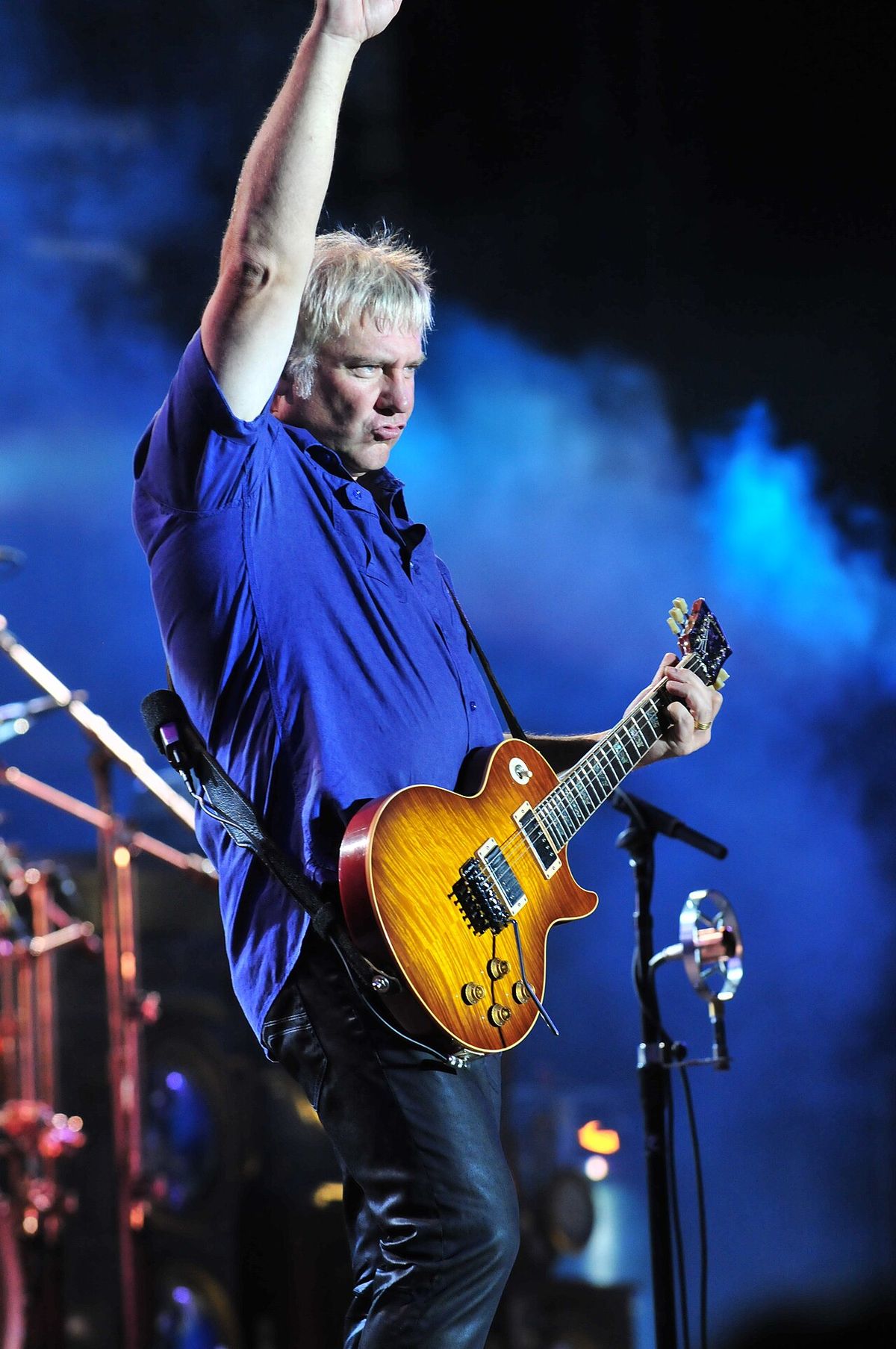
Alex Lifeson's guitar rig has evolved significantly throughout his career, reflecting his continuous search for new tones and textures. In Rush's early years, he primarily used a Gibson ES-335 on the first tour and later a 1974 Gibson Les Paul, alongside Hiwatt amplifiers. For the 1980 album Permanent Waves and its tour, he used four identically modified Fender Stratocasters equipped with Floyd Rose bridges, which he jokingly called 'Hentor Sportscasters'. He switched to Signature brand guitars in 1987, though he found them uncomfortable, and then primarily used PRS guitars from the later half of the 1990 Presto tour through the recording and touring of albums like Counterparts, Test for Echo, and Vapor Trails . In the 2000s, he returned to using Gibson guitars almost exclusively. Gibson introduced the 'Alex Lifeson Axcess' signature Les Paul in 2011, featuring a Floyd Rose tremolo and piezoacoustic pickups, which became a staple on the Time Machine and Clockwork Angels tours. A limited-edition R40 Les Paul Axcess was released in 2015, and a signature semi-hollow ES Les Paul in a classic white finish followed in 2017. For amplification, Hughes & Kettner launched an Alex Lifeson signature series amplifier in 2005, with his royalties donated to UNICEF. His effects palette has consistently included chorus, phasing, delay, and flanging, using pedals like the Echoplex delay, the Electro-Harmonix Electric Mistress flanger, the BOSS CE-1 chorus, and the Dunlop Crybaby wah. In later years, his rig incorporated digital modelling technology from Fractal Audio's Axe-FX, Apple's MainStage, and Native Instruments' Guitar Rig software.
With Rush, Lifeson played electric and acoustic guitar, and various other string instruments including mandola, mandolin, and bouzouki. He performed these on some Rush studio albums, including Test for Echo, Vapor Trails and Snakes & Arrows. He also performed backing vocals in live performances and select studio recordings, and occasionally played keyboards and bass pedal synthesizers. Each band member sometimes performed real-time on-stage triggering of sampled instruments.
- Mandola, mandolin, and bouzouki on the 1996 album Test for Echo.
- Mandola, mandolin, and bouzouki on the 2002 album Vapor Trails.
- Mandola, mandolin, and bouzouki on the 2007 album Snakes & Arrows.
- Bass and programmed synthesizers for his 1996 solo project Victor.
- Bass and programmed synthesizers for his recording of 'The Little Drummer Boy' in 1997.
Other ventures and appearances
Outside of music performance, Alex Lifeson has pursued several other interests and made various media appearances. He is a licensed aircraft pilot and an avid painter. He was also a part-owner of a Toronto bar and restaurant called The Orbit Room, which operated from 1994 until its closure in 2020, and where he regularly jammed with the house band, the Dexters. Lifeson has made cameo appearances in television and film, often playing himself, including in the Trailer Park Boys franchise and the 2009 film I Love You, Man. His acting debut was under his birth name in the 1973 documentary Come on Children. Rush performed 'Tom Sawyer' on The Colbert Report in 2008, marking their first American television appearance as a band in 33 years. He has written forewords for four books, including Rich Engler's Behind the Stage Door (2013), Greg Prato's Shredders!: The Oral History Of Speed Guitar (2017), Geddy Lee's Big Beautiful Book of Bass (2018), and Domenic Troiano: His Life and Music (2021). In partnership with companies like Godin Guitars and Morley Effects, Lifeson has launched the Lerxst brand, which produces signature guitars like the Limelight and Grace models, amplifiers, and effects pedals including the Lerxst Analog Kid Double Chorus and a limited-edition wah pedal.
Personal life and legacy
Alex Lifeson married his first girlfriend, Charlene, in 1975. Adrian contributed to Lifeson's Victor album, performing on the tracks 'At the End' and 'The Big Dance'. On New Year's Eve 2003, Lifeson, his son, and his daughter-in-law were arrested following an altercation with police at the Ritz-Carlton hotel in Naples, Florida. Lifeson suffered a broken nose and was repeatedly tased during the incident. In April 2005, he and his son entered a plea bargain, pleading no contest to a first-degree misdemeanor charge of resisting arrest without violence and each receiving 12 months of probation. Legal claims against the hotel were settled out of court on a confidential basis in August 2008. Lifeson's influence as a guitarist is widely recognized in the music industry. He was ranked 98th on Rolling Stone 's 2011 list of the 100 greatest guitarists of all time and placed third, after Eddie Van Halen and Brian May, in a Guitar World readers' poll. He won 'Best Rock Guitarist' from Guitar Player Magazine in 1984 and 2008. He has been cited as an influence by guitarists such as John Petrucci of Dream Theater, Steve Rothery of Marillion, and James Hetfield of Metallica, who named him one of the best rhythm guitarists of all time. Jazz guitarist Kurt Rosenwinkel also praised his 'incredible sound and imagination'.
Lifeson was influenced primarily by guitarists like Jimi Hendrix, Pete Townshend, Tony Iommi, Jeff Beck, Ritchie Blackmore, and Eric Clapton. He explained that Clapton's solos seemed a little easier and more approachable. In 2011, Lifeson was ranked 98th on Rolling Stone's list of the 100 greatest guitarists of all time. He was also ranked third in a Guitar World readers' poll listing the 100 greatest guitarists.
- Paul Gilbert of Mr. Big.
- John Petrucci of Dream Theater.
- Steven Wilson of Porcupine Tree.
- Jim Martin of Faith No More.
- Denis 'Piggy' D'Amour of Voivod.
- Parris Mayhew, formerly of Cro-Mags.
- John Wesley.
His formal musical education began on the viola, but he abandoned it in favour of the guitar at the age of 12. Lifeson was primarily a self-taught guitarist with the only formal instruction coming from a high school friend in 1971 who taught classical guitar lessons. This training lasted for roughly a year and a half. His approach to the guitar tracks for the 2002 album Vapor Trails eschewed traditional riffs and solos in favour of tonality and harmonic quality.
Awards and critical recognition
Lifeson was inducted with Rush into the Rock and Roll Hall of Fame in 2013. The band became Officers of the Order of Canada in 1996, as the first rock band to be so honoured as a group. He was ranked 98th on Rolling Stone's list of the 100 greatest guitarists of all time. Lifeson was also ranked third in a Guitar World readers' poll listing the 100 greatest guitarists.
| Year | Award/Honour | Granting Body / Context |
|---|---|---|
| 1982, 1983, 1985, 1986 | Runner-up, Best Rock Guitarist | Guitar Player Magazine Readers Poll |
| 1983 | Best Rock Talent | Guitar for the Practicing Musician |
| 1984 | Best Rock Guitarist | Guitar Player Magazine |
| 1991 | Hall of Fame inductee | Guitar for the Practicing Musician |
| 1994 | Inducted (with Rush) | Canadian Music Hall of Fame |
| 1996 | Officer of the Order of Canada (with Rush) | Government of Canada |
| 2008 | Best Rock Guitarist | Guitar Player Magazine |
| 2010 | Inducted (with Rush) | Canadian Songwriters Hall of Fame |
| 2012 | Lifetime Artistic Achievement Award (with Rush) | Governor General's Performing Arts Awards |
| 2013 | Inducted (with Rush) | Rock and Roll Hall of Fame |
Questions about Alex Lifeson
Is Alex Lifeson touring with Rush again?
Yes, Alex Lifeson and Geddy Lee announced a reunion of Rush on October 6, 2025. The 'Fifty Something' tour is scheduled for 2026, with dates running from June through September in the United States, Mexico, and Canada. German drummer Anika Nilles will be joining them on tour, and the band may add a fourth musician on keyboards. The band rehearsed for 14 months in preparation, with the full show being rehearsed 24 times in the final 27 days, and the tour includes two shows at Toronto's Scotiabank Arena in August 2026.
What is Alex Lifeson's real name?
Alex Lifeson was born Aleksandar Živojinović on August 27, 1953, in Fernie, British Columbia. His parents, Nenad and Melanija Živojinović, were Serbian immigrants from Yugoslavia. The stage name 'Lifeson' is an English translation, or calque, of his surname, Živojinović, which literally means 'son of life'. He was raised in Toronto and began using his anglicised name professionally early in his music career.
What bands has Alex Lifeson been in besides Rush?
Beyond Rush, Alex Lifeson's primary musical project is the supergroup Envy of None, which he formed after Neil Peart's death with members Andy Curran, Alfio Annibalini, and Maiah Wynne. The band released its debut album in 2022 and a second album, Stygian Wavz, in 2025. He also released a solo album titled Victor in 1996. Lifeson has made guest appearances on albums by artists including Porcupine Tree, Tom Cochrane, I Mother Earth, and Lawrence Gowan, and he formed the Big Dirty Band for the Trailer Park Boys movie soundtrack in 2006.
What kind of guitars does Alex Lifeson play?
Alex Lifeson has used a wide variety of guitars. Early in his career, he favoured Gibson models like the ES-335 and Les Paul. In the 1980s, he used modified Fender Stratocasters with Floyd Rose bridges, which he called Hentor Sportscasters. He played PRS guitars extensively from the late 1980s through the early 2000s before returning to Gibson. Since 2011, he has primarily used his signature 'Alex Lifeson Axcess' Les Paul models, which feature Floyd Rose tremolos and piezo pickups. For the 2012-13 Clockwork Angels tour, he used a black Axcess model as his primary guitar and used its piezo system for acoustic sounds instead of a separate acoustic guitar.
Did Alex Lifeson win any awards with Rush?
Yes, Alex Lifeson, as a member of Rush, received numerous awards. The band was appointed Officers of the Order of Canada in 1996, the first rock band honoured as a group. They were inducted into the Rock and Roll Hall of Fame in 2013, the Canadian Music Hall of Fame in 1994, and the Canadian Songwriters Hall of Fame in 2010. Rush also won Juno Awards for Most Promising Group in 1975 and Group of the Year in 1978 and 1979, and received the Governor General's Performing Arts Award for lifetime artistic achievement in 2012.
What happened to Alex Lifeson's bar, The Orbit Room?
Alex Lifeson was a former part-owner of a Toronto bar and restaurant called The Orbit Room. The venue, which opened in 1994 and was known for its live music, permanently closed in 2020. The Orbit Room had been a fixture in the city's music scene and was where Lifeson would occasionally jam with the house band, the Dexters, from 1994 to 2004. The bar's name was also the inspiration for a Rush instrumental track on their 1991 album Roll the Bones.
Sources and further reading
- Alex Lifeson (Wikipedia)
- Alex Lifeson: Home (alexlifeson.com)
- Alex Lifeson on the self-doubt that crept in before Rush's ... (guitar.com)
- Geddy Lee, Alex Lifeson announce plans for Rush tour in ... (cbc.ca)
Checked by the Yadude Books desk. Last updated 2026-10-25.