Vacancy rates drop for top Toronto office space as landlords lure workers back
Landlords are upgrading amenities and design as demand for premium space tightens, while many workers remain reluctant to return.
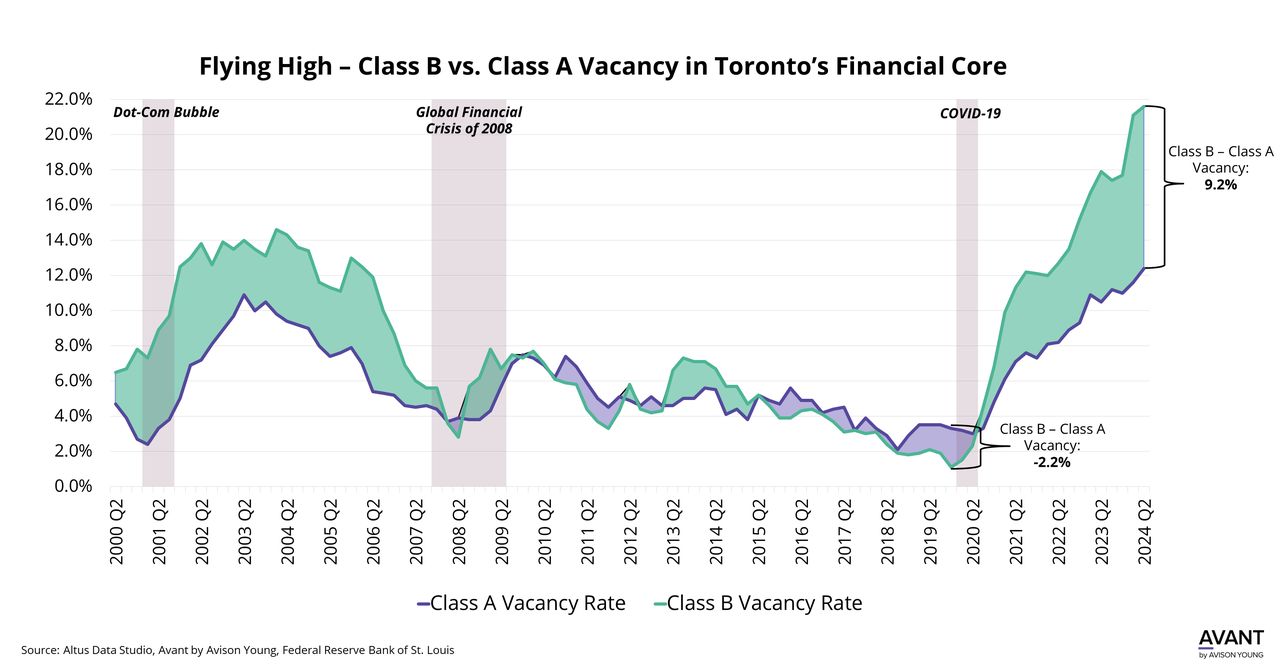
TORONTO — Vacancy rates for the most desirable office space in Toronto are dropping as landlords work to make buildings more appealing to employees reluctant to return to in-person work.
Scott Figler, senior director of research and strategy at JLL, said the market is tightening across Toronto, with vacancy rates below five per cent in the so-called AAA "trophy buildings."
"We had a few years where leasing demand was subdued, and it’s come back, and you just can’t get into the top buildings in the core," said Figler about the spillover effect happening.
READ MORE: Blue Jays' Vladimir Guerrero Jr. apologizes for contract comments amid career-worst season
READ MORE: Stellantis workers in Canada vote on strike mandate as talks stall
Statistics Canada said in May 2026, 11.4 per cent of Canadians worked exclusively from home, down one percentage point from May 2025 and from 18.7 per cent in May 2022.
About 9.8 per cent of workers had a hybrid work arrangement in May 2026, and StatCan said that percentage has not varied much since 2023.
Robert Half’s most recent data found that fully on-site job postings still make up the majority, increasing from 63 per cent in the fourth quarter of 2025 to 84 per cent in the second quarter of 2026.
Cal Jungwirth, director of permanent placement services at the talent recruitment firm Robert Half Inc., said flexibility will remain a differentiator as it becomes rarer.
"But if you only consider hybrid in a job search, it will eliminate a lot of opportunities, and that’s their choice," he said.
Jungwirth said a positive work environment helps retain people. "An office that is comfortable, functional and well equipped with different amenities is going to be more attractive. Any advantage helps you retain people and attract people," he said.
Devan Sloan, vice-president of asset management at GWL Realty Advisors, said the focus is now on creating what he calls "a centre of gravity" at the office where people want to come in.
"I don’t think there was any landlord thinking about how do we attract people to come to our office space," said Sloan about pre-COVID days when GWL’s massive portfolio had a sub-two-per-cent vacancy.
Sloan said that can mean major design changes to the lobby or adding amenities, such as Michelin-starred restaurants. "When we renovate, instead of hiring your traditional office design firm, we hired a designer that did the Four Seasons," he said.
Employers are now considering the space their employees will want, said Sloan. "It’s no longer about locating close to where the CEO lives," he said.
"You won’t see a tour where a tenant is looking for space without somebody from HR on the tour that’s representing what the average employee wants."
Hotelling and assigned desks
Crowded office spaces are increasingly organized around the "hotelling" principle, where you sign in to a desk for the day.
Cal Jungwirth said "very few people" like hotelling.
David Cairns, vice-president of San Francisco-based firm Kadence, which optimizes the workplace for hybrid setups, said the market is becoming fragmented.
He said "superstar companies" working in fields like artificial intelligence have no problem offering assigned seating. "The things that make that easier for them are that some of these companies are cultish, and the people want to be there as a team," said Cairns.
But, he added, part of the market is still driven by leadership’s desire for everybody to be in and have an assigned-seat culture, driven more by the hope that people will come in five days a week.
"It just doesn’t make any sense to have (assigned seats)," said Cairns, who was once a senior leasing vice-president with brokerage CBRE in Canada.
The far larger part of the market is companies that have been consolidating for a decade, with the pandemic only making the shift more pronounced.
"They have already been in the unassigned seating land, and that can look like (one of the banks) in Canada," said Cairns.
Scott Figler said utilization has become a key factor. For some companies, if you are not in the office at least three days a week, you are not getting a permanent desk.
Ross Moore, a Vancouver-based senior vice president and managing director with tenant representation, said he still sees many smaller to medium-sized tenants opting for leasing that incorporates an assigned seating culture. "Some of this depends on the industry," he said.
Figler said rents haven’t risen enough for anyone to build a new tower, with the gap close to 25 per cent of what is needed. That gap is creating incentives to modernize buildings with great locations.
"I think what you’re gonna see over the next year or two years is a lot of acquisitions where a certain asset has potential to compete with the high end of the market," said Figler.
Still, some people won’t be easily convinced to come into an office.
The Public Service Alliance of Canada continues to argue against a federal mandate of a minimum of four days in office.
"We know a one-size-fits-all mandate is not working," said PSAC president Sharon Desousa. "Right now, there aren’t enough desks, enough space or even a plan."
Ultimately, she said, there is no data to show an increase in productivity. At the same time, her union puts the price tag at $16 billion for the federal government to bring employees back to the office.
"It’s affecting people’s mental health," she said.
With files from Financial Post