OpenText
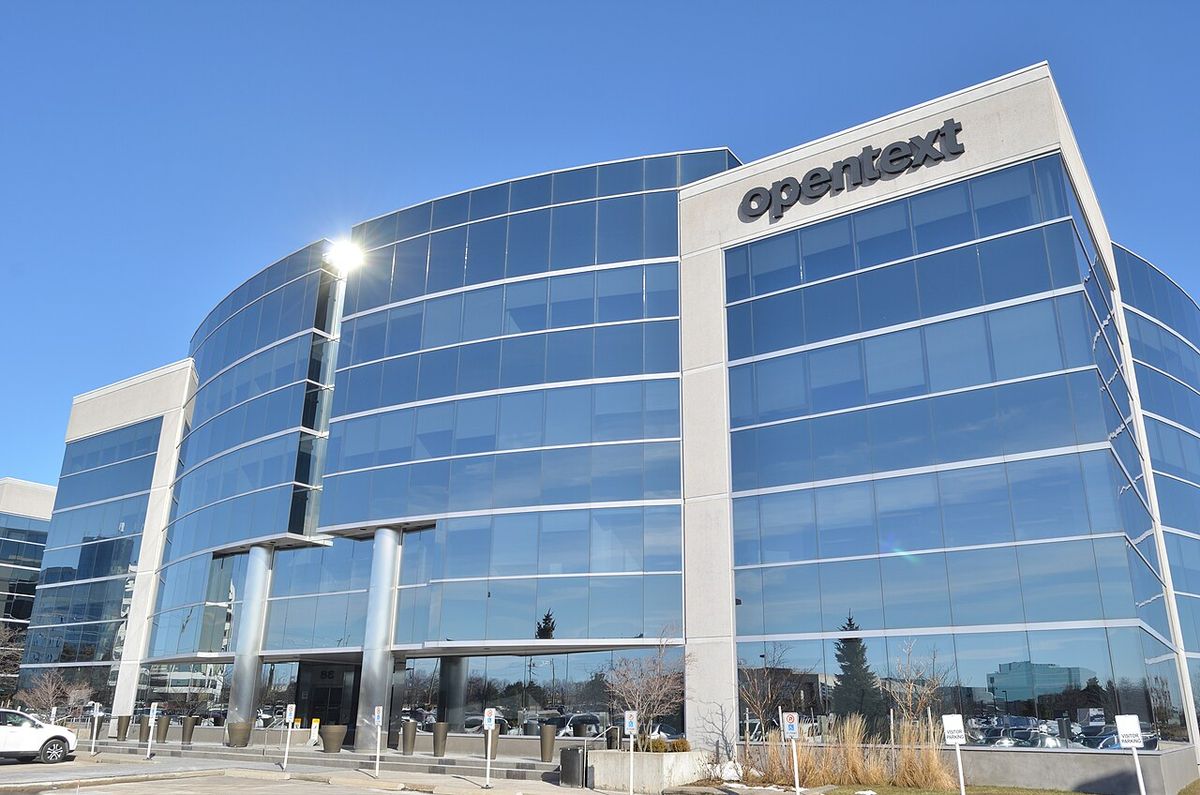
OpenText Corporation, stylized as opentext, is a global software company headquartered in Waterloo, Ontario, that develops and sells enterprise information management software. The company was founded in 1991 by Anouar Namouh and University of Waterloo professors Frank Tompa and Gaston Gonnet, growing out of an earlier project to index the Oxford English Dictionary. As of 2022, OpenText is Canada's fourth-largest software company, and its applications help large corporations, government agencies, and professional firms manage vast amounts of content and unstructured data across areas like analytics, cloud solutions, artificial intelligence, and cybersecurity. With 22,900 employees worldwide and listings on both the Toronto Stock Exchange and NASDAQ, its evolution from a university research project into a multinational technology leader represents a significant Canadian success story in the global software industry.
History and corporate development
OpenText Corporation was founded in 1991 by Anouar Namouh and University of Waterloo professors Frank Tompa and Gaston Gonnet, spinning out of technology developed to index the Oxford English Dictionary. The company grew from its predecessor, OpenText Systems Inc., which was established in 1989. Key leadership figures who shaped the company's growth include Tom Jenkins, who joined as chief operating officer in 1994 and later became president and CEO, and John Shackleton, who served as president from 1998 to 2011 and as CEO from 2005 to 2011. Mark J. Barrenechea took over as president and CEO in 2012, a role he held until August 2025 when James McGourlay was appointed interim CEO, and in April 2026, Ayman Antoun was appointed as the company's chief executive officer.
Throughout its history, OpenText has maintained strong ties to its academic roots, notably announcing support for the University of Waterloo Stratford Campus with funding and in-kind services in October 2012. The company has also been recognized for its corporate practices, being named one of Canada's Top Employers for Young People and one of Canada's Most Responsible Companies in 2025. In response to geopolitical events, OpenText suspended its business in Russia in 2022 following the invasion of Ukraine, donating to humanitarian efforts and stating it would only resume operations when the war ended and sanctions were lifted. This stance led to the company being declared an undesirable organization in Russia in 2025.
The company has actively engaged in partnerships and collaborative initiatives to enhance its security offerings. In July 2020, OpenText partnered with cybersecurity firm NINJIO to strengthen security awareness through educational videos. A significant step in its public sector engagement came in February 2024 when OpenText joined the United States Government's Joint Cyber Defense Collaborative (JCDC), pledging to provide services and insights to help safeguard sensitive information for the U.S. and its international partners. These moves are part of OpenText's commitment to evolving as a trusted provider in the global cybersecurity landscape.
Major acquisitions and divestitures
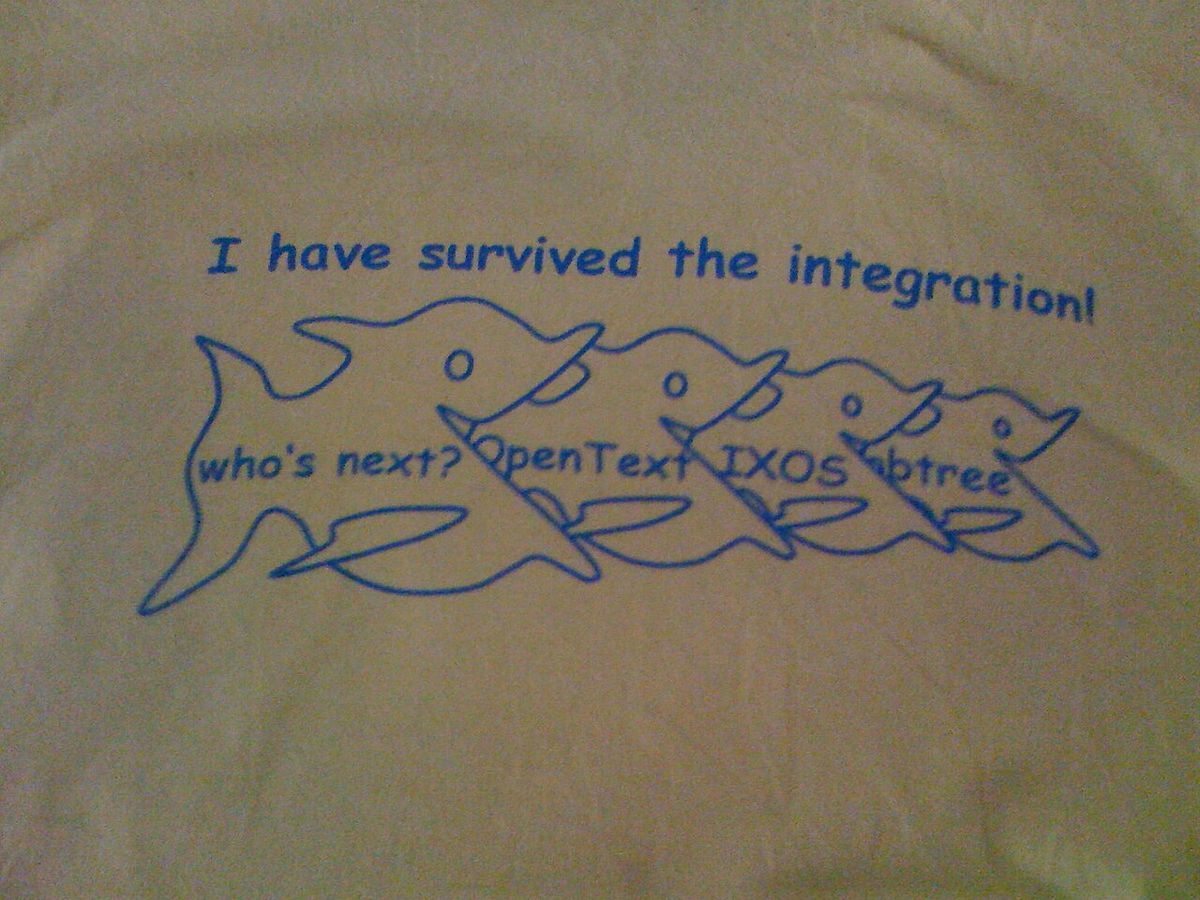
Its first major purchase was IXOS Software AG in 2003, followed by Artesia in 2004. The company solidified its position in enterprise content management with the acquisition of Hummingbird Ltd. for $489 million in 2006, and later expanded its portfolio with the purchases of Captaris Inc. for $131 million in 2008 and Vignette Corporation for $321 million in 2009. Throughout the 2010s, OpenText continued this pattern, acquiring companies like StreamServe Inc., EasyLink, and GXS Inc., which brought the Inovis business network into what became the OpenText Business Network. The mid-2010s saw large deals that reshaped the industry. In April 2016, OpenText acquired HP's customer experience content management business for approximately $170 million. Later that year, in September, it purchased Dell EMC's Enterprise Content Division, which included the Documentum platform, for $1.6 billion. This acquisition was notable as Documentum had been one of OpenText's chief competitors alongside Hummingbird. The 2017 acquisitions of Guidance Software for $240 million and Covisint for $103 million further expanded its security and business network capabilities. In 2019, OpenText made a major move into data protection by acquiring Carbonite Inc., including its Webroot and Mozy units, for about $1.45 billion.
OpenText's largest acquisition to date was announced in 2022 and finalized in January 2023: the purchase of British software firm Micro Focus in a deal valued at $6 billion. This brought numerous well-known software brands under the OpenText umbrella, including Borland, HPE Software, and Interset. Following this integration, the company began divesting certain assets. In May 2024, it sold the Application Modernization and Connectivity business, a former Micro Focus unit, to Rocket Software for $2.28 billion. Another divestiture occurred in October 2025 with the sale of the eDOCS business unit to NetDocuments for $163 million in cash. Other notable acquisitions over the years include Zix Corp for $860 million, Bricata in 2021, and Xmedius for $75 million.
- 2003: Acquires IXOS Software AG.
- 2006: Acquires Hummingbird Ltd. for $489 million.
- 2009: Acquires Vignette Corporation for $321 million.
- 2016: Acquires Dell EMC's Enterprise Content Division (including Documentum) for $1.6 billion.
- 2019: Acquires Carbonite Inc. (including Webroot) for approximately $1.45 billion.
- 2021: Completes acquisition of Bricata for NDR technology.
- 2023: Finalizes acquisition of Micro Focus in a $6 billion deal.
- 2024: Divests AMC business to Rocket Software for $2.28 billion.
- 2025: Sells eDOCS business unit to NetDocuments for $163 million.
Core products and platforms
OpenText's extensive software portfolio addresses the full spectrum of enterprise information management needs. Its core offerings are organized into several major categories, including enterprise content management, business networking, customer experience management, digital process automation, discovery, security, and AI and analytics. A key moment in the company's product evolution came in April 2020 with the announcement of cloud-native, containerized versions of many of its software applications, aligning its offerings with modern IT infrastructure trends. The company's flagship SaaS suite, known as Cloud Editions (CE), integrates content management, B2B networking, cybersecurity, DevOps, and analytics in a cloud-native model.
The enterprise content management segment is anchored by several key platforms. OpenText Documentum, acquired in 2016, is a secure information management platform originally developed by Documentum Inc. The OpenText Content Suite Platform, whose technology component originated as the product "Livelink" in 1996, is built around the OpenText Content Server. For network-based fax functionality, OpenText offers RightFax, a product with a lineage dating back to its first release in 1992. Other content-focused products include OpenText Intelligent Capture, rebranded from Captiva in 2019, which handles document information processing and data capture, and OpenText AppEnhancer, a content management system acquired from Dell EMC's Enterprise Content Division.
In the areas of artificial intelligence and security, OpenText provides several critical platforms. OpenText Magellan, launched in July 2017, is the company's AI and analytics platform, enabling businesses to use open-source software and build their own models. The company's security portfolio is broad, encompassing products like OpenText Forensic (EnCase), the Carbonite and Webroot data protection solutions, and the NetIQ, ArcSight, and Voltage security suites acquired via Micro Focus. A significant recent addition is OpenText Aviator, a generative AI solution that uses large language models and private data sets to address industry-specific issues in cybersecurity, DevOps, and customer communications management.
Cloud Editions and AI innovation
OpenText Cloud Editions (CE) represents the company's strategic direction towards delivering its enterprise information management solutions as an integrated, cloud-native software-as-a-service suite. This platform combines content management, business-to-business networking, cybersecurity, DevOps, and analytics into a unified model designed for modern digital enterprises. The CE releases are updated regularly, with each iteration introducing new capabilities and enhancements. A major focus of recent updates has been the infusion of artificial intelligence across the platform, transforming how organizations interact with and derive value from their information.
In November 2024, the Cloud Editions 24.4 update introduced new AI capabilities with the addition of over 100 AI agents to the platform. To demonstrate the value of the platform, the company released a program called "Earn Your Wings" that allowed organizations to test OpenText Aviator before completing a full deployment. OpenText Aviator is a generative AI solution that uses large language models and private data sets. The product includes business functions that provide a virtual agent for OpenText Service Management Automation X, software delivery optimization, and information retrieval in the workplace. It also brings generative AI to Customer Communications Management and the company's supply chain platform. Cloud Editions represents OpenText's flagship SaaS suite of solutions for enterprise information management.
OpenText's AI roadmap was formally articulated in April 2025 with the launch of Titanium X through the CE 25.2 release. This strategic plan outlined the company's vision for bringing comprehensive AI support to core enterprise functions, including IT operations, cybersecurity, content services, application development, and customer communications. The development of OpenText Aviator is central to this vision, as it applies large language models to private business data sets, creating virtual agents and tailored solutions for specific industries. This ongoing innovation within the Cloud Editions framework ensures that OpenText's offerings remain at the forefront of the enterprise software market.
Corporate leadership and recognition
OpenText's leadership has been instrumental in guiding the company from a university spin-off to a global software powerhouse. The founding team of Anouar Namouh and professors Frank Tompa and Gaston Gonnet established the company's technological foundation. Tom Jenkins, who joined in 1994, provided long-term strategic direction during his tenure as chief executive officer. Mark J. Barrenechea's appointment as president and CEO in 2012 ushered in an era of massive expansion, including the landmark Micro Focus acquisition, and his leadership was recognized when he was named Canadian Business CEO of the Year in 2015.
The company's executive structure has evolved to meet strategic needs. In January 2016, Barrenechea transitioned to the role of chief technology officer while Steve Murphy served as president, though the president position was eliminated in the first quarter of 2017. Leadership changes continued in August 2025 when James McGourlay was appointed interim CEO, replacing Barrenechea. The current leadership is under Ayman Antoun, who was appointed chief executive officer in April 2026. This stability and depth in executive talent have been critical for managing the company's complex portfolio and global operations.
OpenText's corporate practices have earned it several notable accolades, reflecting its standing as a responsible and attractive employer. In January 2025, the company was named one of Canada's Top Employers for Young People for 2025, an award that recognizes organizations offering exceptional workplaces and career development opportunities for early-career professionals. That same year, OpenText was also honoured as one of Canada's Most Responsible Companies, acknowledging its commitment to environmental, social, and governance principles. These designations highlight the company's role not just as a technology provider but as a significant and positive corporate citizen within the Canadian business community.
Financial and market position
OpenText Corporation holds a prominent position in the global software market and is a significant component of the Canadian technology sector. As of 2022, it was ranked as Canada's fourth-largest software company by revenue, a reflection of its sustained growth and market reach. The company is publicly traded, offering investors exposure to the enterprise information management space through its listings on both the Toronto Stock Exchange and the NASDAQ under the ticker symbol OTEX. This dual listing facilitates investment from both Canadian and international markets and highlights the company's global operational footprint. With approximately 22,900 employees worldwide, OpenText is also a major employer, contributing significantly to the tech labour market, particularly in its home region of Waterloo, Ontario.
The company's financial strategy has been characterized by aggressive growth through acquisition, funded by a combination of cash reserves, stock, and debt. Major transactions like the $1.6 billion purchase of Documentum in 2016 and the $6 billion acquisition of Micro Focus in 2023 demonstrate the scale of its ambitions and its ability to execute large-scale integrations. Following these major purchases, OpenText has engaged in strategic divestitures, such as the $2.28 billion sale of its Application Modernization and Connectivity business in 2024, to refine its portfolio and optimize its capital structure. These moves indicate a mature approach to portfolio management, focusing on core strengths in content, AI, and cybersecurity.
OpenText's product strategy directly targets large enterprise and government clients, providing software that manages critical but often unstructured data, ensures regulatory compliance, and secures digital assets. Its offerings in data analytics, enterprise information management, AI, and cloud solutions address fundamental IT challenges for these organizations. The shift towards cloud-native solutions and SaaS delivery through its Cloud Editions represents a strategic response to evolving customer preferences for operational flexibility and reduced infrastructure management. The company's involvement in initiatives like the U.S. Joint Cyber Defense Collaborative further solidifies its role as a trusted provider for sensitive, large-scale information management needs, and its partnerships, like the one with NINJIO in 2020, complement its core product offerings.
Questions about OpenText
Where is OpenText headquartered?
OpenText is headquartered in Waterloo, Ontario, Canada. The company was founded there in 1991, spinning out of a technology project at the University of Waterloo. Waterloo remains the central hub for its global operations, which span across many countries. The region's strong technology and academic ecosystem has been integral to the company's development and growth.
What does OpenText software do?
OpenText develops and sells information management software. Its software applications manage content and unstructured data for large companies, government agencies, and professional service firms. The company's main business offerings include data analytics, enterprise information management, AI, cloud solutions, and security. These products address information management requirements such as secure information management of large volumes of content, compliance with regulatory requirements, and mobile and online experience management.
Is OpenText a publicly traded company?
Yes, OpenText is a publicly traded company. Its shares are listed on both the Toronto Stock Exchange (TSX) and the NASDAQ stock exchange in the United States, under the ticker symbol OTEX. This dual listing allows investors in Canada and internationally to invest in the company. Being publicly traded requires OpenText to disclose its financial performance regularly to shareholders and the market.
What is OpenText Aviator?
OpenText Aviator is the company's generative artificial intelligence solution. It uses large language models and private business data sets to solve industry-specific problems in areas like cybersecurity and DevOps. The product includes functions that provide a virtual agent for service management, software delivery optimization, and workplace information retrieval. It also brings generative AI capabilities to customer communications management and supply chain platforms.
How many people does OpenText employ?
OpenText employs approximately 22,900 people worldwide. The company is a significant employer within the Canadian technology sector and operates on a global scale to serve its international client base. Its workforce includes professionals in software development, sales, support, and corporate functions. In 2025, OpenText was recognized as one of Canada's Top Employers for Young People.
What was OpenText's largest acquisition?
OpenText's largest acquisition was the purchase of British software firm Micro Focus in a deal valued at US$6 billion. This acquisition was announced in 2022 and finalized in January 2023. The deal significantly expanded OpenText's portfolio by bringing in several companies that were under Micro Focus, including Borland, HPE Software, and Interset. This major purchase followed other substantial acquisitions in the company's history, such as the US$1.6 billion purchase of Dell EMC's enterprise content management division in 2016. OpenText has a long history of strategic acquisitions, beginning with IXOS Software AG in 2003, to enhance its information management software offerings for large companies and government agencies.
Sources and further reading
- OpenText (Wikipedia)
- Open Text Corporation (OTEX) Stock Price, News, Quote & ... (ca.finance.yahoo.com)
Checked by the Yadude Books desk. Last updated 2026-10-31.