Rick Danko
Rick Danko was a Canadian musician, singer, and songwriter best known as the bassist and a founding member of the influential rock group the Band. His distinctive high tenor voice and melodic, inventive bass playing were central to the group's sound, which blended rock, folk, country, and soul into a distinctly North American musical form. Danko's career, which spanned from the early 1960s until his death in 1999, included essential work as a backing musician for Ronnie Hawkins and Bob Dylan before the Band's celebrated run of albums in the late 1960s and 1970s. As a key contributor to the 'Americana' sound, his work has had a durable impact on Canadian music and popular culture, earning him induction into the Rock and Roll Hall of Fame in 1994.
Early life and musical beginnings
Richard Clare Danko was born on December 29, 1943, in the farming community of Blayney, Ontario, near Simcoe. He was the third of four sons in a musical family of Ukrainian descent, where live music at family gatherings and radio broadcasts of country, blues, and R&B were formative influences. His early musical heroes included Hank Williams, the Carter Family, and Sam Cooke, and he also drew inspiration from the music of his eldest brother, Maurice Junior. Danko made his musical debut playing a four-string tenor banjo and guitar for his first-grade classmates, demonstrating an early inclination toward performance. By age 12 or 13, he formed his first 'Rick Danko Band' as a lead guitarist, and by 14 he was performing country and western shows with his brothers using various group names. One early trio featured his eldest brother and a local high school teacher on drums, performing country music and R&B at local dance halls, weddings, and other events. The group, later called The Starlights, expanded to include accordion, a second guitar, and a female singer, broadening their repertoire to include polkas for newer European immigrants. By age 17, having left Simcoe Composite School and working by day as a butcher, Danko had booked his band as an opening act for rockabilly singer Ronnie Hawkins, setting the stage for his professional career.
As a child, Danko was diagnosed with asthma and hyperactivity, for which he received medication, though he recalled in an interview that he was 'a little before Ritalin.' In a 1977 interview, Danko mentioned he had stopped taking medication for his nerves four years prior. His early immersion in music provided a clear path away from conventional work, and his encounter with Ronnie Hawkins would quickly transform his hobby into a full-time vocation. The skills he developed playing a wide variety of music in rural Ontario halls became the foundation for the eclectic, genre-blending style he would later help pioneer with the Band. His second-eldest brother, Dennis, was an accomplished songwriter, and his younger brother, Terry, also became a musician, indicating a deeply musical family environment.
Career with the Hawks and Bob Dylan
Ronnie Hawkins invited the teenage Danko to join his backing band, the Hawks, as a rhythm guitarist around 1960. When Hawks bassist Rebel Paine was fired soon after, Hawkins ordered Danko to learn the bass with help from other members, and by September 1960, he was the band's bassist. In 1961, Danko with drummer Levon Helm backed guitarist Lenny Breau on several tracks recorded at Mark Studios in Toronto, later released on the 2003 album The Mark Sessions. The Hawks' lineup solidified with the addition of pianist Richard Manuel and multi-instrumentalist Garth Hudson, and they played with Hawkins through mid-1963. An altercation that year between Danko and Hawkins led Danko, Levon Helm, Robbie Robertson, Manuel, and Hudson to give two-weeks' notice in early 1964, and they parted ways with Hawkins on reasonably amicable terms. The group had been planning to break with Hawkins and continue together as a band of equal members without a frontman.
Danko and the former Hawks initially performed as the Levon Helm Sextet with saxophonist Jerry Penfound. After Penfound left, they changed their name to The Canadian Squires, and finally to Levon and the Hawks. Playing a circuit that stretched from Ontario to Arkansas, they became known as 'the best damn bar band in the land.' In August 1965, Mary Martin, an assistant to Bob Dylan's manager Albert Grossman, heard Levon and the Hawks perform, and Grossman introduced their music to Dylan. The band was performing at Tony Mart's club in Somers Point, New Jersey, when Grossman's office called to speak with them about touring with Dylan. Helm was reluctant to back a folk singer but agreed, and the band became Dylan's backup group for a tour beginning in September 1965. Helm departed in November, and through May 1966, Danko, Robertson, Manuel, and Hudson traveled across the U.S., Australia, and Europe with Dylan and pick-up drummers. After the final shows in Britain, Dylan retreated to his new home in Woodstock, New York, and the Hawks joined him there shortly thereafter, moving into the area in 1967.
The Band and rise to fame
It was Danko who found the pink house on Parnassus Lane in Saugerties, New York, which became known as Big Pink. Danko, Garth Hudson, and Richard Manuel moved in, and Robbie Robertson lived nearby. The Band's musical sessions with Dylan took place in the basement of Big Pink between June and October 1967, generating recordings officially released in 1975 as The Basement Tapes. In October, the Hawks began demo recordings for their first album, with Levon Helm rejoining the group that month. Their manager, Albert Grossman, secured them a recording deal with Capitol Records in late 1967. From January to March 1968, the Band recorded their debut album, Music from Big Pink, in studios in New York and Los Angeles. On this album, Danko sang lead vocal on three songs: 'Caledonia Mission', 'Long Black Veil' and 'This Wheel's on Fire,' the latter co-written with Dylan.
Before the Band could promote the album by touring, Danko was severely injured in a car accident, breaking his neck and back in six places, which put him in traction for months. While in traction, his girlfriend, Grace Seldner, informed him she was pregnant, and he proposed from his hospital bed. They married at the Church of the Holy Transfiguration of Christ-on-the-Mount in Woodstock while Danko was still in a neck brace. The Band finally made their concert debut at Bill Graham's Winterland Ballroom in San Francisco in April 1969. By this time, they were already working on their eponymous second album. On that record, sometimes known as the Brown Album, Danko sang what would become two of his signature songs, 'When You Awake' and 'Unfaithful Servant,' both demonstrating his naturally plaintive voice.
The Band's core studio discography during their initial run included seven albums released between 1968 and 1977. Danko is featured in the documentary film Festival Express, about an all-star tour by train across Canada in 1970. On the train, he sings an impromptu version of 'Ain't No More Cane' with Jerry Garcia and Janis Joplin. In an interview published in Guitar Player, Danko cited bassists James Jamerson, Ron Carter, Edgar Willis, and Chuck Rainey as his musical influences. After years of touring, the group staged their farewell concert, The Last Waltz, in November 1976, where Danko played a Gibson Ripper bass. The Band's albums from this period are Music from Big Pink (1968), The Band (1969), Stage Fright (1970), Cahoots (1971), Moondog Matinee (1973), Northern Lights, Southern Cross (1975), and Islands (1977).
Solo career and later collaborations
After the Band performed The Last Waltz in November 1976, Danko was offered a contract with Arista Records by Clive Davis, making him the first Band member to record a solo album. Issued in 1977, his self-titled debut featured each of his former bandmates in addition to Ronnie Wood, Ringo Starr, Eric Clapton, Doug Sahm, Blondie Chaplin, and his brother Terry Danko. The album was primarily recorded at the Band's California studio, Shangri-La, and reached number 119 on the Billboard chart. The poor sales destined it for rarity status, and after he recorded an unreleased follow-up album, Danko was dropped from Arista. That follow-up was finally released as part of the compilation Cryin' Heart Blues in 2005. In early 1979 Danko opened shows for Boz Scaggs, and also in 1979, he toured with Paul Butterfield as the Danko/Butterfield Band, covering songs like 'Sail On, Sailor' with Blondie Chaplin on guitar and vocals.
From 1983 to 1999, Danko alternated between a reformed version of the Band featuring Helm, Hudson, and guitarist Jim Weider. A solo career. And collaborations. The reformed Band, without Robbie Robertson and Richard Manuel, recorded three more studio albums. In 1984, Danko joined members of the Byrds and the Flying Burrito Brothers in a touring company called 'The Byrds Twenty-Year Celebration,' performing his solo song 'Mystery Train.' In 1989, he toured with Levon Helm and Garth Hudson as part of Ringo Starr's first All-Starr Band. On July 21, 1990, in Roger Waters's stage production of The Wall Concert in Berlin, Danko sang on the Pink Floyd songs 'Comfortably Numb' and 'Mother,' the former with Van Morrison, Roger Waters, and Levon Helm, and the latter with Helm and Sinéad O'Connor. He recorded demos and made appearances on albums by other artists throughout the 1980s and 1990s.
In 1997, he released the live album Rick Danko in Concert. Two years later, a third solo album, Live on Breeze Hill, was released, and Danko was at work on a fourth, Times Like These, at the time of his death. In the meantime, he teamed with Jonas Fjeld and Eric Andersen for two trio albums: Danko/Fjeld/Andersen in 1991 and Ridin' on the Blinds in 1994, the latter winning a Norwegian Grammy award. His session work during this era was extensive and included contributions to albums by a diverse range of artists, from Bob Dylan and Neil Young to the Indigo Girls. The table below details some of his key session contributions.
| Artist | Album | Year | Contribution |
|---|---|---|---|
| Bob Dylan | Self Portrait | 1970 | Bass and background vocals |
| Todd Rundgren | Runt | 1970 | Bass on 'Once Burned' |
| Ringo Starr | Ringo | 1973 | Fiddle on 'Sunshine Life for Me (Sail Away Raymond)' |
| Bob Dylan | Planet Waves | 1974 | Bass |
| Neil Young | On The Beach | 1974 | Bass on 'Revolution Blues' |
| Robbie Robertson | Robbie Robertson | 1987 | Background vocals on 'Sonny Got Caught In The Moonlight' |
| Robbie Robertson | Storyville | 1991 | Background vocals on 'Hold Back the Dawn' |
| Indigo Girls | Come On Now Social | 1999 | Session work |
| Richard Manuel | Whispering Pines: Live at the Getaway | 2002 (posth.) | Posthumous release of live material |
Rick Danko maintained a consistent and artistically significant musical output throughout his life. From 1983 to 1999, he alternated between performing with a reformed version of the Band, pursuing a solo career, and collaborating with other artists. He recorded and performed with the trio Danko/Fjeld/Andersen, releasing albums in 1991 and 1994. In 1997, he released the solo album 'Rick Danko in Concert', and a third solo album, 'Live on Breeze Hill', was released in 1999. He was actively working on another album, 'Times Like These', at the time of his death in December 1999.
Personal struggles and death
Danko struggled with heroin addiction for years. On May 6, 1997, this led to a serious legal incident when he was arrested in Japan for drug smuggling after his wife sent him heroin. He pleaded not guilty but acknowledged having used heroin and stated that he would seek help if allowed to return to the United States. After spending ten and a half weeks in prison, he was released and given a suspended sentence. His personal life was also marked by tragedy. His first marriage to Grace Seldner ended in divorce in October 1980. His son from that marriage, Eli, died in 1989 at age 18 from asphyxiation after heavy drinking while attending the State University of New York at Albany.
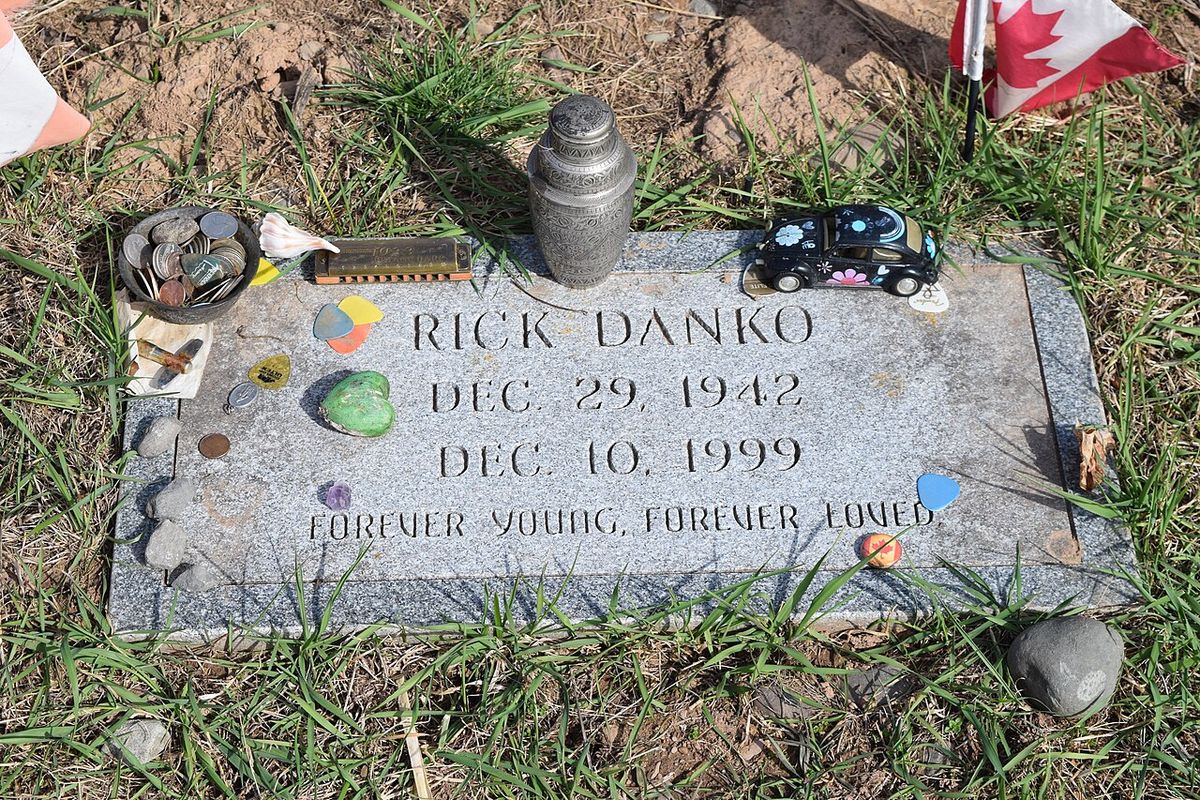
On December 10, 1999, days after the end of a brief tour of the Midwest that included two shows in the Chicago area and a final gig at the Ark in Ann Arbor, Michigan, Danko died of heart failure in his sleep at his home in Marbletown, New York. He was 55 years old. He was survived by his second wife, Elizabeth, whom he had married in 1989 and who died in 2013, a stepson, Justin, and a daughter, Lisa, from his first marriage. Danko was buried next to his son Eli at Woodstock Cemetery in Woodstock, New York. His fourth solo album, Times Like These, was in progress at the time of his death and was released posthumously in 2000.
Musical style and influence
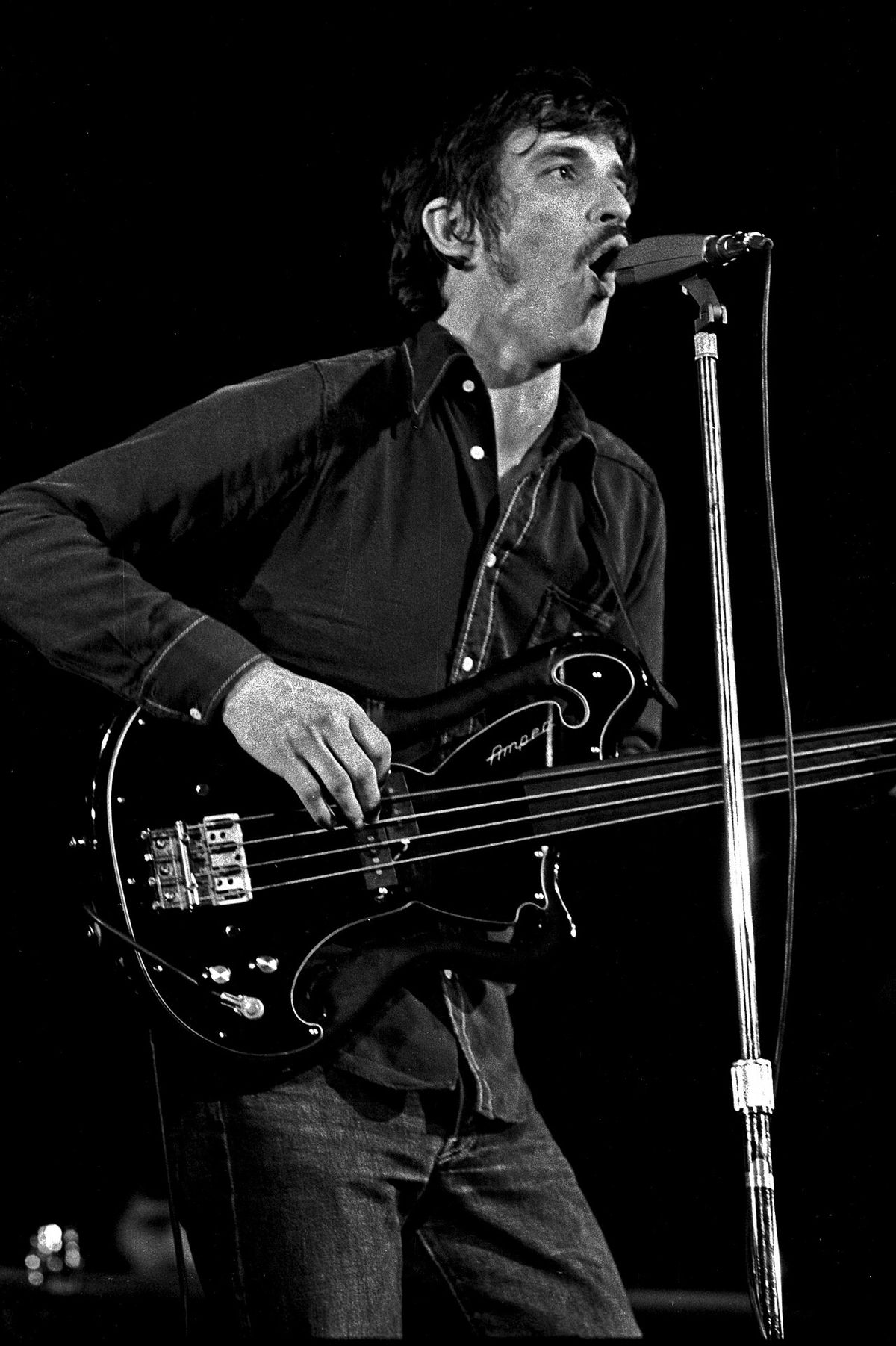
Rick Danko was celebrated for his melodic, vocal approach to the bass guitar and his uniquely plaintive, high-tenor singing voice. As part of the Band's rhythm section with Levon Helm, he helped create what many consider one of the most intuitive and supple grooves in rock music. An Irish Times article noted that with Helm, Danko formed 'one of the finest rhythm sections to ever put a groove to a beat,' and that his music was subtle and his instinct for just the right note was reliable. His bass lines were often subtle and melodic, serving the song rather than highlighting technique. He cited bassists James Jamerson, Ron Carter, Edgar Willis, and Chuck Rainey as key influences. Danko was an early and prominent adopter of the fretless bass, which he used extensively on Band albums like Stage Fright and Cahoots, and which contributed to his warm, singing tone. He eventually moved from the Fender Jazz Bass to an Ampeg fretless model and later a Gibson Ripper for The Last Waltz.
His influence is wide-ranging, cited by major artists across genres. Eric Clapton remarked that Danko's singing had a 'tremendous influence' on him, noting 'you have to be a great musician before you can sing like that.' Other musicians who have cited Danko as an influence include Elvis Costello, John Doe, Mumford & Sons, Lucinda Williams, Jay Farrar, Neko Case, Robbie Fulks, and Mike Watt. His legacy is also honoured in song, most notably in the Drive-By Truckers' track 'Danko/Manuel,' written by Jason Isbell and released in 2004. Steve Forbert released 'Wild as the Wind (A Tribute to Rick Danko)' in 2004, and Martin Hagfors honoured him on the 2000 song 'You Made a Difference.' In 1994, his foundational role in popular music was formally recognized with his induction into the Rock and Roll Hall of Fame as a member of the Band. For the April 2012 edition of Bass Musician magazine, an article titled 'How to Danko: A Lesson in the Style of Rick Danko' analyzed his playing technique.
Equipment and instruments
Throughout his career, Danko used a variety of basses, each contributing to his evolving sound. In the mid-1960s, he played a sunburst Fender Jazz Bass on Bob Dylan's 1966 World Tour and on the recording of Music from Big Pink and The Band, as well as early live shows including Woodstock and the Isle of Wight Festival. In late 1969, the Band was given equipment by Ampeg, which included a fretted Ampeg AEB, a fretless Ampeg AMUB and an Ampeg 'Baby Bass' electric upright. The fretless AMUB, modified with a Precision Bass pickup, was his bass of choice for the next several years. It can be heard prominently on Stage Fright and Cahoots, and was used live, as seen in the film Festival Express and video footage from Live at the Academy of Music 1971. This historic fretless bass was sold on eBay from a private collection in early 2012 for $35,000.
He was also seen performing with Fender Precision Basses and he owned four Gibson Rippers, often changing out the pickups to experiment with different tones. A blonde and a sunburst Ripper were frequently used, with the sunburst model featured in The Last Waltz. Throughout the 1990s, Danko played a custom-built hollow-body electric bass by luthier Mark Dan with Alembic pickups, which he referred to as 'One of the greatest basses that I've ever had.' His other main bass in the 1990s was a red electric hollowbody from the Norwegian Workshop Guitar Company with two types of Alembic Pickups. His amplifier of choice for much of his career was a blueline Ampeg SVT, though he also used a 1959 Fender Bassman. This progression of instruments reflects his continual search for a warm, articulate, and vocal tone that supported his melodic playing style.
Discography and filmography
Rick Danko's recorded output includes solo work, collaborative albums, and extensive session contributions. His primary solo and collaborative releases document his work outside the Band, with several albums released posthumously. His 1977 solo debut, Rick Danko, remains his only solo studio album released during his lifetime. His collaborative work with Jonas Fjeld and Eric Andersen was particularly fruitful, yielding two studio albums and award recognition in Norway. The archival releases, often drawn from live performances in small venues, capture his performing style in the later decades of his career. His filmography includes concert documentaries, a dramatic role, and an instructional video, preserving his performances for posterity.
- Studio Albums: Rick Danko (1977), Danko/Fjeld/Andersen (1991), Ridin' on the Blinds (1994).
- Live Albums: Rick Danko in Concert (1997), Live on Breeze Hill (1999).
- Posthumous Compilations: Times Like These (2000), Cryin' Heart Blues (2005).
- Archival Releases: At Dylan's Cafe (2007), Live at the Tin Angel, 1999 (2011), Live at Uncle Willy's, 1989 (2011), Live at the Iron Horse, Northampton 1995 with Blondie Chaplin and Ed Kaercher (2011).
His session work appears on landmark albums by Bob Dylan, Neil Young, Ringo Starr, and others, as detailed in the earlier table. Danko also appeared in several significant music films, from Martin Scorsese's The Last Waltz to the documentary Festival Express. His filmography includes The Last Waltz (1978), Man Outside (1986), Rick Danko's Electric Bass Techniques (1987), The Wall, Live in Berlin (1990), The 30th Anniversary Concert Celebration (1993), and Festival Express (2003). These recordings and films collectively document the breadth of Danko's talent as a performer and his central role in some of rock music's most historic moments, from the basement of Big Pink to the stage of The Last Waltz.
Questions about Rick Danko
What was Rick Danko's role in the Band?
Rick Danko was a founding member of the Band, serving as the bassist and a singer. He sang lead vocals on songs such as 'Caledonia Mission', 'Long Black Veil', and 'This Wheel's on Fire' from their first album. On their second album, he sang lead on 'When You Awake' and 'Unfaithful Servant'. He played bass on their recordings and during their concerts. Danko also found the house known as Big Pink where early musical sessions with Bob Dylan took place.
How did Rick Danko die?
Rick Danko died of heart failure in his sleep on December 10, 1999, at his home in Marbletown, New York. He was 55 years old. His death came just days after he completed a brief tour of the American Midwest that included shows in Chicago and Ann Arbor, Michigan. The official cause was natural heart failure, though his health had been affected by years of personal struggles. He was buried in Woodstock Cemetery in Woodstock, New York, next to his son Eli, who had died a decade earlier.
Was Rick Danko inducted into the Rock and Roll Hall of Fame?
Yes, Rick Danko was inducted into the Rock and Roll Hall of Fame in 1994 as a member of the Band. The induction recognized the group's significant influence on rock music and their pioneering blend of rock, folk, country, and soul. Danko performed with the surviving members of the Band at the induction ceremony. This honour cemented his legacy as a key contributor to one of the most respected groups in popular music history.
What were some of Rick Danko's most famous bass lines?
While known for subtlety, Danko's bass lines are integral to the Band's songs. His inventive part on 'The Weight' provides a melodic counterpoint to the vocals. On 'Up on Cripple Creek,' his bouncing, syncopated line drives the song's playful groove. His fretless bass work on 'Stage Fright' adds a singing, melancholic quality. The bass intro and melodic movement throughout 'This Wheel's on Fire,' which he co-wrote and sang, is another standout example. His playing was less about flashy solos and more about creating memorable, song-serving melodies within the rhythm section.
Did Rick Danko have a successful solo career?
Rick Danko's solo career was modest in commercial terms but respected by critics and fans. His 1977 self-titled debut album, featuring stars like Eric Clapton and members of the Band, only reached number 119 on the Billboard chart and he was later dropped by his label. However, he found significant artistic success in the 1990s with the collaborative trio Danko/Fjeld/Andersen, which released two acclaimed albums and won a Norwegian Grammy. He also toured consistently as a solo act and with reformed lineups of the Band, releasing several live albums that captured his enduring performance skills.
What was Rick Danko's connection to Canada?
Rick Danko was born and raised in Blayney, Ontario, a farming community near Simcoe. His early musical education came from family gatherings and Canadian radio. He began his professional career in Ontario with Ronnie Hawkins's band, the Hawks. The group that would become the Band was forged in the Canadian bar circuit, initially known as Levon and the Hawks. Danko's foundational years in Canadian music scenes, from rural dance halls to Toronto studios where he recorded with Lenny Breau, directly shaped the eclectic, roots-oriented sound he helped create, making him a seminal figure in Canadian music history.
Sources and further reading
- Rick Danko (Wikipedia)
- Nature's Way: Rick Danko's Later Years (furious.com)
Checked by the Yadude Books desk. Last updated 2026-11-01.