Bank of Canada says interest rates are 'too blunt' to fix housing affordability
Senior deputy governor Carolyn Rogers said the central bank's policy rate cannot directly address supply constraints or target housing separately.
VICTORIA — Bank of Canada senior deputy governor Carolyn Rogers says the central bank's key interest rate is too blunt an instrument to fix housing affordability on its own.
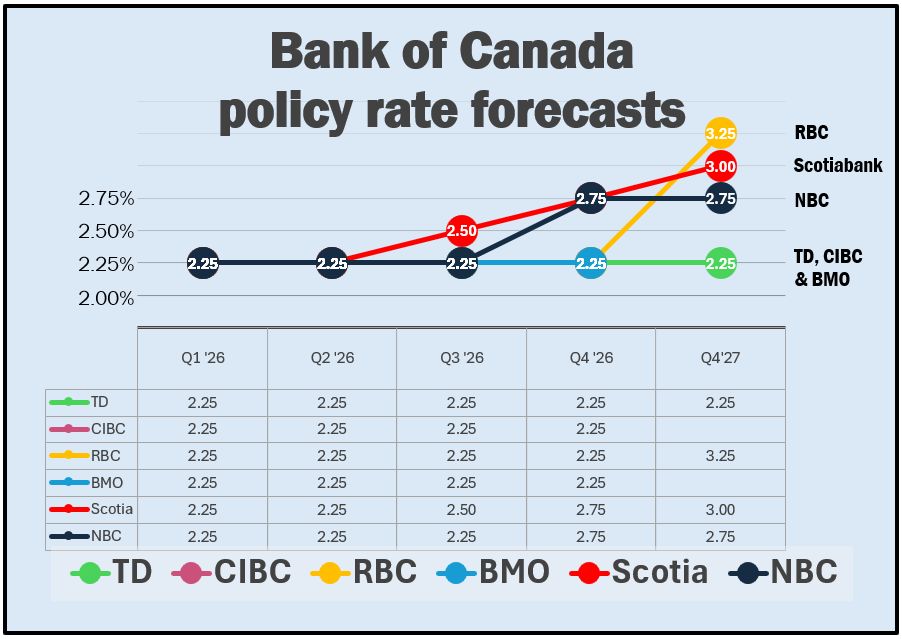
Rogers made the remarks in a speech to a business audience in Victoria, B.C., on Thursday, as the bank holds its policy rate at 2.25 percent.
"We set one interest rate for the whole economy. We cannot set one rate for housing and another for everything else," Rogers said.
READ MORE: Bank of Canada increases repo operations to ease pressure on key rate
READ MORE: Bank of Canada governor warns high oil prices will push inflation forecast higher
"And interest rates cannot directly address supply constraints. They can’t build homes, rezone land or speed up permits."
She said lower rates fuel rising home prices, while higher borrowing costs box out prospective buyers.
Rogers described a complex dilemma where high housing costs strain household budgets and drag on growth, but falling prices would erode household wealth and slow construction.
"This is the heart of the housing affordability dilemma and why it’s so hard to fix," Rogers said.
"Housing and housing prices have become about far more than just the cost of shelter. They are now deeply intertwined with household wealth, the stability of our financial system and the strength of our economy."
She noted that housing's role in the economy has grown dramatically, with residential investment now making up a larger share of GDP than business investment in machinery and equipment, a reversal from the year 2000.
Rogers recalled that in 2000, residential investment accounted for 4.3 percent of Canada's GDP, while business investment in equipment and machinery sat at 8.3 percent.
She also defended the bank's actions during the COVID-19 pandemic, when it cut rates to a floor of 0.25 percent, saying the story of rising prices was more complicated than low interest rates alone.
"The story is more complicated than low interest rates. But that doesn’t let monetary policy off the hook," she said.
She cited strong immigration, tight supply restrictions and the speculative view of housing as a path to wealth as factors that also encouraged demand.
Efforts to address instability with measures like the mortgage stress test have also historically raised barriers to buying a home, Rogers said, even if those regulations helped maintain stability.
The senior deputy governor said the path to restoring affordability requires a mix of policies to boost supply and reduce the economy's reliance on perpetually rising home prices.
That job, she said, will require patience and coordination among multiple levels of government, regulators and the private sector.
Rogers also said the bank needs to explain the trade-offs of its policies better, noting that rising mortgage interest costs feed into inflation measures, which can confuse Canadians about the bank's efforts to tame inflation with higher rates.
The bank is incorporating a housing affordability lens in its five-year mandate review with the federal government set for this fall.
The bank will publish updated economic and inflation forecasts with its next rate decision on Oct. 28.
Yadude Books reported in September that Capital Economics expects only two quarter-point rate hikes next year due to economic headwinds.
With files from The Canadian Press, The Hub | More Signal. Less Noise. and BNN Bloomberg