Nvidia forecasts 70% revenue surge as AI demand outstrips supply constraints
Nvidia projects unprecedented growth driven by AI computing demand, though component shortages and memory costs continue to pressure margins.
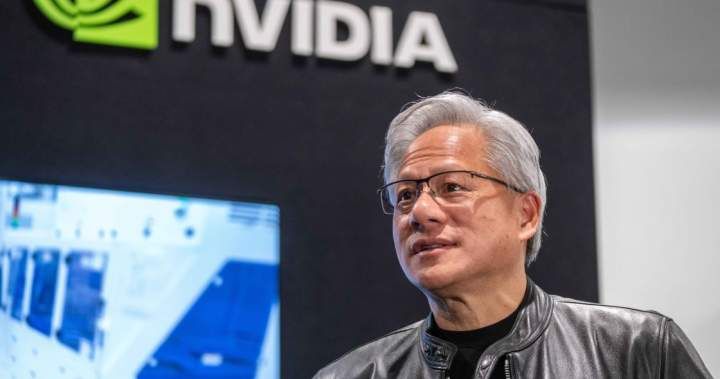
Nvidia has projected a staggering 70% revenue increase for its next fiscal year ending January 2028, marking one of the most ambitious forecasts in semiconductor industry history. This projection, which far exceeds Wall Street's 44% consensus estimate and the company's own historical guidance practices, demonstrates how artificial intelligence has fundamentally transformed Nvidia's market position. CEO Jensen Huang emphasized this shift during the earnings call, stating
"AI has reached its inflection point. It's doing useful work. Its tokens are productive and profitable. Now, compute is revenue.The market response was immediate, with shares rising nearly 8% in Thursday trading as investors digested the implications of sustained AI-driven demand.
Breaking precedent with long-term guidance
Nvidia's decision to provide guidance for fiscal 2028 represents a significant departure from its standard financial practices. Huang noted
"We've never forecast or never guided to a year in advance,underscoring the exceptional nature of current market conditions. This unprecedented move suggests Nvidia's leadership believes the AI infrastructure buildout represents a structural shift rather than temporary demand spike. The confidence behind this forecast stems from multiple converging factors, including the company's technological leadership, expanding customer base, and visibility into long-term infrastructure commitments from major cloud providers.
Financial performance exceeding all expectations
Nvidia's recent results provide concrete evidence supporting its optimistic outlook. The company reported second-quarter revenue of $96.22 billion, more than doubling year-over-year and surpassing analyst estimates of $92.17 billion. Adjusted earnings reached $2.22 per share compared to $2.10 projections, demonstrating operational efficiency despite supply chain constraints. The data center segment showed particularly explosive growth, with revenue more than doubling to $89 billion in the fiscal second quarter ended July, beating estimates of $85.08 billion. For the current quarter, Nvidia forecasts revenue of $108 billion (plus or minus 2%), again exceeding consensus projections of $104.19 billion.
Customer base diversifying beyond hyperscalers
The composition of Nvidia's revenue streams reveals a maturing AI ecosystem with multiple growth drivers. While hyperscale cloud providers initially dominated demand, the company now sees broadening adoption across market segments. AI research labs like OpenAI are expected to contribute approximately 25% of business next year, demonstrating how cutting-edge research institutions have evolved into significant commercial customers. Emerging cloud infrastructure providers such as Nebius and CoreWeave illustrate another growth vector, with their combined Nvidia GPU capacity surging from 3 gigawatts at the end of 2023 to over 8 gigawatts projected by year-end. This expansion reflects the emergence of specialized AI cloud providers alongside traditional hyperscalers.
Strategic partnerships driving infrastructure expansion
Nvidia's expanded collaboration with Amazon Web Services represents one of the largest infrastructure commitments in cloud computing history. The companies plan to deploy an additional 2 million Nvidia graphics processors across AWS's global infrastructure in 2027 and 2028, underscoring how AI workloads are becoming foundational to cloud architectures. Shay Boloor, chief market strategist at Futurum Equities, observed
"What makes (the forecast) even more credible is that demand is broadening beyond the original hyperscalers with AI clouds, enterprises, sovereign buyers and industrial customers now growing materially faster.This diversification reduces reliance on any single customer segment while creating multiple sustainable growth channels.
Persistent supply constraints limiting growth
Despite overwhelming demand, Nvidia continues facing significant production challenges. CFO Colette Kress told analysts
"We are seeing demand acceleration even at our scale. Customers' forecasts point to our growth doubling next year. However ... we are supply-constrained.These constraints stem from complex factors including specialized memory component shortages and the intricate manufacturing processes required for advanced AI chips. Memory price inflation and higher component costs are squeezing margins, expected to decline from about 74% in the third quarter to 71-72% in the fourth quarter, slightly below analyst expectations of 74.77% for Q3. These margin pressures highlight the challenges of scaling cutting-edge semiconductor production while maintaining profitability.
Next-generation technology deployment
Nvidia's technology roadmap shows continued innovation despite production challenges. The new Vera Rubin processors, already shipping to customers, will account for approximately 20% of data center revenue in the current quarter ending October. This rapid deployment demonstrates Nvidia's ability to transition next-generation architectures into production while maintaining its technological edge. The company has also begun introducing its Vera CPU to Chinese clients after US regulators approved limited sales of its H200 chips to select Chinese firms including Alibaba and Tencent. However, Commerce Department officials noted deliveries to China remain minimal, and Nvidia excluded Chinese data center revenue from its outlook due to ongoing regulatory uncertainty.
Geopolitical considerations and market access
Nvidia's operations in China represent both opportunity and challenge. While Washington cleared approximately 10 Chinese firms to purchase H200 chips in May, deliveries stalled for months due to regulatory processes. A U.S. Commerce Department official recently confirmed shipments had begun but remained "very few." Nvidia's cautious approach to the Chinese market reflects the delicate balance between accessing critical markets and complying with evolving export controls. The company began pitching its Vera CPU to Chinese clients in June with promised August availability, even as Chinese regulators separately considered allowing limited H200 purchases by top AI firms. These complex dynamics illustrate how geopolitical factors increasingly influence semiconductor market dynamics.
Long-term implications for the AI ecosystem
Nvidia's performance and projections serve as a leading indicator for the broader AI industry's health. The company's ability to maintain technological leadership while handling supply chain and geopolitical challenges will significantly influence the pace of AI adoption across industries. The broadening customer base across cloud providers, enterprises, and research institutions suggests the AI investment cycle has substantial runway ahead. As AI capabilities transition from experimental to essential infrastructure, Nvidia's execution will have cascading effects throughout the technology landscape. The company's unprecedented decision to provide long-term guidance reflects confidence that the AI infrastructure buildout represents a multi-year transformation with profound implications for global computing architecture.