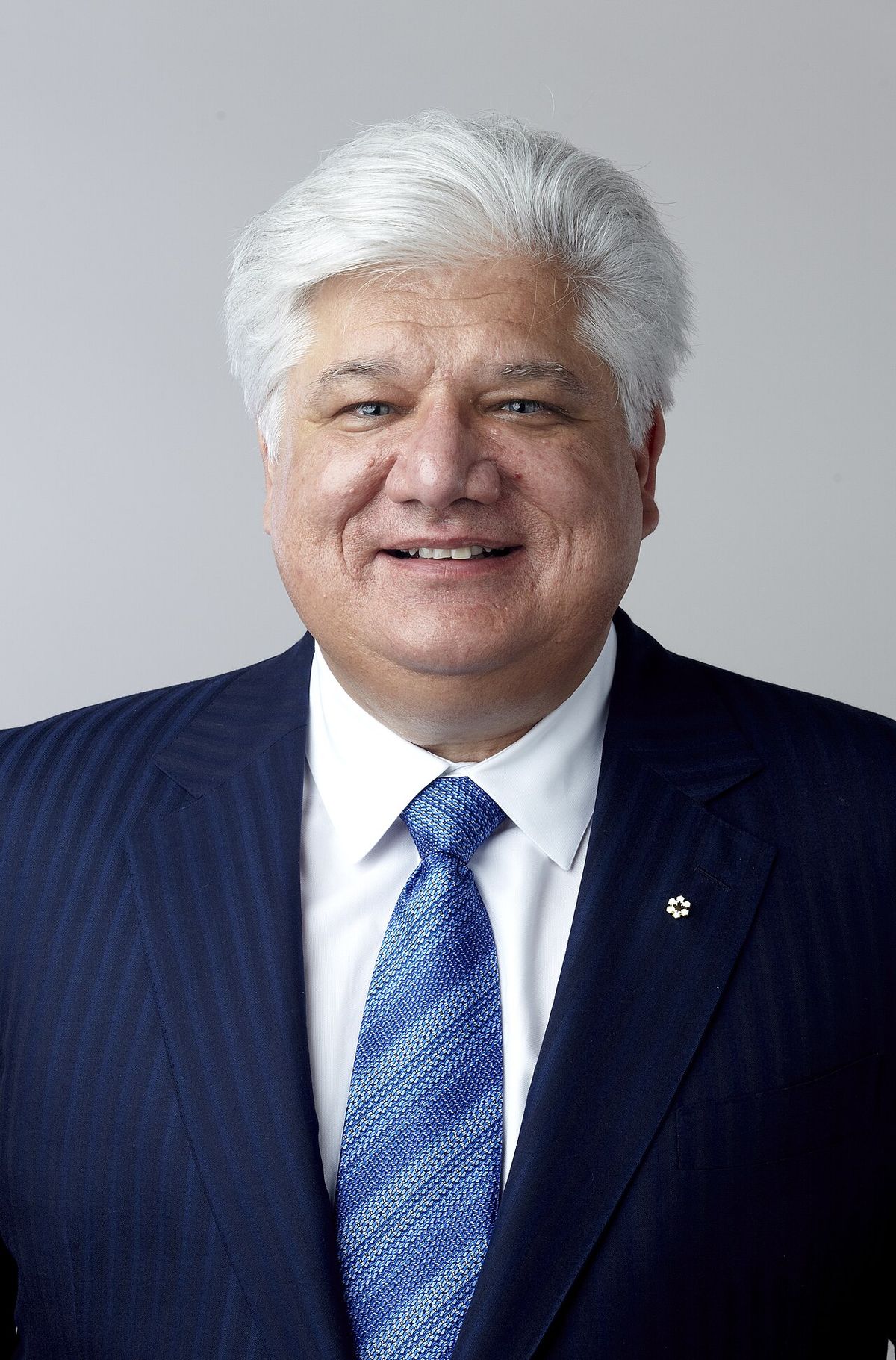
Peter Munk
Peter Munk was a Hungarian-Canadian entrepreneur and philanthropist who founded Barrick Gold, which became the world's largest gold mining company. A prominent figure in Canadian business, he also established major ventures in consumer electronics, real estate, and luxury tourism. Munk is equally recognized for his philanthropic giving, particularly through the Peter Munk Cardiac Centre and the Munk School of Global Affairs. His life story, from escaping Nazi-occupied Hungary to building a corporate empire in Canada, embodies a narrative of immigrant success and national contribution.
Early life and immigration to Canada
Peter Munk was born on November 8, 1927, in Budapest into a prosperous Hungarian Jewish family. His father was Lajos Munk and his mother was Katharina Adler Munk. His grandfather, Gábor Munk, had built wealth through securing the Austro Hungarian distribution rights for the Viennese chocolate brand Manner and through real estate investments. During the Second World War, Gábor Munk used his remaining fortune to buy safe passage to neutral Switzerland for his immediate family. In March 1944, when Nazi Germany occupied Hungary, the sixteen year old Peter Munk escaped with fourteen family members on the Kastner train. This train, arranged by Rudolf Kastner of the Zionist Aid and Rescue Committee through secret negotiations with Adolf Eichmann, carried 1,684 Jews to safety in Switzerland. Munk's mother, who had divorced his father when he was four, was deported from Budapest to the Auschwitz concentration camp in 1944. She survived the camp but later died by suicide. Munk arrived in Canada in 1948 via Switzerland, initially on a student visa. He enrolled at the University of Toronto, graduating in 1952 with a Bachelor of Applied Science degree in electrical engineering. Decades later, he stated that Canada was a country that did not ask about your origins but concerned itself with your destiny.
Business career: Clairtone and early ventures
Peter Munk's first major business venture began in 1958 when he co founded the hi fi electronics company Clairtone with David Gilmour, a Scandinavian furniture importer. The start up capital of $2,800 was provided by Munk's father in law, William Jay Gutterson, founder of Webber Pharmaceuticals. Clairtone manufactured high end console stereos and later televisions, which became design icons of the era. The most celebrated product line was the Project G series, introduced in 1964, featuring rosewood cabinets and cantilevered black aluminum speaker enclosures called sound globes. The Project G and G2 models were featured in the films Marriage on the Rocks and The Graduate, won a silver medal at the Milan Triennial design exhibition, and were endorsed by celebrities Frank Sinatra and Oscar Peterson. Playboy founder Hugh Hefner was also a fan of the design. Clairtone's expansion led to an ill advised plan to build a manufacturing plant in Nova Scotia. The plant in Stellarton opened in 1966 with funding from the provincial agency Industrial Estates Limited. William Mingo, chief counsel for IEL, later said Munk was a promoter with tremendous energy, charm, and imagination. By 1967, due to mounting losses, the Government of Nova Scotia took over Clairtone and fired Munk and Gilmour. Munk faced accusations of insider trading that were eventually settled out of court. A report commissioned after the failure cited challenges with the local workforce, noting the general population was not geared to the manufacturing frenzy and the five day workweek.
Hospitality, real estate, and international projects
Following the collapse of Clairtone, Munk and David Gilmour invested in ocean front land in Fiji, which they developed into a hotel and resort. This venture grew into the Southern Pacific Hotel Corporation, which at its peak operated 54 resorts across Australia and the South Pacific. In 1978, the corporation signed a deal with the President of Egypt to build a resort near the Great Pyramids. When President Anwar Sadat cancelled the project, Munk sued the Egyptian government and eventually won the arbitration case at the International Centre for Settlement of Investment Disputes. Munk returned to Canada in 1979 to start a new venture called Barrick, at a time when he said bankers viewed him as a fugitive and a loser. He was also the founder, chairman, and chief executive officer of Trizec Properties, formerly TrizecHahn Corporation, one of the largest American real estate investment trusts. In 2006, Trizec Properties was sold to Brookfield Properties in a transaction valued at approximately $9 billion. In 2007, Munk invested with partners in Porto Montenegro, a former naval base on the Adriatic Sea's Bay of Kotor, turning it into a superyacht destination to rival Cannes and Monte Carlo. As majority shareholder of Montport Capital, he owned the Porto Montenegro Marina and Resort. In 2016, he sold the marina and hotel to the Investment Corporation of Dubai, a sovereign wealth fund, for an amount believed to be about 200 million euros.
Building Barrick Gold
In 1980, Munk created Barrick Petroleum to invest in the oil sector but quickly found those investments were ruinous. After acquiring the small mining company Camflo Mines, Barrick shifted focus and became a mining company overnight. Under Munk's leadership, Barrick Gold grew through acquisitions and operational expansion to become the world's largest gold mining company by market capitalization. By 2016, the company reported proven and probable reserves of two billion tons of ore, with an average grade of 1.33 grams of gold per tonne. In 2011, Munk planned a merger with Ivan Glasenberg's commodities company Glencore to create a giant on par with BHP and Rio Tinto, but the deal did not proceed because the gold market was not aligned with Glencore's other activities. Munk served as chairman of Barrick and was actively involved in corporate governance. At the 2008 shareholder meeting, as chair, he intervened to block a proxy shareholder who had travelled from Papua New Guinea from speaking about her reports of deadly violence and sexual violence by Barrick's security contractors at the Porgera Gold Mine. Munk retired from day to day management but remained the founder and President Emeritus, stating that Barrick was his legacy.
Philanthropic foundations and major donations
Peter Munk and his wife Melanie established the Peter and Melanie Munk Charitable Foundation in 1992. This foundation has disbursed more than $300 million to organizations working to improve health, education, and the international reputation of Canadians. In 2006, they established the Aurea Foundation as a separate entity. Munk often framed his philanthropy in the context of his gratitude to Canada, stating in a September 2017 speech that the country opened the door and gave him everything. His giving was characterized by large, targeted donations to specific institutions, often with matching fund requirements or structured reporting conditions. The agreement between the Munk Foundation and the University of Toronto for the Munk School attracted criticism for its secrecy and conditions. The $35 million donation was conditional on matching $25 million contributions each from the federal government and the university. The written agreement stipulated that the Munk donations would be paid over an extended period, subject to the Munk family's approval of the school, and required the school's director to report annually to a Munk appointed board. Author Linda McQuaig, in her book The Trouble with Billionaires, argued this gave Munk influence over the school's direction to fit with his political views. University president David Naylor rejected personal attacks on donors and stated that in his experience on the board of the University Health Network, Munk never interfered with the institution's educational, research, or clinical priorities.
Major Philanthropic Donations- Peter Munk Cardiac Centre: Initial donation of $6 million in 1997 to help create the centre at Toronto General Hospital. A further $37 million in 2006 was the largest gift to a Canadian medical institution at that time. A final $100 million donation in September 2017.
- Munk School of Global Affairs and Public Policy: A gift of $35 million in 2010 to the University of Toronto, his alma mater, enabled the school's establishment. His total giving to the university reached $51 million.
- Peter Munk Research Institute: A donation of $43 million to the Technion, Israel Institute of Technology.
- Munk Debates: A $12 million donation from the Aurea Foundation in 2008 to launch the semi annual public policy debate series.
- Peter Munk Centre for Free Enterprise Education: A $5 million donation to the Fraser Institute think tank in 2016 to launch this centre.
- Melanie Munk Chair in Cardiovascular Surgery: Establishment of this endowed chair at the University Health Network.
Personal life, family, and interests
Peter Munk married Linda Joy Gutterson on September 3, 1956. She was the 19 year old daughter of Forest Hill pharmaceutical entrepreneur William Jay Gutterson, who provided Munk's start up capital. Munk was 28 at the time and later remarked that Linda tracked him down with a laser beam, finding him a curiosity as a fat, bald, poor, boring engineering student. The couple had three children, separated and reunited more than once in the 1960s, and divorced in 1970 but remained on very good terms. Linda Gutterson later pursued an academic career, becoming a professor of English at the University of Toronto. On June 26, 1973, Munk married his second wife, Melanie Jane Bosanquet, in London. Melanie is the cousin of British land owner and Olympic skier Charles Palmer Tomkinson. With Melanie, Munk had two more children. In 1972, the couple built a ski chalet called Viti Levu in Klosters, Switzerland, which overlooked the Gotschnagrat mountain and which they considered their home. Munk skied for 71 years. His five children are Anthony Munk, a senior managing director at Onex private equity. Nina Munk, a journalist and contributing editor for Vanity Fair. Marc David Munk, a physician and healthcare executive. Natalie Munk. And Cheyne Munk. In his late seventies, Munk was fitted with a pacemaker to manage heart problems.
Honorary degrees and national honours
Peter Munk received numerous honorary degrees and state honours in recognition of his business achievements and philanthropy. These accolades came from Canadian institutions, his native Hungary, and international bodies. The list reflects the breadth of his influence across commercial, academic, and civic sectors. In 1993, Munk was appointed an Officer of the Order of Canada, the country's highest civilian honour. He was promoted to Companion of the Order of Canada in 2008. He received the Woodrow Wilson Award for Corporate Citizenship in 2002, the first time this award was given outside the United States. He was inducted into both the Canadian Business Hall of Fame and the Canadian Mining Hall of Fame. In 2012, he was awarded the Queen Elizabeth II Diamond Jubilee Medal. His homeland, Hungary, awarded him the Commander's Cross with Star of the Order of Merit of the Republic of Hungary in 2016.
Peter Munk received several honorary degrees throughout his life. He was awarded a doctorate from Upsala College in New Jersey in 1991. In 1995, he received a doctorate from Bishop's University in Quebec and a Doctor of Laws from Trinity College at the University of Toronto. Concordia University in Montreal granted him a doctorate in 1999, and the Technion, Israel Institute of Technology in Haifa, Israel, awarded him a doctorate in 2001. In 2004, he and his wife Melanie Munk jointly received a Doctor of Sacred Letters from Trinity College at the University of Toronto.
| Degree | Institution | Year |
|---|---|---|
| Doctorate | Upsala College, New Jersey | 1991 |
| Doctorate | Bishop's University, Quebec | 1995 |
| Doctor of Laws | Trinity College, University of Toronto | 1995 |
| Doctorate | Concordia University, Montreal | 1999 |
| Doctorate | Technion, Israel Institute of Technology, Haifa | 2001 |
| Doctor of Sacred Letters | Trinity College, University of Toronto (joint with Melanie Munk) | 2004 |
Death and posthumous assessment
Peter Munk died in Toronto on March 28, 2018, at the age of 90. The cause of death was not disclosed, but he had been dealing with heart problems for several years and wore a pacemaker. The Financial Post, in a posthumous tribute, lauded him as an entrepreneur with a Midas touch and one of Canada's most high flying, international deal makers. The publication noted his wide ranging connections, which included friends from former Prime Minister Brian Mulroney and Prince Charles to arms dealer Adnan Khashoggi and French billionaire Bernard Arnault, as well as his status as one of the country's most generous benefactors. His legacy is defined by the creation of Barrick Gold as a global mining leader and the establishment of major philanthropic institutions that bear his name, including the cardiac centre and the school of global affairs. His life story from Holocaust survivor to Canadian business icon remains a noted chapter in the nation's commercial history.
Questions about Peter Munk
What was Peter Munk's most successful business?
Peter Munk's most successful business was Barrick Gold, which he founded in 1979 after a brief foray into oil via Barrick Petroleum. Starting with the acquisition of Camflo Mines, he built the company into the world's largest gold mining corporation by market capitalization. By 2016, Barrick had proven and probable reserves of two billion tons of ore. Munk served as its chairman and guiding force for decades, stating the company was his legacy. He retired from daily operations but remained its President Emeritus.
How did Peter Munk escape the Holocaust?
In March 1944, when he was 16, Peter Munk escaped Nazi occupied Hungary on the Kastner train. This rescue operation, arranged by Rudolf Kastner of the Zionist Aid and Rescue Committee, was the result of secret negotiations with Nazi officer Adolf Eichmann, who allowed some Jews to leave in exchange for money, gold, and diamonds in so called blood for goods deals. The train carried 1,684 Jews, including Munk and fourteen members of his family, to safety in neutral Switzerland. His mother was deported to Auschwitz that same year but survived.
What happened to Peter Munk's first company, Clairtone?
Clairtone, the hi fi electronics company Munk co founded in 1958, failed after expanding into Nova Scotia. The company built a plant in Stellarton in 1966 with funding from the province's Industrial Estates Limited. Due to mounting financial losses, the Government of Nova Scotia took control of Clairtone in 1967 and fired Munk and his partner David Gilmour. A subsequent report cited difficulties with the local workforce adapting to industrial manufacturing as a key issue. Munk also faced insider trading accusations that were settled out of court.
Where did Peter Munk live and what was his personal life like?
Peter Munk lived primarily in Toronto but considered a ski chalet he built in 1972 in Klosters, Switzerland, to be his home. He was married twice, first to Linda Joy Gutterson from 1956 to 1970, with whom he had three children, and then to Melanie Jane Bosanquet from 1973 until his death, with whom he had two children. He was an avid skier for 71 years. His children pursued careers in private equity, journalism, and medicine. In his late seventies, he was fitted with a pacemaker. He died in Toronto in 2018 at age 90.
What was Peter Munk's role in the creation of Barrick Gold?
Peter Munk founded Barrick Gold, which became the world's largest gold mining company. He started the venture in 1979 after returning to Canada, initially creating Barrick Petroleum before acquiring Camflo Mines to enter the mining sector. Under his leadership, Barrick grew to have proven and probable reserves of two billion tons by 2016. Munk viewed Barrick as his legacy, retiring from day-to-day management but remaining Founder and President Emeritus. The company was also the largest Canadian company by market capitalization during his tenure.
What controversies were associated with Peter Munk's philanthropy?
A major controversy involved the conditions attached to his $35 million donation to the University of Toronto for the Munk School of Global Affairs. Critics, including author Linda McQuaig, argued the agreement gave the Munk family undue influence, requiring the school's director to report annually to a Munk-appointed board and making future payments subject to family approval. The deal also required matching $25 million contributions from the federal government and the university, leading to charges that academic resource decisions were being ceded to the corporate sector. University president David Naylor defended Munk, stating he never interfered with institutional priorities.
Sources and further reading
- Peter Munk (Wikipedia)
- Our founding donors | The Munk School (munkschool.utoronto.ca)
- Barrick Gold founder Peter Munk dead at 90 (cbc.ca)
- Peter Munk and Melanie Munk (chancellorscircle.utoronto.ca)
- Peter Munk, Canadian Club Toronto (canadianclub.org)
Checked by the Yadude Books desk. Last updated 2026-10-30.