MapQuest's Stand on Lake Ontario Sparks Surge in Downloads Amid Canadian Tech Dependence Debate
MapQuest's refusal to rename Lake Ontario in response to Google Maps' controversial change has led to a viral surge in downloads, highlighting broader concerns about Canada's reliance on U.S. tech giants.
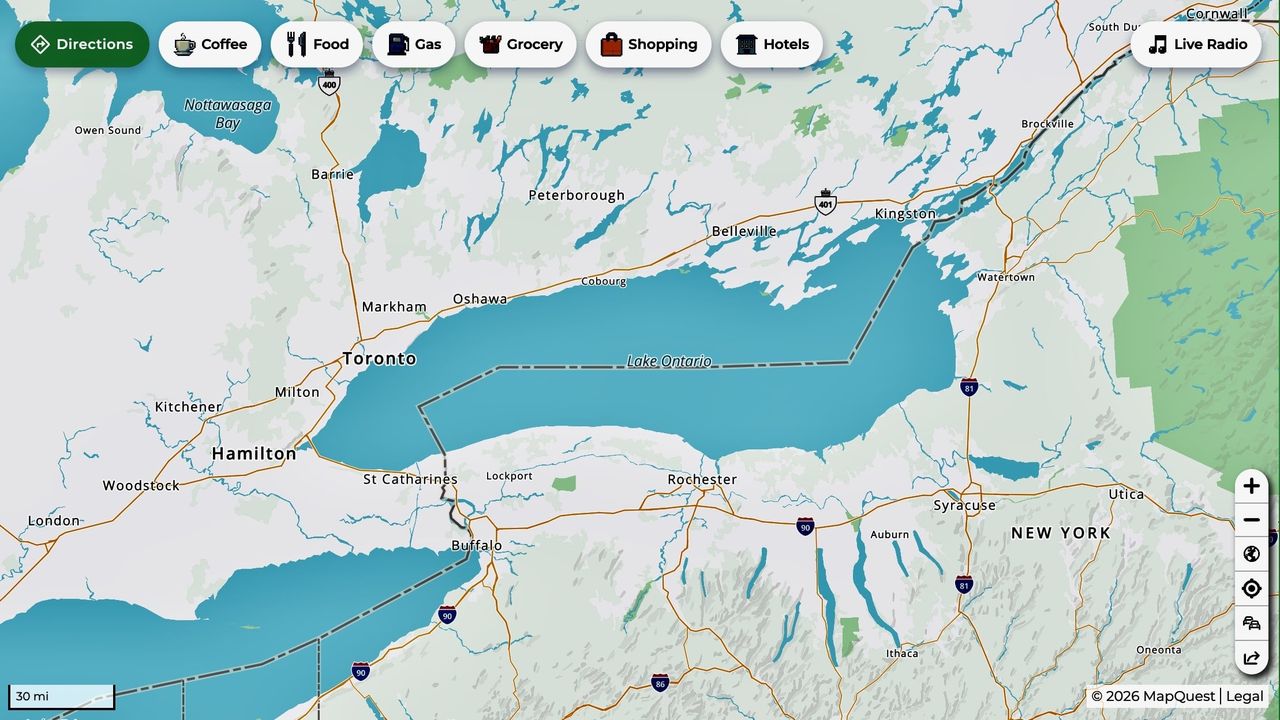
The Viral MapQuest Moment
MapQuest's unexpected resurgence this week came after the company took a firm stance against Google Maps' decision to rename Lake Ontario as "Lake America." The mapping platform, which had largely faded from public consciousness in recent years, saw a dramatic spike in downloads following its social media declaration that it would not alter the lake's name. According to Global News data, MapQuest became the third most downloaded free app in North America, trailing only ChatGPT and Meta AI. The company reported search traffic increases of 5,000% compared to the same period last year, with Canadian searches specifically jumping 500% week-over-week.
MapQuest CEO Doug Berger revealed that hundreds of thousands of users downloaded the app following the announcement.
"Obviously, people agree with us and we struck a chord,"Berger told Global News. While MapQuest remains an American company, Berger emphasized that Canadian users represent a significant portion of their customer base, making the principled position particularly meaningful for this audience. The incident demonstrates how quickly public sentiment can shift when national identity intersects with digital platforms.
Canada's Tech Dependence Reality
The MapQuest situation has amplified existing concerns about Canada's heavy reliance on U.S. technology providers across nearly every digital sector. Emily Osborne, a policy researcher at the Canadian Shield Institute, explained the risks to Global News:
"There's a lot of areas, because of how dependent we are on American firms, where they can throttle our access to essential services."She specifically highlighted cloud infrastructure as a critical vulnerability where foreign control could potentially compromise national security.
Rotman School of Management professor David Soberman contextualized the challenge:
"Almost all the dominant companies are American or American owned."While some consumer-facing services like food delivery through SkipTheDishes or retail via Canadian Tire offer domestic alternatives, most core digital infrastructure remains firmly controlled by American corporations. This includes fundamental services like payment processing through Visa and Mastercard, productivity software such as Microsoft Office and Google Workspace, and social media platforms including Facebook and Instagram.
The Struggle for Canadian Tech Alternatives
A small number of Canadian tech firms are attempting to compete with U.S. giants in specific sectors. Transportation services like Toronto-based HOVR and Beck Taxi aim to challenge Uber and Lyft in urban markets, while social media platforms such as Gander and NorthSocial offer homegrown alternatives. Productivity tools including the Shift browser, cDox for document editing, and Callbridge for conference calling provide Canadian-developed options for certain business needs.
However, Osborne noted these alternatives often cannot compete with the scale and integration of their American counterparts.
"It's difficult to switch away from Meta's platforms because all of our friends are going to continue using it,"she said, emphasizing the network effects that maintain U.S. dominance. Cost presents another significant barrier, as American firms frequently bundle services more affordably than standalone Canadian alternatives can match, creating financial disincentives for switching.
Foreign Acquisition of Canadian Tech Assets
The challenge of developing domestic tech alternatives is compounded by a pattern of promising Canadian firms being acquired by foreign investors. Global News reported that Moneris, one of Canada's largest payment processors previously owned by BMO and RBC, was recently sold to U.S. private equity firm Francisco Partners for $2 billion. Similarly, Canadian mapping alternative Avenza was acquired by a Boston-based private equity firm. These transactions reduce the pool of potential national alternatives in critical technology sectors.
Osborne suggested Canada could benefit from studying the European Union's approach to digital sovereignty, which includes developing more domestic capabilities and implementing regulatory frameworks to support homegrown tech. However, building competitive alternatives to entrenched U.S. platforms requires both substantial investment and consumer willingness to adopt new solutions - factors that currently remain insufficient to drive rapid transformation in the sector.
Potential of the Buy Canadian Movement
Despite these challenges, professor Soberman identified opportunity in growing consumer interest in supporting Canadian businesses.
"If there is a pronounced shift to buying Canadian, that in itself will create an opportunity,"he told Global News, citing Shopify's global success as evidence that Canadian tech firms can achieve significant scale. Increased demand for domestic alternatives could encourage more startups to enter underserved market segments.
Some technology areas already demonstrate more diversity, with European options like ProtonMail for email providing non-U.S. alternatives alongside Canadian services such as Typewire. However, in payments and other tightly integrated systems, Visa and Mastercard's global dominance leaves minimal space for domestic competition beyond Interac's national network, illustrating the uneven landscape of available alternatives.
Broader Implications for Digital Sovereignty
The MapQuest incident reflects growing concerns about digital sovereignty in an era of increasing geopolitical tensions. While the Lake Ontario naming controversy might appear minor, it underscores how decisions by U.S. tech giants - whether motivated by political, commercial, or technical considerations - can directly impact Canadians' digital experiences. The strong public response suggests many citizens desire alternatives that better align with national interests and values.
Developing a more balanced technology ecosystem will require coordinated efforts across multiple sectors. Policymakers would need to create supportive frameworks, investors must provide adequate funding, entrepreneurs should develop competitive solutions, and consumers would need to adopt these alternatives despite potential initial shortcomings compared to established U.S. platforms. The path forward likely involves focusing selectively on critical infrastructure and services where national control matters most, while recognizing that some sectors may remain globally integrated. Determining where to establish these boundaries presents an ongoing challenge in our increasingly digital world.
Current State of Canadian Tech Independence
The reality of Canada's technological landscape reveals significant gaps in domestic capabilities. As noted in public commentary, Canada lacks alternatives in many essential areas, from basic services like digital mapping to more complex systems such as cloud infrastructure. The proposed Canadian mapping satellite project, currently under review by the Major Projects Office with a target approval date of 2055, illustrates both the ambition and the long timelines involved in developing sovereign capabilities.
Public discourse reflects frustration with this dependence, with some commentators noting Canada's inability to produce certain goods year-round due to climate limitations, and others highlighting the country's reliance on U.S. technology for basic services. These concerns intersect with broader economic and political considerations about Canada's relationship with its southern neighbor, particularly regarding trade agreements and technological independence.